Generative AI raises CRM productivity by automating drafting, summarizing, and triage work, and it personalizes customer communication at a scale no rep could match alone. Sales, service, and marketing teams see the fastest gains. None of it holds up, though, unless you fix your data and governance first. That single step decides whether the rest of this works.
TL;DR:
- Generative AI’s productivity gains in CRM are limited to about 10-35% unless data quality and governance are addressed first.
- A reliable “golden record” and integrated, up-to-date document indexing are essential to prevent errors and ensure accurate AI outputs.
- On-premise deployment is necessary for regulated industries to maintain control over sensitive data and comply with local regulations.
- Tighter governance, including role assignments and audit trails for prompts and outputs, is critical for scaling AI use without risking compliance violations.
- Starting with high-value use cases and establishing KPIs before scaling ensures practical ROI and avoids inflated expectations based on demo environments.
Table of Contents
- Where generative AI earns its keep across sales, service, and marketing
- What productivity gains to actually expect, and how to measure them
- The data foundations your CRM needs before you trust AI output
- Making generative AI auditable: governance steps that actually hold up
- Choosing where the model lives: hosting and architecture trade-offs
- Why Arabic documents need a different processing pipeline
- A practical rollout plan from pilot to scale
- What enterprise deployments in the region actually teach you
- How Singleclic helps you deploy generative AI in CRM without the guesswork
- Primary sources and further reading
- Sources
- FAQ
Where generative AI earns its keep across sales, service, and marketing
The clearest wins sit in three functions, and each one has a specific job the technology is good at.
In sales, generative models draft outreach emails and follow-ups personalized against CRM fields such as deal stage, industry, and past interactions, cutting the blank-page time that eats into a rep’s day. They also turn call transcripts into structured meeting summaries that populate opportunity records automatically, so notes stop living in someone’s inbox.
In service, generative AI drafts first-response replies, summarizes long ticket histories for a human agent picking up a case, and triages incoming requests by urgency and topic before a person ever reads them. Agent-assist tools that surface a suggested reply next to the ticket, rather than replacing the agent, tend to get adopted faster because the human stays in control of what goes out.
In marketing, the same models generate campaign copy variants tied to segmentation data already sitting in the CRM, so a single campaign brief becomes ten personalized versions instead of one generic blast.
The more advanced pattern is agentic: a chain of actions where the model creates an opportunity record, drafts a proposal, and notifies the right sales rep, all from one triggering event. That’s a meaningful step up from single-turn generation, and it is where most of the productivity gains from AI in CRM actually come from once the groundwork is in place.
- Sales: personalized outreach drafts and automatic call-to-CRM summaries.
- Service: first-response drafting, ticket triage, and agent-assist summaries.
- Marketing: segmentation-driven copy variants generated from existing CRM data.
- Agentic workflows: one triggering event chains several CRM actions without manual handoffs.
What productivity gains to actually expect, and how to measure them
Vendor pitches love round numbers. The honest range is narrower, and it depends heavily on what you count.
Purpose-built generative AI in CRM is expected to lift productivity by roughly 10-35%, mainly through automating content generation, meeting summarization, and data entry, according to third-party analysis on productivity and ROI from AI. That band matters because it covers specific repetitive tasks, not the whole job of selling or supporting customers. Translate it into KPIs you can actually track rather than treating it as a promise.
- Response time: hours to first reply, before and after deployment.
- Case resolution rate and average handling time per ticket.
- Time saved per rep on drafting and data entry, measured directly.
- Campaign throughput: number of personalized variants shipped per cycle.
- Pipeline velocity: days from opportunity creation to close.
Run a short pilot with a control group before you scale anything. Baseline your current numbers, hold a comparison team on the old process, and watch quality metrics like accuracy and escalation rate alongside speed. Early estimates often look inflated because they come from clean demo data, not the noisy, duplicate-riddled records most CRMs actually hold. Ungrounded outputs on messy data will beat your baseline in a demo and disappoint you in production.
The data foundations your CRM needs before you trust AI output
Generative AI is only as reliable as the record it’s drawing from, and most CRM databases are not clean enough to trust blindly.
Start with a single source of truth, often called a golden record, built through identity resolution that merges duplicate contacts and reconciles conflicting fields across systems. Without it, a generated email might reference the wrong contract or an outdated contact title, and no amount of clever prompting fixes that.

Integration comes next. Zero-copy access and data fabric approaches let generative tools query ERP and legacy systems without duplicating data everywhere, which keeps a single version of the truth. This is the same principle behind connecting AI-ready CRM workflows to core systems instead of bolting AI onto a database nobody trusts.
Retrieval-augmented generation, or RAG, is the mechanism that grounds a model’s output in your actual documents rather than its general training data. It indexes enterprise content, contracts, product sheets, past tickets, and retrieves the relevant pieces at the moment of generation.
- Build a golden record through identity resolution before connecting any generative tool.
- Choose zero-copy or data fabric integration over duplicating data into a new silo.
- Index your enterprise documents for RAG so outputs cite real, current material.
- Track metadata and provenance on every generated output for auditability.
Pro Tip: Run a data quality audit on your CRM before piloting generative AI. A model grounded in duplicate or stale records will simply automate the errors faster.
Making generative AI auditable: governance steps that actually hold up
Governance is not a compliance afterthought here. It is the difference between a pilot that scales and one that gets shut down after the first bad output reaches a customer.
The NIST AI Risk Management Framework’s Generative AI Profile lays out concrete governance actions rather than vague principles, and CRM teams can adapt them directly.
- Inventory every generative AI system touching customer data and map each one to a risk tier based on what it can act on.
- Write an acceptable-use policy that defines what a model can generate unsupervised versus what needs human sign-off before it reaches a customer.
- Assign clear roles for who reviews outputs, who owns model updates, and who approves exceptions.
- Log prompts, model versions, and retrieved sources immutably so every generated item has a traceable lineage back to its inputs.
- Schedule periodic reviews and red-team high-risk use cases, such as anything that could misstate a price or a contractual term.
- Set a review cadence tied to model updates, not a fixed calendar, since a vendor’s model change can shift behavior overnight.
Regulated sectors, banking and healthcare especially, need this discipline built in from day one rather than retrofitted after a near-miss. The tension between speed and compliance is real, but a documented risk tier system lets low-risk uses (draft suggestions a human reviews) move fast while high-risk ones (anything auto-sent to a customer) get more scrutiny.
Choosing where the model lives: hosting and architecture trade-offs
The hosting decision shapes almost everything else, from cost to what data you’re legally allowed to send where.
On-premise large language models give you full control over data residency and are often the only option regulated industries can approve, at the cost of more infrastructure to manage. Cloud-hosted models are faster to deploy and get vendor-managed upgrades, but every prompt and document you send leaves your perimeter.
RAG is usually sufficient when your goal is grounding outputs in existing documents and records. Fine-tuning or a private LLM becomes worth the investment when you need domain-specific language, tone, or terminology baked into the model itself, not just retrieved at query time.
Agentic setups that chain several CRM actions together carry more risk than single-turn generation, since one bad step can cascade, which is exactly why the governance checkpoints from the previous section matter more as autonomy increases.
- On-prem: better data control and compliance fit, higher setup and maintenance cost.
- Cloud: faster deployment and managed updates, less control over where data travels.
- RAG fits document grounding; fine-tuning fits domain-specific tone and terminology.
- Agentic chains raise risk and need tighter human checkpoints than single-turn tasks.
Pro Tip: Start with RAG on a cloud model for your pilot, then move sensitive workloads to a private or on-premise model once you know exactly what the use case requires.
Why Arabic documents need a different processing pipeline
Generic OCR tools trained mainly on Latin-script text tend to struggle badly with Arabic, and that gap shows up directly in CRM data quality across the region.
Arabic’s cursive script, right-to-left flow, and diacritic variability all break the assumptions most OCR models were built on. A specialized vision-language model called Baseer, built specifically for Arabic document OCR, reached a word error rate of roughly 0.25 on expert-verified benchmarks, a marked improvement over general-purpose OCR on the same Arabic document set. That gap is exactly why generic tools misread contracts, invoices, and forms that a CRM later ingests as structured fields.
The practical pipeline runs OCR first, then a normalization step that handles diacritics and font variability, then entity extraction, and only then does the result get pushed into CRM records. Skipping the normalization step tends to produce false positives in named-entity extraction, since a diacritic mismatch can turn one name into two separate contact records.
- Generic OCR underperforms on Arabic script due to cursive form and right-to-left flow.
- A normalization step before entity extraction reduces duplicate and false-positive records.
- Domain-tuned or fine-tuned models outperform general-purpose tools on Arabic CRM documents.
A practical rollout plan from pilot to scale
None of this needs to be a year-long program. A focused sequence gets you from idea to a defensible go or no-go decision within a few months.
- Pick one high-value use case, ticket triage or outreach drafting are common starting points, and define the KPIs before you build anything.
- Build your golden record and RAG corpus for that specific use case rather than trying to clean the entire database at once.
- Set governance guardrails: risk tier, review cadence, and who signs off on outputs before they reach a customer.
- Choose your hosting model and instrument logging so every prompt and output is traceable from day one.
- Run the pilot with a human in the loop, measure against your baseline and control group, and iterate on prompts and grounding.
- Decide go or no-go based on the KPI data, not on how impressive the demo looked.
- Scale with automated monitoring, cost controls on model usage, and a change management plan that trains reps on what to trust and what to verify.
Pro Tip: Treat the pilot’s go or no-go decision as a real gate, not a formality. Killing a weak pilot early costs far less than unwinding a bad rollout across every rep’s queue.
What enterprise deployments in the region actually teach you
The pattern shows up repeatedly across enterprise rollouts: the technology is rarely the hard part. Data readiness is. Teams that skip identity resolution and document normalization end up debugging AI output that was never going to be accurate because the underlying records were never clean.
Arabic document processing is a recurring blocker specifically, and regulated sectors, banking, healthcare, government, consistently ask for on-premise deployment before they’ll approve any generative AI project at all. That preference is not a compliance formality, it is a hard procurement requirement in much of the region.
The organizations that scale generative AI fastest are rarely the ones with the flashiest models. They’re the ones that fixed their data and their governance before they turned anything on.
— Tamer Badr
How Singleclic helps you deploy generative AI in CRM without the guesswork
Building the data foundations, governance guardrails, and Arabic-aware document pipelines described above is real engineering work, and most CRM teams do not have the bandwidth to build it from scratch while running their day job.
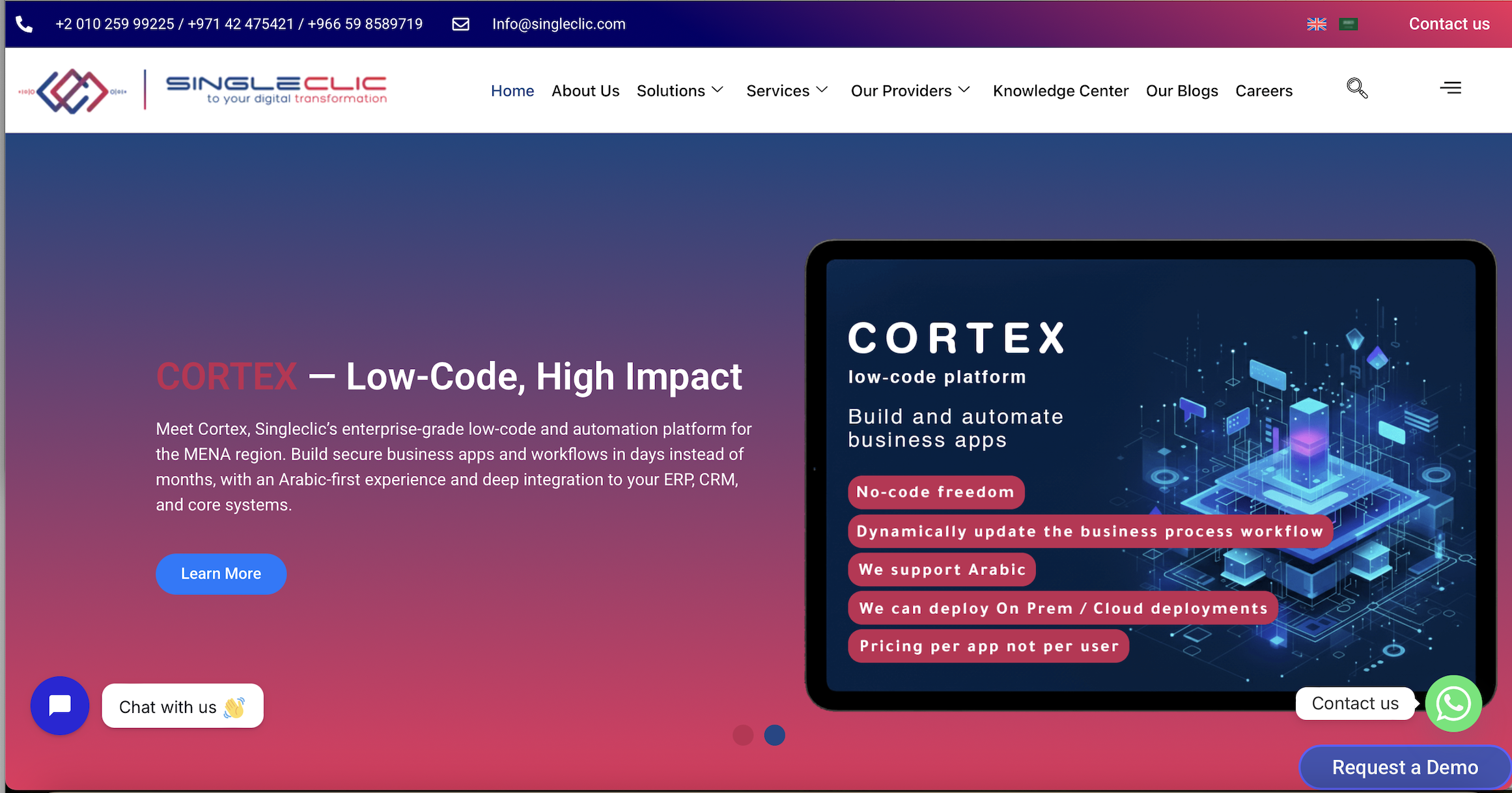
Cortex, Singleclic’s Arabic-enabled, on-premise low-code platform, connects approvals, ERP, CRM, and legacy systems into workflows your team can adjust without writing code, including runtime changes with no downtime. For sectors that require data to stay on-premise, on-prem LLM options can be paired with a low-code platform to keep generative AI grounded in governed data rather than sending it to a third-party cloud.
A typical engagement runs pilot, then integration with existing CRM systems, then governance setup, then scale, following a structured sequence, built and supported end to end.
- Low-code workflows that connect CRM, ERP, and legacy systems without custom code.
- On-premise deployment options for regulated industries that cannot send data to third-party clouds.
- Integration paths into leading CRM implementations.
If your CRM data and governance are not ready for generative AI yet, start with Singleclic’s services overview to scope what a governed pilot would take for your team.
Primary sources and further reading
- NIST Generative AI Profile: governance actions for AI risk management.
- Baseer arXiv paper: Arabic document OCR benchmarks.
- State of Salesforce report: agentic AI and data integration lessons.
Sources
- Baseer: A vision-language model for Arabic document OCR (arXiv)
- Artificial Intelligence Risk Management Framework: Generative Artificial Intelligence Profile (NIST)
- The state of Salesforce 2025–2026: 3 pillars for cost-effective agentic AI at scale (IBM/analysis)
FAQ
Which AI is best for CRM?
There is no single best model since the right choice depends on your hosting requirements, language needs, and use case. Purpose-built generative AI integrated directly into your CRM tends to outperform generic chatbots because it can ground outputs in your actual records through RAG techniques.
How can AI be used in CRM?
Generative AI drafts personalized outreach emails, summarizes calls into CRM notes, triages service tickets, and generates campaign copy variants from existing segmentation data. More advanced agentic setups chain several of these actions together, such as creating an opportunity and notifying a rep automatically.
Can I create a CRM using AI?
AI can accelerate building CRM workflows through low-code platforms that let you design approval chains, data flows, and automations without writing code, such as Cortex. Building a production-grade CRM from scratch with AI alone is not realistic; most enterprises extend a proven platform like Dynamics 365 or Odoo instead.
What is the 30% rule for AI?
Nucleus Research puts that expected productivity lift at roughly 10 to 35% for tasks like content generation, summarization, and data entry.
What data does generative AI need to work well in CRM?
It needs a reconciled golden record with duplicates merged and identities resolved, plus an indexed document corpus for retrieval-augmented generation. Without clean, connected data, generated outputs will repeat the same errors already sitting in your database.