No, the UAE does not impose blanket data localization. Federal Decree-Law No. 45 of 2021 (the PDPL) permits cross-border data transfers when proper safeguards exist. But banking, healthcare, and government data face sector-specific rules that often require in-country storage. Start by classifying your regulated datasets, then apply whichever rule (federal, sector, or free zone) is most restrictive.
TL;DR:
- Most cross-border data transfers are permitted if safeguards like contractual clauses or adequate protections are in place, but certain sectors require in-country storage.
- Banking, healthcare, and government data often face strict residency rules, demanding local storage or regulatory approval before data leaves the UAE.
- UAE enterprises should first map and classify all datasets, then apply the strictest applicable rule and choose architecture options that segment regulated data for compliance.
- Cloud providers with local UAE infrastructure, such as AWS Middle East, hold a significant advantage, influencing vendor selection and contract negotiations.
- Companies must document and revisit all cross-border data flow bases, as current regulations rely more on contracts and technical safeguards than a formal adequacy list.
Table of Contents
- What data residency means for data residency UAE compliance
- Key UAE laws and regulators that affect residency
- Where residency is commonly required or enforced
- Practical compliance steps UAE enterprises should take now
- Enforcement, penalties, and how to prioritize fixes
- Lessons from building compliance-friendly architectures in the UAE
- Comparison of UAE data residency requirements with global standards
- Impact of data residency laws on cloud service providers operating in the UAE
- Data transfer mechanisms and adequacy decisions
- Recent updates and what enterprise IT teams should watch
- An enterprise IT roadmap, not a checkbox exercise
- How Singleclic supports UAE data residency compliance
- Primary sources to consult
- Sources
- FAQ
What data residency means for data residency UAE compliance
Data residency refers to the physical location where an organization stores its data. Data sovereignty goes further: it means data is subject to the laws of the country where it sits, regardless of where the company is headquartered. Localization is the strictest cousin of both terms. It requires that certain data never leave a jurisdiction at all.
The PDPL does not default to localization. It allows cross-border transfer of personal data when the receiving country offers “an adequate level of protection,” when contractual safeguards are in place, or in specific cases with informed consent. That is a materially different standard from a hard localization mandate, and it is where many UAE businesses get their first compliance decision wrong.
- Data residency: where data physically sits
- Data sovereignty: whose laws govern that data
- Localization: a legal requirement to keep specific data in-country
- Cross-border transfer: moving data outside the UAE under PDPL safeguards
Free zones complicate this picture further. DIFC and ADGM run independent data protection regimes with their own transfer rules, separate from onshore PDPL, which means a single UAE-based group can face three different compliance regimes at once.
Key UAE laws and regulators that affect residency
Four frameworks decide where your data can legally sit. Miss one and you inherit its penalties.
The PDPL is the federal baseline, effective since January 2, 2022, and it governs personal data processing across the mainland UAE. It permits cross-border transfers under adequacy findings, contractual clauses, or documented safeguards, but the Bureau’s detailed executive regulations on transfer mechanics have been slow to materialize, so compliance teams should track Bureau guidance as it lands rather than assume the framework is finished evolving.
Pro Tip: Don’t wait for final executive regulations to act. Build your data map and classification now using the PDPL’s existing text, then adjust contractual clauses once the Bureau issues detailed transfer rules.
- PDPL: national baseline, allows transfers with safeguards
- Healthcare ICT Law (Federal Law No. 2 of 2019): requires health data storage inside the UAE absent a specific health authority resolution
- CBUAE: consumer protection and payment rules push customer and transaction data toward local storage
- DIFC / ADGM: independent regimes, each with its own adequacy and transfer standards
Regulators expect financial institutions to treat cross-border transfers as high-risk by default. Even where the PDPL would permit a transfer on contractual grounds, CBUAE and payment regulators frequently require explicit approval before customer or transaction data leaves the country.
Where residency is commonly required or enforced
Some sectors face residency expectations in practice, even without a single unifying localization statute. Here is where enterprises hit friction most often:
- Banking and transaction records. The Central Bank’s Consumer Protection Standards push retail banks toward keeping customer and transaction data in-country, and cross-border moves typically need documented justification.
- Payment services and card data. Retail payment service providers face similar local-storage expectations under CBUAE rules, with regulator sign-off often required before data leaves the UAE.
- Healthcare records. The Healthcare ICT Law requires storage of health data inside the UAE unless the relevant health authority issues a resolution permitting an exception, and central health systems generally expect onshore hosting.
- Government and sensitive datasets. Government entities and critical infrastructure operators, along with certain IoT and smart-city data categories, tend to face the tightest internal storage and access controls of any sector.
If your organization spans more than one of these categories, the safest approach is to apply the strictest applicable rule to any dataset that touches multiple regimes, rather than trying to segment compliance by department.
Practical compliance steps UAE enterprises should take now
Compliance starts with knowing what you have, not with buying new infrastructure. Map every dataset, tag it by sensitivity and regulator, and only then decide where it should live.
- Map and classify first. Identify which datasets fall under PDPL only, which fall under a sector law, and which sit inside a free zone regime.
- Apply the most restrictive rule. When a dataset crosses regimes (say, a bank operating from DIFC with mainland customers), default to the tightest applicable standard.
- Choose your architecture deliberately. Options include full on-premise deployment, a UAE-based cloud region such as AWS Middle East (UAE) Region, or a hybrid model that keeps regulated workloads local while running lower-sensitivity workloads elsewhere.
- Lock down contracts. Data processing agreements, encryption requirements, and segmentation controls need to be explicit, not assumed.
- Don’t rely on consent alone. In regulated sectors like finance, authorities often expect a formal approval workflow layered on top of user consent, not consent as a standalone basis for transfer.
- Build operational controls. Retention schedules, consent tracking, and audit trails need to be embedded in your workflows, not bolted on after an incident.
Pro Tip: Treat consent tracking as a workflow problem, not a checkbox. If your CRM or ERP system can’t prove when and how consent was captured, an auditor will treat that gap as noncompliance regardless of your policy documents.
Vendor assessments matter here too. Before signing with any cloud or software provider, confirm where their default data region sits, whether they support in-UAE hosting, and how quickly they can produce audit logs on request. Our guide to data security best practices for IT teams in UAE and KSA walks through the technical side of this in more depth.
Enforcement, penalties, and how to prioritize fixes
Enforcement in the UAE runs through the sector regulator that owns your data type, not a single privacy authority handling every case. The PDPL’s data protection authority handles general violations, while CBUAE governs financial data breaches, and the health authority oversees Healthcare ICT Law violations. Consequences range from corrective orders and fines to suspension of specific data processing activities.
When you’re triaging a compliance gap, work in this order:
- Quick technical wins first: restrict access, encrypt data at rest, and disable unnecessary cross-border replication.
- Contractual containment next: update DPAs and vendor contracts to reflect actual data flows.
- Architectural remediation last: migrate workloads to UAE regions or on-premise environments where the first two steps aren’t enough.
Fixing the contract before the architecture usually buys you time without a costly migration.
Lessons from building compliance-friendly architectures in the UAE
The enterprises that handle this well don’t treat residency as a single decision. They segment workloads: regulated data goes into local regions or on-premise systems, gated exports handle the rest. That segmentation is what actually reduces audit friction, more than any policy document does.
On-premise deployments and local-region cloud hosting both give regulated industries a defensible answer when an auditor asks where data lives. Pairing that with tightly integrated ERP or CRM environments closes the gap between policy and practice.
Comparison of UAE data residency requirements with global standards
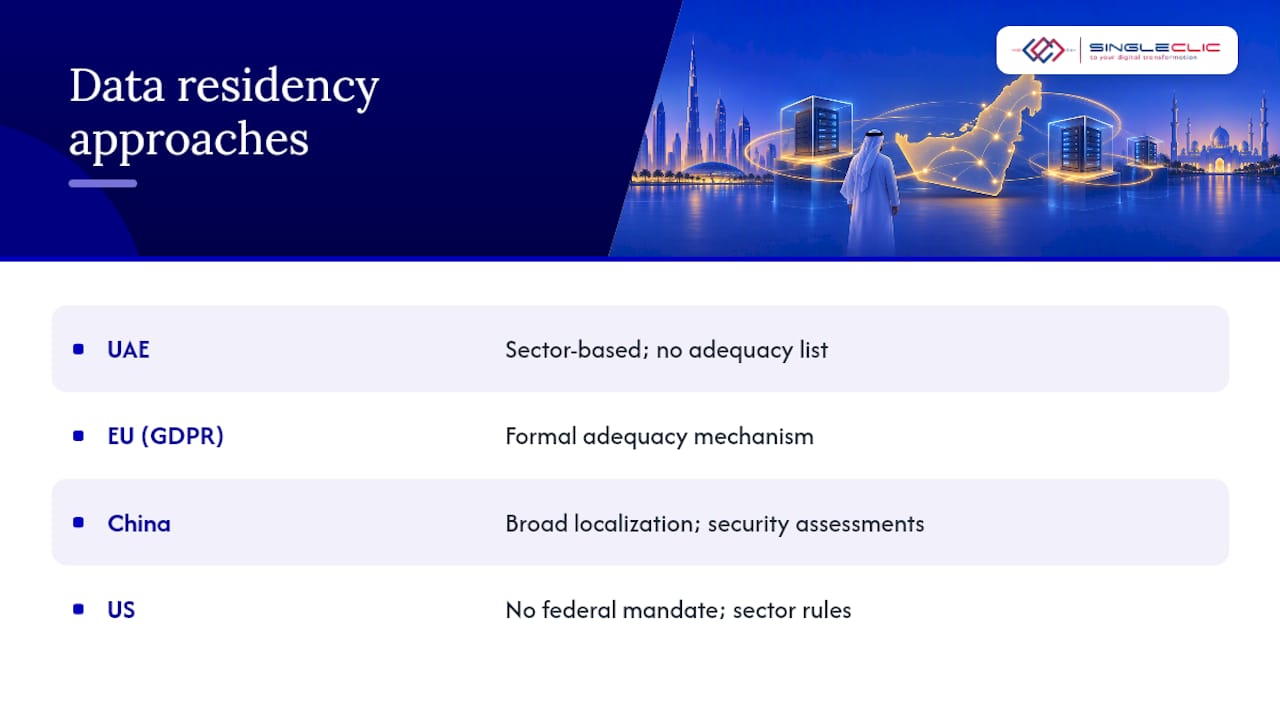
The UAE’s approach sits closer to a sector-based model than the blanket localization regimes some countries impose, and it differs sharply from the European Union’s General Data Protection Regulation (GDPR) in structure, even where both share similar goals. GDPR relies on a formal adequacy mechanism: the European Commission assesses whether a non-EU country’s protections are equivalent, and transfers proceed freely only where that finding exists. The UAE’s PDPL borrows the language of “adequate protection” but does not yet operate a fully published adequacy list, leaving compliance teams to rely more heavily on contractual safeguards case by case.
Compare that to markets like China, where the Personal Information Protection Law imposes strict localization on broad categories of data with security assessments required before most cross-border transfers. The UAE’s posture is lighter than China’s but heavier than the United States, which has no federal data residency mandate at all and relies on sector-specific rules (HIPAA for health data, GLBA for financial data) that resemble the UAE’s own sector-based approach more than they resemble GDPR.
For a multinational operating across these markets, the practical implication is that a single global data policy rarely works. A company running PDPL-compliant operations in Dubai, GDPR-compliant operations in Frankfurt, and HIPAA-compliant operations in Texas needs distinct data maps for each jurisdiction, because “compliant” means something different in each one. Enterprises that build one architecture and assume it satisfies every regime tend to discover the gaps during an audit, not before one.
Impact of data residency laws on cloud service providers operating in the UAE
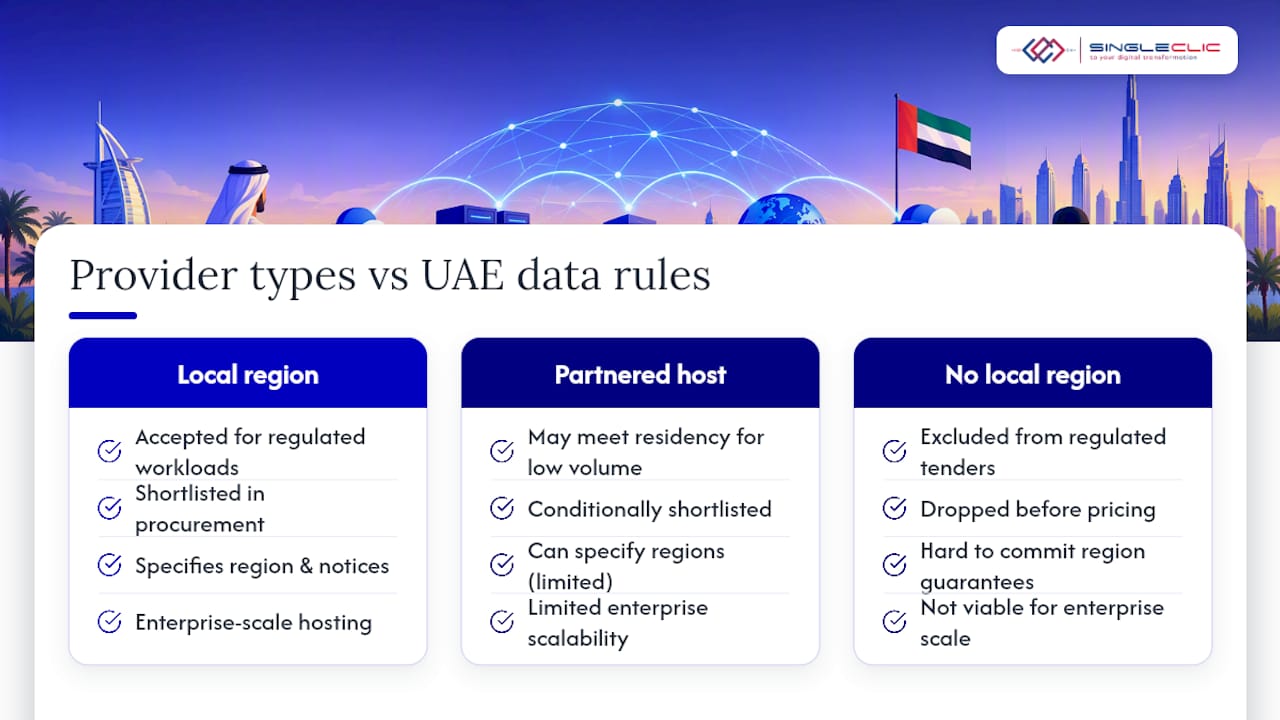
Cloud providers serving UAE enterprises now compete partly on where their infrastructure physically sits. The launch of the AWS Middle East (UAE) Region gave enterprises a way to keep workloads in-country without sacrificing the elasticity of public cloud, and it reflects a broader pattern: providers that lack a local region face a structural disadvantage with regulated UAE customers, regardless of their global scale or pricing.
This changes how IT leaders evaluate vendors. A provider’s default data region, its support for customer-controlled region selection, and its ability to produce audit documentation on demand now matter as much as uptime guarantees. Providers that can’t demonstrate in-country hosting for regulated workloads get excluded from banking and healthcare procurement before pricing is even discussed.
It also changes contract negotiations. Enterprises increasingly require providers to specify, in writing, which region hosts primary data and backups, and to commit to notifying the customer before any change in that arrangement. That level of specificity was rare five years ago and is now close to standard for regulated-sector procurement in the UAE. Our overview of cloud security for IT leaders in KSA and UAE covers the practical side of evaluating these commitments during vendor selection.
Smaller cloud providers without a UAE presence often respond by partnering with local data center operators or offering dedicated hosting arrangements, which can satisfy residency requirements without a full regional buildout. That route works for lower-volume workloads but rarely scales cleanly for enterprise-grade financial or health data traffic.
Data transfer mechanisms and adequacy decisions
The PDPL recognizes several bases for moving data outside the UAE: an adequacy determination for the receiving country, standard contractual clauses between sender and receiver, binding corporate rules for intra-group transfers, or explicit consent in narrower cases. In practice, most UAE enterprises rely on contractual safeguards today, because a comprehensive published adequacy list has not yet matured the way it has under GDPR.
That gap matters operationally. Without a clear adequacy list, compliance teams can’t simply check a country against an approved roster and move on. Each transfer arrangement needs its own contractual documentation, and for regulated sectors like finance, that documentation often needs a regulator’s sign-off on top of the underlying contract, not just internal legal approval.
Free zones add another layer. A DIFC or ADGM entity transferring data to a mainland UAE affiliate is technically moving data across regimes, even though both sit within the same country’s borders. Treating an intra-UAE, cross-regime transfer the same as a purely domestic transfer is one of the more common mistakes we see in early-stage compliance programs.
The practical guidance here is straightforward even if the legal landscape isn’t finished evolving: document every cross-border flow, tie each one to a specific legal basis (adequacy, contract, or consent), and revisit those bases whenever the Bureau issues new executive regulations. Enterprises that keep a living data transfer register, rather than a static compliance binder, adapt faster when the rules shift.
Recent updates and what enterprise IT teams should watch
The most consequential recent development isn’t a new law. It’s the ongoing wait for the PDPL’s executive regulations, which are expected to spell out cross-border transfer mechanics, adequacy criteria, and enforcement procedures in far more detail than the base decree-law provides. Until those regulations land in full, enterprises are operating with a framework that states principles clearly but leaves several operational questions to contractual judgment.
CBUAE has also continued tightening expectations around payment data and consumer protection, reflecting a broader regional pattern of financial regulators moving faster than general data protection authorities on residency specifics. Enterprises in banking and fintech should expect this trend to continue, with more explicit local-storage guidance likely before the general PDPL framework catches up.
For healthcare, coordination with the health authority before any cloud migration remains essential, and that is unlikely to loosen given the sector’s long retention requirements. Enterprises planning a shift to hybrid or cloud infrastructure for health workloads should build in regulatory coordination time as a project milestone, not an afterthought.
The direction of travel across all three fronts points toward more specificity, not less. Enterprises that build flexible, well-documented compliance programs now will adapt more easily than those waiting for a final rulebook that may keep evolving for years.
An enterprise IT roadmap, not a checkbox exercise
Most compliance guidance treats data residency as a yes-or-no legal question. It isn’t. The PDPL’s permissive stance on cross-border transfer means the real work happens in architecture and contracts, not in a single legal memo.
The conventional advice, “consult a lawyer and get a compliance certificate,” misses that data residency is fundamentally an engineering decision dressed in legal language. A lawyer can tell you what the Healthcare ICT Law requires. Only your IT architecture team can tell you whether your current systems can actually deliver it without a rebuild.
My take: enterprises that succeed here start with data classification before they touch a single cloud contract. They build systems that segment regulated data by design, so residency isn’t a retrofit every time a regulator issues new guidance. The ones that struggle bought infrastructure first and asked compliance questions second. If you take one thing from this roadmap, make it that sequencing decision.
— Tamer Badr
How Singleclic supports UAE data residency compliance
There are alternatives to rebuilding your entire IT stack from scratch when residency rules tighten. Approaches that pair Arabic-enabled, on-premise low-code platforms with ERP and CRM integrations can help keep regulated workloads under your control instead of scattered across systems you can’t fully audit.
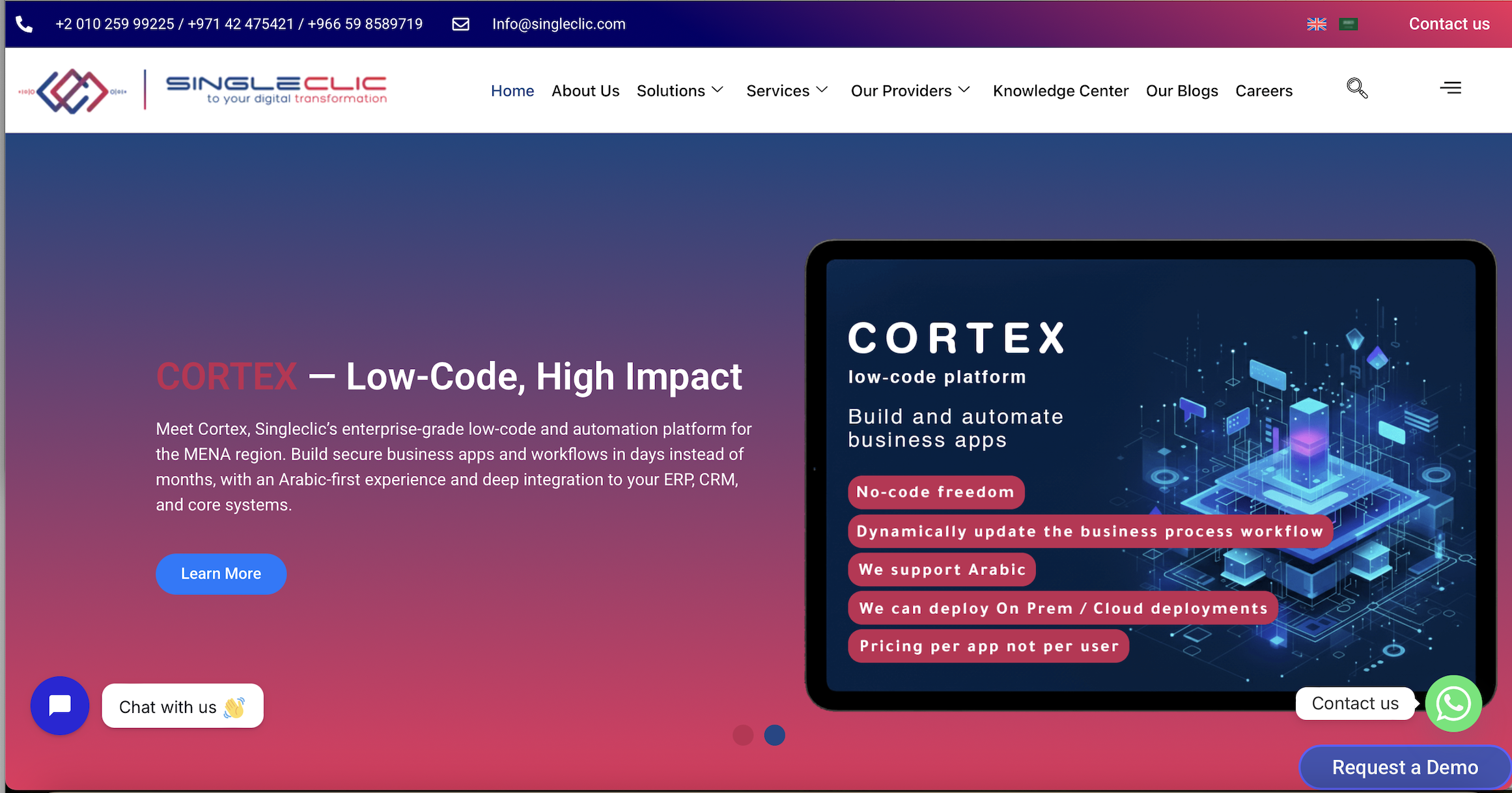
Some low-code platforms are built to address constraints faced by banks and government entities in the UAE, including on-premise deployment, support for unlimited users, full Arabic UI, and real-time process changes without requiring downtime for every regulatory update. If you’re running a bank, hospital system, or government agency and need to map ERP, CRM, and legacy data flows against PDPL or Healthcare ICT Law requirements, that’s precisely where our business process automation and low-code services come in.
If a cloud migration or system integration project is already on your roadmap, get it assessed against your actual residency obligations before you sign a vendor contract. Reach out to Singleclic to scope a compliance-aware architecture review for your organization.
Primary sources to consult
- PDPL full text for federal data protection obligations
- Healthcare ICT Law for health data storage and retention rules
- ADGM data protection overview for free zone regimes
- AWS UAE region announcement for cloud hosting options
Sources
- Federal Decree by Law No. (45) of 2021 Concerning the Protection of Personal Data (PDPL)
- Federal Law No. 2 of 2019 Concerning the Use of the Information and Communications Technology in Health Fields
FAQ
What is a data residency requirement?
A data residency requirement specifies that certain data must be stored within a defined geographic or legal boundary, often to satisfy national security, privacy, or regulatory concerns. In the UAE, this applies mainly to specific sectors, such as healthcare and banking, rather than as a blanket rule under the PDPL.
Does the UAE monitor WhatsApp communications?
UAE authorities have broad telecommunications oversight powers under national security and cybercrime laws, and messaging platforms operate within that legal framework. This falls outside data residency law specifically, but it’s a related privacy consideration enterprises should factor into their communication policies for regulated data.
What are the top nationalities living in the UAE?
The UAE’s population is majority expatriate, with large communities from India, Pakistan, Bangladesh, the Philippines, and Egypt alongside Emirati citizens. This demographic mix is relevant to data residency planning because it shapes cross-border data flows for HR, payroll, and remittance systems handling employee data from multiple home countries.
What are the data retention requirements in the UAE?
Retention periods vary by sector: the Healthcare ICT Law specifies long retention for certain health records, in some provisions reaching a minimum of 25 years. Financial and general personal data retention periods depend on the applicable sector regulation and the specific PDPL provisions governing that data category.
Does Singleclic help with UAE data residency compliance projects?
Singleclic supports UAE enterprises through on-premise deployments of its Cortex low-code platform along with Odoo integrations, all designed to keep regulated data under enterprise control. Current service details and engagement options are available on the Singleclic services page.