A successful Dynamics 365 F&O implementation follows a phased, Success by Design-aligned program built on key principles including executive sponsorship, a data-first blueprint, and UAE localization scoped early. Mid-market programs typically run 6 to 12 months and enterprise programs 12 to 24 months, with licensing, integration count, and data cleanup as the main cost drivers. The next move is simple: scope a blueprint workshop before you sign anything.
TL;DR:
- Adding integrations or legal entities to the scope significantly increases costs and testing complexity, especially if legacy systems were not inventoried early.
- Fixed-price contracts work best for well-defined, stable scopes, while time and materials models suit evolving requirements, but both need clear acceptance criteria and change controls to prevent budget overruns.
- Successful governance requires a dedicated decision-maker for scope disputes and a core team including project managers, functional leads, and super users, with responsibilities like data quality and UAT often under-resourced.
- UAE localization must be scoped during blueprinting, covering VAT, e-invoicing, WPS payroll, and bilingual support, as delaying these items risks scope creep and project delays.
- Ongoing costs include scheduled updates via One Version and validation using automated regression tools, while user adoption relies on role-based training, KPIs, and continuous reinforcement post-go-live.
Table of Contents
- What are the phases of a Dynamics 365 F&O implementation?
- How long does a Dynamics 365 F&O implementation take?
- Fixed price or time and material: which contract fits your project?
- Who should sit on the project governance team?
- What data needs cleanup before migration?
- What does the go-live readiness review check?
- What UAE compliance items must be scoped early?
- How does Microsoft’s One Version update model affect ongoing costs?
- How do you drive adoption after go-live?
- Why regional implementation experience matters for F&O projects
- What should you do this quarter to move forward?
- A regional implementer’s take on what actually derails these projects
- How Singleclic supports your F&O implementation
- Sources
- FAQ
What are the phases of a Dynamics 365 F&O implementation?
Every credible Dynamics 365 finance and operations implementation follows some version of Microsoft’s Success by Design framework: envision, design, build, test, and deploy. Skipping a phase to save time almost always costs more later, usually during user acceptance testing when nobody wants to hear it.
Here’s what each phase actually delivers:
- Envision (2-4 weeks): Confirms scope, success metrics, and a signed-off solution blueprint.
- Design (4-8 weeks): Maps business processes to F&O modules, flags customization needs, and locks the fit-gap analysis.
- Build (8-16 weeks): Configures the environment, develops integrations, and migrates test data.
- Test (4-8 weeks): Runs unit, integration, and user acceptance testing against the signed blueprint.
- Deploy (2-4 weeks): Executes cutover, go-live readiness review, and hypercare support.
Phased rollouts (module by module or entity by entity) can reduce risk for complex, multi-entity organizations. Big-bang deployments generally fit smaller, single-entity businesses with simpler chart-of-accounts structures. Parallel run, involving legacy and new systems operating side by side briefly, is often chosen when regulatory reporting requires no gap, although it increases costs due to duplicate data entry.
How long does a Dynamics 365 F&O implementation take?
Timeline expectations vary sharply by organizational size and scope, and vendors who quote a single number for every client are guessing. Mid-market implementations generally span 12 to 24 months, while enterprise programs with multiple legal entities and legacy integrations often stretch 18 to 36 months.
Budget typically breaks down across four buckets:
- Partner services (consulting, configuration, development): usually the largest line item.
- Licensing and cloud infrastructure: ongoing subscription costs tied to user count and modules.
- Internal resources: the project team’s time, frequently underestimated.
- Contingency: 10 to 15% held back for scope changes and unforeseen integration work.
Statistic Callout: Adding integrations or legal entities to a project scope generally increases both cost and testing burden, as each connected system requires dedicated testing and support processes.
The biggest cost inflator isn’t licensing. It’s unplanned integrations discovered mid-build because nobody inventoried legacy systems during the blueprint phase.
Fixed price or time and material: which contract fits your project?
Choosing the wrong pricing model is one of the most common ways a well-planned F&O implementation strategy goes over budget. Here’s how to decide:
- Choose fixed price when scope is well defined and stable. It works for organizations with mature, documented processes and minimal customization. The hidden risk: any scope creep triggers change orders, and vendors sometimes pad estimates upfront to cover ambiguity.
- Choose time and material (T&M) when requirements will evolve, particularly for complex integrations or multi-country rollouts. T&M shifts risk to the client, so it demands active governance, not passive invoicing.
- Require contract controls regardless of model: written acceptance criteria per milestone, a formal change control process, and payments tied to deliverables rather than calendar dates.
Never sign a contract without a defined acceptance test for each phase. Ambiguity there is where budgets quietly disappear.
Who should sit on the project governance team?
Governance failures, not software defects, cause most delays. A steering committee (typically the sponsoring executive, CFO or CIO, and the implementation partner’s engagement lead) should meet biweekly to resolve scope and budget decisions fast.
Core team composition typically includes:
- A project manager from both partner and client sides.
- Functional leads for finance, supply chain, and any specialized modules in scope.
- A dedicated data migration lead.
- Super users from each business unit who will later train peers.
Customer-owned responsibilities that partners typically do not cover include data quality assurance, user acceptance testing, and internal change management — and these are consistently where under-resourced projects stall.
Pro Tip: Assign one named executive as the single decision-maker for scope disputes. Committees that “decide by consensus” add weeks to every disagreement.

What data needs cleanup before migration?
Master data (customers, vendors, chart of accounts, item records) must be cleaned before transactional data migration begins, never the other way around. Migrating dirty master data just moves the mess into a new system faster.
Common issues that balloon scope include duplicate vendor records, inconsistent unit-of-measure conventions, and orphaned chart-of-accounts entries carried over from decades-old legacy systems. If your organization migrated from AX 2012, expect extra cleanup around deprecated dimension structures.
- Sequence migration as master data first, then open transactions, then historical data.
- Run at least one full dry-run migration before the final cutover rehearsal.
- Reconcile record counts and control totals between legacy and new systems before sign-off.
What does the go-live readiness review check?
Testing in F&O isn’t a single event. It layers unit testing (individual configurations), integration testing (system-to-system data flow), regression testing (nothing broke that used to work), and increasingly automated test suites that run these checks continuously.
- Unit and integration testing happen throughout the build phase, not just before go-live.
- The Go-live Readiness Review is a mandatory gate, verifying environment configuration, Lifecycle Services milestones, and a documented production support plan before anyone touches the production tenant.
- Cutover rehearsal should run at least twice, with rollback criteria defined in advance so a failed rehearsal doesn’t become a live-fire go-live decision.
Statistic Callout: Scheduling multiple cutover rehearsals, ideally with automated regression suites run prior to the final one, helps catch environment and performance issues that might be missed otherwise.
Skipping the readiness review to hit a deadline is the single riskiest shortcut in any F&O project.
What UAE compliance items must be scoped early?
Any Dynamics 365 F&O setup guide for a UAE-based organization has to treat localization as a build requirement, not a post-launch patch. Waiting until UAT to configure tax reporting is a scope failure, not a technical one.
Priority items include:
- VAT and ER configurations: Dynamics 365 Finance uses Electronic Reporting configurations with the UAE report layout, the VAT declaration model, and Excel-based mapping to generate compliant VAT declarations.
- FTA e-invoicing (Fatoora) integration: must be tested against real invoice scenarios well before go-live, not assumed to work because a connector exists.
- WPS payroll integration: required for salary compliance reporting to UAE labor authorities.
- Arabic RTL support and bilingual templates: these directly affect user adoption, since finance teams working daily in Arabic-first interfaces resist English-only screens.
Statistic Callout: Prebuilt UAE localization packs covering VAT, e-invoicing, and bilingual UX consistently shorten time to value compared with building these configurations from scratch.
How does Microsoft’s One Version update model affect ongoing costs?
Dynamics 365 F&O runs on a continuous update model called One Version, which means the platform is never “done” the way an on-premise ERP might feel done.
- Updates arrive on a predictable cadence, and your team selects maintenance windows rather than skipping releases indefinitely.
- Lifecycle Services (LCS) and the Power Platform admin center give you the controls to schedule, validate, and roll back updates across environments.
- Automated regression testing, using tools like the Regression Suite Automation Tool, protects your customizations from breaking silently during a routine update.
Budget for update validation as an ongoing line item, not a one-time project cost.
How do you drive adoption after go-live?
Go-live is the start of value realization, not the finish line. Role-based training paired with a super-user model, where trained business users field first-line questions, keeps helpdesk tickets manageable in the first 90 days.
- Build a runbook defining operational SLAs for BAU support requests.
- Track adoption through concrete KPIs: time-to-close for financial periods, helpdesk ticket volume, and transaction accuracy rates.
- Revisit training quarterly for the first year, since new hires and process tweaks erode initial competency fast.
Pro Tip: If helpdesk tickets aren’t dropping by month three post-go-live, the problem is almost always training gaps, not software defects.
Why regional implementation experience matters for F&O projects
[brand_signal] A regional leader in Microsoft Dynamics 365 ERP implementation has delivery experience across construction, healthcare, banking, and government sectors in the region. That kind of vertical exposure shortens the blueprint phase because fewer assumptions need testing from scratch.
- Blueprint workshops often map UAE VAT, Fatoora e-invoicing, and WPS requirements before build starts.
- Where relevant, low-code platforms integrate approvals and legacy workflows alongside the F&O core.
- When evaluating any partner, request client references, a live localization demo, and a sample data migration plan before signing.
What should you do this quarter to move forward?
Momentum matters more than perfection at this stage. A clear next action beats another round of vendor decks.
- Secure executive sponsor alignment and a named decision-maker for scope disputes.
- Scope and schedule a blueprint workshop with your shortlisted implementation partner.
- Run an internal data audit covering master data quality across finance and supply chain.
- Shortlist two to three partners and request localization and migration references.
- Define written acceptance criteria before any contract is signed.
Minimum artifacts to bring into that workshop: your current org chart, chart of accounts, and a full inventory of systems needing integration. Walking in without these three guarantees a slower blueprint phase.
A regional implementer’s take on what actually derails these projects
Most failed F&O projects don’t fail on technology. They fail because nobody owned data quality or UAT with enough authority to say no to a rushed deadline. Governance and data ownership are not administrative details. They are the project.
— Tamer Badr
How Singleclic supports your F&O implementation
A direct implementation partner can support organizations planning a Dynamics 365 F&O implementation in the region, bringing vertical experience across construction, healthcare, banking, and government, plus UAE localization work built into the blueprint process, so VAT, Fatoora, and WPS requirements get scoped early instead of discovered late.
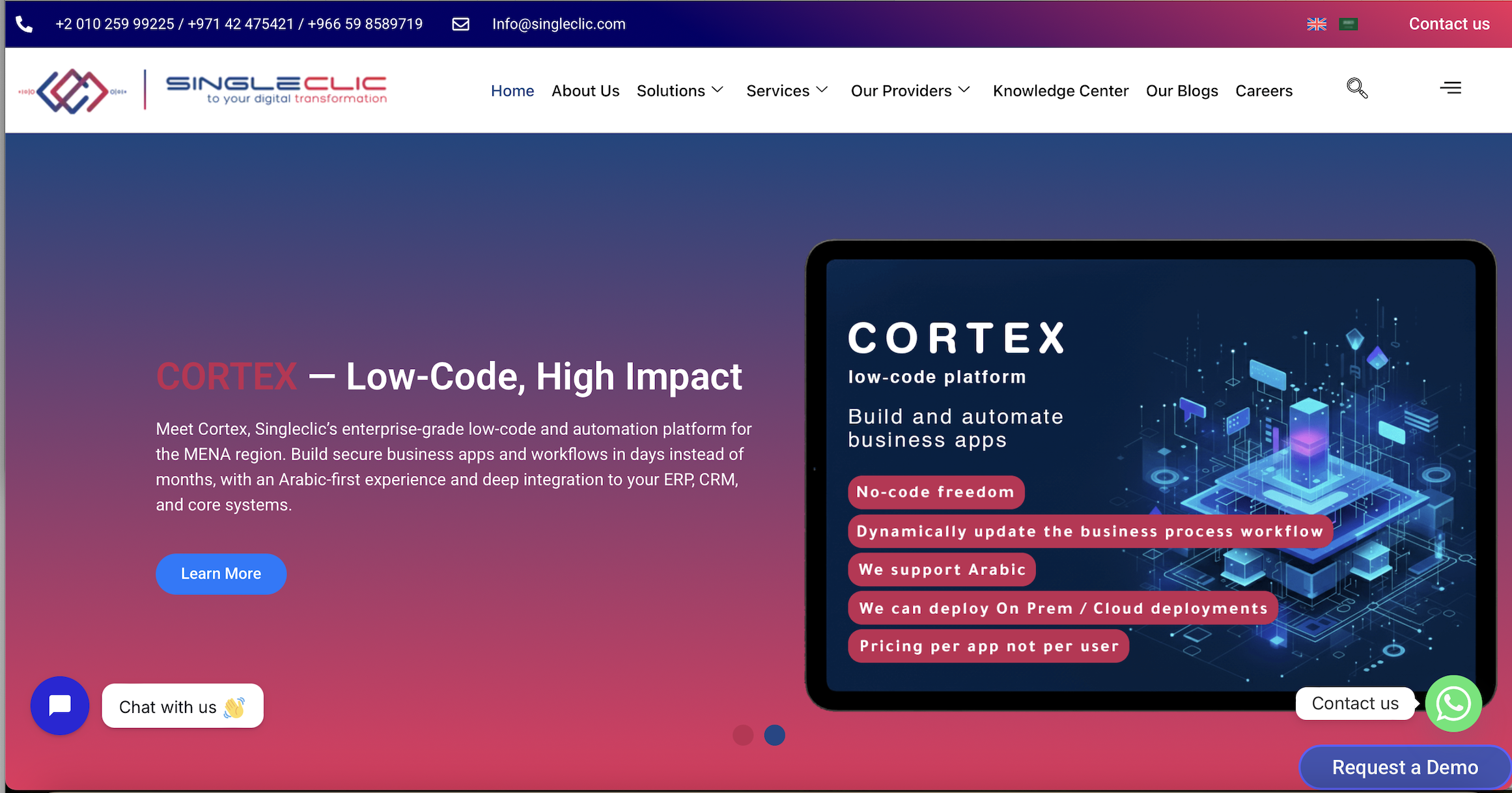
Where a broader business process needs automating alongside F&O, Cortex connects approvals, legacy systems, and workflows without a separate integration project. If your program also touches CRM or IBM-based automation, Singleclic’s Dynamics 365 services cover customization, integration, and ongoing support under one team, and the full services portfolio outlines everything from data analytics to low-code development. The practical next step is a discovery call to scope your blueprint workshop before you finalize any partner shortlist.
FAQ
What is Microsoft Dynamics 365 F&O?
Dynamics 365 Finance and Operations is Microsoft’s cloud ERP platform for managing financial, supply chain, manufacturing, and operational processes across large and mid-sized organizations. It runs on the continuous One Version update model, meaning the platform updates regularly rather than through periodic major version releases.
How many modules are in D365 F&O?
D365 F&O includes core modules for finance, supply chain management, manufacturing, project operations, and human resources, with additional industry-specific modules available depending on sector. The exact module count in your deployment depends on licensing tier and which capabilities your organization activates during the blueprint phase.
What is the difference between Dynamics 365 F&O and Business Central?
F&O is built for large, complex, multi-entity organizations with heavy customization and integration needs, while Business Central targets small and mid-sized businesses with simpler processes and faster deployment. Organizations outgrowing Business Central’s scale limits typically migrate to F&O rather than the reverse.
How much does a Dynamics 365 F&O implementation cost in the UAE?
Costs vary widely based on scope, number of legal entities, and integration count, with partner services, licensing, and internal resource time as the main drivers. Singleclic does not publish fixed project pricing since scope defines cost. Current details are available directly through Singleclic’s Dynamics 365 services page.
What are the biggest risks in an F&O implementation?
The most common risks are under-resourced data cleanup, skipping the go-live readiness review to hit a deadline, and treating UAE localization as an afterthought instead of a build requirement. Governance gaps, particularly the absence of a single accountable decision-maker for scope disputes, cause more delays than any technical defect.