Operational complexity in Saudi Arabian hospitals or UAE construction sites requires more than status updates and spreadsheets. Leaders need technology that not only mirrors real-world processes but also delivers actionable insights as systems evolve. Digital twins offer a bidirectional connection between physical operations and their virtual counterparts, enabling continuous learning and real-time decision support. This article helps CTOs and CIOs distinguish digital twins from basic simulations, clarifies common misconceptions, and demonstrates how these virtual representations of real-world systems drive integrated efficiency across both industries.
Table of Contents
- Digital Twins Explained And Common Misconceptions
- Types Of Digital Twin Models And Their Uses
- How Digital Twins Integrate With Real-World Data
- Industry Applications: Construction And Healthcare
- Operational Risks, Pitfalls, And Best Practices
Key Takeaways
| Point | Details |
|---|---|
| Digital Twins vs. Simulations | Digital twins provide real-time insights and adapt based on live data, unlike one-way simulations that rely on historical models. |
| Continuous Learning | Digital twins improve over time by learning from operational data, identifying patterns, and enhancing decision-making capabilities. |
| Implementation Focus | Start with a single high-impact process to demonstrate ROI, and ensure data quality and integration standards are met before scaling. |
| Industry Applications | In construction and healthcare, digital twins optimize operations by predicting issues and improving resource allocation, leading to tangible operational benefits. |
Digital Twins Explained and Common Misconceptions
Digital twins sound complex, but the core concept is straightforward. They’re virtual representations of real-world systems that receive continuous data from their physical counterparts. Think of a hospital’s operating room mirrored digitally or a construction site replicated in code.
The power comes from bidirectional data flow. Your physical system sends real-time information to the digital version. The virtual duplicate then analyzes that data, predicts problems, and sends insights back to inform decisions.
What Makes Digital Twins Different from Simulations
Many people confuse digital twins with traditional simulations. That’s the first major misconception. Simulations are typically one-way predictions based on historical models.
Virtual information constructs with predictive capabilities operate differently. Digital twins blend modeling, observation, and human-machine interaction in real-time. They adapt and learn from actual operational data, not just predetermined rules.
Here’s the practical difference:
- Simulation: “Based on current parameters, here’s what might happen”
- Digital Twin: “Here’s what’s happening right now, and here’s what comes next based on live data”
For healthcare administrators in the UAE managing patient flows, a digital twin continuously mirrors current operations. For construction leaders in Saudi Arabia tracking project timelines, it reflects actual site conditions—not theoretical projections.
Here’s how digital twins differ from simulations and traditional monitoring:
| Aspect | Simulation | Traditional Monitoring | Digital Twin |
|---|---|---|---|
| Data Flow | One-way predictions | Passive real-time tracking | Bidirectional, live |
| Learning Capability | Static, model-based | No learning | Adaptive, AI-powered |
| Decision Support | Theoretical outcomes | Historical reports | Predictive optimization |
| Operational Impact | Scenario testing | Status updates only | Continuous improvement |
The Learning Misconception
Many organizations underestimate how intelligent digital twins become over time. They think digital twins simply copy physical systems statically.
In reality, these systems learn and improve. They identify patterns across thousands of data points. In construction, a digital twin learns how weather affects project schedules. In healthcare, it discovers which staffing configurations optimize patient outcomes.
Scope Beyond Monitoring
Another widespread misconception: digital twins only mirror what’s already happening. People assume they’re passive observers.
They’re actually proactive problem-solvers. Digital twins optimize complex operations. They test scenarios before implementation. Construction teams use them to identify scheduling conflicts weeks in advance. Healthcare facilities use them to optimize resource allocation during peak demand periods.
Digital twins transform how organizations make decisions—from reactive problem-solving to predictive optimization.
Implementing this technology requires more than just connecting sensors. Integration platforms like a low-code solution can accelerate deployment by automating workflows and data connections without extensive coding.
Common Implementation Mistakes
Many organizations fail because they approach digital twins incorrectly:
- Start too ambitious—attempting to digitize entire operations at once instead of one process
- Neglect data quality—garbage data creates worthless predictions
- Underestimate security—bidirectional data flows require robust protection
- Ignore change management—teams need training and process adjustments
Leaders in Saudi Arabia and the UAE who’ve succeeded typically start with a single high-impact process. A hospital might begin with emergency department operations. A construction firm might focus on equipment utilization tracking.
Pro tip: Start your digital twin journey with one critical operation that generates substantial data and directly impacts your bottom line—this proves ROI before scaling organization-wide.
Types of Digital Twin Models and Their Uses
Digital twins aren’t one-size-fits-all. They come in different flavors, each designed for specific operational challenges. Understanding which type matches your needs is critical before implementation.
Think of digital twins as existing on a complexity spectrum. Some monitor single components. Others manage entire enterprise systems. The more complex the twin, the more data it processes and the smarter it becomes.
Component-Level Twins
The simplest type focuses on individual equipment or parts. A hospital might create a digital twin for a single imaging machine. A construction company might monitor a concrete pump or excavator.
Component twins excel at predictive maintenance. They track sensor data from that specific piece of equipment and alert you before failure occurs. In Saudi Arabia’s healthcare facilities, this prevents expensive downtime in operating rooms.
Key benefits include:
- Early warning systems for equipment failure
- Reduced unplanned maintenance costs
- Extended equipment lifespan
- Lower replacement expenses
System-Level Twins
Move up in complexity and you reach system twins. These monitor interconnected processes rather than single components. A hospital emergency department involves nurses, doctors, equipment, and beds working together—that’s a system.

Digital twins at different modeling scopes support simulation, monitoring, and optimization across production lines and enterprise operations. System twins optimize how these pieces interact. Construction project managers use system twins to balance labor, equipment, and material flow across entire job sites.
They answer questions like: “If we add two more nurses, how does patient wait time change?” or “What happens if this delivery arrives late?”
Cognitive Twins
The most sophisticated level incorporates machine learning and artificial intelligence. Cognitive twins don’t just monitor or simulate—they learn and adapt over time.
These twins identify patterns humans miss. A healthcare facility’s cognitive twin might discover that patient outcomes improve when certain departments coordinate differently. A construction firm’s cognitive twin learns which scheduling approaches work best under different weather conditions.
This type requires substantial data volume and computational power. UAE-based enterprises with mature data infrastructure are increasingly deploying cognitive twins for competitive advantage.
The more data your operations generate, the more valuable a cognitive twin becomes—it transforms raw information into strategic decisions.
Enterprise-Wide Twins
Some organizations build twins spanning their entire operation. These massive digital replicas integrate product design, manufacturing, logistics, and customer feedback loops. They’re expensive but reveal optimization opportunities across silos.
Real-World Application Breakdown
- Healthcare: Patient flow optimization, operating room scheduling, equipment maintenance
- Construction: Project timeline prediction, resource allocation, safety compliance tracking
- Manufacturing: Production line efficiency, quality control, waste reduction
Your organization likely needs component or system twins first. Master these before attempting enterprise-wide implementation.
This summary table highlights the major types of digital twin models and their organizational value:
| Model Type | Complexity | Primary Use | Value to Organizations |
|---|---|---|---|
| Component-Level Twin | Low | Equipment monitoring | Reduces downtime, saves costs |
| System-Level Twin | Moderate | Process optimization | Improves workflow efficiency |
| Cognitive Twin | High | Predictive analytics | Strategic, AI-driven insights |
| Enterprise Twin | Very High | End-to-end integration | Cross-silo optimization |
Pro tip: Start with a component twin for your highest-cost or most failure-prone equipment—this generates quick wins that build organizational confidence for larger deployments.
How Digital Twins Integrate With Real-World Data
A digital twin without real-world data is just a digital ghost. The magic happens when actual operational information feeds continuously into the virtual model. This is where digital twins become genuinely valuable.
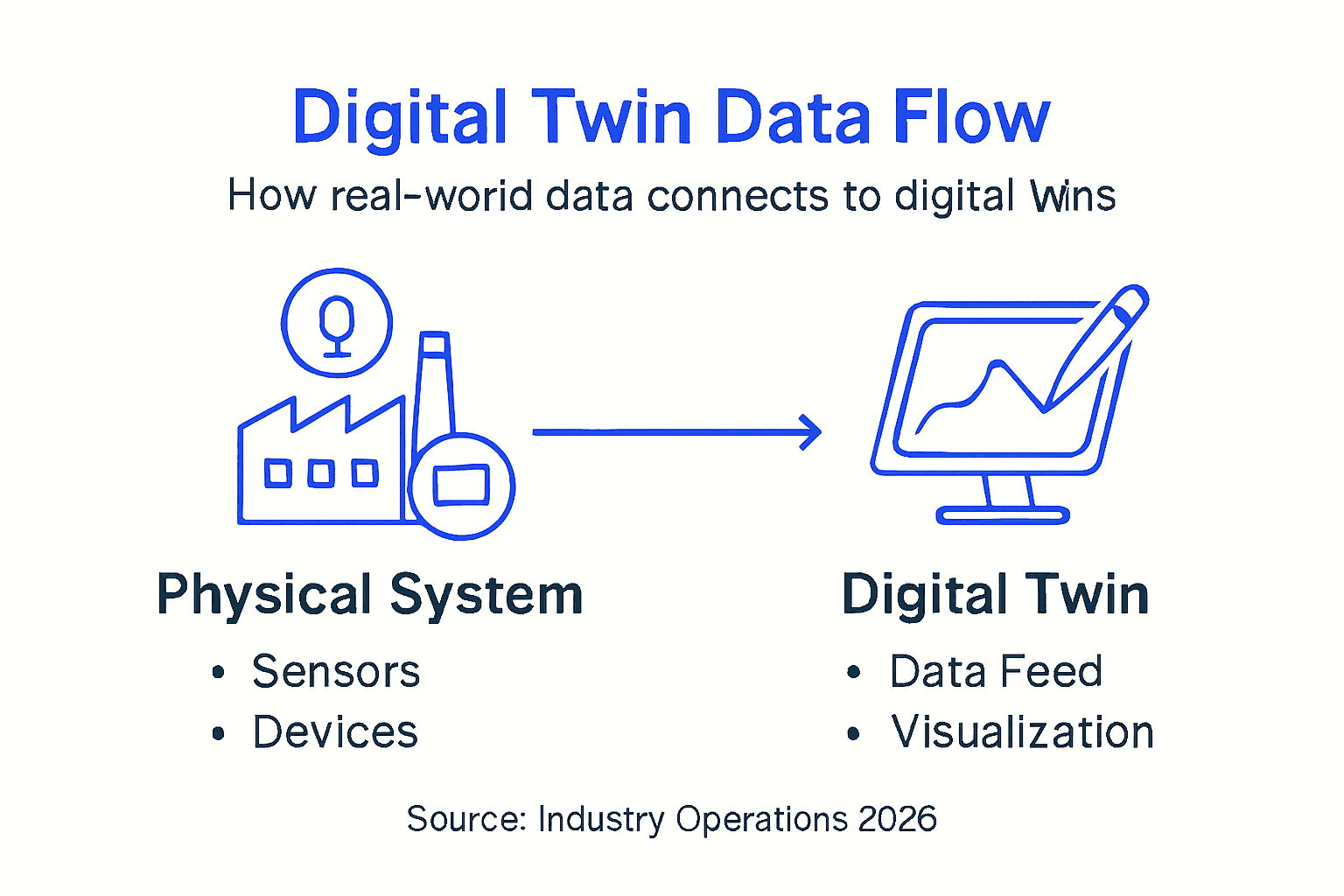
Your physical systems generate data constantly. Machines report sensor readings. Devices log operational metrics. Processes record timestamps and outcomes. All this information flows into the digital twin, keeping it synchronized with reality.
The Data Pipeline
Sensors and IoT devices are the primary data collectors. A hospital’s operating room has dozens of sensors monitoring temperature, equipment status, and patient vitals. Construction sites deploy sensors on equipment and structures.
Sensors, IoT networks, and operational logs continuously feed data into digital twins, facilitating accurate monitoring and performance optimization. This constant inflow transforms the digital twin from a static model into a living reflection of your operation.
Data sources typically include:
- Equipment sensors tracking performance metrics
- IoT networks monitoring environmental conditions
- Operational logs recording workflow events
- System databases capturing transaction history
- Manual entries from staff observations
Real-Time Updates and Synchronization
The power lies in real-time synchronization. Your digital twin updates instantly as new data arrives. A healthcare facility’s twin reflects current patient locations and staff availability right now, not yesterday.
This speed matters enormously. Construction managers need to know equipment failures immediately. Hospital administrators need current capacity data to make staffing decisions.
Machine Learning Enrichment
Once data flows into your digital twin, machine learning takes over. AI algorithms analyze patterns that humans would never spot. They identify anomalies before they become problems.
A construction company’s twin learns: “When temperature drops below 5 degrees Celsius and humidity exceeds 80 percent, concrete curing fails.” A hospital’s twin discovers: “Patient wait times decrease 15 percent when we assign nurses differently.”
Raw data means nothing. Intelligence comes from AI that transforms operational information into actionable insights.
Data Quality and Security Challenges
Integrating real-world data creates challenges. Different systems speak different languages. Data quality varies. Security vulnerabilities multiply with every connection.
Solutions exist but require planning:
- Establish clear data governance standards
- Implement robust cybersecurity protocols
- Use integration platforms to standardize formats
- Deploy validation processes to ensure quality
- Monitor data flows continuously
Organizations in Saudi Arabia and the UAE increasingly use low-code platforms to automate these integration tasks without requiring extensive custom coding. This accelerates deployment while reducing implementation risks.
The Continuous Loop
Digital twins create feedback loops. Physical operations generate data. The digital twin processes this information. Predictions and recommendations flow back to guide decisions. Those decisions affect physical operations, creating new data.
This cycle never stops. The longer it runs, the smarter your digital twin becomes.
Pro tip: Before deploying a digital twin, audit your data sources and establish quality standards—garbage data produces garbage predictions, no matter how sophisticated your AI is.
Industry Applications: Construction and Healthcare
Digital twins aren’t abstract technology. They’re solving real problems in two sectors critical to Saudi Arabia and the UAE: construction and healthcare. Understanding how they work in these industries shows their tangible value.
Both sectors share common challenges: complexity, high costs, safety concerns, and the need for precise resource allocation. Digital twins address all of these simultaneously.
Construction: Building Smarter
Construction projects are chaos management. Multiple teams, vendors, equipment, and timelines intersect. One delay cascades across everything else. Digital twins eliminate guesswork.
Digital twin technology enables virtual design, real-time monitoring, and predictive analytics throughout construction lifecycles. Project managers visualize the entire build before equipment arrives. They monitor progress in real-time and catch delays weeks before they impact deadlines.
Constructors gain:
- Virtual walkthroughs before construction begins
- Real-time progress tracking against schedules
- Equipment maintenance predictions preventing downtime
- Safety hazard identification through simulation
- Energy efficiency optimization in building design
- Asset management across multiple sites
A major contractor in the UAE recently deployed a digital twin for a complex mixed-use development. They identified scheduling conflicts that would have cost millions in delays. The twin paid for itself in the first month.
Healthcare: Optimizing Patient Care
Hospitals operate on razor-thin margins. Every inefficiency costs lives and money. Patient outcomes depend on complex coordination across departments, staff, and equipment.
Digital twins integrate patient-specific data enabling personalized treatment, real-time monitoring, and clinical decision-making. They optimize resource allocation and create safe training environments.
Healthcare leaders achieve:
- Personalized treatment protocols based on patient data
- Real-time patient monitoring across departments
- Resource allocation optimization reducing wait times
- Staff training in virtual environments without patient risk
- Predictive analytics for equipment maintenance
- Emergency response scenario planning
A hospital network in Saudi Arabia implemented a digital twin for emergency department operations. Patient wait times dropped 23 percent. Staff utilization improved 18 percent. These aren’t theoretical gains—they’re documented operational improvements.
Digital twins transform healthcare from reactive to predictive, from crisis management to proactive optimization.
Scalability and Integration Challenges
Both industries face obstacles. Data from legacy systems doesn’t integrate easily. Standards vary. Implementation costs intimidate organizations.
Successful deployments use low-code integration platforms to connect disparate systems without extensive custom development. This reduces implementation timelines from months to weeks while lowering costs substantially.
- Start with one high-impact facility or project
- Establish data governance and quality standards
- Integrate with existing operational systems
- Train staff on new workflows
- Measure results rigorously
- Scale to additional locations
Organizations that follow this roadmap see measurable ROI within the first year.
Pro tip: Select your pilot project based on highest operational cost and clearest success metrics—this builds executive support for broader digital twin investments across your organization.
Operational Risks, Pitfalls, and Best Practices
Digital twin projects fail regularly. Organizations invest heavily, deploy systems, then watch them collect dust. The technology works, but execution doesn’t. Understanding what goes wrong—and how to prevent it—separates winners from cautionary tales.
Failure rarely comes from the technology itself. It comes from poor planning, inadequate data, weak governance, and misaligned expectations.
Common Pitfalls
Most organizations stumble over the same obstacles. Recognizing them early saves time and money.
The biggest mistake: underestimating data quality requirements. Organizations connect sensors and expect magic. When data is inconsistent, incomplete, or inaccurate, the digital twin produces worthless predictions. Your virtual model mirrors garbage operational data, so predictions are garbage too.
Another critical pitfall: ignoring integration complexity. Legacy systems speak different languages. Connecting them without proper standards creates chaos. Data quality issues and scalability challenges emerge when organizations rush implementation without addressing these fundamentals.
Common implementation failures include:
- Insufficient stakeholder buy-in and change management
- Inadequate cybersecurity protections for sensitive data
- Poor validation and verification processes
- Lack of cross-functional collaboration between departments
- Scaling too quickly before proving ROI on initial pilots
- Neglecting continuous monitoring and updates
Risk Management Framework
Successful organizations use structured risk assessment. Risk assessment methodologies integrated with decision-making frameworks help prioritize threats and allocate resources effectively.
Start here:
- Identify all potential failure points
- Assess likelihood and impact of each risk
- Prioritize by severity and organizational importance
- Develop mitigation strategies for high-priority risks
- Assign ownership and accountability
- Monitor continuously throughout implementation
Best Practices That Work
Organizations in Saudi Arabia and the UAE that succeed follow proven patterns. First: establish robust digital infrastructure before deployment. This means networks, storage, computing capacity, and security foundations.
Second: define interoperability standards from day one. Your digital twin must talk to existing systems seamlessly. Low-code integration platforms accelerate this without extensive custom coding.
Third: invest in stakeholder alignment. Technical excellence matters nothing if people resist change. Train staff, communicate value, celebrate early wins.
Failed digital twins share one characteristic: weak governance and unclear accountability for outcomes.
Fourth: validate continuously. Don’t wait until deployment to discover problems. Test assumptions, verify data accuracy, and refine processes throughout development.
Fifth: secure data ruthlessly. Bidirectional data flows create vulnerabilities. Implement encryption, access controls, and monitoring.
The Implementation Roadmap
Don’t try everything at once. Phased deployment reduces risk dramatically.
- Phase 1: Single process or component with clear success metrics
- Phase 2: Expand to related processes with proven technology
- Phase 3: Integrate with broader operational systems
- Phase 4: Scale organization-wide with established governance
Each phase validates lessons before moving forward. Phase 1 should run 3-6 months with documented results.
Pro tip: Establish a digital twin governance committee before deployment—assign clear ownership, set measurable targets, and require monthly progress reviews to catch problems early when they’re still fixable.
Unlock the Full Potential of Digital Twin Technology with Singleclic
The journey to mastering digital twin technology requires more than just connecting sensors and collecting data. It demands intelligent integration, real-time insights, and adaptive business processes that evolve seamlessly with your operations. Whether you are in healthcare or construction in Saudi Arabia or the UAE, overcoming challenges like data quality, legacy system integration, and effective change management is critical to transforming your digital twin from a static replica into a proactive, predictive powerhouse.
Singleclic specializes in bridging these gaps by delivering comprehensive solutions including AI-powered low-code platforms like Cortex that enable real-time process optimization without heavy coding. Our expertise in ERP, CRM, Robotic Process Automation, and enterprise AI positions us perfectly to help organizations optimize operations at scale. Learn how we empower your teams to turn complex operational data into actionable insights, reduce downtime, and accelerate growth.
Take the next step in elevating your digital twin strategy beyond traditional monitoring. Explore how Singleclic’s integrated solutions can optimize your workflows and deliver measurable ROI today.
Discover tailored digital transformation solutions at Singleclic and start your journey toward operational excellence now. Visit our Business Process Automation and AI & Low-Code Platform Development pages to learn more.
Frequently Asked Questions
What is a digital twin?
A digital twin is a virtual representation of a real-world system or process that receives continuous data from its physical counterpart, enabling real-time monitoring, analysis, and optimization.
How do digital twins differ from traditional simulations?
Digital twins operate in real-time with bidirectional data flow, adapting and learning from actual operational data, while traditional simulations are typically one-way predictions based on historical models.
What are the different types of digital twin models?
There are several types of digital twin models, including component-level twins for monitoring individual equipment, system-level twins for interconnected processes, cognitive twins that incorporate machine learning, and enterprise-wide twins that integrate entire operations.
What challenges do organizations face when implementing digital twins?
Organizations often encounter challenges such as poor data quality, integration complexities with legacy systems, underestimating security requirements, and failing to manage change effectively during implementation.