For most UAE organizations, data residency can be met in a UAE cloud region. On-premise becomes necessary when a regulator, a government directive or your own risk profile requires you to hold the administrative keys and the control plane as well as the data. The right answer is rarely all cloud or all on-premise. It comes from classifying your data and placing each class where it belongs.
This guide is for CIOs, CTOs, CFOs and business owners who must decide where ERP, CRM and workflow data will live. It covers what the law says, what Dynamics 365 does and does not keep in the country, and how to design a hybrid setup you can defend in an audit.
TL;DR
- Residency means where data is physically stored. Sovereignty means who holds legal authority and operational control over it. Treat them as two separate questions.
- Dynamics 365 offers UAE datacenter regions in Abu Dhabi and Dubai, but auxiliary services such as logs, diagnostics and identity metadata need their own review.
- On-premise is not automatically more compliant. A badly patched server room is a bigger risk than a certified regional cloud.
- Classify workloads as public, sensitive or secret/critical, then use a hybrid model: cloud for the first, on-premise for the last.
- Document the decision before go-live. Auditors ask for the reasoning, not just the architecture.
Table of Contents
- Residency, sovereignty and the law: what you are actually deciding
- What Dynamics 365 keeps in the UAE
- When on-premise is genuinely required
- Classify first, then choose
- Hybrid in practice: three UAE scenarios
- Do not forget HR and documents
- Our perspective: control is a design choice, not a hosting choice
- How Singleclic helps
- Use cases at a glance
- Talk to us before you commit to an architecture
- FAQ
- Article details
- Sources
Residency, sovereignty and the law: what you are actually deciding
The UAE’s Personal Data Protection Law, Federal Decree-Law No. 45 of 2021, took effect on 2 January 2022. It is the federal framework for personal data. It allows cross-border transfers under specific conditions and expects technical and organizational measures to secure the data. It does not say every record must sit on a server in your own building.
That is where many projects go wrong. Regional guidance points out that organizations often collapse residency and sovereignty into one concept. A UAE datacenter satisfies the question of where the data physically sits. It does not by itself settle which foreign statutes could reach the provider, such as the US CLOUD Act. Whether that matters depends on your risk profile.
A simple way to separate the two:
| Question | Residency | Sovereignty |
|---|---|---|
| What does it answer? | Where is the data stored? | Who has legal and operational control? |
| Typical owner | Legal and compliance | CISO, CIO and regulator liaison |
| Usually satisfied by | A UAE cloud region | Customer-held keys, local administration, on-premise or sovereign deployment |
| Typical trigger | PDPL, sector rules, contracts | Government directives, financial-sector oversight, internal audit |
Sector rules sit on top of the federal law. Banks, healthcare providers, telecom operators and government entities often carry stricter requirements than the PDPL alone. Check them with your legal counsel and your regulator before you freeze an architecture. We do not give legal advice, and your obligations depend on your sector and on the data in question.
What Dynamics 365 keeps in the UAE
If you run, or plan to run, Microsoft Dynamics 365, the first question is whether the platform can hold your data in the country. According to Microsoft’s documentation, finance and operations apps support deployment in the UAE geography, with datacenter regions in Abu Dhabi and Dubai. Microsoft also documents the Dynamics 365 and Power Platform regions and the macro-region concept, which acts as the residency boundary for an environment. Its UAE cloud regions also carry the Dubai Electronic Security Center (DESC) Cloud Service Provider security certification, which many UAE buyers look for first.
That answers where customer data at rest is stored. It does not answer everything.
The gaps to check
Microsoft’s data residency documentation for Dynamics 365 and Power Platform explains where customer data is stored and which data may be handled elsewhere. In practice, teams that pick the UAE region assume everything stays put. Then an audit finds that supporting services hold metadata, logs or diagnostic information outside the country. Review at least these:
- Lifecycle and deployment tooling. Project and environment management services may sit outside the UAE geography.
- Identity. Directory and sign-in metadata follow their own residency rules.
- Support and diagnostics. A support case with attached logs can move data to wherever the support team works.
- Integrations. A connector to a third-party SaaS tool moves data to that tool’s region, whatever your ERP settings say.
- Backups and sandboxes. Confirm where copies of production data are created and who can restore them.
True isolation comes from explicit environment configuration and a cloud governance policy that covers the auxiliary services too, not only the primary database. Our guide to Dynamics 365 UAE localization for Finance and IT covers the compliance checks to finish before go-live.
When on-premise is genuinely required
For many government and highly regulated financial entities, residency is only half the battle. They may be required to keep the administrative control plane in local, physical reach: access management, security keys and patching. A cloud region can satisfy the legal residency test and still fail an internal security audit.
On-premise or sovereign deployment typically makes sense when:
- A government directive or a financial regulator requires you to keep full custody of administrative keys and access.
- The data is classified secret or critical, such as citizen records, core banking data or national infrastructure data.
- You must operate in an air-gapped or restricted network with no outbound dependency.
- Contracts with public-sector clients prohibit any third-party hosting of the data.
It makes much less sense when the main driver is general unease about the cloud. Experts in the region note that on-premise is not inherently more compliant than well-managed cloud. What counts is your ability to maintain resilience, security and patching. A neglected on-premise environment poses higher risks than a certified major provider’s regional datacenter.
For a broader view of the trade-offs, see our articles on cloud vs on-premise ERP and MENA compliance and on-premise vs cloud security.
Classify first, then choose
The decision should not be binary. The UAE’s own Cloud First policy paper from the Telecommunications and Digital Government Regulatory Authority (TDRA) treats data privacy and sovereignty as a core consideration. It encourages treating data as a national asset while still protecting personal and confidential information. That balance is why hybrid models are popular here.
A workable classification scheme has three tiers:
| Tier | Examples | Typical placement |
|---|---|---|
| Public | Marketing content, published price lists, public tender documents | Public cloud, any region |
| Sensitive | Employee records, customer contact data, supplier contracts, financial transactions | UAE cloud region with governed configuration |
| Secret or critical | Citizen identity data, core banking records, clinical records under strict mandates, security keys | On-premise or sovereign deployment with local custody |
A five-step assessment you can finish in weeks
- Inventory your workloads. List every system that touches ERP, CRM, HR, procurement and workflow data, including integrations and shadow IT.
- Map each to a tier. Involve legal, security and the business owner, not IT alone.
- Check the obligations per tier. PDPL, sector regulator rules, customer contracts and your own policies.
- Match placement to control needs. Ask who holds the keys, who patches, who can access in an emergency.
- Write it down. A signed classification and placement decision is what an auditor asks for first.
This is the step teams skip. Data classification, not blanket fear of the cloud, is what usually drives the on-premise decision.
Hybrid in practice: three UAE scenarios
These are illustrative scenarios, not client case studies.
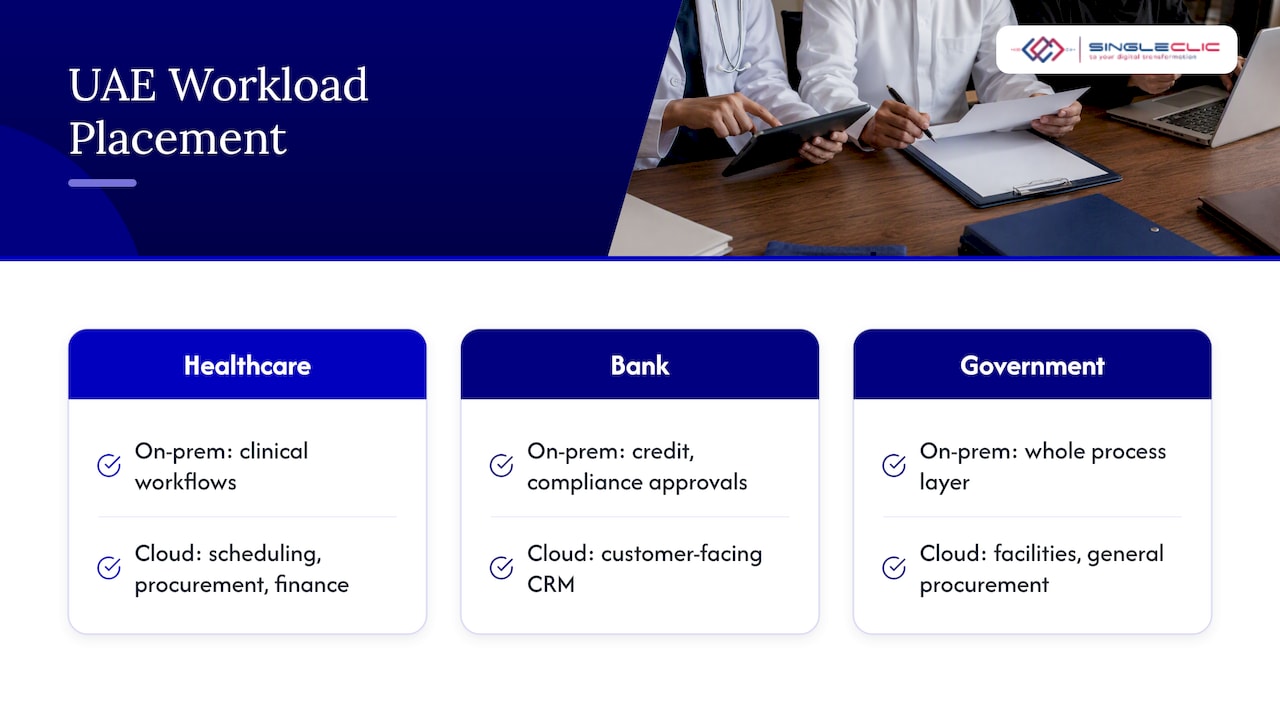
A healthcare group. Appointment scheduling, procurement and finance run on Dynamics 365 in a UAE region. Clinical workflows touching the most sensitive patient data run on an on-premise workflow layer that connects to the ERP through governed integrations. Only the data each process needs crosses the boundary.
A bank. The customer-facing CRM sits in the cloud region. Approval workflows for credit and compliance, which handle the most sensitive records, run on-premise with keys held by the bank’s security team.
A government entity. Citizen-facing services follow sovereign mandates, so the whole process layer is on-premise. Non-sensitive internal functions such as facilities and general procurement use cloud services.
The pattern is the same each time: the process that touches secret data stays under local control, and the rest takes advantage of cloud speed and lower operating effort.
Do not forget HR and documents
Residency questions are not only about ERP tables. HR files, signed contracts, timesheets and medical certificates are personal data, and they are often scattered across file shares, email and scanned archives. Before you migrate, decide where those records live and how long you keep them. Electronic records can also need to hold up as evidence. For a look at how another jurisdiction handles the legal validity of electronic timekeeping records, see this explainer on electronic time records and their legal validity (in Portuguese). The details are Brazilian, but the discipline of linking each record to its legal basis, retention and audit trail applies anywhere.
For long-retention sectors such as healthcare, our UAE data residency roadmap for enterprises walks through retention planning.
Our perspective: control is a design choice, not a hosting choice
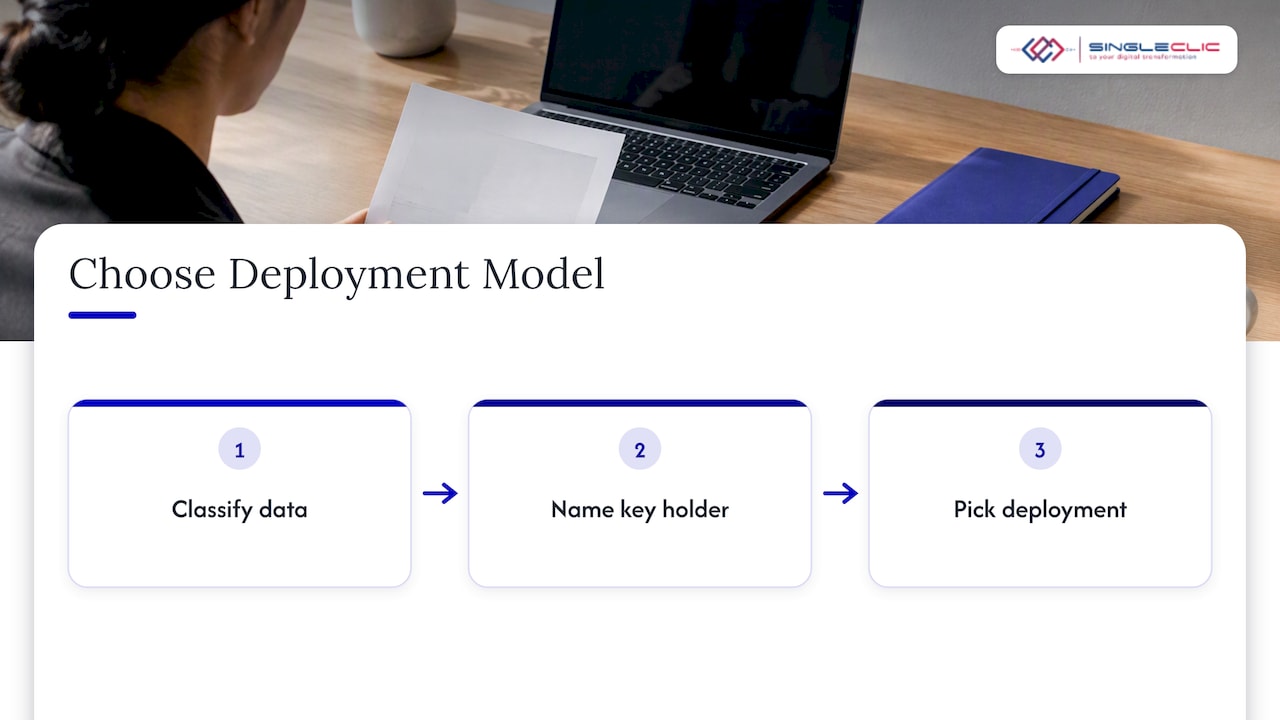
We see the same pattern in UAE and Saudi projects. A client asks for on-premise, or for the cloud, before anyone has looked at the data. Then the architecture is argued over for months. Our advice is to reverse the order. Classify the data, name who must hold the keys, and only then pick the deployment model.
We work with Microsoft Dynamics 365, Odoo and IBM BAW, and we built Cortex, our Arabic-enabled, on-premise low-code platform, for organizations that cannot send their most sensitive processes outside their own walls. Cortex supports unlimited users and runtime workflow changes without downtime. That lets a bank or a government entity keep secret data on-premise and still connect approvals to the ERP, CRM and legacy systems that sit in the cloud.
The mistake we warn against most is treating the region selector as the finish line. Selecting the UAE region is step one. Governing the metadata, the integrations and the people who administer the environment is the real work.
— Tamer Badr
How Singleclic helps
We support the full path from classification to go-live:
- Assessment. We help your team map workloads to the public, sensitive and secret tiers and identify auxiliary services that need review.
- Dynamics 365. Our D365 implementation, integration, customization and support services cover environment design, localization and governance. Start with our Dynamics 365 implementation guide for UAE leaders if you are early in the journey.
- On-premise process layer. Cortex, our low-code and BPM platform, connects approvals, ERP, CRM, data and legacy systems, with full Arabic UI and on-premise deployment for banks and governments. You can see it on our main site.
- Security practice. Read our guidance for IT teams in data security best practices for UAE and KSA and on cloud security for IT leaders.
We do not publish prices for these services. Scope depends on your data, your sector and your integrations, so we start with a conversation.
Use cases at a glance
- Banking and finance: on-premise approvals and credit workflows, cloud CRM and reporting.
- Healthcare: UAE-region ERP for finance and supply chain, on-premise handling of the most sensitive clinical workflows.
- Government: sovereign process layer for citizen services, with controlled integration to shared platforms.
- Real estate and construction: UAE-region ERP for projects and contracts, with governed document and approval flows.
- Telecom: segmented architecture that keeps subscriber-related data under strict local control.
Talk to us before you commit to an architecture
If you are choosing between a UAE cloud region and an on-premise deployment, bring us your workload list. We will help you classify it and propose a placement you can defend to your auditors. Explore our services or contact the team through our website.
FAQ
Does Dynamics 365 support data residency in the UAE?
Yes. Microsoft documents that finance and operations apps can be deployed in the UAE geography, with datacenters in Abu Dhabi and Dubai. That keeps customer data at rest in the country. You should still review logs, diagnostics, identity metadata and integrations, which can be handled outside the UAE.
Does the UAE PDPL require data to stay on-premise?
No. The PDPL allows cross-border transfer of personal data under specific conditions and requires technical and organizational security measures. It does not mandate on-premise hosting. Sector regulators and government directives may be stricter, so confirm with your legal counsel.
What is the difference between data residency and data sovereignty?
Residency is where data is physically stored. Sovereignty is who holds legal authority and operational control over it. A UAE datacenter satisfies residency, but it does not by itself address foreign statutes that could apply to a provider, which is why some entities require local custody of keys.
Is on-premise more secure than the cloud?
Not automatically. Security depends on patching, resilience and access control. A poorly managed on-premise environment can expose data more than a certified provider’s regional datacenter. Choose on-premise when control requirements demand it, not as a default.
Can we mix cloud and on-premise?
Yes, and it is common in the UAE. Classify your data, keep secret or critical workloads on-premise, and run public or lower-sensitivity processes in a UAE cloud region. A workflow platform such as Cortex can connect both sides so approvals and data flow without moving sensitive records.
Article details
- SEO title: Data residency in the UAE: when on-premise is the right call
- Slug: data-residency-uae-on-premise
- Keyword: data residency UAE on-premise
- Secondary keywords: Dynamics 365 data residency, UAE PDPL, sovereign deployment, hybrid cloud UAE
- Pillar cluster: Compliance and secure deployment for ERP, CRM and BPM in MENA
Sources
- UAE Government: Data protection laws
- Microsoft Learn: Available geographies for Dynamics 365 finance and operations apps
- Microsoft Learn: Power Platform and Dynamics 365 datacenter regions
- Microsoft Learn: Dynamics 365 and Power Platform data residency documentation
- Emirtech: Cloud vs on-premise server decision guide
- Magnus Gulf: Data residency UAE, essential questions
- TDRA: Cloud First policy strategy