TL;DR:
- Emirates Global Aluminium achieved over $100 million in impact and a 170% ROI by integrating AI with agile methodologies. Business agility is now essential for resilience and competitiveness in Saudi Arabia and the UAE’s fast-evolving digital landscape. Leaders should focus on outcome-driven pilots, cultural change, and technology integration to realize measurable benefits.
Emirates Global Aluminium (EGA) generated more than $100M in impact and a 170% return on investment by weaving agile methodologies into an AI transformation program, a result that forces every C-level executive in Saudi Arabia and the UAE to stop treating agility as an abstract concept. The region’s digital transformation agenda is accelerating faster than most organizations can adapt, and the gap between leaders who move with precision and those still locked in rigid hierarchies is widening by the quarter. This guide gives you a practical, regionally grounded breakdown of how agility actually works, where it fails, and what you can do to make it your competitive edge.
Table of Contents
- Why business agility matters for Saudi Arabia and UAE
- How agile methodologies and technology integration drive performance
- Agility pitfalls: avoiding process bloat and ‘agile theater’
- From intent to impact: Practical steps for leaders
- A fresh perspective: Why real agility starts with culture, not ceremonies
- How Singleclic helps leaders drive true agility
- Frequently asked questions
Key Takeaways
| Point | Details |
|---|---|
| Agility drives results | Top Saudi/UAE businesses achieve measurable gains in efficiency, ROI, and resilience through agile practices. |
| Tech integration is essential | Combining agile methodologies with AI and automation accelerates delivery and productivity. |
| Avoid agile pitfalls | Success requires outcome-driven culture and lean approaches, not just frameworks and ceremonies. |
| Leadership sets the tone | C-level leaders must manage paradoxes, align strategy, and focus on measuring actual flow, not activity. |
| Adapt for regional context | Agility works best when customized to the realities of Saudi Arabia and UAE business environments. |
Why business agility matters for Saudi Arabia and UAE
Business agility in 2026 is no longer a methodology choice. It is a survival posture. Saudi Arabia’s Vision 2030 and the UAE’s digital economy ambitions are creating enormous pressure on enterprises to modernize operations, serve customers faster, and build resilience against market shocks, whether those shocks come from oil price cycles, regional geopolitics, or global supply chain disruptions.
At its core, agility means your organization can sense change, decide quickly, and act with coordination across functions. It is not simply running two-week sprints or holding daily standups. PMI’s Manifesto for Enterprise Agility emphasizes three foundational shifts for MENA businesses: moving from rigid hierarchies to shared purpose, enabling decentralized decision-making, and integrating technology as a strategic enabler rather than a back-office function.
The attributes that define a genuinely agile organization include:
- Decentralized authority: teams own their decisions without waiting for approvals from multiple layers above
- Continuous learning: the organization treats each iteration as a data point and adjusts course accordingly
- Technology fluency: digital tools are embedded in workflows, not layered on top as afterthoughts
- Customer centricity: every process improvement is measured against its direct impact on service delivery
- Strategic alignment: short-term actions are always traceable back to long-term business goals
UAE firms now prioritize agility over scale as the primary driver of resilience, a shift confirmed by empirical benchmarks from leading regional enterprises. The old logic was that size protected you. Today, size without adaptability is a liability.
| Capability | Traditional approach | Agile approach |
|---|---|---|
| Decision speed | Weeks to months | Days to hours |
| Change response | Planned annual cycles | Continuous iteration |
| Technology role | Support function | Strategic core |
| Performance measure | Activity output | Business outcome |
| Team structure | Siloed departments | Cross-functional pods |
Evidence from agile tech efficiency research shows that organizations pairing agile practices with strong technology integration consistently outperform those relying on either approach alone. The combination is what creates durable operational efficiency, not one or the other in isolation.
How agile methodologies and technology integration drive performance
With agility defined, let’s look at exactly how agile methodologies paired with technology drive performance for leading regional firms.
EGA’s transformation is the most striking regional proof point. The company achieved a 170% ROI and $100M+ impact alongside a 12% throughput increase and 18% labor productivity gain. These numbers came from integrating AI and machine learning directly into production workflows guided by agile delivery principles. The technology did not replace the methodology. The methodology is what gave the technology structure and accountability.
Globally, similar patterns hold. Cisco reduced defects by 40% after embedding agile practices across its product engineering teams. Another global enterprise recorded a 40% increase in delivery speed and a 25% reduction in time-to-market by pairing agile frameworks with AI-assisted planning tools. These outcomes are not random. They reflect a specific operating model where technology provides analytical power and agile provides the human coordination layer.

The comparison between traditional and agile-enabled performance is stark:
| Metric | Traditional delivery | Agile plus technology |
|---|---|---|
| Time-to-market | 9 to 18 months | 2 to 4 months |
| Defect rate | High, caught late | Low, caught early in iteration |
| ROI visibility | End of project | Continuous, per sprint |
| Team responsiveness | Reactive, slow | Proactive, fast |
| Scalability | Expensive and slow | Modular and fast |
Understanding agile development methodology more deeply reveals why these outcomes are repeatable: agile forces small, testable hypotheses that either prove value or surface failure early, before you have committed your entire budget to a flawed direction.
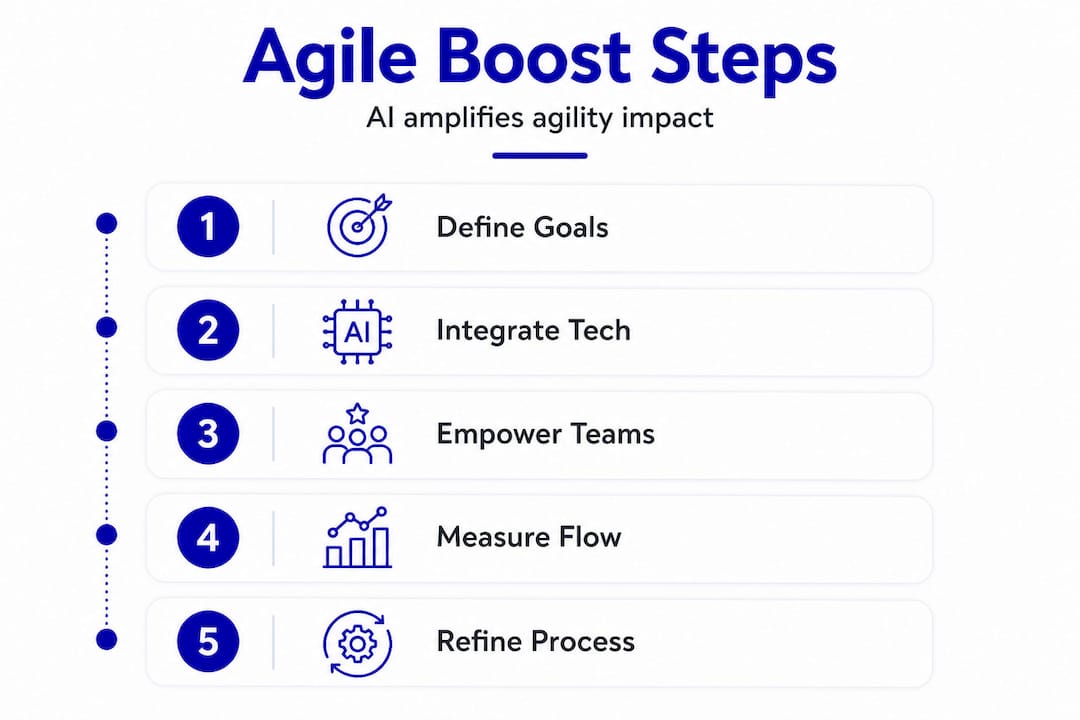
Here is how you can launch an agile-technology pilot in your organization:
- Identify one value stream that touches the customer directly, such as order fulfillment, customer onboarding, or service resolution.
- Map the current flow from trigger to outcome, and mark every handoff, approval step, and delay point.
- Form a cross-functional team that includes operations, IT, finance, and customer service, not just technical staff.
- Select one AI or automation tool that can eliminate the most costly delay in the value stream.
- Run a time-boxed pilot of six to eight weeks, tracking lead time and outcome quality, not hours worked.
- Review results and iterate. If the pilot works, expand it. If it does not, adjust before scaling.
Building a solid digital transformation roadmap before you launch pilots prevents the common trap of running technology experiments that never connect to enterprise strategy. Similarly, aligning ERP and strategy ensures that your core operational systems support rather than constrain your agile workflows.
The role of AI in business efficiency is particularly significant here. AI does not make teams agile. It amplifies the agility they already practice by giving them faster, more accurate signals about what is working and what is not.
Pro Tip: Track flow metrics, specifically predictability and lead time, rather than activity metrics like story points completed or hours logged. A team that delivers consistently predictable outcomes on shorter lead times is outperforming a team that looks busy but misses commitments.
Agility pitfalls: avoiding process bloat and ‘agile theater’
Despite impressive agile-driven gains, not all agile initiatives succeed. Here’s what can go wrong and how to avoid it.
The most damaging failure mode is what practitioners call “agile theater,” the practice of running all the ceremonies, daily standups, sprint reviews, retrospectives, and backlog grooming sessions, without actually changing how decisions are made or how value gets delivered. Teams hold the meetings. They update the boards. Nothing measurable improves. Leadership declares the transformation a success. The customer notices no difference.
Critics increasingly flag agile theater and framework bloat as the primary reasons agile transformations disappoint. Scaled frameworks like SAFe (Scaled Agile Framework) often add so much coordination overhead that they recreate the very bureaucracy agile was meant to eliminate. With AI now automating many of the tasks that sprints and standups were designed to manage, organizations that do not adapt their rituals to reflect new realities are running processes that no longer serve any productive purpose.
The warning signs of agile theater in your organization:
- Ceremonies dominate calendars but outputs remain slow or unpredictable
- Teams report on tasks rather than on business outcomes delivered
- Decision-making still escalates to senior leaders who are outside the agile team structure
- Framework compliance is audited but customer satisfaction is not measured or improving
- Technology is present but not integrated into how the team actually makes decisions
“Agility enhances operational efficiency and scalability, but it fails without cultural fit. Organizations are better served by starting lean and team-first rather than immediately adopting heavy scaled frameworks.” — Business Review MEA, on UAE firms redefining survival strategies
The cultural dimension is non-negotiable. A team operating inside a command-and-control culture cannot be agile regardless of which framework you layer over it. Leaders who do not genuinely empower their teams to make decisions within agreed boundaries will always see agile initiatives underperform.
Understanding the key elements of digital strategy in the KSA and UAE context helps executives see why cultural readiness must precede framework selection. The regional business environment has specific dynamics around authority, hierarchy, and relationship-based decision-making that imported agile playbooks rarely account for. These are not weaknesses to be corrected. They are realities to be incorporated into your design. See also agile methodology insights for a practical breakdown of how to structure ceremonies around outcomes rather than rituals.
From intent to impact: Practical steps for leaders
Knowing the pitfalls, here’s how regional leaders can ensure agile investment drives real business impact.
For Saudi and UAE executives, the path from agile intent to measurable results follows a clear structure. PMI’s enterprise agility guidance for MENA is explicit: integrate agile with AI and machine learning through targeted pilots in specific value streams, measure flow rather than activity, and ensure leadership manages the inherent paradoxes of empowering teams while maintaining strategic alignment.
Here are the concrete steps for translating agility from intent into impact:
- Start with leadership alignment. Your C-suite must agree on what business outcomes agility is meant to deliver, whether that is faster product launches, lower operational cost, better customer satisfaction scores, or all three. Misaligned expectations at the top will cascade into confusion at every level below.
- Select two or three pilot value streams. Choose areas with clear ownership, measurable outcomes, and meaningful customer impact. Avoid choosing internal back-office processes for your first pilots since they rarely generate the visible results needed to build organizational momentum.
- Integrate AI tools deliberately. Do not add AI because it is available. Add it because it solves a specific bottleneck in your chosen value stream. Define the problem first, then select the technology.
- Appoint outcome owners, not process owners. Each agile team needs a single accountable leader who is measured on business results, not on whether the team followed the correct process.
- Measure flow metrics from day one. Track lead time from customer request to resolution, track predictability (the percentage of commitments met), and track quality measured by rework rate or defect recurrence. These three metrics tell you more about real agility than any framework compliance checklist.
- Build a feedback cadence. Run a monthly review where pilot teams share what they learned, what they changed, and what they will try next. This learning loop is the mechanism that makes agility self-reinforcing over time.
Leadership in transformation is itself an evolving capability. Leaders who have thrived by controlling information and centralizing decisions must develop new skills around coaching, enabling, and creating clarity rather than providing direction on every issue.
Enterprise transformation must-haves reinforce that governance structures, data foundations, and technology infrastructure must be in place before agile practices can scale effectively. Agility cannot compensate for missing foundational capabilities.
AI competitive advantage strategies remind us that the organizations winning with AI are not the ones with the most tools. They are the ones with the clearest sense of which problems AI is actually solving for their customers and operations.
Pro Tip: Ask each agile team to answer one question every two weeks: “What did we learn that changed how we work?” If teams cannot answer it, they are executing tasks, not practicing agility.
A fresh perspective: Why real agility starts with culture, not ceremonies
After observing agile transformations across construction, banking, healthcare, and government sectors in Saudi Arabia and the UAE, one pattern stands out above everything else: the organizations that succeed are the ones that changed how people think and decide, not just how they schedule their meetings.
The conventional wisdom is that choosing the right framework, whether that is SAFe, LeSS, or Spotify’s squad model, is the primary driver of agile success. That is largely wrong. The framework is a tool. The culture is the engine. You can adopt the most sophisticated scaling framework available, but if your senior leaders still expect weekly status reports covering every micro-decision, your teams will never reach the decision velocity that agility requires.
We have seen this firsthand with successful digital government projects in MENA, where the transformations that delivered lasting results were grounded in genuine empowerment at the team level. The projects that stalled were often the ones with the most elaborate governance structures and the most ceremonious agile implementations.
The uncomfortable truth for many regional leaders is that agility requires you to tolerate ambiguity at a level that feels deeply uncomfortable. You will not have perfect information before decisions need to be made. You will need to trust teams that have not yet fully proven themselves. That is the price of speed. The leaders who accept that trade-off early are the ones whose organizations build real adaptive capacity.
Saudi and UAE businesses should not try to import Silicon Valley agile cultures wholesale. Your organizational DNA, your stakeholder relationships, your regulatory environments, and your talent markets are different. Build an agile operating model that honors those realities while still pushing hard on the principles that matter most: outcome focus, decentralized decision-making, and continuous learning.
How Singleclic helps leaders drive true agility
Agility at scale requires more than a framework change. It requires the right technology foundation, the right process automation, and a partner who understands the specific dynamics of Saudi and UAE enterprises.
Singleclic has spent over a decade helping organizations across KSA, UAE, and Egypt move from rigid, manual operations to genuinely agile, technology-enabled businesses. Our work spans ERP implementation with Odoo and Microsoft Dynamics 365, business process automation using IBM BAW and UiPath, and AI integration that puts real-time intelligence directly into operational workflows. Our low-code platform, Cortex, is built specifically for MENA enterprises and gives your teams the ability to design, automate, and evolve business processes without writing code, including full Arabic UI support and on-premise deployment for banks and government entities. Explore our low-code agility tips to see how Cortex can accelerate your agile roadmap today.
Frequently asked questions
What are the core benefits of business agility for Saudi/UAE firms?
Business agility leads to improved operational efficiency, faster market response, and greater resilience, with UAE firms prioritizing agility over scale as their primary survival strategy in volatile conditions.
How can leaders avoid ‘agile theater’ and process bloat?
Focus relentlessly on outcomes rather than ceremonies, empower teams to make real decisions, and start lean before scaling rather than adopting heavy frameworks from day one.
What technologies are critical for scaling agility in MENA businesses?
Artificial intelligence, machine learning, and low-code platforms are the most impactful enablers, and PMI’s Manifesto for Enterprise Agility explicitly positions technology integration as a foundational requirement for MENA businesses.
What metrics should leaders use to measure agility?
Track flow metrics like predictability and lead time rather than activity-based metrics like hours logged or tasks completed, since flow metrics reflect actual business outcomes rather than team busyness.
Is business agility equally relevant across all industries?
Agility is essential for every sector in the region, but UAE benchmarks confirm that the specific practices must be adapted to the unique demands and regulatory environments of each industry rather than applied as a one-size-fits-all solution.