An Arabic chatbot for government is a conversational assistant that answers citizens’ and residents’ questions about services, and in many cases completes the service itself, in Arabic and usually English as well. In the UAE, the working model is already visible: U-Ask at federal level, Mahboub at the RTA, an assistant inside TAMM 3.0 in Abu Dhabi, and Salama at SIRA. What separates a chatbot people trust from one they abandon is not the model alone. It is dialect handling, privacy design, a clean handoff to a human, and the back-end systems behind the conversation.
TL;DR
- UAE entities already run Arabic-capable assistants for fines, license renewals, utility payments and security services, so the question is no longer whether to build one but how.
- Arabic quality means more than right-to-left text: Modern Standard Arabic, Gulf and Emirati dialects, voice input and mixed Arabic-English queries all need to be tested.
- Privacy by design, a data protection impact assessment and human oversight belong in the project plan from day one.
- A chatbot that only answers questions is a search box. Value comes when it connects to approvals, ERP, CRM and identity systems.
- Measure handoff rate, call-centre demand and answer accuracy, not only conversation counts.
Table of Contents
- What UAE government chatbots already do
- What “Arabic-ready” really means
- Benefits and limits to plan around
- Privacy, security and governance
- A practical implementation path
- Connecting the chatbot to the back office
- Measuring whether it works
- Perspective
- How Singleclic helps
- Start with a scoped pilot
- Article details
- FAQ
- Sources
What UAE government chatbots already do
The UAE is a useful reference because several entities have gone live, each with a different scope.
| Entity | Assistant | What it covers |
|---|---|---|
| UAE Government (federal) | U-Ask | An AI-powered assistant that gives natural-language access to government information and services |
| Roads & Transport Authority, Dubai | Mahboub | Services such as fine payment and vehicle renewal |
| Abu Dhabi (TAMM 3.0) | AI assistant | Voice conversations in Arabic and English for services including license renewal and utility payments |
| Sharjah Intelligence and Reporting Authority style security services (SIRA) | Salama | A virtual security assistant that understands Modern Standard Arabic, Emirati dialect and English |
Three patterns stand out. First, the assistants sit in front of transactions, not only FAQs. Second, voice is treated as a first-class channel. Third, language is handled deliberately: U-Ask supports typed and spoken interaction in more than 57 languages including Arabic and English, while Salama is tuned to a local dialect.
For a wider regional view, see our overview of chatbots in the public sector across MENA.
What “Arabic-ready” really means
Many vendors say a chatbot supports Arabic when the interface mirrors to right-to-left. That is the easy part. A government chatbot needs to pass five tests.
1. Right-to-left layout and mixed text
Citizens type reference numbers, Emirates ID digits, plate codes and English service names inside Arabic sentences. The interface must render these bidirectional strings correctly, including in buttons, forms, receipts and exported transcripts.
2. Modern Standard Arabic and dialects
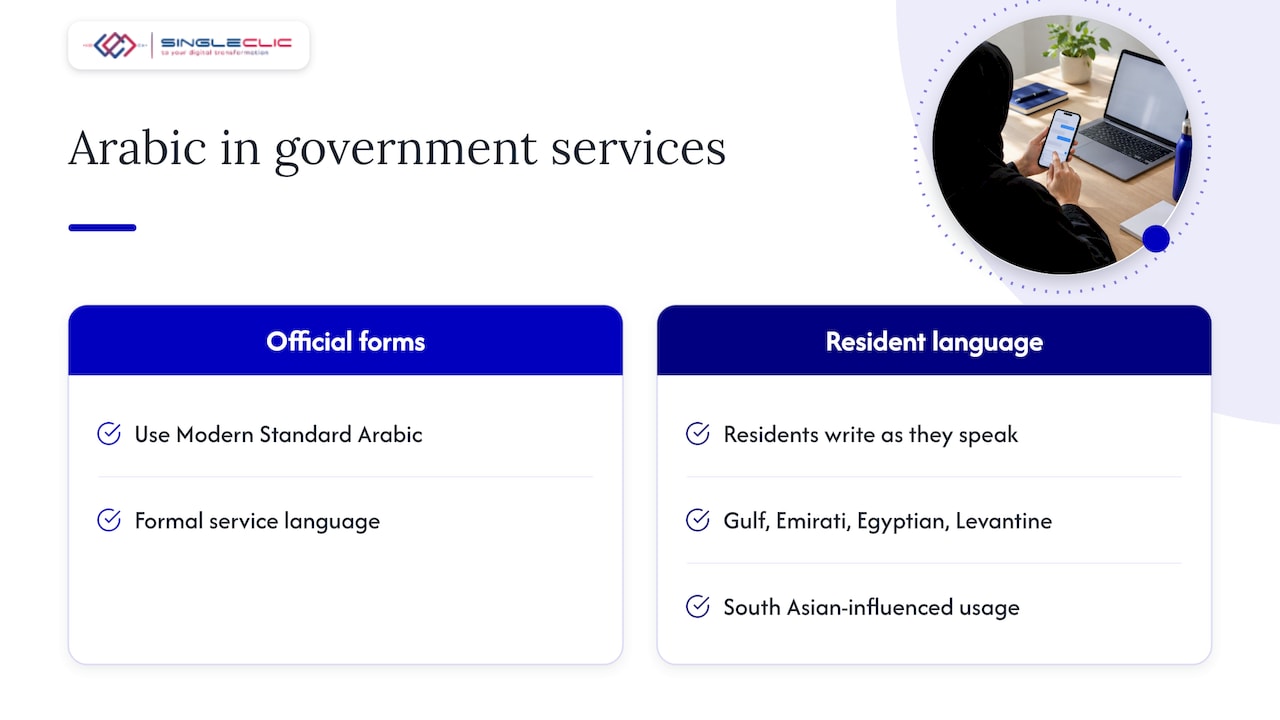
Official forms are written in Modern Standard Arabic. Residents write the way they speak. Academic work on Arabic chatbots repeatedly points to morphology, inconsistent spelling and dialect variety as the main obstacles to accuracy. In the UAE this means testing Gulf phrasing, Emirati expressions and the Egyptian, Levantine and South Asian-influenced usage common among residents.
SIRA’s approach is instructive. Salama uses a vocabulary dictionary that swaps standard Arabic words for Emirati equivalents, plus a pronunciation dictionary trained on voices of SIRA employees. The point SIRA makes is that a recognizable local tone builds trust.
3. Voice
Spoken Arabic adds accent, background noise and code-switching. If you plan a voice channel, collect real recordings from your service counters and call centre for testing, with consent and under your data rules.
4. Arabic-English switching
A user may open in Arabic, paste an English document title and finish in English. The assistant should keep context across the switch and answer in the language the user last used, unless they ask otherwise.
5. Accessibility and content standards
Federal portals follow a content framework, DLS 2.0, which sets expectations for consistency, optimization and accessibility. A chatbot embedded in a federal site should be built to fit it, including keyboard use, screen-reader labels and plain-language answers.
Benefits and limits to plan around
The benefits are concrete. Citizens get answers outside office hours, in their own language, without choosing the correct department first. Staff spend less time on repeat questions. Service content gets a single consistent voice.
The design challenges are just as concrete, and each has a known remedy:
- Dialect gaps: build a test set of real phrasings per dialect and retrain on failures.
- Wrong or outdated answers: ground answers in approved service content and show the source page.
- Biased or thin data: the UAE government’s adoption guideline notes that AI tools need high-quality, representative data to avoid bias and error.
- Dead ends: every conversation needs a way out to a person.
Treat these as acceptance criteria in the tender, not as surprises after launch.
Privacy, security and governance
A government chatbot handles identity data, payment details and sometimes security-related information. Four reference points apply in the UAE.
- The UAE AI Charter lists ethical and responsible use, privacy and data security, transparency and human oversight among its principles.
- Federal Decree-Law No. 45 of 2021 on personal data protection sets standards for processing, including measures such as encryption and pseudonymization. It also contains exemptions for government data and entities, so your legal team should confirm exactly which obligations apply to your entity and which come from internal policy or sector rules.
- UAE AI ethics guidance recommends privacy by design and oversight mechanisms such as designated Data Protection Officers. It also says privacy should be addressed across the whole AI lifecycle, including how outputs are generated and how users respond to recommendations.
- The government adoption guideline advises entities to run Data Protection Impact Assessments and keep Records of Processing Activities for AI agents that aggregate personal data.
In practice, that translates to a short checklist: decide what the bot may see, log what it did, keep personal data out of prompts and logs where you can, and agree who reviews incidents. Where the data cannot leave your own infrastructure, an on-premise deployment is the cleaner route. We cover the trade-offs in what secure AI changes for organizations that cannot compromise on data control and in securing data in AI-driven environments. For the governance side, read data ethics and AI governance in government.
A practical implementation path
The UAE adoption guideline’s advice is to define AI use cases, assess value and feasibility, build flexible and resilient technology foundations, and apply data privacy controls. Here is how that looks as a sequence.
- Pick three to five high-volume services. Start with questions your call centre hears every day: fee inquiries, status checks, renewals, appointment booking.
- Map each service end to end. Note the data needed, the system of record, the approval steps and the exceptions. A chatbot that cannot trigger the next step only sends people elsewhere.
- Build the Arabic test set before the bot. Gather real queries in each dialect and in mixed Arabic-English, then agree pass marks with the service owner.
- Connect identity and payment. Mahboub’s updated licensing transactions use UAE Pass for digital identity verification and Dubai Sadad for secure payments. Developers can see how we handle the sign-in flow in our UAE PASS integration guide.
- Design the handoff. When confidence is low, pass the full transcript to an agent so nobody repeats themselves. SIRA’s assistant hands off when it does not know an answer, and sampled conversations are reviewed daily by humans for accuracy and tone.
- Pilot, then widen. Launch to one service line or one channel, review the failures weekly, and expand once accuracy holds.
Connecting the chatbot to the back office
The chatbot is the front door. Behind it sit case management, approvals, ERP finance, CRM records and often legacy systems. If these are not connected, the assistant can explain a service but cannot progress it, and staff end up re-keying data.
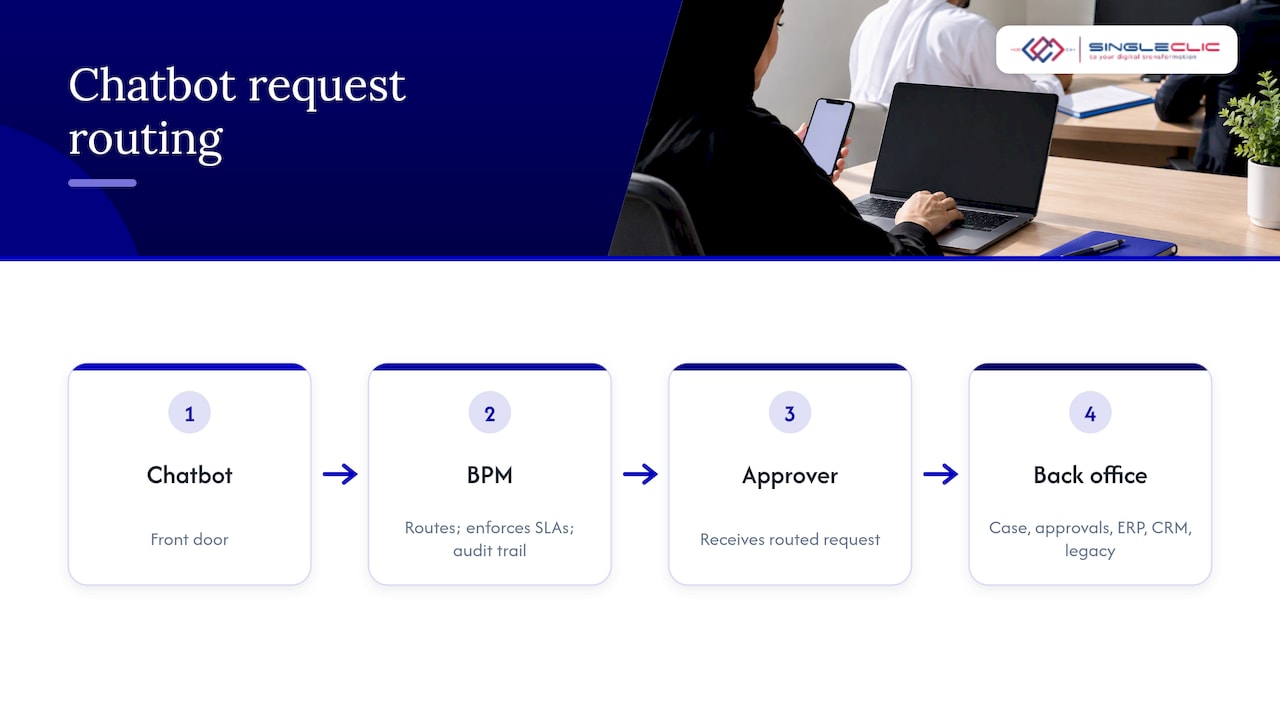
This is where workflow and integration work decides the outcome. A BPM layer routes each request to the right approver, enforces service-level targets and leaves an audit trail. Our article on how automation transforms the public sector in Saudi Arabia and the UAE explains the pattern, and the business process automation guide for C-level leaders covers how to scope it. If your citizen or customer records live in a CRM, generative AI for MENA CRM looks at governance and Arabic document handling.
Measuring whether it works
Conversation volume is a vanity number. Choose measures tied to service delivery.
- Handoff rate: how often a person must take over. RTA reports a live-chat transfer rate of 1.5% for Mahboub and call-centre demand reduced by up to 70%. Those are RTA’s own figures for its own services, so use them as a direction, not a promise for your entity.
- Containment with completion: the share of users who finished the task, not just stopped chatting.
- Answer accuracy: a weekly human review of a sample, scored per dialect and per language.
- Repeat contacts: the same person calling after chatting signals an unresolved case.
- Time to resolution: compare chat-initiated cases with phone-initiated cases.
Report these by language and by channel. An average hides the dialect or the voice channel that is quietly failing.
Perspective
Government leaders often ask us which language model to choose first. We would start one step earlier: which processes will the assistant touch, and where must the data stay?
A chatbot with fluent Arabic but no connection to approvals is a good brochure. The real gain comes when the conversation, the workflow, the ERP or CRM record and the identity check are one chain.
That is why we built Cortex as an Arabic-enabled, on-premise low-code platform for MENA enterprises. It gives teams a full Arabic interface, unlimited users and runtime workflow changes without downtime, so a service owner can adjust a process without waiting for a release. For banks and government bodies that need data to stay in-house, on-premise deployment is part of the design, not an add-on.
Our advice: pilot on a few high-volume services, test Arabic with real citizens’ phrasing, and keep a human route open at every step.
Tamer Badr
How Singleclic helps
We work with organizations across the UAE, Saudi Arabia and Egypt, including healthcare and government-related clients. For a chatbot program, our role is usually the layer around the model:
- Process design and automation with BPM and IBM BAW, so conversations trigger real approvals.
- Cortex low-code to build Arabic forms, workflows and integrations without heavy coding.
- ERP and CRM integration with Microsoft Dynamics 365 and Odoo, so answers reflect live records.
- AI solutions and data analytics, including on-premise options for sensitive data.
If you are comparing deployment models first, read cloud vs on-prem for low-code platforms in the Middle East.
Start with a scoped pilot
See how Cortex, our Arabic-first low-code platform, connects approvals, data and legacy systems, and how our AI and automation services fit a government service program. Bring us two or three services and we will help you map the process, the data and the Arabic scenarios you need to test.
Talk to our team through singleclic.com to book a working session.
Article details
- SEO title: Arabic chatbot for government: how UAE entities should plan one
- Slug: arabic-chatbot-for-government
- Primary keyword: Arabic chatbot for government
- Secondary keywords: government chatbot UAE, Arabic conversational AI, Arabic dialect chatbot, public sector AI assistant, workflow automation
- Pillar cluster: Enterprise AI and public sector automation in MENA
- Use cases: fine and license services, utility payments, permit status, appointment booking, HR and employee helpdesk, security and inquiries triage
FAQ
Does an Arabic government chatbot need to support dialects?
Yes, if you want residents to use it freely. Official content is in Modern Standard Arabic, but people type and speak in dialect. Research on Arabic chatbots lists dialect variety and spelling inconsistency as core accuracy challenges, so build a test set of real phrasings before launch.
Can a government chatbot handle voice in Arabic?
Yes. TAMM 3.0 in Abu Dhabi offers an assistant with voice interaction in Arabic and English, and U-Ask accepts typed or spoken input. Voice needs separate testing for accents and noise.
What privacy rules should we check?
Start with the UAE AI Charter and the government AI guidance on privacy by design and impact assessments. Your legal and data protection teams should confirm how the personal data law and its exemptions apply to your entity.
When should the chatbot hand over to a person?
Whenever confidence is low, the user asks for a person, or the case involves an exception or a complaint. Pass the full transcript along. Human review of sampled conversations, as SIRA describes for Salama, keeps accuracy and tone on track.
How long does a pilot take?
It depends on the number of services, the systems to integrate and your security review, so we scope it with you rather than quote a generic timeline. A pilot limited to a few high-volume services is the quickest way to get real usage data.
Sources
- U-Ask, the official platform of the UAE Government
- RTA: revamping services through the virtual assistant Mahboub
- Department of Government Enablement: Abu Dhabi launches TAMM 3.0
- SIRA: Salama at GITEX Global 2025
- TDRA: generative AI on government portals aligned with DLS 2.0
- The UAE Charter for the Development and Use of Artificial Intelligence
- Federal Decree-Law No. 45 of 2021 on the Protection of Personal Data
- UAE Government: AI ethics
- UAE Government: adoption guideline in government services
- The challenges of using Arabic chatbots in Saudi universities