The right way to approach Dynamics 365 CRM integration starts with four questions: how much data moves, how fast it needs to arrive, which direction it flows, and whether the process can wait or must happen instantly. Answer those, and the pattern almost picks itself: Dataverse native connections for straightforward reads, Dual-write for real-time bidirectional sync, Power Automate for lightweight workflows, or Azure Integration Services when the stakes and volume get serious. Everything else in this guide is detail. Run through the criteria first.
TL;DR:
- For high-volume, real-time bidirectional sync between ERP and CRM, Dual-write is preferred due to native support and schema stability across upgrades, despite higher setup costs.
- Power Automate suits small to moderate workflows with numerous connectors, while Azure Logic Apps and Service Bus are better for large-scale, reliable, enterprise-grade integrations.
- Asynchronous, event-driven designs with retry and dead-letter logic are critical for building resilient integrations that can withstand system failures or heavy loads.
- Authentication should rely on Entra ID and OAuth2 with secrets stored in Azure Key Vault, avoiding static API keys and lax security practices.
- A thorough discovery and testing process that models real data volumes and failure scenarios is essential to prevent costly rebuilds and ensure lasting integration stability.
Table of Contents
- Core Dynamics 365 integration patterns explained
- Power Platform or Azure: which integration tooling fits?
- How do you choose the right integration pattern?
- Common Dynamics 365 CRM integration scenarios
- Building an integration architecture that doesn’t break
- Security and governance for Dynamics 365 integrations
- A phased checklist for implementing Dynamics 365 integrations
- How Singleclic approaches Dynamics 365 CRM integration in MENA
- What most Dynamics 365 CRM integration advice gets backwards
- Get Dynamics 365 integration built right the first time
- Sources
- FAQ
Core Dynamics 365 integration patterns explained
Every Dynamics 365 CRM integration project eventually comes down to picking one of five patterns, and picking wrong is the single most common reason integration projects blow their budgets.
Dataverse is the shared data layer underneath Dynamics 365 and most Power Platform apps. If your target system can read or write directly against Dataverse tables, and your data volume is modest, native Dataverse integration is often all you need. No middleware, no custom code, minimal maintenance.
Dual-write solves a specific, high-stakes problem: keeping Finance & Operations and Dataverse synchronized in near real time, in both directions. When customer records, pricing, or inventory need to match instantly between your ERP and CRM, Dual-write is the Microsoft-recommended pattern because it’s natively supported and maps entities consistently across upgrades, unlike custom sync jobs that break every time Microsoft ships a schema change.
Virtual entities and OData/REST APIs handle the opposite scenario: you need to read data on demand without copying it into Dataverse at all. This suits reporting dashboards or lookups where duplicating the data would just create a governance headache.
Data Management Framework (DMF) exists for bulk operations. Migrating 500,000 legacy customer records into Dynamics 365 is a DMF job, not a real-time integration job.
Business events and webhooks trigger downstream workflows the moment something happens in Dynamics 365, such as an order status change kicking off a shipping notification.
- Dataverse native: low-volume, direct reads/writes, minimal middleware
- Dual-write: bidirectional, near real-time, F&O to Dataverse
- Virtual entities/OData: on-demand reads without data duplication
- DMF: high-volume batch migrations and bulk loads
- Business events/webhooks: event-driven, trigger-based workflows
Power Platform or Azure: which integration tooling fits?
Once you know your pattern, the next decision is tooling, and this is where a lot of IT teams either over-engineer a simple problem or under-engineer a complex one.
Power Automate and Power Apps are the low-code answer. Microsoft Power Platform now has more than 1,000 certified connectors, covering everything from Salesforce to SAP to Slack, which means a huge share of routine automations never need a single line of custom code.
1,000+ certified connectors ship with Power Platform, turning most point-to-point Dynamics 365 connections into configuration work rather than development work.
Azure Logic Apps, Service Bus, and API Management are the enterprise middleware tier. They exist for the integrations that Power Automate wasn’t built for: high message volume, strict reliability requirements, or the need to decouple systems so a failure in one doesn’t cascade into another.
- Power Automate: fastest to build, best for departmental workflows and moderate volume
- Azure Logic Apps: visual workflow design with enterprise-grade reliability
- Azure Service Bus: message queuing for guaranteed delivery at scale
- API Management: governs, secures, and throttles API traffic across systems
- Azure Functions: custom transformation logic where connectors fall short
- Synapse Link: continuous analytical export from Dataverse without ETL jobs
The dividing line is usually complexity of transformation, not just volume. If data needs heavy reshaping before it lands in the target system, Azure Functions earns its place even at moderate scale.
How do you choose the right integration pattern?
Four criteria decide the pattern, every time. Skipping any one of them is how projects end up rebuilt six months after go-live.
- Data volume. Thousands of records a day behaves nothing like millions. High volume points toward DMF or Azure Data Factory batch jobs; low volume can often run through Dataverse APIs directly.
- Latency tolerance. If the business needs the update now, you need Dual-write or an event-driven pattern. If overnight is fine, batch processing is cheaper to build and easier to operate.
- Directionality. One-way feeds (CRM to a data warehouse) are simpler than bidirectional sync, which requires conflict resolution logic on both ends.
- Synchronous vs. asynchronous. Practitioner guidance from Microsoft cautions against forcing synchronous, real-time calls when an asynchronous, queued design would be more resilient and perform better under load.
Mapped out, common combinations look like this: high-volume batch loads point to DMF or Azure Data Factory; bidirectional master data between CRM and F&O points to Dual-write; simple event-driven notifications point to Power Automate or webhooks; and read-only reporting feeds point to virtual entities or Synapse Link.
Pro Tip: Ask “what breaks if this integration is down for an hour?” before you ask “what’s the fastest way to build this?” The answer usually tells you whether you need Azure-grade resilience or whether Power Automate is genuinely enough.
Common Dynamics 365 CRM integration scenarios
Most enterprise integration requests fall into a handful of recurring shapes, and recognizing which one you’re dealing with saves weeks of design debate.
Customer and master data sync between CRM and ERP is the classic case. Dual-write handles it when both systems need to stay current in real time; virtual entities work when one system just needs read access without owning a copy of the data. The tradeoff is maintenance versus freshness: Dual-write costs more to set up but eliminates the drift that plagues custom sync scripts.
Marketing automation and lead routing typically runs through Power Automate connected to Dataverse, since lead capture from a web form or campaign tool rarely needs enterprise-grade throughput, just reliable, fast handoffs.
E-commerce order ingestion behaves differently. Order spikes during promotions or holiday sales can flood a synchronous integration, which is why asynchronous queuing through Azure Service Bus paired with Azure Functions holds up better than a direct API call under pressure.
Analytics and reporting increasingly bypasses traditional ETL altogether. Synapse Link exports Dataverse data continuously into analytical stores without a nightly copy job, which matters for organizations that need same-day dashboards rather than yesterday’s numbers.
- CRM to ERP master data: Dual-write (real-time) or virtual entities (read-only)
- Marketing to CRM: Power Automate plus Dataverse connectors
- E-commerce orders: Service Bus queuing plus Azure Functions
- Reporting and analytics: Synapse Link or scheduled ETL
Building an integration architecture that doesn’t break
The architecture decisions you make before writing a single connector are usually what separate a system that survives three years of growth from one that needs a rebuild.
Favor asynchronous, event-driven design over synchronous calls wherever the business allows it. A synchronous integration ties the health of your CRM to the uptime of every system it talks to; if one downstream API times out, the whole transaction can stall. Queued, asynchronous patterns absorb that shock instead of passing it along.

Azure Service Bus with idempotency keys solves the retry problem cleanly: if a message gets processed twice because of a network hiccup, the receiving system recognizes the duplicate and discards it instead of double-posting an order or double-charging an invoice.
Rate limits deserve early planning, not late firefighting. Batching requests and applying exponential backoff keeps you inside Dynamics 365 API throttling limits instead of triggering them during your busiest sales day.
- Design async-first; reserve synchronous calls for genuinely instant needs
- Use idempotency keys with Service Bus to prevent duplicate processing
- Batch API calls and apply backoff logic to respect rate limits
- Package Dataverse solutions properly and run CI/CD pipelines across dev, test, and production
- Automate integration and regression testing before every release
Pro Tip: Build your dead-letter queue handling before go-live, not after the first production incident. A message that fails silently is far more expensive to diagnose than one that lands somewhere you can actually see it.
Application lifecycle management (ALM) discipline matters as much as the integration code itself. A clear environment strategy, solution packaging in Dataverse, and automated testing catch the breaking changes that Microsoft’s regular update cycle otherwise surfaces in production.
Security and governance for Dynamics 365 integrations
Authentication failures and credential leaks account for a disproportionate share of integration incidents, which makes this section non-negotiable rather than optional hardening.
Every integration should authenticate through Microsoft Entra ID using OAuth2, never through hardcoded API keys or shared service accounts buried in a configuration file. Store secrets, connection strings, and certificates in Azure Key Vault, and prefer managed identities over stored credentials wherever the platform supports them, since a managed identity can’t be copied into a phishing email.
Inside Dataverse, apply least-privilege security roles and field-level security so an integration account can touch exactly the records it needs, nothing more. A marketing automation connector rarely needs write access to financial fields.
- Authenticate via Microsoft Entra ID and OAuth2, not static API keys
- Store all secrets in Azure Key Vault; favor managed identities
- Assign least-privilege Dataverse security roles per integration account
- Apply field-level security for sensitive data (financial, HR, health records)
- Confirm data residency requirements before choosing hosting regions
- Log all integration activity for audit and incident response
Data residency questions come up constantly for regulated sectors like banking and healthcare, where local hosting or specific compliance frameworks can dictate where integration data physically lives.
A phased checklist for implementing Dynamics 365 integrations
A rollout that skips discovery almost always pays for it later, usually in the form of a pattern chosen for the wrong reason.
- Discovery. Map every business process touching the integration, agree on which system is the system of record for each entity, and capture realistic data volumes and service-level expectations from the business side, not just IT’s assumptions.
- Design. Select the pattern using the four criteria above, build the Dataverse entity mapping in detail, and define exactly what happens when a record fails to sync, including retry counts and escalation paths.
- Build and test. Develop in an isolated sandbox, run integration tests against realistic data volumes, and load-test before assuming production traffic will behave like your test environment.
- Rollout and support. Cut over in phases rather than all at once, keep monitoring dashboards live from day one, and hand over documented runbooks to the team that will operate this after the project team moves on.
Pro Tip: Run your performance test with the ugliest data you have, duplicate records, missing fields, malformed dates, because that’s what production will actually send you, not the clean sample data from your design workshop.
This sequencing matters more than any individual tool choice. A well-chosen Dual-write implementation still fails if nobody mapped the entity fields correctly during design, and a perfectly designed integration still fails if nobody tested it against real data volumes before go-live.
How Singleclic approaches Dynamics 365 CRM integration in MENA
Singleclic provides Microsoft Dynamics 365 ERP and CRM implementation, business process automation, and enterprise AI services, serving organizations across Saudi Arabia, the UAE, and Egypt. On integration projects, our teams follow the same discipline outlined above: discovery first, Dataverse entity mapping second, then Power Platform for lighter workflows, or Azure middleware where scale demands it.
Where it goes further is Cortex, our Arabic-enabled, on-premise low-code platform, which connects approvals, ERP, CRM, legacy systems, and workflows for banks, government entities, and enterprises that need on-premise deployment and real-time process changes without downtime.
What most Dynamics 365 CRM integration advice gets backwards
Most integration guidance treats connectors as the hard part. They’re not. The hard part is resisting the urge to force every integration through the same pattern because it worked once. Teams that had success with Dual-write on one project often try to reuse it everywhere, even for scenarios that call for a simple webhook. That’s expensive overengineering dressed up as consistency.
The conventional advice also underrates asynchronous design. Synchronous integrations demo well in a workshop, they feel instant, they feel simple, but they’re the ones that fail first under real load, because they tie your CRM’s stability to every system it touches. If I had to name the one thing worth prioritizing above all else, it’s building the retry and dead-letter logic before launch, not after the first 2 AM outage call.
Treat integration as process design, not plumbing. The goal isn’t just moving data between systems; it’s closing the loop so that data actually drives the next action, whether that’s a sales alert, a restock trigger, or an AI-generated forecast. Get that framing right, and the pattern choice becomes a lot easier to defend to the business stakeholders who ultimately fund the project.
— Tamer Badr
Get Dynamics 365 integration built right the first time
Reading about Dual-write and Azure Service Bus is one thing. Mapping your actual Dataverse entities, negotiating rate limits with a legacy ERP, and building the retry logic that keeps your CRM stable under real load is another. Singleclic offers Microsoft Dynamics 365 integration services to organizations in Saudi Arabia, the UAE, and Egypt, working with sectors including construction, real estate, healthcare, banking, and government projects.
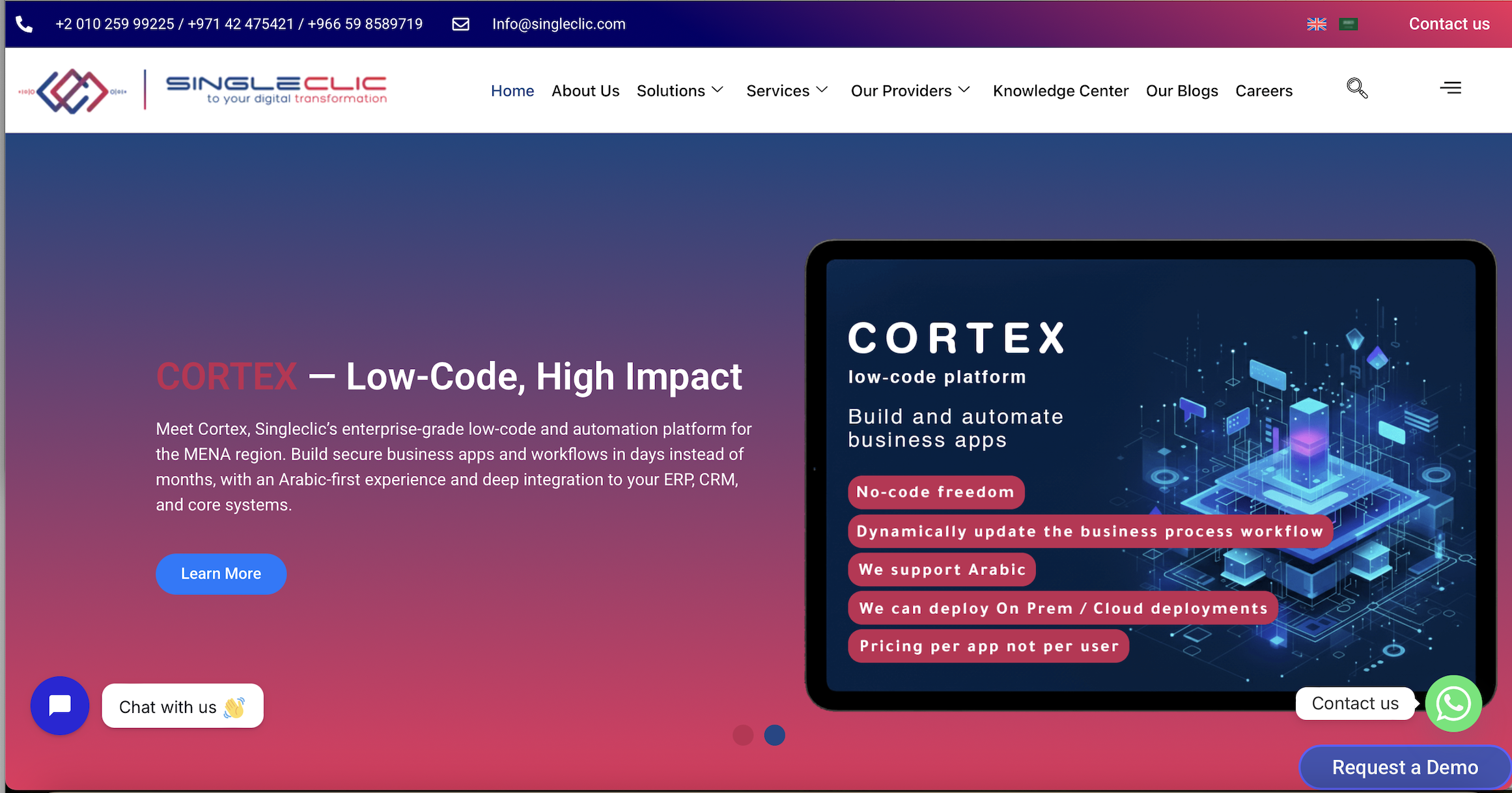
Our Dynamics 365 services cover implementation, customization, integration, and ongoing support, and where a project calls for connecting Dynamics 365 CRM to ERP, legacy systems, or third-party platforms, our CRM development and integration work follows the exact discovery-to-rollout sequence outlined in this guide. For organizations that also need Arabic-enabled, on-premise workflow automation tying CRM data into approvals and legacy systems, Cortex extends that integration further without adding downtime. If your integration project is stuck at the design stage or already showing cracks in production, reach out to Singleclic’s Dynamics 365 team for a scoped assessment of your current architecture.
Sources
- Integrate other solutions: choose pattern – Dynamics 365 | Microsoft Learn
- Microsoft Power Platform celebrates 1,000 certified connectors
FAQ
Can Dynamics 365 be used as a CRM?
Yes. Dynamics 365 CRM covers sales, customer service, marketing, and field service as distinct applications built on the shared Dataverse platform, functioning as a full CRM suite rather than a single bundled product.
What is CRM in Dynamics 365?
CRM in Dynamics 365 refers to the customer-facing applications, Sales, Customer Service, Marketing, and Field Service, that manage customer relationships, separate from the Finance & Operations (ERP) side of the platform.
What is the difference between CRM and Dynamics 365?
Dynamics 365 is the umbrella platform covering both CRM applications (Sales, Customer Service) and ERP applications (Finance & Operations, Supply Chain Management); CRM is one category of apps within that broader platform.
What integration tools are available for Microsoft Dynamics 365?
The core toolset includes Dataverse native connections, Dual-write, OData/REST APIs, Power Automate with its 1,000+ connectors, and Azure Integration Services (Logic Apps, Service Bus, API Management, Functions) for enterprise-scale needs.
How do I decide between low-code and custom API integration for Dynamics 365?
Choose low-code tools like Power Automate when connectors cover your systems and volume is moderate; move to custom Azure Functions or APIs when transformation logic is complex or throughput demands exceed what pre-built connectors handle reliably.
Recommended
- Beyond Silos: CRM–ERP Integration with Dynamics 365, Odoo, and Power Platform
- What Is Microsoft Dynamics 365? A Leader’s Guide to Connected ERP, CRM, and Intelligent Automation
- CRM Selection Checklist for IT and Business Leaders
- How to Choose the Right Microsoft Dynamics 365 Implementation Partner in Saudi Arabia