Start with a capacity-first assessment, define your SLOs, and pilot a stateless microservice behind autoscaling — those three moves give you a working proof of concept you can present to a CIO or board within 90 days.
Here is what to do today:
- Baseline your current load. Collect queries per second (QPS), daily active users (DAU), monthly active users (MAU), average payload size, and P95 latency at the edge, application tier, and database.
- Assign ownership. Name the architect responsible for the capacity model, the SRE lead who owns SLOs, and the product owner who signs off on the pilot scope.
- Draft three SLOs. Start with availability (99.9%), P95 latency (under 300ms), and error rate (below 0.1%). These are negotiable — but you need a number before you can measure anything.
- Define the pilot scope. Pick one stateless endpoint that handles a predictable, high-volume request type. Wrap it in autoscaling, put a load balancer in front, and run a 30-minute load test at 2x expected peak.
- Set a 90-day milestone. Pilot live in staging by week 6, load-test results reviewed by week 8, go/no-go for production by week 12.
- Identify one quick win. Moving a single stateless service behind autoscaling typically cuts manual capacity interventions and gives leadership a visible, measurable outcome fast.
Pro Tip: *Don’t present a single-point capacity forecast to your board.
Key takeaways
Effective scalability planning requires a capacity-first assessment, defined SLOs, the right architecture patterns for each subsystem, and a phased roadmap with clear role assignments and risk controls at every stage.
| Point | Details |
|---|---|
| Start with metrics and SLOs | Collect QPS, DAU/MAU, and P95 latency before any architecture decision; define SLOs before writing infrastructure code. |
| Match scaling type to subsystem | Use vertical scaling for stateful databases, horizontal for stateless services, and functional decomposition when one module drives disproportionate cost. |
| Test before production | Run load, stress, soak, and chaos tests with defined success criteria and rollback triggers; a plan not tested is a hypothesis. |
| Govern for UAE compliance | UAE PDPL, CBUAE, DHA, and NESA requirements must be built into architecture and procurement from day one, not retrofitted. |
| Singleclic for regional delivery | Singleclic’s Cortex platform, Dynamics 365, and Odoo implementations give UAE organizations a proven path from capacity assessment to production-scale systems. |
Table of Contents
- What is scalability planning, and why does it matter for UAE organizations?
- Vertical, horizontal, and functional scaling: which type fits your situation?
- How to build a capacity plan your CIO will actually approve
- Architecture patterns that actually enable scale
- Scaling the data tier: replication, sharding, and CAP trade-offs
- Caching strategies and CDN selection for UAE deployments
- Autoscaling, load balancing, and protective patterns
- How to test scalability before it matters in production
- A practical roadmap from assessment to full production
- Monitoring, SLOs, alerting, and incident response
- Cost drivers, procurement, and trade-offs for UAE organizations
- Real-world case studies: what scaling decisions actually produced
- How Singleclic helps UAE organizations operationalize scalability
- Is your team actually ready to scale?
- Security considerations in scalable architectures
- How to identify scalability bottlenecks before they cause outages
- Governance and compliance in UAE scalability programs
- How to evaluate your tech stack and select vendors for scalability
- What most MENA scaling programs get wrong
- Singleclic’s scalability capabilities: from pilot to production
- Sources
What is scalability planning, and why does it matter for UAE organizations?
Scalability planning is the discipline of designing systems, processes, and organizations so they can handle growth without proportional increases in cost, complexity, or failure risk. It operates on two layers simultaneously: the technical layer (infrastructure, architecture, data) and the business layer (operating model, procurement, team structure). Treating them separately is one of the most common reasons scaling programs stall.
HBS Online’s framework makes a useful distinction: growth targets (the numeric goal) and growth strategy (the plan and capabilities to reach it) are not the same thing. Over-investing in short-term capacity without building the underlying capabilities is a reliable path to expensive rework.
For UAE organizations, the stakes are specific:
- Data residency. The UAE’s Personal Data Protection Law (PDPL) and sector-specific regulations from the Central Bank of the UAE (CBUAE) and Dubai Health Authority (DHA) require certain data categories to remain within UAE borders. Cloud architecture must account for this from day one, not as an afterthought.
- Cloud region availability. Microsoft Azure UAE North (Abu Dhabi) and UAE Central (Dubai) are the primary in-country regions. AWS and Google Cloud have Middle East presence but with different availability zone configurations. Your architecture choices must map to what is actually available in-region.
- Vendor selection constraints. Government and quasi-government entities in the UAE often require vendors to hold local trade licenses, pass NESA (National Electronic Security Authority) assessments, and demonstrate data sovereignty compliance before procurement can proceed.
- Procurement cycles. Enterprise procurement in the UAE, particularly in banking and government, runs on longer approval cycles than many Western markets. Build that lead time into your roadmap.
MIT Sloan’s research on scalable business models argues that the fastest path to scale often runs through business-model levers — new distribution channels, platform models, outsourcing capacity constraints — rather than pure infrastructure investment. That framing matters here: a UAE bank adding 200,000 retail customers needs a scalable onboarding process as much as it needs scalable compute.
Vertical, horizontal, and functional scaling: which type fits your situation?
The three types of scalability are not interchangeable. Each fits a different problem, and choosing the wrong one wastes money or creates architectural debt that compounds over time.
Vertical scaling (scale up) means adding more resources to an existing node: more CPU, RAM, or faster storage. It is operationally simple and requires no application changes, which makes it attractive for legacy systems or monolithic databases. The ceiling is real, though. A single server can only grow so large, and vertical scaling introduces a single point of failure unless you pair it with replication.
- Best for: relational databases (Oracle, SQL Server, PostgreSQL) where sharding is not yet justified; legacy ERP modules that cannot be decomposed; short-term capacity relief while a longer-term architecture is designed.
Horizontal scaling (scale out) means adding more nodes and distributing load across them. This is the pattern behind most cloud-native architectures and is the default approach for stateless services. It requires your application to be stateless or to externalize state to a shared store (Redis, a distributed cache, or a database).
- Best for: web and API tiers, microservices, message consumers, and any workload where requests are independent of each other.
Functional (diagonal) scaling means decomposing a system by capability and scaling each function independently. A monolithic ERP, for example, might have its reporting module extracted into a separate read-optimized service while the transactional core stays on a vertically scaled database. This is the most complex approach but often the most cost-effective at enterprise scale.
- Best for: systems where one function (reporting, search, notifications) consumes disproportionate resources; business-process platforms where approval workflows and analytics have very different load profiles.
How to build a capacity plan your CIO will actually approve
Capacity planning sits at the intersection of scalability, performance, and cost. SystemDesignHandbook’s guidance frames it clearly: accurate traffic estimation, distinguishing average from peak loads, and using autoscaling and queuing as standard countermeasures are the foundations of any credible capacity model.
The metrics you must collect
| Metric | Unit | Where to measure |
|---|---|---|
| Queries per second (QPS) | req/s | Edge / load balancer |
| Requests per second (RPS) | req/s | Application tier |
| Concurrency | active connections | App server / thread pool |
| Daily active users (DAU) | users/day | Analytics / identity layer |
| Monthly active users (MAU) | users/month | Analytics / identity layer |
| Requests per user per session | req/session | Application logs |
| Average payload size | KB | Edge / CDN |
| Storage growth rate | GB/day | Database / object store |
| Cache hit rate | % | Cache layer (Redis, Memcached) |
| P95 / P99 latency | ms | APM (Datadog, New Relic, Dynatrace) |
Forecasting demand
BCG’s growth guidance recommends stress-testing assumptions under different market scenarios and building buffers across supply chains and P&L. Apply the same logic to infrastructure: build three demand scenarios.
- Baseline: current traffic with seasonal adjustment (Ramadan, National Day, year-end for financial services).
- Growth scenario: user growth over 12 months.
- Stress scenario: 3x peak load sustained for 30 minutes (a product launch, a government portal deadline, a flash sale).
Headroom calculation is simple: target capacity = (peak load × headroom multiplier) / target utilization.
Translating metrics into SLOs
An SLO (Service Level Objective) is an internal target; an SLA (Service Level Agreement) is the contractual commitment to a customer. Always set SLOs tighter than SLAs to give yourself an error budget. For enterprise workloads in the UAE:
- Availability SLO typically targets high uptime percentages for non-critical services and even higher for customer-facing portals.
- P95 latency SLO: under 300ms for API responses; under 100ms for cached reads.
- Error rate SLO: below 0.1% of all requests over any 5-minute window.
Choose P99 over P95 when your user base includes high-value transactions (banking, healthcare) where the worst-case experience matters more than the average.
Pro Tip: Avoid single-point forecasts entirely. A capacity model that gives leadership one number is a model that will be wrong. Present a range tied to your three scenarios, and let the board choose which risk level they are willing to fund.
Architecture patterns that actually enable scale
The patterns below are not theoretical. Each one addresses a specific failure mode that appears when systems grow beyond their original design assumptions. HashiCorp’s well-architected guidance is direct on the most important one: prioritize stateless architecture and externalize state early, because decoupling is what makes horizontal scaling and independent microservice upgrades safe.
- Stateless services. Every request carries all the context the service needs. No session state stored in memory on the server. This is the prerequisite for horizontal scaling — without it, you need sticky sessions, which reintroduce single points of failure.
- Microservices. Decompose by business capability, not by technical layer. An order service, a payment service, and a notification service can each be scaled, deployed, and failed independently. The operational cost is real: you now need service discovery, distributed tracing, and a more complex deployment pipeline.
- Event-driven / async pipelines. Decouple producers from consumers using a message broker (Apache Kafka, Azure Service Bus, RabbitMQ). This absorbs traffic spikes without cascading failures and lets you scale consumers independently of producers.
- CQRS (Command Query Responsibility Segregation). Separate the write path (commands) from the read path (queries). Reads can be served from optimized read replicas or materialized views; writes go to the authoritative store. This is particularly effective for ERP and CRM workloads where reporting queries compete with transactional writes.
- API gateway. A single entry point for all external traffic. Handles authentication, rate limiting, request routing, and protocol translation. Reduces the surface area exposed to the internet and gives you one place to enforce policies.
- Service mesh (Istio, Linkerd). Handles service-to-service communication, mutual TLS, retries, and circuit breaking at the infrastructure level rather than in application code. Adds observability overhead but significantly reduces the complexity of building resilience into each individual service.
- Bulkhead isolation. Partition resources so that a failure in one subsystem cannot exhaust resources needed by another. A slow database query in the reporting module should not starve the transaction processing pool.
For board and vendor briefings, an architecture diagram showing these layers — with explicit labels for where state lives, where the API gateway sits, and how autoscaling boundaries are drawn — is more persuasive than any slide deck. Build it before the conversation, not after.
For practical integration patterns that connect these architectural layers to ERP and CRM systems, Singleclic’s guide on CRM-ERP integration with Dynamics 365 and Odoo covers the specifics in detail.
Scaling the data tier: replication, sharding, and CAP trade-offs
The data layer is where most scaling programs hit their first hard wall. Stateless application tiers scale easily; the database does not, unless you design for it deliberately.
Replication, sharding, and partitioning compared
| Strategy | Operational complexity | Latency impact | Failover behavior | Best use case |
|---|---|---|---|---|
| Read replicas (replication) | Low | Minimal for reads; replication lag for writes | Automatic with managed services | Read-heavy workloads; reporting; analytics |
| Sharding | High | Low if shard key is well-chosen; high if cross-shard queries are common | Manual or semi-automated; complex | Very large datasets; write-heavy workloads; multi-tenant SaaS |
| Partitioning (table/range) | Medium | Low | Transparent to application | Time-series data; archival; large tables with clear partition keys |
CAP theorem in practice
The CAP theorem states that a distributed system can guarantee at most two of three properties: Consistency, Availability, and Partition tolerance. In practice, network partitions happen, so the real choice is between consistency and availability.
For UAE enterprise workloads, the decision splits cleanly by vertical:
- Banking and financial services (CBUAE-regulated). Consistency is non-negotiable. A payment that debits one account must credit another atomically. Choose CP systems (PostgreSQL with synchronous replication, Oracle RAC) and accept that availability degrades gracefully during a partition rather than serving stale data.
- Analytics and reporting. Availability matters more than perfect consistency. A dashboard that shows data 30 seconds old is acceptable; a dashboard that is unavailable during a replica failover is not. Choose AP systems (Cassandra, DynamoDB) or read replicas with acceptable replication lag.
For UAE deployments, cross-region replication to a secondary Azure UAE region (UAE Central as DR for UAE North, or vice versa) satisfies both data residency requirements and business continuity obligations. Backup strategy should include daily snapshots to Azure Blob Storage with geo-redundant storage (GRS) enabled within the UAE geography. Point-in-time recovery targets of 15 minutes or less are achievable with managed database services.
Singleclic’s work on scalability in ERP systems covers the specific data-layer considerations for healthcare and construction ERP deployments in the region.
Caching strategies and CDN selection for UAE deployments
Caching is the fastest way to reduce backend load without adding servers.
The five cache tiers
- Client-side cache. Browser cache and mobile app cache. Controlled by HTTP headers (Cache-Control, ETag). Zero server cost; reduces repeat requests for static assets and API responses that change infrequently.
- CDN / edge cache. Serves static assets (images, JS, CSS) and cacheable API responses from points of presence (PoPs) close to the user. For UAE users, choose a CDN with Middle East PoPs: Cloudflare has a Dubai PoP; Akamai and Fastly have regional presence. Azure CDN integrates natively with Azure UAE North.
- Reverse proxy / edge cache (Nginx, Varnish). Sits in front of your application servers and caches full HTTP responses. Effective for pages or API responses that are identical across many users.
- Application cache (Redis, Memcached). In-memory store for session data, computed results, and frequently accessed database records. Redis is the default choice for most enterprise workloads because it supports data structures, persistence, and pub/sub.
- Database query cache. Most relational databases have a built-in query cache. Useful for repeated identical queries but can become a bottleneck under high write rates. Treat it as a supplement, not a primary cache strategy.
Cache patterns
- Cache-aside (lazy loading). The application checks the cache first; on a miss, it reads from the database and populates the cache. Simple to implement; risk of cache stampede on cold start.
- Write-through. Every write goes to the cache and the database simultaneously. Cache is always warm; write latency increases slightly.
- Write-back (write-behind). Writes go to the cache first; the database is updated asynchronously. Lowest write latency; risk of data loss if the cache node fails before the write is persisted.
- TTL strategy. Set time-to-live based on how frequently the underlying data changes. User profile data: 5–15 minutes. Product catalog: 1–24 hours. Static reference data: 24 hours or more.
For UAE-specific compliance, cache purge policies matter. If a user exercises a data deletion right under the PDPL, cached copies of their data must be invalidated across all cache tiers, not just the database. Build cache invalidation into your data deletion workflow from the start.
Autoscaling, load balancing, and protective patterns
Autoscaling without protective patterns is incomplete. You need both: autoscaling to handle legitimate growth, and rate limiting plus circuit breakers to handle abuse and cascading failures.

Autoscaling policy design
CPU utilization is the most common autoscaling trigger, but it is often the wrong one. A service that is CPU-idle but queue-backed-up will not scale on CPU metrics. Better triggers:
- Request rate (RPS). Scale out when RPS exceeds a threshold per instance. Direct, predictable, and easy to reason about.
- Queue depth. For async consumers, scale when the message queue depth exceeds a target (e.g., more than 1,000 unprocessed messages). This is the pattern recommended by HashiCorp’s compute design guidance for event-driven architectures.
- Custom business metrics. Orders per minute, active checkout sessions, concurrent video streams. These map directly to business outcomes and are more meaningful to leadership than CPU percentages.
Scale-in (removing instances) should be conservative: wait longer before scaling in than you do before scaling out. A 5-minute scale-out trigger and a 15-minute scale-in cooldown is a reasonable starting point.
Load balancing strategies
- Round robin. Distributes requests evenly. Works well for stateless services with uniform request cost.
- Least connections. Routes to the instance with the fewest active connections. Better for services where request processing time varies significantly.
- IP hash. Routes the same client IP to the same instance. Required for stateful services that cannot externalize session state. Avoid if possible — it reintroduces the scaling constraints of stateful architecture.
Place load balancers at the edge (between the internet and your application tier) and between tiers (between your application and database tiers). Azure Application Gateway and AWS Application Load Balancer both support path-based routing, SSL termination, and WAF integration.
Protective patterns
- Rate limiting. Enforce per-client request limits at the API gateway. Protect against both abuse and accidental DDoS from misconfigured clients.
- Circuit breaker. When a downstream service fails repeatedly, stop sending requests to it for a defined period. This prevents a slow dependency from cascading into a full system failure.
- Bulkhead. Allocate separate thread pools or connection pools to different downstream dependencies. A slow database query cannot exhaust the connections available to the payment service.
- WAF (Web Application Firewall). Azure WAF and AWS WAF provide OWASP rule sets and rate-based rules. For UAE government and banking deployments, WAF is often a compliance requirement, not just a best practice.
For UAE multi-region deployments, Azure UAE North and UAE Central are the two in-country availability zones. For most enterprise workloads, multi-AZ within UAE North is sufficient for high availability. Multi-region (UAE North + UAE Central) is appropriate for disaster recovery with an RPO under 15 minutes.
How to test scalability before it matters in production
Testing is where scalability planning becomes real. A plan that has not been tested is a hypothesis.
- Define your test goals. What are you trying to prove? Typical goals: confirm the system meets SLOs at 2x expected peak; identify the failure mode at 5x peak; validate that autoscaling triggers within 90 seconds of a load spike.
- Build your workload model. Use production traffic logs to construct a realistic mix of request types, user journeys, and payload sizes. A load test that only hits one endpoint is not representative.
- Set success criteria before you run. P95 latency under 300ms at 2x peak; error rate below 0.1%; autoscaling adds instances within 90 seconds; no data corruption after 4 hours of sustained load.
- Define rollback triggers. If error rate exceeds 1% during the test, stop immediately. If database replication lag exceeds 30 seconds, pause and investigate before continuing.
- Run a load test (normal load + 2x peak). Tools: Apache JMeter, k6, Locust, or Azure Load Testing. Measure QPS, P95/P99 latency, error rate, queue depth, and DB replication lag throughout.
- Run a stress test (ramp to failure). Increase load until the system degrades. Note the failure mode: does it fail gracefully (errors returned, no data loss) or catastrophically (process crash, data corruption)?
- Run a soak test (sustained load for 4–8 hours). Catches memory leaks, connection pool exhaustion, and disk fill that only appear under prolonged load.
- Run chaos experiments. Kill a random instance mid-test. Introduce artificial latency on a downstream dependency. Simulate a database failover. Tools: Chaos Monkey, Azure Chaos Studio, Gremlin. Verify that circuit breakers and bulkheads behave as designed.
- Review APM data after each test. Datadog, New Relic, and Dynatrace all provide distributed traces that show exactly where latency accumulates. Look for the slowest 1% of requests — they usually point to the next bottleneck.
- Document results and compare against success criteria. A test that does not produce a written report did not happen, as far as your next architecture review is concerned.
A practical roadmap from assessment to full production
McKinsey’s ten rules of growth make a point that applies directly here: companies that scale successfully use a holistic blueprint combining bold aspirations, embedded enablers, and clear initiatives. The roadmap below is that blueprint in operational form.
Phase 1: Discovery and assessment (weeks 1–4)
- CIO/CTO delivers: executive mandate, budget envelope, and risk appetite statement.
- Architects deliver: current-state architecture diagram, bottleneck analysis, and capacity baseline (the metrics from Section 4).
- SRE lead delivers: existing SLO inventory (or confirmation that none exist) and incident history for the past 12 months.
- Security/compliance team delivers: data residency requirements, regulatory constraints, and vendor approval criteria.
- Risk control: document the current state before changing anything. This is your rollback baseline.
Phase 2: Architecture design and pilot scope (weeks 5–8)
- Select the pilot service (one stateless endpoint, as described in the opening checklist).
- Design the target architecture for the pilot: stateless service, autoscaling policy, load balancer, monitoring.
- Draft SLOs for the pilot service and get sign-off from the product owner.
- Risk control: pilot scope is strictly limited. No changes to production databases or shared services during this phase.
Phase 3: Pilot execution and validation (weeks 9–12)
- Deploy pilot to staging. Run load tests. Validate SLOs.
- Present results to leadership: before/after latency, autoscaling behavior, cost delta.
- Go/no-go decision for production rollout.
- Risk control: maintain a rollback window of 48 hours after production deployment. Monitor error rates continuously.
Phase 4: Phased migration (months 4–9, three stages)
- Stage 1 (months 4–5): Migrate the next two to three high-traffic services to the new architecture. Validate SLOs for each.
- Stage 2 (months 6–7): Migrate data-tier changes (read replicas, caching layer). Validate replication lag and cache hit rates.
- Stage 3 (months 8–9): Migrate remaining services. Decommission legacy capacity where safe to do so.
- Risk control: data sync validation checkpoints at the start and end of each stage. No stage begins until the previous stage’s SLOs are met for 14 consecutive days.
Phase 5: Full cutover and retrospective (month 10)
- Full production traffic on new architecture.
- 30-day hypercare period with enhanced monitoring.
- Retrospective: what worked, what did not, what to carry into the next program.
For a field-tested implementation playbook with Dynamics 365 and Odoo, Singleclic’s ERP implementation steps guide covers phase-by-phase delivery in detail.
Monitoring, SLOs, alerting, and incident response
Operational readiness is not a phase you reach — it is a practice you build. The difference between a team that scales confidently and one that scales anxiously is usually the quality of their observability stack and incident runbooks.
SLI and SLO examples for enterprise workloads
- Availability SLI: percentage of successful HTTP responses (non-5xx) over a rolling 28-day window. SLO target: 99.9% for standard services; 99.95% for customer-facing portals.
- Latency SLI: percentage of requests completed under 300ms (P95). SLO target: 95% of requests under 300ms; 99% under 800ms.
- Error rate SLI: percentage of requests returning 5xx errors. SLO target: below 0.1% over any 5-minute window.
- Throughput SLI: requests processed per second. SLO target: system sustains target RPS with latency SLO intact.
Alerting strategy
Alert on symptoms, not causes. “P95 latency exceeds 400ms” is a symptom alert — it tells you something is wrong that affects users. Symptom alerts page the on-call engineer; cause alerts go to a dashboard for investigation during business hours.
Escalation matrix:
- P1 (SLO breach, user impact): page on-call SRE immediately; notify CTO within 15 minutes if not resolved.
- P2 (SLO at risk, no current user impact): notify on-call SRE via chat; resolve within 4 hours.
- P3 (anomaly, no SLO impact): create a ticket; resolve within 72 hours.
Incident response checklist
- Acknowledge the alert and post in the incident channel within 5 minutes.
- Identify the blast radius: which services and users are affected?
- Apply the fastest available mitigation (rollback, feature flag off, traffic shift to healthy region).
- Communicate status to stakeholders every 15 minutes until resolved.
- Declare resolution only when SLOs are met for 10 consecutive minutes.
- Conduct a blameless RCA within 48 hours. Document contributing factors, timeline, and follow-up actions with owners and due dates.
Cost drivers, procurement, and trade-offs for UAE organizations
Cost is where architecture decisions become business decisions. The primary cost drivers in a scaled architecture are compute, storage, network egress, engineering and operations headcount, and software license fees.
- Compute: autoscaling reduces waste, but right-sizing instances matters more than autoscaling policy. An oversized instance that autoscales is still expensive. Use Azure Advisor or AWS Compute Optimizer to identify right-sizing opportunities.
- Network egress: data leaving a cloud region costs money. In UAE deployments, egress from Azure UAE North to on-premises or to a secondary region adds up quickly. Design data flows to minimize cross-region traffic.
- Engineering headcount: microservices and distributed systems require more operational expertise than monoliths. Budget for SRE capacity before you commit to a microservices architecture.
- License fees: Microsoft Dynamics 365, Odoo, and IBM BAW all have per-user or per-module pricing. Scaling user counts without renegotiating license terms is a common budget surprise.
MIT Sloan’s scalable business model research identifies outsourcing capacity constraints as one of the fastest levers for achieving scale without linear cost growth. For UAE organizations, this often means engaging a regional implementation partner rather than hiring a full in-house team for a one-time scaling program.
Cloud vs on-premises vs hybrid
- Cloud-first is the right default for most new workloads. Azure UAE North and UAE Central provide in-country data residency, managed services, and pay-as-you-go pricing that aligns cost with actual usage.
- On-premises is required for certain banking and government workloads where data sovereignty rules prohibit cloud hosting, or where latency to a cloud region is unacceptable for real-time transaction processing. The TCO of on-premises is higher when you include hardware refresh cycles, data center costs, and the engineering time to manage infrastructure.
- Hybrid is the practical reality for most UAE enterprises: cloud for new workloads and analytics, on-premises for legacy systems and regulated data. The integration layer between the two is where complexity and cost accumulate.
When presenting trade-offs to finance and executive stakeholders, frame the comparison as total cost of ownership over three years, not annual license cost. Include the cost of not scaling: downtime cost, lost revenue during outages, and the engineering cost of emergency capacity increases.
Real-world case studies: what scaling decisions actually produced
E-commerce: peak traffic management during Ramadan
A UAE-based e-commerce platform faced annual Ramadan traffic spikes that consistently caused checkout failures. The intervention: move the checkout service to a stateless microservice behind Azure Application Gateway with autoscaling triggered by RPS. Add Redis caching for product catalog and session data. Run a CDN with a Dubai PoP for static assets. The lesson: isolating the highest-value transaction path and making it independently scalable is more effective than scaling the entire monolith.
Healthcare: ERP scaling for a multi-site hospital group
A healthcare group operating across multiple UAE emirates needed their ERP to support a substantial increase in patient volume following a new government contract. The constraint: data residency requirements meant the system had to remain on-premises. The intervention: vertical scaling of the database tier (additional RAM and NVMe storage), read replicas for reporting queries, and partitioning of historical patient records by year. Outcome: report generation time dropped from 18 minutes to under 3 minutes; the transactional system maintained sub-second response times at the new patient volume. The lesson: for regulated on-premises workloads, read replicas and partitioning often deliver more value than architectural redesign.
Fintech: payment processing resilience
The intervention: event-driven architecture using Azure Service Bus for payment message queuing, circuit breakers between the payment service and downstream banking APIs, and multi-AZ deployment within Azure UAE North. The lesson: for financial workloads, the combination of async queuing and circuit breakers is more reliable than synchronous scaling alone.
How Singleclic helps UAE organizations operationalize scalability
Singleclic brings together the technical and organizational dimensions of scalability planning that most implementation programs treat separately.
- Cortex low-code platform. Singleclic’s Cortex platform is built specifically for MENA enterprises. It supports on-premises deployment for banks and government organizations, full Arabic UI/UX, and runtime workflow changes without downtime. For organizations that need to scale business processes without scaling engineering headcount, Cortex connects approvals, ERP, CRM, data, and legacy systems into a single orchestration layer.
- Microsoft Dynamics 365 and Odoo. Singleclic implements and customizes both platforms across healthcare, construction, real estate, banking, and government verticals in the UAE. Both platforms support the data-layer scaling patterns described in this guide: read replicas, partitioning, and integration with Azure-native services.
- ERP/CRM integration. Singleclic’s integration work connects Dynamics 365 and Odoo to legacy systems, government portals, and third-party APIs — the integration layer that determines whether your scaled architecture actually delivers consistent data across the business.
- When to engage Singleclic vs build in-house. If your organization has fewer than five dedicated SREs, no existing SLO framework, and a scaling program that needs to deliver results within 12 months, an implementation partner accelerates delivery significantly. If you have a mature SRE practice and are scaling a greenfield cloud-native system, in-house delivery is viable with the right architecture guidance.
- Regional delivery. Singleclic’s 70+ consultants and engineers across UAE, KSA, and Egypt understand the data residency, procurement, and compliance constraints that affect scaling programs in this market. Clients include Emirates Health Services, Dubai Healthcare City, QNB, and AlBaraka.
For scalable IT infrastructure planning that aligns architecture with long-term growth targets, Singleclic’s technical team works with CIOs and architects from assessment through production.
Is your team actually ready to scale?
Technical architecture is only half the equation. Workday’s research on scaling strategy identifies automation, self-service, and skills pathways as core enablers for operations to keep pace with growth. The organizational side of scalability planning deserves the same rigor as the technical side.
DevOps practices that enable scale:
- CI/CD pipelines that deploy to production multiple times per day. If your deployment cycle is measured in weeks, your ability to respond to scaling failures is severely limited.
- Infrastructure as Code (Terraform, Bicep, Pulumi) so that capacity changes are version-controlled, reviewable, and repeatable. Manual infrastructure changes are the enemy of consistent scale.
- Feature flags (LaunchDarkly, Azure App Configuration) that let you enable or disable functionality without a deployment. Critical for canary releases and rollback during scaling events.
Cross-team collaboration requirements:
- A shared SLO framework that product owners, engineers, and SREs all use. Without shared metrics, scaling conversations become political rather than technical.
- A blameless postmortem culture. Teams that fear blame after incidents hide problems rather than surfacing them early. Early surfacing is what prevents small scaling issues from becoming large ones.
- A dedicated platform engineering team (or a managed partner) that owns the shared infrastructure so that product teams can scale their services without becoming infrastructure experts.
Automation also extends beyond infrastructure: repeatable, automated processes reduce the marginal cost of each additional unit of output, whether that unit is a software deployment, a customer onboarding, or a compliance report.
Security considerations in scalable architectures
Scale increases attack surface. Every new service, endpoint, and integration point is a potential entry vector. Security cannot be retrofitted after the architecture is built.

Zero-trust network architecture. In a scaled microservices environment, assume no service is inherently trusted, even within the private network. Use mutual TLS (mTLS) between services (a service mesh handles this automatically), enforce least-privilege IAM policies, and require explicit authentication for every service-to-service call.
Secrets management. As the number of services grows, so does the number of API keys, database credentials, and certificates. Use a secrets manager (Azure Key Vault, HashiCorp Vault) rather than environment variables or configuration files. Rotate secrets automatically.
API security. Every API gateway should enforce OAuth 2.0 or OpenID Connect for authentication, rate limiting per client, and input validation. Inject OWASP rule sets at the WAF layer. For UAE financial services, CBUAE’s Open Banking Framework specifies additional API security requirements.
Data encryption. Encrypt data at rest (Azure Storage Service Encryption, Transparent Data Encryption for SQL) and in transit (TLS 1.2 minimum, TLS 1.3 preferred). For UAE government and healthcare workloads, encryption key management must comply with NESA and DHA requirements.
Dependency scanning. Scaled architectures use many open-source libraries. Integrate dependency scanning (Snyk, Dependabot, Azure Defender for DevOps) into your CI/CD pipeline so that vulnerable dependencies are caught before they reach production.
How to identify scalability bottlenecks before they cause outages
A bottleneck is any resource that limits the throughput of the entire system. The goal is to find it in testing, not in production.
Profiling and distributed tracing. APM tools (Datadog, Dynatrace, New Relic) generate distributed traces that show the latency contribution of each service in a request chain. The slowest span in the trace is your current bottleneck. Fix it, and the next slowest span becomes the new bottleneck. This is the process of systematic bottleneck elimination.
Amdahl’s Law as a mental model. The speedup from parallelizing a workload is limited by the fraction that cannot be parallelized. Identify and eliminate sequential dependencies first.
Database query analysis. The most common bottleneck in enterprise systems is a slow database query. Use the slow query log (available in PostgreSQL, MySQL, SQL Server) to identify queries that take more than 100ms. Add indexes, rewrite queries, or move the workload to a read replica.
Connection pool exhaustion. Under high load, services run out of database connections before they run out of CPU or memory. Monitor active vs available connections in your connection pool (PgBouncer, HikariCP). Set pool size based on your database’s max_connections limit divided by the number of application instances.
Thread pool saturation. Synchronous services that block threads waiting for I/O will saturate their thread pools under load. Switch to async/non-blocking I/O (Node.js, async Python, reactive Java) for I/O-bound services.
Governance and compliance in UAE scalability programs
Governance is what keeps a scaling program from becoming a liability. In the UAE, the regulatory environment adds specific obligations that must be built into your architecture and procurement decisions.
Data residency and sovereignty. The UAE PDPL (Federal Decree-Law No. 45 of 2021) requires that personal data of UAE residents be processed and stored within the UAE unless specific conditions for cross-border transfer are met. For cloud deployments, this means Azure UAE North or UAE Central, with explicit data residency configurations enabled. For on-premises deployments, it means your data center must be physically located within the UAE.
Sector-specific regulations. CBUAE regulations govern data handling for financial institutions. DHA and DOH (Department of Health Abu Dhabi) govern health data. TDRA (Telecommunications and Digital Government Regulatory Authority) governs telecom operators. Each sector has specific requirements for audit logging, data retention, and incident reporting that must be reflected in your architecture.
Change management governance. Every architecture change in a regulated environment should go through a formal change advisory board (CAB) process. Document the change, the risk assessment, the rollback plan, and the approval chain. This is not bureaucracy for its own sake — it is the audit trail that regulators expect.
Vendor due diligence. UAE government and banking procurement requires vendors to demonstrate compliance with NESA’s Information Assurance Standards. For cloud vendors, this means reviewing the shared responsibility model and confirming which compliance obligations the vendor covers and which remain with your organization.
Audit logging. Every access to sensitive data, every configuration change, and every privileged action must be logged with a tamper-evident audit trail. Azure Monitor, Microsoft Sentinel, and Splunk are commonly used for this in UAE enterprise deployments.
How to evaluate your tech stack and select vendors for scalability
Tech stack decisions made for a 10,000-user system often become constraints at 1,000,000 users. Evaluate for the scale you expect to reach in three years, not the scale you have today.
Evaluation criteria tied to scalability:
- Horizontal scaling support. Does the platform support stateless deployment and external session management? Can you add instances without application changes?
- Managed service availability in UAE regions. Is the managed database, cache, or messaging service available in Azure UAE North or UAE Central? Running a self-managed cluster adds operational overhead that scales poorly.
- Vendor support SLAs. What is the vendor’s committed response time for P1 incidents? For UAE deployments, confirm that support is available in the Gulf Standard Time (GST) timezone.
- License model at scale. Per-user licensing becomes expensive at scale. Evaluate whether the vendor offers concurrent user, named user, or consumption-based pricing, and model the cost at your three-year projected user count.
- Integration ecosystem. A platform that integrates natively with your ERP, CRM, and identity provider reduces the custom integration work that typically becomes a scaling bottleneck.
- Community and talent availability. A technology with a thin talent pool in the UAE market means higher hiring costs and longer time-to-fill for critical roles. PostgreSQL, Kubernetes, and the Microsoft Azure stack all have strong local talent availability.
HBS Online’s framework for growth strategy applies here too: allocate resources across short-, medium-, and long-term horizons. A tech stack decision is a long-term resource allocation. Choose platforms where the vendor’s roadmap aligns with your three-to-five-year architecture direction, not just your current requirements.
For ERP and CRM specifically, Singleclic’s guide on ERP-CRM integration resilience covers vendor selection criteria for integrated enterprise stacks in detail.
What most MENA scaling programs get wrong
The recurring failure patterns in MENA scaling programs are not primarily technical. They are organizational and strategic.
Tight coupling as the default. Most legacy systems in the region were built monolithically because that was the fastest path to delivery. When growth demands scale, the coupling that made delivery fast makes scaling expensive. The fix is not a full rewrite — it is identifying the two or three highest-traffic interfaces and decoupling them first, using the strangler fig pattern to migrate incrementally.
Missing SLOs at the start. Teams that begin a scaling program without defined SLOs have no way to know when they are done. Every architecture decision becomes a debate rather than a measurement. Define SLOs before you write a single line of infrastructure code.
Over-customization of ERP platforms. Heavily customized ERP instances are the hardest systems to scale. Every upgrade cycle requires regression testing of custom code; every scaling intervention risks breaking a customization. The discipline of keeping ERP customization minimal and using integration layers for business-specific logic pays compounding dividends as the system grows.
Scale theatre. Some organizations invest in microservices, Kubernetes, and service meshes because those technologies signal technical sophistication, not because their scale requirements justify the operational overhead. A system serving 5,000 users does not need a 12-service microservices architecture. Match the architecture to the actual scale requirement.
Pro Tip: When presenting a scaling investment to leadership, frame it in terms of the cost of not scaling: the revenue lost during a peak-traffic outage, the engineering cost of emergency capacity increases, and the reputational risk of a public failure. That framing converts a technical budget request into a business risk conversation.
Singleclic’s scalability capabilities: from pilot to production
Singleclic delivers end-to-end scalability programs for UAE enterprises that need results within a defined timeline, not a multi-year research project. The starting point is a structured capacity assessment and SLO workshop, typically completed in two to three weeks, that gives your leadership team a clear picture of where the constraints are and what it will cost to address them.
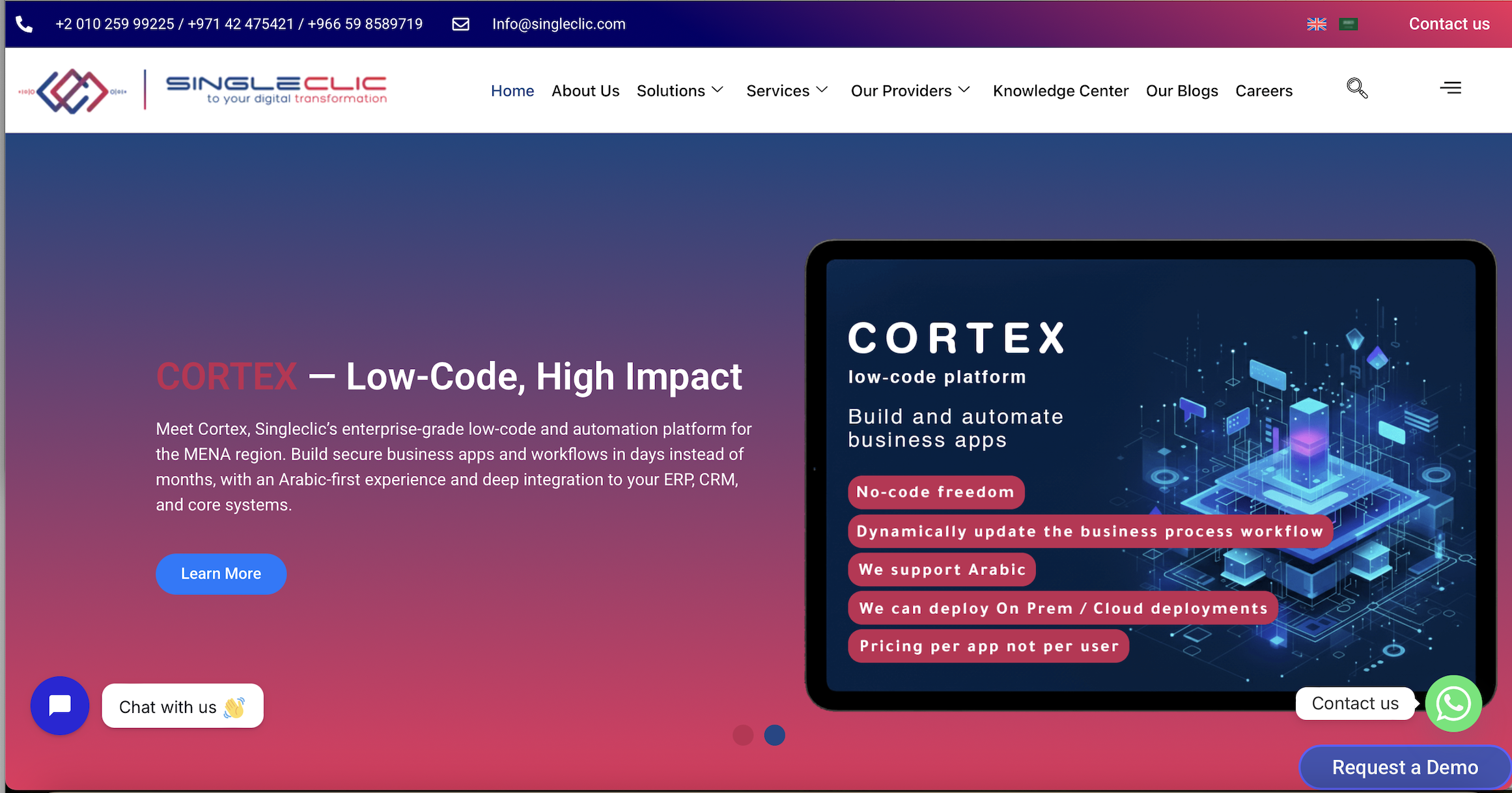
From there, Singleclic’s 70+ engineers and consultants across UAE, KSA, and Egypt implement the architecture, data-layer, and process changes your organization needs — using Microsoft Dynamics 365, Odoo, Cortex low-code, IBM BAW, and Azure-native services. The Cortex platform is particularly relevant for organizations that need to scale business processes (approvals, onboarding, compliance workflows) without scaling engineering headcount, with full Arabic UI support and on-premises deployment for banks and government entities.
For organizations ready to move from planning to execution, the next step is a Dynamics 365 capabilities review or a business process automation consultation with Singleclic’s team. Book a planning call to define your pilot scope and 90-day milestone.
Sources
The following sources informed key sections of this guide and are recommended for deeper reading:
- The CEO’s guide to growth — seizing opportunity (BCG)
- Capacity planning in system design (SystemDesignHandbook)
- HashiCorp well-architected guidance on compute and design
- Revenue growth: Ten rules for success (McKinsey)
- How to develop business growth strategies that drive results (HBS Online)
- Building scalable business models (MIT Sloan Review)