TL;DR:
- Data security best practices involve deploying controls, policies, and technical measures to safeguard sensitive information from breaches.
- In the UAE and Saudi Arabia, these practices must align with regional laws, sector requirements, and frameworks like NIST CSF 2.0 to effectively manage risks.
Data security best practices are defined as the structured set of controls, policies, and technical measures organizations deploy to protect sensitive information from unauthorized access, disclosure, and loss. For IT professionals and data security managers operating in the UAE and Saudi Arabia, the stakes are particularly high. Regional digital transformation initiatives, cross-border data flows, and sector-specific compliance requirements in banking, healthcare, and government create a threat surface that generic security advice cannot address. Frameworks like NIST CSF 2.0 organize these practices into risk-managed categories covering Identify, Protect, Detect, Respond, and Recover, giving enterprise teams a structured operating model rather than a checklist.

What are data security best practices and why do they matter?
Data security is defined as protecting corporate and personal data against unauthorized access through encryption, access controls, and policy-driven management that preserves confidentiality, integrity, and availability. These three properties, collectively known as the CIA triad, form the foundation of every credible information security program. Without all three, an organization may encrypt data but still expose it through misconfigured access controls, or maintain availability while losing integrity through undetected tampering.
For organizations in the UAE and Saudi Arabia, effective information security goes beyond technical controls. It intersects with the UAE’s Personal Data Protection Law, Saudi Arabia’s National Cybersecurity Authority (NCA) Essential Cybersecurity Controls, and global standards like GDPR for any entity handling EU citizen data. The NIST CSF 2.0 framework transforms best practices into a continuous, risk-managed operating model, enabling prioritized improvements across all five security functions. This makes it the most practical structural reference for enterprise security programs in the region today.
How to establish a continuous data discovery and classification program
Continuous data discovery and classification is the prerequisite for every other security control you will implement. You cannot encrypt what you have not found, and you cannot enforce access policies on data you have not categorized. Forcepoint’s 2026 guidance identifies continuous discovery and classification as the foundation of layered cloud data security, and that observation holds equally for hybrid and on-premise environments common in KSA government and banking sectors.
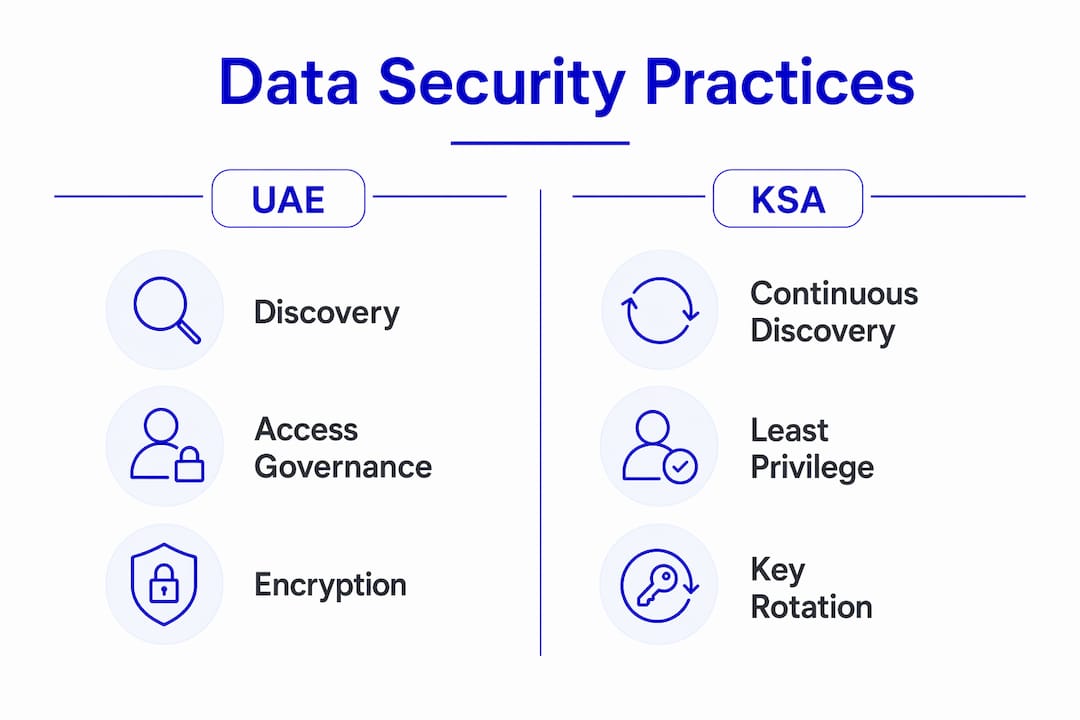
A practical classification program uses sensitivity tiers: public, internal, confidential, and restricted. Each tier maps to specific handling rules, retention periods, and access permissions. The challenge in organizations across the UAE and Saudi Arabia is that data does not stay in one place. Shadow IT, personal cloud sync tools, and distributed SaaS platforms mean sensitive records appear in locations your security team never approved.
To address this, consider the following elements when building your classification workflow:
- Automated scanning tools such as Microsoft Purview or Varonis continuously scan file shares, databases, email systems, and cloud storage for sensitive data patterns including PII, financial records, and health information.
- Classification labels applied at creation time, not retroactively, reduce the remediation burden on security teams significantly.
- Integration with DLP policies so that classification labels automatically trigger enforcement rules without manual intervention.
- Regular discovery sweeps of SaaS platforms like Microsoft 365, Salesforce, and SAP to catch data that migrates outside approved repositories.
- Governance workflows that route newly discovered sensitive data to data owners for review and reclassification.
Pro Tip: Run a shadow IT discovery scan before launching your classification program. In most regional enterprises, 20 to 30 percent of sensitive data resides in tools the security team has never formally reviewed.
How to enforce least-privilege access and access governance effectively
Least-privilege access is defined as granting users, systems, and applications only the minimum permissions required to perform their specific functions. Role-based access control (RBAC) is the standard implementation method, mapping permissions to job roles rather than individuals. This reduces the attack surface when credentials are compromised and limits the blast radius of insider threats.
In the UAE and Saudi Arabia, workforce mobility across organizations and frequent contractor engagements create a specific risk called privilege creep. Privilege creep occurs when users accumulate permissions over time as their roles change, without corresponding revocation of old access rights. Zero Trust architecture directly addresses this by shifting security focus to continuous evaluation of identity, device posture, location, and resource sensitivity rather than assuming trust based on network location.
Follow these steps to build an access governance program that scales:
- Define role profiles for every job function in your organization, mapping each role to the minimum data sets and systems it requires.
- Implement multi-factor authentication (MFA) for all users accessing sensitive systems, with phishing-resistant methods like FIDO2 hardware keys for privileged accounts.
- Conduct quarterly access reviews where data owners certify that each user’s permissions remain appropriate for their current role.
- Automate provisioning and deprovisioning through integration between your HR system and identity provider, so access is revoked the moment an employee changes roles or exits.
- Monitor privileged account activity using a Privileged Access Management (PAM) solution such as CyberArk or BeyondTrust, generating alerts for anomalous behavior.
- Segment access by environment, keeping production data access separate from development and testing environments.
Pro Tip: Treat your quarterly access review as a compliance artifact, not just an operational task. Documented, timestamped reviews are the first evidence regulators request during an audit in both the UAE and Saudi Arabia.
Best practices for encrypting data at rest and in transit
Encryption is the technical control that renders data unreadable to unauthorized parties even when other controls fail. The two domains are distinct in implementation but equally critical. Data at rest encryption protects stored data in databases, backups, file systems, and SaaS platforms. Data in transit encryption protects data moving between systems, users, and cloud services.
| Encryption domain | Standard | Key management approach | Common pitfall |
|---|---|---|---|
| Data at rest | AES-256 | Customer-managed encryption keys (CMEK) with regular rotation | Storing encryption keys alongside encrypted data |
| Data in transit | TLS 1.2 or higher | Certificate lifecycle management with automated renewal | Using self-signed certificates in production environments |
| Database connections | TLS with mutual authentication | Centralized secrets management (e.g., HashiCorp Vault) | Hardcoding credentials in application code or containers |
| Backup encryption | AES-256 with offline key copy | Air-gapped key storage for disaster recovery | Encrypting backups but leaving restore keys unprotected |
Encryption key management is as important as encryption itself. Using customer-managed encryption keys and rotating them regularly is the standard for maintaining data confidentiality and meeting compliance requirements. A key that never rotates becomes a single point of failure across the entire data estate.
Thales highlights that operational security often fails where low-level implementation gaps exist, such as insecure secrets handling or insufficient database transport security. This means your encryption policy may be technically sound while your containers are connecting to databases without TLS, or your developers are hardcoding API keys in source code. Platforms like Thales CipherTrust and HashiCorp Vault address secrets management at the infrastructure level, closing the gap between policy intent and operational reality.
How do DLP, zero trust, and continuous monitoring work together?
Layered security controls are the defining characteristic of mature data protection programs. No single control prevents every breach. The combination of data loss prevention (DLP), Zero Trust architecture, and continuous monitoring creates overlapping defenses that catch threats at multiple points.
Effective DLP spans multiple data channels including email, web, cloud sync, USB devices, and AI tools, enforcing policies consistently to prevent sensitive data leakage regardless of the exit point. This is particularly relevant for organizations in the UAE and Saudi Arabia where employees frequently use personal devices and regional cloud services that may not be covered by default DLP configurations.
Key components of a layered control framework include:
- DLP policy coverage across all data channels, including generative AI tools like Microsoft Copilot and ChatGPT Enterprise, which introduce new data exfiltration vectors that most legacy DLP tools do not cover natively.
- Zero Trust micro-segmentation that isolates workloads so that a compromised application cannot access adjacent systems or data stores without re-authentication.
- Behavioral analytics and insider risk management using tools like Microsoft Purview Insider Risk Management or Varonis DatAlert to detect anomalous data access patterns before exfiltration occurs.
- Continuous compliance monitoring through automated tools that track data handling against frameworks like GDPR, HIPAA, and PCI DSS, enabling faster audit readiness and real-time risk detection across multi-cloud environments.
- Security information and event management (SIEM) platforms such as Microsoft Sentinel or IBM QRadar that correlate events across your entire environment and surface threats that individual tools miss.
For IT leaders managing cloud security in KSA and UAE, the practical challenge is integrating these tools across hybrid environments where some workloads remain on-premise and others run in public cloud. Avoiding common cloud data protection mistakes during this integration phase is as important as the tools themselves.
How to prepare an incident response plan that meets compliance requirements
An incident response plan is defined as a documented, role-assigned workflow that guides an organization through detecting, containing, eradicating, and recovering from a data security incident. The plan must be tested, not just written. Organizations that discover their incident response plan during an actual breach face compounded damage from delayed containment and regulatory penalties.
Wiz’s 2026 compliance guidance stresses that incident response plans must align with regulatory notification rules, including GDPR’s 72-hour breach notification requirement, and must incorporate AI-specific breach scenarios and documentation workflows. For organizations in Saudi Arabia and the UAE operating under NCA controls and UAE PDPL, notification timelines and evidence requirements are equally specific.
Build your incident response plan around these steps:
- Assign a dedicated incident commander with clear authority to make containment decisions without requiring committee approval during active incidents.
- Define breach classification tiers (low, medium, high, critical) with pre-approved response actions for each tier to eliminate decision delays.
- Document regulatory notification timelines for every jurisdiction your organization operates in, including the specific data elements required in each notification.
- Automate evidence collection using your SIEM and endpoint detection tools to capture logs, access records, and timeline data the moment an incident is declared.
- Conduct tabletop exercises at least twice per year, including at least one scenario involving an AI-related data exposure or a third-party SaaS breach.
Incident response requires dynamic, documented, and timed response plans with assigned roles and workflows. This reduces delays and helps meet breach notification deadlines. Automation in evidence collection is not optional at enterprise scale. Manual log collection during an active incident introduces errors and delays that regulators and auditors will scrutinize.
Key takeaways
Effective data security requires layered, continuous controls spanning discovery, access governance, encryption, DLP, and tested incident response plans aligned with regional compliance requirements.
| Point | Details |
|---|---|
| Start with discovery | You cannot protect data you have not found; continuous classification is the foundation of every other control. |
| Enforce least privilege | Quarterly access reviews and automated deprovisioning prevent privilege creep in high-mobility workforces. |
| Encrypt at every layer | Use AES-256 at rest, TLS 1.2 or higher in transit, and customer-managed keys with regular rotation. |
| Layer your defenses | Combine DLP, Zero Trust micro-segmentation, and behavioral monitoring to catch threats at multiple points. |
| Test your incident response | A documented plan that has never been exercised will fail under real breach conditions. |
What I have learned about data security in the UAE and Saudi Arabia
Working with enterprise clients across the region for over a decade, I have seen a consistent pattern. Organizations invest heavily in perimeter security and compliance documentation, then discover during an audit or incident that their actual data handling practices diverged from policy months or years earlier. The gap is almost never intentional. It is the result of rapid growth, shadow IT adoption, and the operational pressure to move fast.
What I find genuinely encouraging is the shift I am seeing among IT leaders in KSA and UAE toward continuous security operations rather than point-in-time compliance. The organizations that handle incidents well are the ones that treat their security controls as living systems, not annual checkboxes. They run discovery scans quarterly, review access rights on a fixed schedule, and test their incident response plans with realistic scenarios including AI-related data exposures.
One area I think deserves more attention is the integration of security controls into low-code and automation platforms. At Singleclic, we built Cortex specifically for MENA enterprises, and one of the design requirements was on-premise deployment with role-based access controls baked into the platform architecture. When organizations automate business processes without embedding access governance and audit logging into those workflows, they create new data exposure vectors that their existing security tools were not designed to monitor. The security architecture conversation needs to happen before the automation project launches, not after.
My honest recommendation: prioritize your data discovery and classification program above everything else in 2026. You cannot make good security decisions about data you have not mapped. Once you know where your sensitive data lives and how it flows, every other control becomes significantly more effective.
— Tamer
Strengthen your security posture with Singleclic
Singleclic works with IT leaders and data security managers across the UAE, Saudi Arabia, and Egypt to integrate security best practices into ERP implementations, business process automation, and enterprise AI deployments. If you are evaluating your organization’s readiness for a secure digital transformation, the ERP implementation checklist for the Middle East is a practical starting point that covers data governance, access controls, and compliance alignment. For organizations looking to automate secure business processes, the business process automation guide for C-level leaders connects automation strategy with security requirements. Singleclic’s Cortex platform also supports on-premise deployment with full Arabic UI, making it a strong fit for government and banking clients in KSA and UAE who cannot move sensitive workloads to public cloud.
FAQ
What is the first step in building a data security program?
Continuous data discovery and classification is the first step. You must identify where sensitive data exists across your environment before you can apply encryption, access controls, or DLP policies effectively.
How does Zero Trust improve data protection?
Zero Trust continuously evaluates identity, device posture, location, and resource sensitivity rather than assuming trust based on network location. This approach significantly reduces the risk of lateral movement after a credential compromise.
What encryption standards should organizations use in 2026?
Use AES-256 for data at rest and TLS 1.2 or higher for data in transit. Pair these with customer-managed encryption keys and a centralized secrets management platform to avoid hardcoded credentials in applications and containers.
How often should access rights be reviewed?
Quarterly access reviews are the recognized standard for enterprise environments. Each review should be documented with timestamps and data owner sign-off to serve as audit evidence for regulators in the UAE and Saudi Arabia.
What does a compliant incident response plan require?
A compliant plan requires assigned roles, pre-defined breach classification tiers, documented regulatory notification timelines, and automated evidence collection. Wiz’s compliance guidance specifically recommends embedding GDPR’s 72-hour notification requirement and AI-specific breach scenarios into your plan.