TL;DR:
- Approval delays in Saudi Arabia and the UAE cause significant operational bottlenecks that impact business agility. To streamline workflows, organizations must map existing approval processes, classify decision types, and leverage technology such as low-code platforms for rapid prototyping and implementation. Effective approval processes rely on parallel routing, rule-based auto-approvals, clear ownership, SLAs, and continuous measurement to ensure ongoing improvement.
Approval delays are costing businesses in Saudi Arabia and the UAE more than just time. Stalled purchase orders, contract sign-offs sitting in inboxes for days, and finance teams waiting on three layers of sign-off before a vendor gets paid are symptoms of a deeper structural problem. Knowing how to streamline approvals is not a nice-to-have skill for modern managers. It is a competitive requirement. This article walks you through the preparation, execution, and measurement steps that actually move the needle, including where technology and low-code platforms fit into the picture.
Table of Contents
- Key takeaways
- What to prepare before redesigning approval workflows
- Steps to design and execute efficient approval workflows
- Common mistakes that undermine approval improvements
- Measuring success and refining your process
- My perspective on approval process inertia in the Middle East
- How Singleclic helps you improve your approval process
- FAQ
Key takeaways
| Point | Details |
|---|---|
| Map before you automate | Document every existing approval step and classify decisions before changing anything. |
| Parallel beats sequential | Running independent approvals simultaneously can cut cycle time by up to 3x. |
| Auto-approve low-risk requests | Tiered auto-approval for routine transactions delivers 40–60% faster processing. |
| SLAs prevent stalls | Mandated response windows with automatic escalation are the only reliable way to keep requests moving. |
| Measure continuously | Track cycle time, approval rates, and exception rates to identify where the process is still breaking down. |
What to prepare before redesigning approval workflows
You cannot improve a process you have not fully mapped. Before touching any tool or workflow setting, spend time documenting every approval step your organization currently uses. That means walking through purchase requests, contract approvals, HR sign-offs, and any other decision gates where work regularly stops and waits.
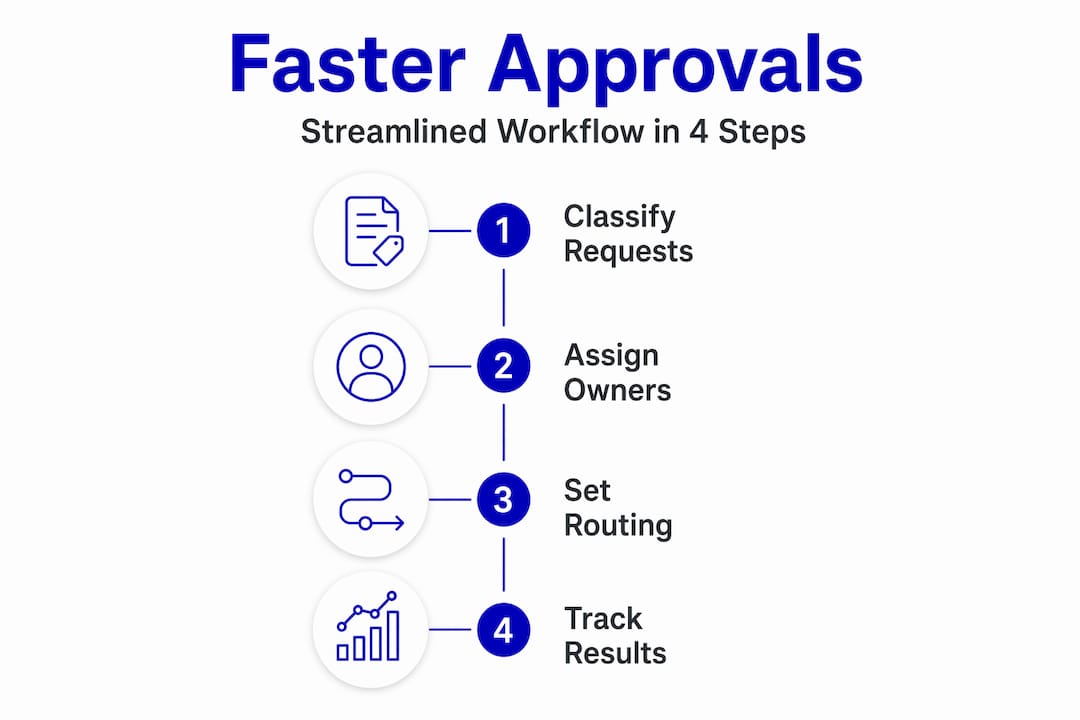
Once you have the map, classify each decision type. Not all approvals are equal.
- Rule-based decisions are those where the answer is almost always determined by a fixed set of conditions: amounts under a certain threshold, vendors already on an approved list, or contract types that match a standard template. These are strong candidates for automation.
- Judgment-based decisions require a human with real context. Complex vendor negotiations, exceptions to policy, or high-value contracts with non-standard terms belong here.
- Hybrid decisions sit in the middle, where AI-assisted review or a single experienced approver can handle the case with minimal delay.
Classifying approvals this way eliminates the most common mistake: sending every request through the same multi-step human chain regardless of complexity or risk.
After classification, assign clear ownership. Every approval category needs a named role, a backup approver, and a defined escalation path. Ambiguity is where requests go to die. You also need to assess your organization’s technology readiness and cultural appetite for change. Many businesses in KSA and UAE operate with strong hierarchy norms, which makes involving senior leadership early a non-negotiable step. If the VP of Operations does not visibly support the new process, middle managers will default to the old one.
Low-code platforms are particularly useful during this preparation phase because they let process owners visualize and prototype workflows without waiting for IT resources. That speed of iteration matters when you are trying to build stakeholder buy-in.
Pro Tip: Before your redesign kickoff meeting, run a 5-day audit of pending approvals. Count how many requests are waiting, how long they have been waiting, and which approver is the bottleneck. That data will make your case better than any presentation.
Steps to design and execute efficient approval workflows
With your process mapped and decisions classified, you are ready to build something better. Here is a practical sequence for designing workflows that actually speed up approvals without losing control.
-
Switch sequential chains to parallel routing. Sequential approval chains cause 3x longer cycle times compared to parallel approvals. If your finance manager and department head both need to approve a purchase, and neither decision depends on the other, they should be reviewing at the same time. Reserve sequential chains only for genuinely dependent decisions.
-
Build conditional routing based on transaction attributes. Rule-based approval systems that route by procurement category, amount threshold, and vendor risk tier are already used by high-performing procurement teams. A $500 office supply order and a $200,000 infrastructure contract should not travel the same approval path.
-
Set SLAs with automatic escalation. Mandated response windows of 4 to 24 hours, paired with automatic escalation to the next approver when a deadline passes, keep requests from sitting idle. Automatic escalation is not about blame. It is about maintaining momentum.
-
Configure rule-based auto-approvals for low-risk transactions. Tiered auto-approval for routine, standard transactions eliminates unnecessary human steps entirely. Companies using this approach see 40–60% faster processing times.
-
Integrate approvals into the tools your teams already use. When approval requests surface inside Microsoft Teams or Slack rather than a separate portal, completion rates rise sharply. 80% of approvals completed inside Slack led to 70% faster overall approval times in tracked implementations.
-
Connect budget controls to the workflow. Budget checks before approval routing mean requests that exceed available budget are flagged or blocked before a human even sees them. This protects finance without adding manual review steps.
-
Use low-code tools for rapid configuration. Low-code platforms reduce IT dependence when modifying workflows, so managers can update rules, change thresholds, and add routing logic without waiting weeks for a development sprint.
Pro Tip: For urgent procurement requests, use a documented fast-track workflow with a required justification field. This maintains audit compliance while giving your team a legitimate way to accelerate time-sensitive approvals.
Here is a quick reference for matching approval design to decision type:
| Decision type | Recommended routing | Approval owner | Target turnaround |
|---|---|---|---|
| Low-risk, rule-based | Auto-approve | System | Instant |
| Medium-risk, standard | Single approver | Department head | 4–8 hours |
| High-risk or high-value | Parallel multi-approver | Director level | 24 hours |
| Exception or non-standard | Sequential with review | C-suite or legal | 48–72 hours |
Common mistakes that undermine approval improvements
Even well-intentioned redesigns fail when the same structural errors creep in. Knowing what to avoid is just as important as knowing what to build.
- Overcomplicating the workflow. Adding more steps, conditions, and branches in the name of thoroughness creates confusion and user resistance. The goal is to reduce friction, not just move it around.
- Leaving rubber-stamp approvals in place. Five-person approval chains often include four reviewers who approve without real scrutiny, each adding 1 to 3 days of delay. That is not oversight. That is theater. Standardize approvals by risk tier, not by organizational rank.
- Failing to assign clear ownership. When multiple people are responsible, nobody feels fully accountable. Every workflow needs a named owner who is responsible for outcomes, not just for reviewing documents.
- Skipping change management. Giving people a new system without explaining why it exists and how it benefits them will trigger resistance. Teams in Saudi Arabia and UAE enterprises often need visible executive sponsorship to adopt new processes with confidence.
- Ignoring poor request quality. Unclear or incomplete request templates force approvers to ask follow-up questions, which stalls the entire process. Standardized digital forms with required fields cut rework significantly.
- Not reviewing approval data regularly. A workflow that worked well six months ago may now be a bottleneck because business conditions changed and the rules did not.
“The most expensive approvals are the ones that look controlled but aren’t. A chain of six sign-offs where five people click approve without reading anything gives you the illusion of governance without the substance.”
Measuring success and refining your process
Building the workflow is only half the work. The other half is making sure it is actually performing the way you intended.
Start by defining the metrics that matter. Cycle time (how long from request to decision), approval rate (what percentage of requests are approved on first submission), exception rate (how often requests fall outside standard rules), and SLA compliance rate are the four numbers that tell you whether your process is working.
Pro Tip: Track first-pass approval rate closely. A low rate means requesters are submitting incomplete or non-compliant requests, which suggests your intake form or guidance documentation needs work, not your approval logic.
| Metric | What it tells you | Target benchmark |
|---|---|---|
| Average cycle time | Overall speed of the process | Reduce by 40–60% from baseline |
| First-pass approval rate | Request quality and clarity | Above 85% |
| SLA compliance rate | Whether approvers are meeting deadlines | Above 90% |
| Exception rate | Workflow coverage and rule accuracy | Below 10% |
Workflow automation provides real-time visibility through dashboards and automated alerts, which shifts your finance and operations teams from reactive firefighting to proactive management. You should also collect structured feedback from both approvers and requesters every quarter. They will surface friction points that your metrics alone will not catch.

Low-code platforms make ongoing iteration practical. When you spot a pattern in the data, such as a specific department consistently missing SLAs, you can update the routing rule or escalation trigger the same day without filing an IT ticket. That agility is what separates businesses that improve continuously from those that redesign every three years.
For more on automating business processes in a way that compounds over time, the approach outlined above pairs well with a broader automation strategy at the organizational level.
My perspective on approval process inertia in the Middle East
I have worked with dozens of enterprises across Saudi Arabia and the UAE over the past decade. The single most consistent finding is this: approval chains grow out of fear, not necessity.
When something goes wrong in an organization, the instinctive response is to add another sign-off. Over time, you accumulate layers of approval that nobody questions because questioning them feels like questioning accountability itself. But accountability without efficiency is just bureaucracy.
What I have seen work is reframing the conversation. When we position automation as a tool that gives managers more visibility and more control over outcomes rather than less, resistance drops. The fear is not really about the technology. It is about losing a sense of oversight. Show a CFO a real-time dashboard of every pending approval, the dollar value at stake, and the time each request has been sitting, and suddenly they are your biggest advocate for removing three of the five sign-offs they used to require.
Leadership commitment to clear ownership is the pivot point in every successful transformation I have been part of. When the CHRO or COO says out loud, “This person is accountable, and this is the decision they have authority to make,” the process moves. Without that signal, teams will always hedge toward excessive approvals to protect themselves.
Low-code platforms like Cortex, Singleclic’s Arabic-enabled on-premise platform built for MENA enterprises, have genuinely changed what is possible for regional businesses. Managers in government, banking, and healthcare no longer need to wait months for IT to build a new approval workflow. They can build it themselves, see it in production within days, and adjust it based on real usage data. That kind of speed changes the culture as much as it changes the process.
— Tamer
How Singleclic helps you improve your approval process
If you are a business leader in Saudi Arabia or the UAE ready to move from manual approvals to a system that actually works, Singleclic has the tools and regional experience to get you there fast.
Singleclic’s ERP and workflow automation solutions, built on Microsoft Dynamics 365, Odoo, and the Cortex low-code platform, support conditional routing, SLA enforcement, parallel approvals, and direct integration with the communication tools your teams already use. Cortex is specifically designed for MENA enterprises with full Arabic UI/UX, unlimited users, and on-premise deployment for organizations that require it.
Whether you need a workflow approval guide to plan your redesign or a full ERP implementation roadmap customized for Middle Eastern markets, Singleclic’s team of 70+ consultants across KSA, UAE, and Egypt is ready to support your next step. Contact Singleclic for an assessment or request a Cortex demo today.
FAQ
How can I speed up approvals without losing control?
Use tiered routing where low-risk requests are auto-approved and high-risk decisions go to a single qualified reviewer. This reduces cycle time significantly while keeping oversight focused where it matters.
What is the best way to reduce approval cycle time?
Parallel approval routing is the most direct lever. Running independent approvals simultaneously instead of sequentially can cut total cycle time by up to three times.
How do SLAs help improve the approval process?
SLAs with automatic escalation keep requests from stalling when an approver is unavailable or unresponsive. Setting a 4 to 24 hour response window with automatic escalation to a backup approver maintains consistent momentum across all request types.
Do I need an IT team to set up automated approval workflows?
Not necessarily. Low-code platforms allow managers and process owners to configure and modify approval workflows directly, without writing code or filing IT requests for every change.
What metrics should I track after redesigning approval workflows?
Focus on average cycle time, first-pass approval rate, SLA compliance rate, and exception rate. These four numbers give you a complete picture of speed, quality, and control across your approval process.