TL;DR:
- Business model innovation involves redesigning how a company creates, delivers, and captures value, beyond digital or product enhancements. Successful innovation requires combining novelty with operational efficiency, customer lock-in, and strong partnerships to outperform competitors. Executives should map their current models, test hypotheses iteratively, and focus on structural changes to stay competitive in evolving markets.
Most executives assume that a bold new product or a flashy digital feature is enough to stay ahead. That assumption is expensive. What is business model innovation, really? It is not about novelty for novelty’s sake. It is about redesigning the architecture of how your company creates value, delivers it, and captures revenue from it. This guide cuts through the confusion, draws on research and real MENA examples, and gives you a practical framework to apply it in your sector — whether you lead a hospital, a bank, a developer, or a telecom operator.
Table of Contents
- What business model innovation really means
- Why novelty alone does not guarantee success
- Business model innovation in practice: case studies from MENA industries
- How to approach business model innovation in your organization
- Challenges and common pitfalls in business model innovation
- Our perspective: the architecture conversation no one is having
- Ready to move beyond digitalization?
- Frequently asked questions
Key Takeaways
| Point | Details |
|---|---|
| business model innovation defined | It means making novel, meaningful changes to how a company creates and captures value, beyond product changes. |
| novelty needs balance | Successful innovation combines new ideas with efficiency, customer lock-in, and strong partnerships. |
| real-world mena examples | Dubai real estate and Saudi healthcare demonstrate practical BMI driving growth and efficiency. |
| iterative approach | Use hypothesis testing and small experiments to validate innovations before scaling. |
| avoid common pitfalls | Don’t mistake minor tweaks for innovation; focus on changing multiple elements for true impact. |
What business model innovation really means
The definition of business model innovation is frequently misquoted. Many treat it as a synonym for digital transformation or product development. It is neither.
According to scholar David Teece’s definition, a business model is “the architecture of value creation, value delivery, and value capture mechanisms of a firm.” Business model innovation, then, requires novel and nontrivial changes to the key elements of that architecture — not just a price adjustment or a new distribution channel.
Think of it this way: if a hospital switches from fee-for-service billing to a subscription-based preventive care plan, it has changed who pays, when they pay, and what outcome it is responsible for delivering. That is business model innovation. If the same hospital launches a new cardiac procedure, that is product innovation. Both matter. But only one reshapes competitive position at the system level.
Here is what genuine business model innovation can affect:
- Value proposition: What problem you solve and for whom
- Revenue model: How and when money flows to you
- Cost structure: What you own vs. what you outsource
- Key partnerships: Who you rely on to deliver value
- Customer relationship model: How you acquire, retain, and deepen ties with customers
- Channels: How you reach and serve your customer segments
Understanding this distinction is the starting point for every executive who wants to build something defensible rather than just different. Explore more on how digital innovation and business optimization ties into this at the organization level.
Why novelty alone does not guarantee success
Once you understand the definition of business model innovation, the next temptation is to assume that being first or most original wins. Research says otherwise.
A study of nearly 300 companies found that novel business models alone do not produce top performance. The companies that actually led their categories configured novelty together with three other elements: operational efficiency, customer lock-in, and strong partnerships.
“Novel business models alone don’t guarantee high performance. Top performers combine novelty with efficiency, lock-in, and complementary partnerships.” — MIT Sloan Management Review
This finding has direct implications for MENA executives. The region has no shortage of ambition or capital. What is sometimes missing is disciplined execution layered onto genuinely new ideas. A few patterns worth noting:
- Novelty without efficiency produces great press releases and poor margins. If your new model costs twice as much to operate, a well-run competitor will outlast you.
- Novelty without lock-in means customers try your model once and walk away. Real estate platforms in the Gulf have learned this repeatedly.
- Novelty without partnerships leaves gaps in delivery that erode trust, especially in regulated sectors like banking and healthcare.
Many MENA firms also fall into the product innovation trap. They invest heavily in new digital experiences while leaving their underlying revenue logic unchanged. The product gets better. The business model stays fragile.
The companies winning in the region right now are combining new ideas with the operational discipline to execute them at scale, which is precisely what the examples in the next section illustrate. For a deeper look at how AI is enabling this combination, see AI and analytics for strategic advantage.
Business model innovation in practice: case studies from MENA industries
Theory lands differently when you can see it working in your own backyard. Here are four examples of business model innovation from the sectors most relevant to MENA executives.
Real estate: renovate-to-resell in Dubai
DMDC and Residual.ae launched what became Dubai’s first renovate-to-resell model, building a $100M villa portfolio with zero upfront cost to property owners. The value capture mechanism shifted entirely: instead of charging owners a renovation fee, the model monetizes the uplift in property value after renovation. Owners carry no financial risk. The platform captures a share of the gain.

Construction: backward integration at Sobha Realty
Sobha Realty shifted 70% of production to in-house factories, reducing dependence on subcontractors, cutting waste, and improving delivery timelines. This is not just operational improvement — it is a structural change in how the company creates and controls value across the supply chain.
Healthcare: digital twins and PPP in Saudi Arabia
Lean Business Services is leading Saudi healthcare’s move toward digital twin technology and public-private partnership models aligned with Vision 2030. Hospitals are no longer just treatment centers — they become data-driven platforms that model patient flow, resource utilization, and outcomes in real time. See how healthcare digital frameworks support this kind of transformation at scale.
Banking: cross-sector integration in Kuwait
Kuwait International Bank launched Salamtek, a digital health platform that integrates banking and healthcare services with access to 200-plus doctors. A bank is now a healthcare provider. The revenue model, the customer relationship, and the value proposition are all fundamentally different from traditional retail banking.
| Sector | Innovation type | Key change made |
|---|---|---|
| Real estate | Revenue model | Value-share on appreciation, not upfront fees |
| Construction | Cost and supply model | In-house factory production at 70% of scope |
| Healthcare | Delivery model | Digital twin platforms and PPP structures |
| Banking | Value proposition | Cross-sector health and financial services |
Pro Tip: When studying these examples, focus on what changed in the business model canvas, not just what the company announced. The press release rarely tells you where the real innovation lives.
For more on digital twin technology and how it enables new operating models across sectors, there is a dedicated resource worth reading.
How to approach business model innovation in your organization
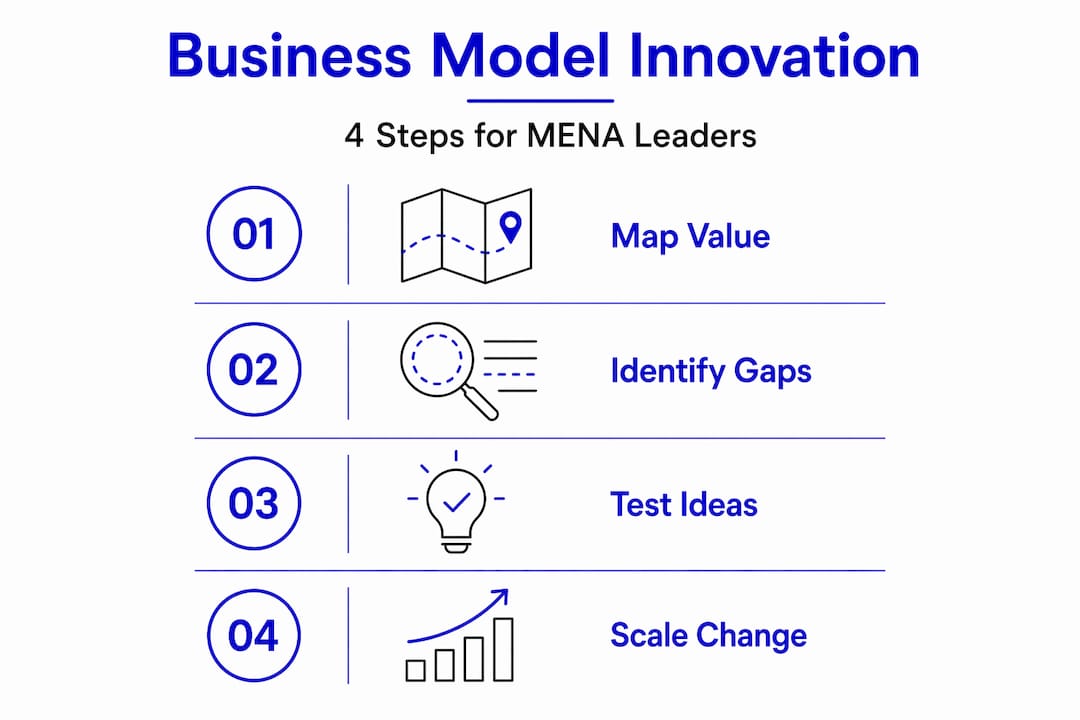
Knowing how to innovate a business model requires a method, not just motivation. Here is a practical framework designed for MENA executives operating in complex, regulated industries.
-
Map your current model explicitly. Use the Business Model Canvas to document every component: value proposition, customer segments, channels, revenue streams, cost structure, key resources, and partnerships. Most leadership teams have never done this as a group. The gaps that surface in that session tell you more than a strategy retreat ever will.
-
Identify the highest-leverage element to change. Not every component offers equal opportunity. A telecom company might find its biggest opportunity in the revenue model (moving from airtime to platform licensing). A hospital group might find it in the key partnerships element (co-delivering services with insurers or employers).
-
Generate multiple options before committing. Iterative hypothesis testing is the core mechanism of credible business model innovation, with practitioners working through cycles of 30 to 90 days per assumption. There are 145 documented business model patterns to draw from. The goal is to generate at least three viable alternatives before picking a direction.
-
Test your riskiest assumption first. Every new business model rests on at least one assumption that could kill it if wrong. Identify it. Design a minimum viable experiment — not a full launch — to test it within 60 days.
-
Run the new model separately from core operations. One of the most common mistakes is trying to integrate an experimental model into existing workflows too early. Give it its own team, its own metrics, and enough runway to prove itself before integration.
-
Scale what survives testing. Once the model validates, invest in the digital workflow infrastructure and process automation needed to run it at scale. This is where the real efficiency gains appear.
Pro Tip: The Business Model Canvas is most useful when you fill it in for your competitors first, then for yourself. The comparison reveals where your model is conventional and where an alternative architecture could win.
For executives looking to connect this framework to enterprise-wide execution, the C-level guide to business process automation covers the operational layer in depth.
Challenges and common pitfalls in business model innovation
Even well-intentioned innovation efforts fail. Here is what goes wrong most often, and what you should watch for in your own organization.
- Confusing incremental change with real innovation. Raising prices, adding a mobile app, or changing a supplier is not business model innovation. Mistaking these tweaks for genuine innovation leads to wasted effort and misallocated capital. Real innovation changes multiple elements of the model simultaneously.
- Focusing only on product. You can build the best digital health app in the Gulf and still lose to a competitor with a worse product but a superior business model. The product is what you deliver. The model is how you sustain delivering it profitably.
- Skipping assumption validation. Every new model is built on assumptions. The ones you do not test are the ones that kill the project. Test the riskiest ones first, before committing budget.
- Launching at full scale. Organizations in construction and real estate are especially prone to this. The project mindset encourages full commitment upfront. Business model experimentation requires the opposite — controlled pilots before scaled rollout.
- Underestimating internal resistance. Existing business models have defenders. Sales teams, finance functions, and operational leaders all have incentives tied to the current model. Managing that resistance is a leadership challenge, not just a strategy one.
“The riskiest assumption in any new business model is the one nobody on the leadership team wants to talk about.” — Tamer Badr, Singleclic
For guidance on avoiding these failure modes through better use of AI-supported transformation, the resources at Singleclic cover this directly. And if you need a framework for identifying where innovation pitfalls typically emerge in MENA organizations, there is research-backed thinking available.
Our perspective: the architecture conversation no one is having
Here is the uncomfortable truth about business model innovation in the MENA region: most organizations are still having the wrong conversation.
Boards want digital transformation. CEOs invest in AI. CIOs buy new platforms. And yet the underlying business model — the actual architecture of how value is created and monetized — stays exactly the same. The technology sits on top of a model designed for a different era. The result is expensive digitization, not real transformation.
What we see consistently across clients in construction, banking, and healthcare is this: the companies gaining ground are not the ones with the newest tools. They are the ones that used new tools to justify a model change. Sobha Realty did not just automate construction. It restructured ownership of the production process. Kuwait International Bank did not just launch an app. It redefined what a bank is responsible for delivering to its customer.
The importance of business model innovation is not just competitive. It is existential in markets that are liberalizing, consolidating, and facing regulation changes simultaneously. Vision 2030 in Saudi Arabia, healthcare privatization in Egypt, and telecom consolidation across the Gulf are all forcing model-level decisions whether leaders are ready or not.
Our advice: stop asking “how do we digitize what we already do?” Start asking “if we were designing this company from scratch in 2026, what would we never do the same way?” That second question is where business model innovation begins.
Ready to move beyond digitalization?
If this article clarified what business model innovation means and what it demands, the next step is figuring out how to execute it inside your specific organization.
At Singleclic, we work with enterprises across KSA, UAE, and Egypt to translate business model thinking into operational reality — through ERP and CRM implementation, intelligent process automation, AI-powered platforms, and our own Arabic-enabled low-code platform, Cortex. We have done this with clients including Emirates Health Services, QNB, Emaar Misr, and AlBaraka. If your model is ready to evolve, we are ready to help you build the infrastructure that makes it work. Reach out to our team to start the conversation.
Frequently asked questions
What exactly differentiates business model innovation from product innovation?
Business model innovation changes how your company creates and captures value system-wide, while product innovation focuses on improving individual products or services. You can have both, but they operate at different levels of your business.
Why is novelty alone insufficient for successful business model innovation?
Research on internet-enabled companies shows that novelty must combine with operational efficiency, customer lock-in, and strong partnerships to drive top performance — new ideas alone do not close the deal.
How can mid-sized MENA companies start innovating their business models without big R&D budgets?
Business model innovation relies on recombining existing resources rather than inventing new technology, making it accessible to mid-sized firms that use structured tools like the Business Model Canvas and run short iterative experiments.
What are some examples of business model innovation in the MENA region?
Strong examples include Dubai’s renovate-to-resell villa model, Sobha Realty’s factory-led construction approach, Saudi Arabia’s healthcare digital twin platforms, and Kuwait International Bank’s integrated health and banking service model.