TL;DR:
- Effective digital KPIs connect technology performance to specific business outcomes.
- Preparing data quality, stakeholder ownership, and balanced indicators is essential before setting KPIs.
- Regular review and adaptation of KPIs ensure continuous improvement and alignment with evolving goals.
How to Set Digital KPIs for Large Enterprises: A Guide
Misaligned KPIs have quietly derailed some of the most ambitious digital transformation efforts across KSA and UAE. Organizations invest millions in ERP upgrades, cloud migrations, and process automation, yet struggle to measure whether any of it is working. The problem rarely comes down to the technology itself. It comes down to measuring the wrong things. This guide gives you a structured, practical approach to setting digital KPIs that connect technology investments to real business outcomes, so your leadership team always knows what is working, what is not, and where to act next.
Table of Contents
- Understanding the digital KPI landscape
- Preparing to set digital KPIs: Foundational steps
- Step-by-step guide: Setting digital KPIs that deliver results
- Verifying, optimizing, and evolving your digital KPIs
- What most digital KPI frameworks miss—and how to get it right
- Accelerate your digital KPI journey with expert support
- Frequently asked questions
Key Takeaways
| Point | Details |
|---|---|
| Align KPIs with strategy | Digital KPIs must directly support core business goals to drive meaningful results. |
| Use SMART criteria | Every KPI should be specific, measurable, achievable, relevant, and time-bound for true effectiveness. |
| Review and adapt regularly | Continuous improvement and stakeholder feedback are critical to keep KPIs relevant and impactful. |
| Integrate leading and lagging | A balanced mix ensures you can respond proactively as well as measure overall outcomes. |
Understanding the digital KPI landscape
Before you can set effective digital KPIs, you need to understand what makes them different from the traditional metrics your organization has used for decades. Traditional KPIs focus on broad business outcomes: revenue growth, profit margin, customer satisfaction scores, and market share. These are valuable, but they do not tell you why a system is underperforming or how a digital initiative is progressing.
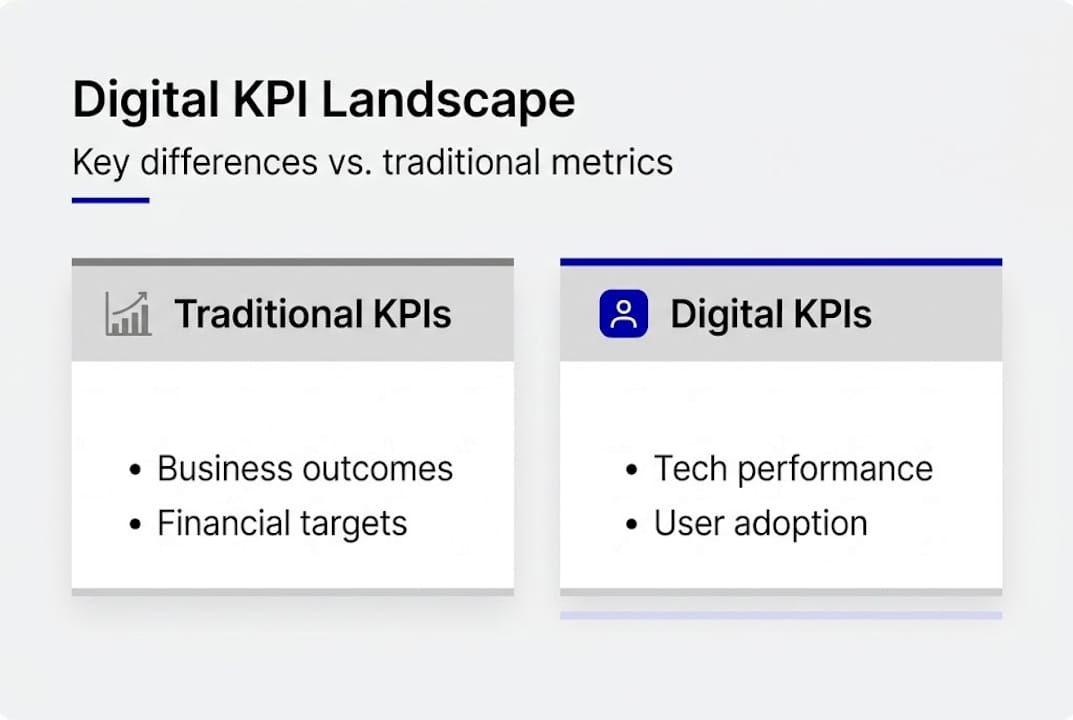
Digital KPIs shift the focus to technology-driven factors. Think system uptime at 99.9%, user adoption rates across new platforms, process automation coverage, and cloud cost efficiency. These measures connect directly to the health of your digital operations. The top KPIs to track for large enterprises always include a mix of both, but the digital layer is what gives you early-warning signals.
One of the most persistent problems in large organizations is siloed measurement. Different departments track different digital metrics using different tools, and no one synthesizes them into a coherent strategic picture. Research shows that 86% of siloed organizations struggle with metrics that fail to communicate across functions, making executive decision-making reactive rather than proactive. That number should concern every CIO and COO in the region.
Here is a quick comparison to clarify the difference:
| Dimension | Traditional KPIs | Digital KPIs |
|---|---|---|
| Focus | Business outcomes | Technology and process performance |
| Measurement frequency | Monthly or quarterly | Real-time or daily |
| Data sources | Finance, sales reports | ERP, CRM, cloud telemetry, analytics |
| Ownership | C-suite, finance | IT, operations, digital teams |
| Example metric | Revenue growth | System uptime, user adoption rate |
The KSA and UAE markets are accelerating this need. Regulatory frameworks, Vision 2030 targets, and rapid private-sector digitalization are all pushing organizations to track digital performance with much greater precision. Monitoring industry momentum insights shows that GCC enterprises are adopting digital tools faster than almost any other region globally, which makes the quality of measurement even more critical.
Key characteristics of effective digital KPIs include:
- Outcome-oriented: They connect to a business result, not just an activity.
- Tech-specific: They reflect the performance of your digital systems directly.
- Actionable: They point to a specific team or process that can respond.
- Real-time capable: They can be monitored continuously, not just at month-end.
- Cross-functional: They are shared across departments, not owned in isolation.
Pro Tip: Resist the urge to build a dashboard with 40 metrics. Executives who track fewer than 10 carefully chosen digital KPIs consistently make faster and better decisions than those drowning in data. Choose measures that directly influence your core strategic goals.
Preparing to set digital KPIs: Foundational steps
Setting digital KPIs is not something you do in an afternoon workshop. It requires real groundwork. Organizations that skip the preparation stage almost always end up with KPIs that look good on paper but cannot be measured in practice, or that no one actually owns.
The single most important framework to apply is SMART. Every digital KPI should be Specific, Measurable, Achievable, Relevant, and Time-bound, with a clearly defined owner, a documented data source, and an explicit calculation method. Without these elements, a KPI is just a wish. SMART criteria force precision, and precision is what separates organizations that improve from those that only report.
Before any KPI is finalized, your organization needs to address four foundational areas:
Data quality and availability. If the underlying data is unreliable, the KPI built on top of it is meaningless. Audit your current data pipelines across ERP, CRM, cloud operations tools, and web analytics platforms. Identify gaps, reconcile inconsistencies, and establish data governance standards. Many enterprises in the region have invested in systems like Microsoft Dynamics 365 or Odoo but have not connected them to a unified reporting layer. That connection is essential.
Stakeholder engagement and accountability. Digital KPIs must be owned by people who have the authority and the tools to act on them. Engage business owners from IT, operations, finance, and the relevant line-of-business functions early. Each KPI should have a named owner who is responsible for monitoring it, escalating issues, and driving improvement. Without named accountability, even the best KPIs go unreviewed.
Balanced indicator types. You need both leading indicators and lagging indicators. Leading indicators are predictive: they tell you what is likely to happen. A good example is the number of employees completing training on a new system before go-live, which predicts future adoption success. Lagging indicators are historical: they confirm what has already happened, like the actual user adoption rate measured three months after launch. A healthy digital KPI framework uses both.

Refer to this digital transformation checklist and your digital roadmap for C-levels to map your readiness before finalizing any KPI set.
Here is a reference table of common data sources and the digital KPIs they typically support:
| Data source | KPIs it enables |
|---|---|
| ERP system | Process cycle time, cost per transaction, automation rate |
| CRM platform | Lead conversion rate, customer response time, pipeline velocity |
| Cloud operations tools | System uptime, infrastructure cost per user, incident resolution time |
| Web and app analytics | Digital channel adoption, user engagement, self-service completion rate |
| HR and training systems | Digital skill completion rate, onboarding time, training ROI |
Taking the time to complete these preparatory steps means your digital KPIs will be grounded in real data, owned by real people, and aligned with real strategic goals.
Step-by-step guide: Setting digital KPIs that deliver results
With your foundations in place, you can move through a systematic process to identify, validate, and implement digital KPIs that actually drive performance. This is not a theoretical exercise. Every step here reflects what works in practice for large enterprises across the GCC.
Step 1: Define the strategic goal. Every KPI must trace back to a specific business goal. Are you trying to reduce operational costs? Improve service delivery speed? Increase digital channel adoption? Start with the goal, then work backward to identify what must be measured to know whether you are making progress.
Step 2: Map candidate KPIs. For each strategic goal, identify three to five candidate KPIs. Use your growth metrics for digital resources to benchmark what similar organizations track. Consider metrics like process automation rate, system uptime, user adoption percentage, and digital self-service rate.
Step 3: Apply SMART validation. Run each candidate through the SMART criteria framework. Can it be measured with available data? Is the target achievable in your current environment? Does it have a clear time horizon? Eliminate any KPI that fails these tests. Be ruthless here. A vague KPI is worse than no KPI.
Step 4: Stakeholder review. Present your shortlisted KPIs to the relevant business owners and IT leads. Confirm that the data sources exist, that the calculation logic is agreed upon, and that the owner accepts accountability. This review should surface any organizational or political barriers before rollout.
Step 5: Pilot the KPI. Before full deployment, run a pilot for four to eight weeks. Collect data, review accuracy, and test whether the KPI is producing actionable signals. Strong digital adoption strategies always include a pilot phase to catch measurement errors early.
Step 6: Set thresholds and targets. Based on pilot data and industry benchmarks, define your red, amber, and green thresholds. For example, system uptime below 99% is red, between 99% and 99.5% is amber, and above 99.5% is green. These thresholds give your teams clear, shared definitions of success.
Step 7: Scale and embed. Integrate the approved KPIs into your executive dashboards, operational reviews, and governance processes. Reference your digital roadmap steps to ensure KPIs are embedded into the broader transformation governance structure. Also monitor industry signals for KPIs to stay ahead of sector-level shifts that may affect your targets.
“The organizations that succeed with digital KPIs are not those with the most metrics. They are those with the clearest connection between what they measure and what they care about as a business.” — Tamer Badr, Singleclic
Pro Tip: Set a firm calendar reminder to review all digital KPIs every quarter. Technology changes, market conditions shift, and a KPI that was highly relevant at the start of a transformation may become obsolete or misleading within twelve months.
Verifying, optimizing, and evolving your digital KPIs
Implementing digital KPIs is not the finish line. It is the starting point for a continuous improvement cycle. Organizations that treat KPIs as static, once-defined measures almost always see them decay into vanity metrics over time.
The first priority after rollout is building a clear, executive-ready dashboard. Visualization matters more than most leaders acknowledge. A well-designed dashboard surfaces the right information at a glance, reduces time spent in status meetings, and supports faster escalation when performance deviates from targets. Your digital growth roadmap should include dashboard governance as a defined workstream, not an afterthought.
Common pitfalls to watch for after launch include:
- Metric drift: The way a KPI is calculated changes subtly over time as systems or processes change, making trend comparisons unreliable.
- Misinterpretation: Teams read a green status as “all is well” when the threshold itself may be set too low to be meaningful.
- Ignoring qualitative feedback: Numbers do not capture everything. User feedback on a new system often reveals performance problems before the quantitative metrics do.
- Lack of review cadence: Without a scheduled review cycle, KPIs sit on dashboards and no one acts on them.
Establish a formal quarterly review process. In each session, assess whether the SMART criteria still apply to each active KPI, whether targets remain ambitious but realistic, and whether any new business priority requires a new measure. Invite both IT leaders and business stakeholders to these sessions. Cross-functional input is what prevents siloed blind spots.
For a real-world example, consider a government-sector client in the UAE that launched a digital services portal with strong uptime and adoption KPIs. Twelve months in, both metrics were green, yet user satisfaction was declining. A quarterly review revealed that the KPIs did not capture transaction completion rates, meaning users were starting processes but not finishing them. Adding a digital self-service completion rate KPI immediately exposed the real problem and led to targeted UX improvements. Monitoring leveraging early business insights frameworks helped the team identify the pattern before it became a crisis.
Use this table to guide your KPI review and optimization decisions:
| Signal | Action |
|---|---|
| KPI consistently green but no business improvement | Raise the threshold or replace with a more sensitive metric |
| KPI data frequently unavailable | Fix the data pipeline or retire the KPI |
| Stakeholder no longer owns the KPI | Reassign ownership immediately |
| Business strategy has shifted | Map new goals and add or retire KPIs accordingly |
| KPI has not changed in 6 months | Investigate stagnation or reconsider relevance |
Build a user adoption workflow that includes KPI health checks, so that underperforming measures trigger structured responses rather than passive observation.
What most digital KPI frameworks miss—and how to get it right
After working with more than 60 enterprise clients across KSA, UAE, and Egypt, one pattern stands out clearly. Most digital KPI failures are not technical failures. They are organizational ones. Teams focus on activity metrics, things like the number of system logins, tickets resolved, or reports generated, rather than on outcome metrics that actually reflect business value.
Activity metrics are easy to collect and easy to report green. Outcome metrics require harder conversations and deeper system integration. Organizations that focus on outcomes over activity consistently outperform those that optimize for dashboards that look good in board presentations.
The second major failure is the “set-and-forget” mindset. Digital environments evolve rapidly. A KPI that was perfectly calibrated during an ERP implementation may be actively misleading twelve months later when the system is in steady-state operation. Adaptive, learning-driven KPI management, where you treat your measurement framework as a living system, is what separates top-performing organizations from those stuck in reporting theater.
Cross-functional measurement is also chronically undervalued. True digital performance cannot be owned by IT alone. When business leaders and IT leaders co-own digital KPIs, organizations move faster and correct course more accurately. Explore how leadership in transformation directly connects executive sponsorship to measurable efficiency gains of up to 40%.
Accelerate your digital KPI journey with expert support
Setting digital KPIs that genuinely drive business optimization requires more than a template. It requires experienced partners who understand both the technology and the operational realities of large enterprises in this region.
At Singleclic, we have spent over a decade helping enterprises across KSA, UAE, and Egypt design measurement frameworks that connect digital investments to real outcomes. Whether you are beginning your transformation or refining an existing KPI program, our business process automation guide and AI in business automation resources offer practical starting points. Explore how Singleclic can support your organization’s digital KPI strategy with tailored consulting, proven frameworks, and a track record across 60+ enterprise clients in the GCC.
Frequently asked questions
What makes a KPI ‘digital’ compared to a traditional KPI?
A digital KPI measures technology-driven factors such as system uptime, user adoption, or cloud costs, whereas traditional KPIs track broad business outcomes like revenue or profit margin.
How often should digital KPIs be reviewed?
Review digital KPIs quarterly or after major technology or business changes. This cadence aligns with SMART KPI best practices and ensures your measures stay relevant as your environment evolves.
What are some common mistakes in setting digital KPIs?
Typical mistakes include focusing on vanity metrics, setting vague targets without clear owners, and failing to align measures with business strategy. Applying SMART criteria from the start prevents most of these errors.
Why is it important to balance leading and lagging indicators in digital KPIs?
A balance ensures you track both predictors and confirmed outcomes, giving you a full picture for proactive management. Relying only on lagging indicators means you are always reacting to problems that could have been anticipated.