TL;DR:
- Cloud providers secure infrastructure, but customers are responsible for configuration, data, and application security.
- Regional mandates in KSA and UAE require data residency, continuous compliance, and alignment with local frameworks.
- Building a security culture with continuous monitoring and expert guidance ensures effective cloud security management.
Many IT leaders in KSA and UAE assume their cloud provider handles security end to end. That assumption is costly. Cloud service providers only secure the infrastructure, leaving customers fully responsible for configuration, data handling, and application-layer controls. In a region where regulators are tightening data sovereignty rules and cybersecurity mandates are evolving fast, that gap creates serious exposure. This guide walks you through the core principles, compliance frameworks, practical controls, and common risks that every IT decision-maker in the Gulf needs to understand before signing off on any cloud strategy.
Table of Contents
- Understanding cloud security: Core principles and shared models
- Frameworks, compliance and regional mandates: Navigating KSA & UAE requirements
- Key mechanics of cloud security: Tools, practices and controls
- Risks, edge cases and emerging challenges in cloud security
- Beyond checklists: What most cloud security guides get wrong
- Advance your cloud security strategy with expert guidance
- Frequently asked questions
Key Takeaways
| Point | Details |
|---|---|
| Shared responsibility | Both the provider and customer play crucial roles in cloud security—know where duties shift. |
| Regional compliance priority | KSA and UAE organizations must focus on data sovereignty and follow strict local mandates. |
| Framework-driven controls | Adopt recognized frameworks like ISO 27001 and CSA CCM for structure and effective security. |
| Continuous monitoring | Proactive audits and real-time monitoring are essential to prevent evolving threats and misconfigurations. |
| Culture over checklists | Organizational leadership and security mindset matter more than static rules for long-term protection. |
Understanding cloud security: Core principles and shared models
Cloud security is not a single product or setting. It covers a layered set of policies, technologies, and controls designed to protect cloud-based infrastructure, applications, and data from unauthorized access, breaches, and service disruptions. Think of it as securing every layer of a building, from the foundation to the individual offices inside.
The most important concept to internalize is the shared responsibility model. This model defines who is accountable for what between a cloud service provider (CSP) and its customers. According to cloud security fundamentals, the CSP secures the underlying infrastructure, while the customer manages operating systems, applications, and data. The split varies by service type:
| Service model | CSP responsibility | Customer responsibility |
|---|---|---|
| IaaS (infrastructure as a service) | Physical hardware, networking, storage | OS, middleware, apps, data |
| PaaS (platform as a service) | Runtime, OS, networking | Applications, data, access |
| SaaS (software as a service) | Everything below the app layer | Data, user access, configurations |
Misunderstanding this table is one of the most common causes of cloud breaches. Your team may believe a misconfigured storage bucket is the provider’s problem. It is not.
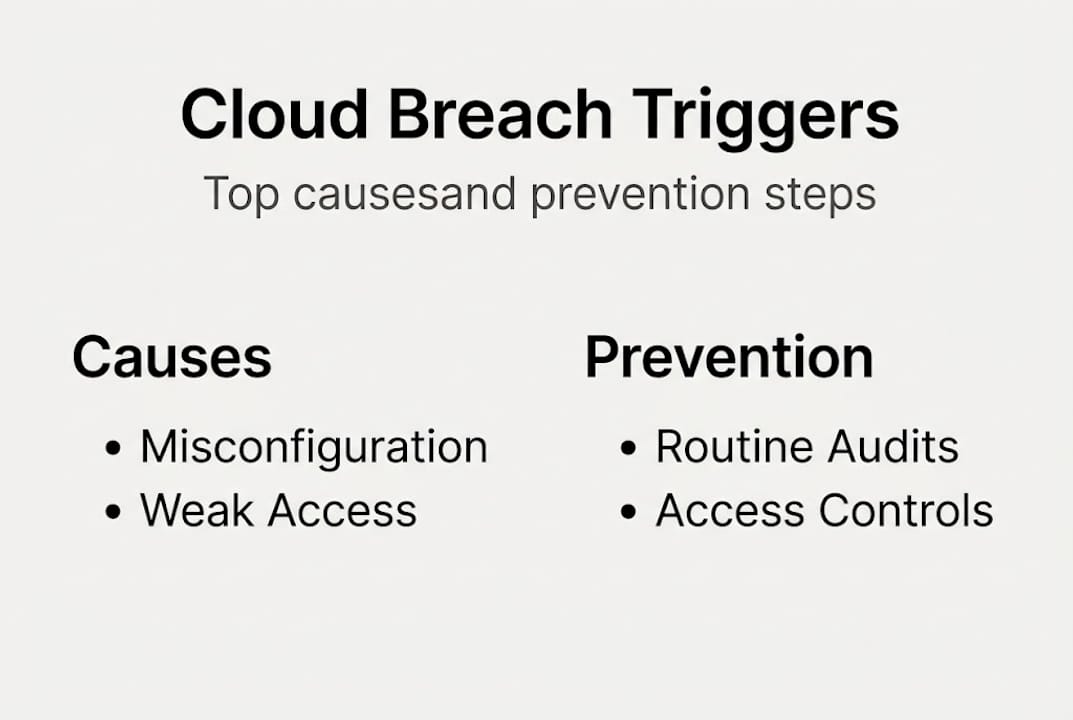
Public and private clouds carry different risk profiles. Multi-tenancy risks and regional sovereignty needs make public cloud environments more complex to secure in regulated markets. Private clouds offer tighter control but require more internal expertise to manage.
For organizations navigating these layers, frameworks like NIST CSF (Cybersecurity Framework), CSA CCM (Cloud Controls Matrix), and ISO 27001/27017 provide structured guidance. These are not optional reading. They are the foundations that regulators in KSA and UAE increasingly reference when auditing enterprise cloud environments. You can explore a broader information protection guide to see how these principles translate into business practice, and review securing cloud environments for applied recommendations.
Key areas covered by cloud security include:
- Physical security: Data center access, hardware integrity
- Network security: Firewalls, segmentation, DDoS (distributed denial-of-service) mitigation
- Identity and access management: Who can reach what, and when
- Application security: Secure coding, API (application programming interface) protection
- Data security: Encryption, masking, backup integrity
For a full view of how compliance frameworks for tech industries align with these layers, reviewing established standards before building your cloud architecture will save significant rework later.
Frameworks, compliance and regional mandates: Navigating KSA & UAE requirements
With core concepts clarified, it is vital to understand how regional compliance shapes security strategies in KSA and UAE. These two markets have moved quickly from general cybersecurity awareness to specific, enforceable mandates.
In Saudi Arabia, the National Cybersecurity Authority (NCA) sets the tone. The NCA CCC (Cloud Cybersecurity Controls) and ECC (Essential Cybersecurity Controls) are binding for organizations operating in the Kingdom. The PDPL (Personal Data Protection Law) adds another layer, requiring organizations to handle personal data of Saudi residents with defined safeguards. In the UAE, federal cybersecurity guidelines from the Telecommunications and Digital Government Regulatory Authority (TDRA) apply alongside sector-specific rules in finance and healthcare.
Local hosting of sensitive data is a non-negotiable requirement in both markets for government and regulated industries. This is often called data sovereignty, and it means your cloud provider must offer in-country or in-region data residency options.

Global frameworks complement these regional mandates. ISO 27017/27018 and CSA STAR align well with NCA guidance and provide internationally recognized benchmarks that auditors respect. ISO 27001 remains the baseline for information security management systems.
Here is a practical compliance checklist for KSA and UAE organizations:
- Map all data assets and classify them by sensitivity and regulatory category.
- Confirm your cloud provider holds in-country or in-region data residency options.
- Align your controls to NCA CCC/ECC (KSA) and TDRA guidelines (UAE).
- Implement PDPL-compliant data handling processes and documented consent flows.
- Achieve or pursue ISO 27001 certification as a baseline.
- Layer CSA STAR certification for cloud-specific assurance.
- Schedule quarterly compliance reviews, not just annual audits.
You can find detailed guidance on digital compliance in the GCC and read how data governance for leaders in Saudi Arabia and the UAE translates into actionable policy. For organizations focused on return on investment, unlocking data governance connects compliance spend to measurable business outcomes.
For a deeper look at how ISO compliance standards map to cloud environments, reviewing the ISO 27017 annex controls is a strong starting point.
Pro Tip: Do not treat compliance as a project with an end date. Build audit cycles into your cloud operating model from day one. Regulators in both KSA and UAE have signaled that enforcement will increase through 2026 and beyond.
Key mechanics of cloud security: Tools, practices and controls
Compliance requirements make the “how” of cloud security even more critical. Let’s look at the practical mechanics that ensure those requirements are met.
Identity and access management (IAM) is the starting point. RBAC (role-based access control) ensures users only access resources relevant to their role. MFA (multi-factor authentication) adds a second verification layer that blocks the majority of credential-based attacks. The principle of least privilege means every account, service, or process gets only the permissions it absolutely needs. Nothing more.
Encryption is non-negotiable. Data must be encrypted at rest and in transit. For regulated sectors in KSA and UAE, key management must also meet local standards, which often means using hardware security modules (HSMs) approved for regional deployment.
Beyond these basics, three categories of cloud security tooling have become essential for modern enterprises:
- CSPM (cloud security posture management): Continuously scans cloud configurations for misalignments against security baselines
- CWPP (cloud workload protection platform): Secures workloads including virtual machines, containers, and serverless functions
- CNAPP (cloud-native application protection platform): Combines CSPM and CWPP into unified visibility across the development and runtime lifecycle
According to cloud security reference guidance, combining IAM, CSPM, CWPP, and continuous monitoring creates the layered defense posture that regulators and auditors expect.
Infrastructure as Code (IaC) tools like Terraform and Ansible allow teams to provision cloud resources through version-controlled scripts. This is powerful, but IaC misconfigurations propagate risks at scale. One bad template, pushed across hundreds of cloud resources, creates hundreds of vulnerabilities simultaneously.
For practical guidance on distributed cloud data security and making the right architectural decisions around hybrid vs. multi-cloud strategies, both resources offer region-specific perspectives.
A thorough review of cloud security tools will help you prioritize which platforms fit your current security maturity level.
Pro Tip: Run IaC templates through automated security scanning before deployment. Tools like Checkov or tfsec catch misconfigurations before they reach production, saving hours of remediation time later.
- Implement MFA across all privileged accounts immediately.
- Run a CSPM scan on your current cloud environment to find misconfigurations.
- Encrypt all data stores at rest and verify TLS is enforced for data in transit.
- Define and document your least-privilege access policy by role.
- Set up real-time alerting for anomalous access patterns.
Risks, edge cases and emerging challenges in cloud security
Even with controls in place, leaders must recognize and address evolving risks. Let’s identify where things often go wrong and how to stay ahead.
Misconfiguration is the single largest driver of cloud breaches globally. Public storage buckets left open, overly permissive IAM policies, and disabled logging are all alarmingly common. Multi-cloud and hybrid complexity amplifies these issues because responsibility mapping becomes inconsistent across providers, and configuration drift accumulates faster than teams can catch it.
Configuration drift happens when a cloud environment gradually diverges from its approved security baseline. Each small change, a firewall rule here, a new service account there, adds up until your actual environment no longer matches what your compliance documentation describes. This gap is where auditors and attackers both find opportunity.
Key risk scenarios to monitor:
- Public storage exposure: S3 buckets, Azure Blob containers, or GCS buckets left publicly readable
- Orphaned accounts: Former employee or contractor credentials that were never deactivated
- Third-party integrations: SaaS tools with excessive API permissions connected to core systems
- AI and ML pipeline risks: Automated workloads that process sensitive data with insufficient access controls or logging
“Organizations using AI and machine learning automation in cloud environments must treat each automated pipeline as a potential attack surface, not just a productivity tool.” — Tamer Badr, Singleclic
Sovereign cloud models are gaining traction in KSA and UAE as an alternative to standard hyperscaler deployments. They offer data control and regulatory alignment that standard public cloud options cannot always guarantee for government and critical infrastructure sectors.
For organizations looking to avoid the most frequent failures, reviewing data protection mistakes specific to 2025 and 2026 cloud environments is a practical next step.
Pro Tip: After any major infrastructure change, such as a cloud migration, a new vendor onboarding, or an architecture redesign, run a full security posture review. Do not wait for the scheduled quarterly audit.
Beyond checklists: What most cloud security guides get wrong
Most cloud security guides hand you a checklist and call it a strategy. That approach worked when cloud environments were simpler and regulations were lighter. In 2026, it does not hold up.
The real challenge for enterprises in KSA and UAE is that compliance frameworks and threat landscapes are both moving targets. A control that satisfies NCA requirements today may be insufficient by next quarter as the authority issues updated guidance. A CSPM tool that catches today’s misconfigurations may not recognize next year’s AI-driven attack vectors.
Static checklists create a false sense of security. They tell you where you stood at the moment of the audit, not where you stand today.
What actually works is building a security culture alongside your technical controls. Leadership has to model the behavior, fund the continuous improvement cycles, and treat cloud security as a business function, not an IT cost center. Organizations that treat it as a living, breathing program rather than a periodic exercise consistently outperform those that treat it as a compliance box.
Regional expertise matters too. The nuances of PDPL, NCA CCC, and UAE cybersecurity guidelines require people who understand both the technical and regulatory context. Generic global frameworks are a starting point, not a finish line. If you want to understand how the digital transformation trends shaping KSA and UAE in 2026 connect to security priorities, that perspective is essential reading for any IT leader planning ahead.
Advance your cloud security strategy with expert guidance
Understanding cloud security principles is the first step. Applying them effectively across a regulated, fast-moving regional environment is where most organizations need a knowledgeable partner.
Singleclic works with enterprises across KSA, UAE, and Egypt to align cloud security strategy with regional compliance mandates, digital transformation goals, and operational realities. Whether you need help navigating digital compliance in the GCC, building a secure and scalable architecture through our digital transformation office, or implementing cloud security best practices that hold up to NCA and UAE regulatory scrutiny, our team of 70-plus consultants and engineers is ready to support your next step. Reach out to start a conversation tailored to your organization’s specific risk profile and compliance landscape.
Frequently asked questions
What is cloud security and why is it important for KSA/UAE organizations?
Cloud security covers the policies, controls, and technologies used to protect cloud-based infrastructure, applications, and data. In KSA and UAE, data sovereignty mandates require local hosting for sensitive and government data, making security strategy directly tied to regulatory standing.
How does the shared responsibility model work?
Cloud providers secure the underlying infrastructure, while customers are responsible for managing application security, configurations, and data. The shared responsibility split shifts depending on whether you use IaaS, PaaS, or SaaS.
What frameworks are recommended for cloud security in the Middle East?
NIST CSF, CSA CCM, and ISO 27001/17/18 are globally recognized standards that align well with regional mandates. Regional alignment with NCA guidance and CSA STAR certification adds the local compliance layer that KSA and UAE regulators expect.
What are common risks in cloud security?
Misconfigurations, configuration drift across multi-cloud setups, exposed public storage buckets, and AI/ML pipeline gaps are the most frequent failure points. Multi-cloud complexity and AI/ML risks are particularly acute as cloud environments grow more sophisticated.
How can organizations ensure ongoing compliance and security in the cloud?
Continuous monitoring, real-time alerting, and regular audits tied to your compliance calendar are essential. Integrating continuous audits and compliance reviews into your cloud operating model, rather than treating them as one-time events, is what separates resilient organizations from reactive ones.