Many executives confuse customer experience platforms with CRM systems, missing their transformative potential. While CRM manages sales pipelines, a customer experience platform orchestrates entire customer journeys across every touchpoint. For C-level and IT leaders in KSA and UAE, understanding this distinction is critical as organizations pursue Vision 2030 goals. The Saudi CX market is projected to reach $746.7M by 2032, driven by demand for Arabic-first, AI-powered solutions that unify data, personalize interactions, and boost operational efficiency. This guide clarifies what customer experience platforms are, how they differ from CRM, and strategic implementation considerations for regional decision-makers.
Table of Contents
- Understanding What A Customer Experience Platform Is
- Core Components And Technology Behind Customer Experience Platforms
- Key Differences Between Customer Experience Platforms And Crm Systems
- Navigating Ai Capabilities And Limitations In Cx Platforms
- Strategic Considerations For Implementing Cx Platforms In Ksa And Uae
- Explore How Singleclic Can Empower Your Cx Platform Strategy
- Frequently Asked Questions About Customer Experience Platforms
Key takeaways
| Point | Details |
|---|---|
| CX platforms unify journeys | They consolidate data from all touchpoints to deliver consistent, personalized interactions across channels. |
| AI drives personalization | Predictive intelligence and automation optimize customer experiences while human agents handle complex cases. |
| Different from CRM | CRM focuses on internal sales efficiency, while CX platforms orchestrate end-to-end customer experiences. |
| Regional growth opportunity | Saudi CX market growing at 20% CAGR with demand for Arabic-enabled, culturally attuned platforms. |
| Integration is essential | Success requires seamless connection with existing ERP, CRM, and business process systems. |
Understanding what a customer experience platform is
A customer experience platform is integrated software that unifies customer data from multiple touchpoints to deliver personalized, consistent interactions across channels. Unlike point solutions that handle single functions, these platforms use AI, analytics, and automation to optimize entire customer journeys. They consolidate behavioral data, purchase history, support interactions, and sentiment signals into a single view.
The power lies in orchestration. When a customer contacts support after browsing your website, the platform ensures the agent sees the browsing history, previous purchases, and sentiment indicators. This context enables personalized responses that feel seamless rather than fragmented. The platform tracks every interaction, learns patterns, and predicts next best actions.
Three core capabilities define these platforms:
- Unified data foundation: Consolidates structured and unstructured data from web, mobile, email, chat, phone, and in-store channels
- Journey orchestration: Manages customer progression through touchpoints with automated triggers and personalized content
- Intelligence layer: Applies AI to predict behavior, recommend actions, and identify at-risk customers before they churn
For enterprises in KSA and UAE, these capabilities directly support operational efficiency goals. Instead of teams working from siloed data sources, everyone accesses the same customer truth. This alignment reduces response times, eliminates contradictory messaging, and improves user experience across digital and physical channels.
“A customer experience platform transforms scattered interactions into coherent journeys, enabling organizations to compete on experience rather than just product features.”
The platform becomes your system of engagement, sitting above transactional systems like ERP and CRM. It pulls data from these sources, enriches it with behavioral signals, and pushes insights back to operational teams. This architecture enables real-time personalization at scale without replacing existing infrastructure.
Core components and technology behind customer experience platforms
Every robust customer experience platform contains five essential technical components that work together to deliver seamless experiences. Understanding these elements helps leaders evaluate solutions and plan implementations.

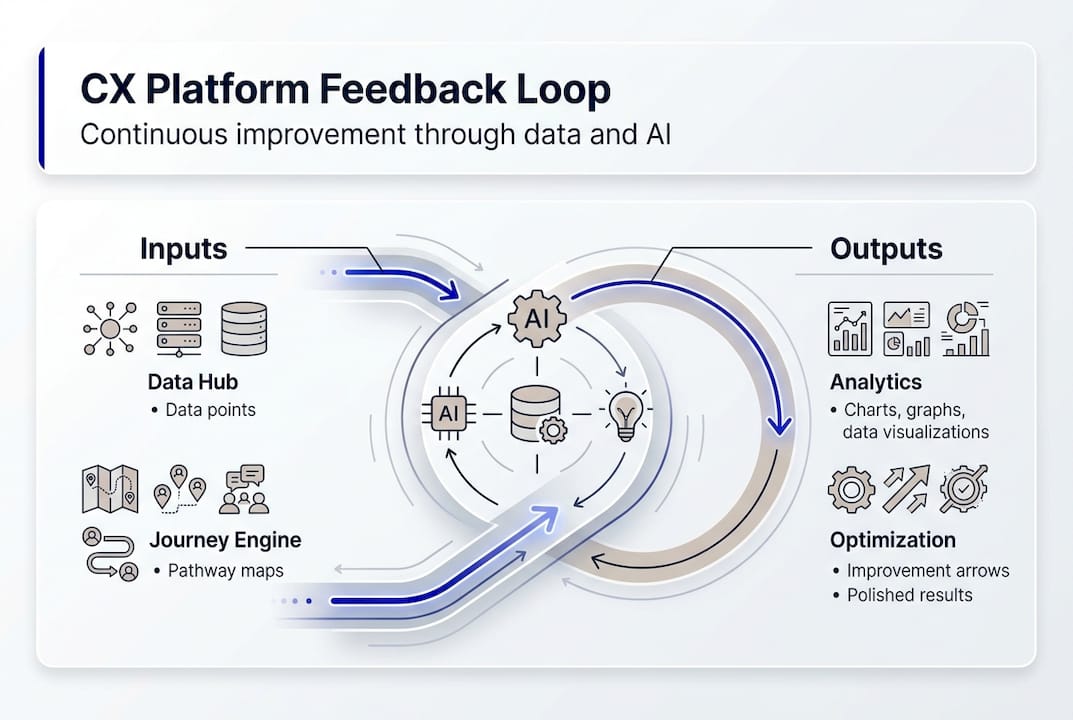
The central data hub functions like a customer data platform, consolidating information from disparate sources into unified profiles. It ingests data from websites, mobile apps, call centers, email systems, and IoT devices. Advanced platforms handle real-time streaming data, ensuring profiles update instantly as customers interact. This hub resolves identity across devices and channels, maintaining accuracy even as customers switch between touchpoints.
Journey orchestration engines manage how customers progress through experiences. These tools define triggers, decision points, and next best actions based on behavior and context. If a customer abandons a cart, the engine might trigger an email with a discount, followed by a personalized SMS if the email goes unopened. Orchestration ensures consistency, preventing customers from receiving conflicting messages from different departments.
The AI intelligence layer adds predictive power. Machine learning models analyze historical patterns to forecast churn risk, lifetime value, and purchase propensity. Natural language processing interprets sentiment in support tickets and social media. Recommendation engines suggest products based on browsing behavior and similar customer profiles. This layer enables anticipating customer behavior before explicit signals appear.
Omnichannel delivery infrastructure ensures experiences translate across channels. A customer starting a purchase on mobile should complete it on desktop without friction. Support conversations initiated via chat should continue seamlessly if the customer calls. This omnichannel capability requires sophisticated session management and state synchronization.
Analytics and measurement tools track performance across journeys. Dashboards show conversion rates, satisfaction scores, and revenue impact by segment. Attribution models identify which touchpoints drive outcomes. ROI calculators demonstrate the business value of experience improvements.
| Component | Primary Function | Business Impact |
|---|---|---|
| Central Data Hub | Unifies customer data | Single source of truth |
| Journey Orchestration | Manages touchpoint flow | Consistent experiences |
| AI Intelligence | Predicts and personalizes | Proactive engagement |
| Omnichannel Delivery | Maintains context | Seamless transitions |
| Analytics | Measures outcomes | Data-driven optimization |
Pro Tip: When evaluating platforms, test how quickly the central hub updates after a customer interaction. Real-time capabilities separate enterprise-grade solutions from legacy systems that batch process overnight.
These components create a feedback loop. Analytics identify friction points, AI suggests optimizations, orchestration implements changes, and the data hub captures results. This continuous improvement cycle drives measurable gains in customer satisfaction and operational efficiency.
Key differences between customer experience platforms and CRM systems
The confusion between customer experience platforms and CRM systems stems from overlapping features, but their fundamental purposes differ. CRM focuses on internal efficiency and transactional data, while CX platforms orchestrate end-to-end customer journeys using behavioral and sentiment data.
CRM systems excel at managing sales pipelines, tracking deals, and organizing customer records for sales teams. They capture contact information, purchase history, and interaction logs. The primary users are sales representatives, account managers, and support agents who need structured data to close deals and resolve issues. CRM optimizes internal processes like lead scoring, opportunity management, and territory planning.
Customer experience platforms take a broader view. They map entire customer journeys from awareness through advocacy, identifying moments that matter across all touchpoints. Instead of focusing on transactions, they capture behavioral signals like browsing patterns, content engagement, and sentiment shifts. The platform uses this data to orchestrate personalized experiences automatically, not just inform human agents.
Key distinctions include:
- Data scope: CRM stores structured transactional data; CX platforms process behavioral, sentiment, and contextual signals
- User focus: CRM serves internal teams; CX platforms directly engage customers through automated personalization
- Journey coverage: CRM handles sales and support; CX platforms manage awareness, consideration, purchase, retention, and advocacy
- Intelligence application: CRM reports on past activity; CX platforms predict future behavior and prescribe actions
For personalized customer journeys, organizations need both systems working together. CRM captures the transactional backbone while the CX platform adds experiential intelligence. When a customer reaches out, CRM provides purchase history and support tickets. The CX platform adds browsing behavior, sentiment analysis, and predictive churn risk.
| Dimension | CRM System | CX Platform |
|---|---|---|
| Primary Goal | Internal efficiency | Customer experience |
| Data Type | Transactional | Behavioral + sentiment |
| Automation | Workflow for teams | Journey orchestration |
| Analytics | Sales metrics | Experience metrics |
Pro Tip: Don’t replace CRM with a CX platform. Integrate them. Use CRM as the system of record for transactions and the CX platform as the system of engagement for experiences.
The integration point is critical. Leading platforms sync bidirectionally with CRM, enriching customer records with experience data while pulling transactional history for context. This architecture preserves existing investments while adding experiential capabilities that drive loyalty and lifetime value.
Navigating AI capabilities and limitations in CX platforms
Agentic AI is transforming customer experience platforms by automating routine interactions and scaling personalization. These AI agents handle common inquiries, process simple transactions, and route complex cases to human specialists. They learn from interactions, improving responses over time without manual programming.
The benefits are substantial. AI agents operate 24/7 across languages, handling thousands of simultaneous conversations. They maintain consistent brand voice, never forget policies, and access complete customer context instantly. For routine tasks like checking order status, updating account information, or answering FAQ questions, AI matches or exceeds human performance while reducing operational costs.
However, AI limitations require careful workflow design. Emotion recognition remains challenging. While AI detects sentiment in text, it struggles with sarcasm, cultural nuances, and complex emotional states. A frustrated customer using polite language might not trigger appropriate escalation. Governance gaps emerge when AI encounters scenarios outside training data, potentially making commitments the organization cannot honor.
Domain expertise limitations affect specialized industries. An AI trained on general customer service may lack the technical knowledge to troubleshoot complex products or navigate regulatory requirements in banking or healthcare. Edge cases like payment failures, shipping delays, or product defects often require human judgment and empathy.
Effective implementations design for AI failures:
- Clear escalation triggers: Define when conversations transfer to humans based on sentiment, complexity, or customer request
- Graceful handoffs: Ensure human agents receive full context when taking over from AI
- Continuous monitoring: Track AI performance metrics and retrain models when accuracy drops
- Transparency: Inform customers when interacting with AI and offer human alternatives
Pro Tip: Start AI deployment with high-volume, low-complexity interactions. Monitor closely, gather feedback, and expand gradually. This approach builds confidence while minimizing risk.
The optimal model combines AI efficiency with human expertise. AI handles the first tier, resolving 60-80% of inquiries instantly. Complex cases escalate to specialists who leverage AI-generated insights and recommendations. This hybrid approach anticipates customer behavior while maintaining the human touch for situations requiring empathy and judgment.
“AI should amplify human capabilities, not replace them. The goal is faster resolution for routine issues and more time for specialists to handle complex situations that build loyalty.”
For KSA and UAE organizations, Arabic language AI presents additional considerations. Models must handle dialectal variations, code-switching between Arabic and English, and cultural context. Platforms with regional language expertise deliver better outcomes than generic solutions adapted for Arabic.
Strategic considerations for implementing CX platforms in KSA and UAE
The Saudi CX market is projected to reach $746.7M by 2032, growing at 20% CAGR. This expansion reflects government digitalization initiatives, rising consumer expectations, and competitive pressure to differentiate on experience. UAE follows similar trajectories, with Dubai and Abu Dhabi leading regional innovation.
For C-level and IT decision-makers, several strategic priorities shape successful implementations. Arabic-first platforms are non-negotiable. Solutions must offer full Arabic UI/UX, right-to-left text rendering, and culturally attuned content. Platforms like Lucidya and CX-awe demonstrate regional success by prioritizing Arabic capabilities from inception rather than adding them as afterthoughts.
Integration with existing ERP and CRM systems determines operational efficiency gains. Customer experience platforms should enhance, not replace, core business systems. Seamless data flow between ERP, CRM, and HR systems ensures customer-facing teams access complete context. Order status from ERP, account history from CRM, and service records from support systems combine to enable informed interactions.
AI-driven personalization aligns with Vision 2030 goals of economic diversification and digital leadership. Platforms that leverage predictive analytics help organizations move from reactive service to proactive engagement. Identifying at-risk customers before churn, recommending products based on behavior, and optimizing journey touchpoints drive revenue while improving satisfaction.
Implementation considerations include:
- Data sovereignty: Ensure platforms support on-premise deployment or regional cloud hosting to meet regulatory requirements
- Scalability: Choose solutions that handle Arabic content processing at enterprise scale without performance degradation
Priority Requirement Regional Relevance Language Full Arabic support Essential for KSA/UAE markets Integration ERP/CRM connectivity Operational efficiency AI Personalization Predictive analytics Vision 2030 alignment Compliance Data sovereignty Regulatory requirements
Pro Tip: Pilot with one customer journey before enterprise rollout. Measure impact on satisfaction, efficiency, and revenue. Use results to build internal support and refine implementation approach.
The regional opportunity extends beyond customer-facing experiences. Internal process optimization through customer insights improves product development, inventory management, and resource allocation. Organizations treating CX platforms as strategic assets rather than marketing tools gain competitive advantages that compound over time.
Success requires executive sponsorship, cross-functional collaboration, and commitment to continuous improvement. Digital trends in 2026 emphasize experience as a primary differentiator. Organizations investing now position themselves for sustained growth as regional markets mature.
Explore how Singleclic can empower your CX platform strategy
Implementing a customer experience platform requires more than software selection. It demands integration expertise, process optimization, and strategic alignment with your operational goals. Singleclic brings 10+ years of digital transformation experience across KSA, UAE, and Egypt, helping organizations connect CX platforms with existing ERP, CRM, and business process systems.
Our approach starts with assessing ERP readiness to ensure your foundational systems can support advanced customer experience capabilities. We then design integration architectures using low-code platforms like Cortex, our Arabic-enabled solution built for MENA enterprises. This enables you to integrate ERP, CRM, and HR systems seamlessly while maintaining data sovereignty.
For C-level leaders evaluating CX investments, our business process automation guide clarifies how customer experience platforms fit within broader digital strategies. We help you identify high-impact use cases, measure ROI, and scale implementations across your organization. Whether you’re implementing Odoo, Microsoft Dynamics 365, or custom solutions, our 70+ consultants deliver results aligned with Vision 2030 objectives.
Frequently asked questions about customer experience platforms
What are the biggest implementation challenges for customer experience platforms?
Data integration complexity tops the list, as platforms must connect with legacy systems, cloud applications, and third-party services. Organizations also struggle with change management, as CX platforms require cross-functional collaboration between marketing, sales, service, and IT teams. Establishing governance for data quality and defining clear ownership of customer experience initiatives are critical success factors.
How long does it take to see ROI from a customer experience platform?
Quick wins appear within 3-6 months through improved response times, reduced support costs, and increased conversion rates on high-traffic journeys. Substantial ROI typically materializes in 12-18 months as organizations optimize more complex journeys, reduce churn, and increase customer lifetime value. The timeline depends on implementation scope, data quality, and organizational readiness.
Can small and medium enterprises benefit from customer experience platforms?
Yes, though SMEs should focus on platforms with modular pricing and rapid deployment capabilities. Cloud-based solutions with pre-built integrations reduce implementation costs and complexity. SMEs gain competitive advantages by delivering personalized experiences that rival larger competitors, often with faster decision-making and implementation cycles.
How do customer experience platforms handle data privacy and compliance?
Leading platforms include consent management, data encryption, access controls, and audit trails as core features. They support regional regulations through configurable data residency, retention policies, and customer data portability. Organizations must still define policies and train teams, but platforms provide technical controls to enforce compliance.
What metrics should executives track to measure customer experience platform success?
Start with customer satisfaction scores, Net Promoter Score, and customer effort score to gauge experience quality. Add operational metrics like average resolution time, first-contact resolution rate, and cost per interaction. Financial metrics include customer lifetime value, churn rate, and revenue per customer. Track journey-specific conversion rates to identify optimization opportunities.
How does a customer experience platform support omnichannel strategies?
The platform maintains unified customer profiles and session state across channels, enabling seamless transitions. When customers switch from web to mobile to phone, context persists. Orchestration engines ensure consistent messaging and offers regardless of channel. Analytics show how customers move between touchpoints, revealing preferred paths and friction points that inform optimization efforts.