Many assume government digital transformation crawls at a glacial pace, burning budgets with minimal results. Yet Saudi Arabia and UAE have shattered this myth, achieving near-total digital service adoption and recycling millions in savings to scale automation beyond initial pilots. This guide reveals the technologies, governance models, and proven strategies enabling Gulf states to deliver exceptional citizen services while slashing costs. You’ll discover actionable insights from landmark projects, understand hybrid AI and RPA systems powering these wins, and learn how to avoid common pitfalls that trap automation efforts in perpetual pilot mode.
Table of Contents
- Understanding The Role Of Automation In Public Sector Transformation
- Successful Automation Projects And Measurable Impact In Saudi Arabia And Uae
- Technologies Powering Automation: Hybrid Ai And Rpa In Public Sector Operations
- Governance, Challenges, And Scaling Automation Beyond Pilot Projects
- Explore Strategic Automation Solutions With Singleclic
- Frequently Asked Questions
Key takeaways
| Point | Details |
|---|---|
| Proven efficiency gains | Saudi Arabia and UAE automation projects achieve 99.5% digital adoption with quantified cost savings exceeding AED 743 million in water management alone. |
| Hybrid technology advantage | Combining AI decision-making with RPA execution overcomes 30-50% failure rates of standalone systems while reducing maintenance costs. |
| Governance drives scale | Concentrated authority, enforceable policies, and reinvestment mechanisms enable UAE to transform pilots into hundreds of automated services. |
| Strategic orchestration | Early investment in AI-enabled orchestration hubs accelerates reform efforts and maximizes automation value across agencies. |
| Policy multiplier effect | Operational streamlining policies like Services 360 eliminate 90% of service delivery points, multiplying automation benefits exponentially. |
Understanding the role of automation in public sector transformation
Saudi Arabia’s Vision 2030 and the UAE’s digital ambition aren’t abstract policy documents. They’re strategic frameworks driving measurable transformation through automation technologies that improve efficiency, reduce costs, and enhance citizen engagement. For public sector leaders, automation represents the execution layer of these national strategies, translating digital ambitions into tangible service improvements and operational gains.
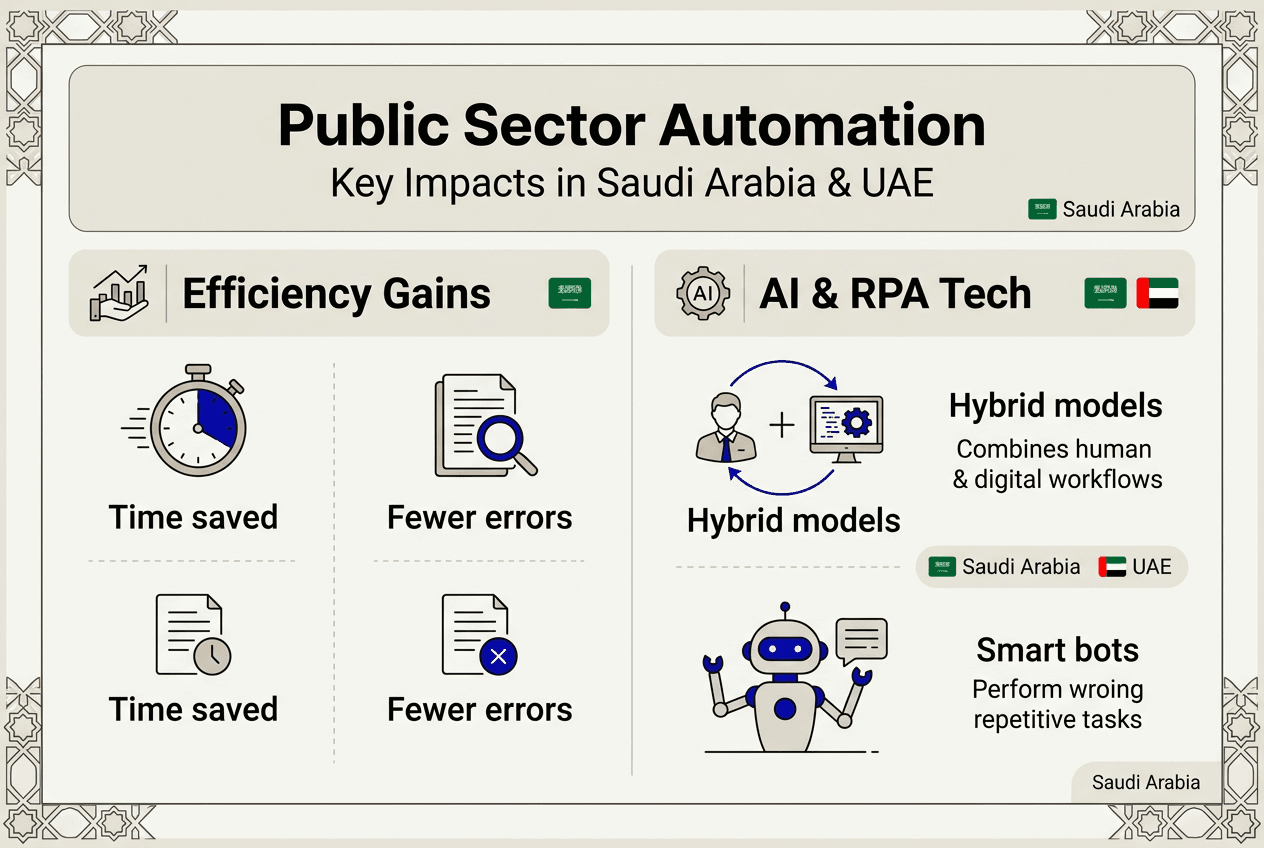
Automation encompasses three core technology families reshaping government operations. Robotic Process Automation handles repetitive, rule-based tasks like data entry and document processing. Artificial Intelligence adds cognitive capabilities for decision support, pattern recognition, and predictive analytics. Hybrid approaches combine both, leveraging AI’s interpretive power with RPA’s execution reliability to tackle complex workflows traditional systems can’t handle.
The strategic value extends beyond efficiency metrics. Automation enables governments to reallocate human talent from mundane tasks to high-value citizen interactions, policy development, and innovation initiatives. It creates data foundations for evidence-based policymaking while improving service consistency and accessibility. For public sector digital transformation to succeed, leaders must view automation as infrastructure investment, not IT project.
Successful implementation demands leadership commitment and strategic orchestration across fragmented agency structures. Leaders championing automation must secure executive sponsorship, align stakeholder incentives, and establish governance frameworks that sustain momentum beyond initial wins. The difference between transformational impact and stalled pilots often hinges on whether automation receives strategic priority or gets relegated to departmental experimentation.
Pro Tip: Investing early in AI-enabled orchestration hubs can accelerate reform efforts by creating centralized automation expertise, reusable components, and cross-agency collaboration mechanisms that prevent duplication and compound learning across government.
Key automation enablers for public sector success include:
- Executive leadership actively championing automation as strategic priority
- Clear governance structures with decision rights and accountability
- Investment in technical infrastructure and talent development
- Citizen-centric service design principles guiding automation choices
- Measurement frameworks tracking both efficiency and service quality outcomes
Successful automation projects and measurable impact in Saudi Arabia and UAE
Dubai Electricity and Water Authority exemplifies automation at scale. DEWA achieved digital integration across more than 100 projects with service automation reaching 100%, demonstrating that comprehensive transformation is achievable, not aspirational. This wasn’t incremental digitization. DEWA orchestrated wholesale service redesign, achieving 99.5% digital adoption among customers while maintaining 99.99% service availability.

The financial impact validates the strategic investment. DEWA’s smart infrastructure generated 3.2 million water leak alerts, preventing massive resource loss and delivering AED 743 million in savings. These aren’t projected benefits. They’re realized returns funding further automation expansion and service enhancements. The utility transformed from cost center to innovation engine, recycling efficiency gains into capabilities that compound over time.
Policy amplification multiplied automation benefits beyond individual projects. The UAE’s Services 360 initiative eliminated 90% of physical service delivery points by consolidating fragmented touchpoints into integrated digital channels. This operational streamlining created network effects where each automated service enhanced the value of others, accelerating adoption and reducing per-service delivery costs exponentially.
| Impact Metric | Achievement | Timeframe |
|---|---|---|
| Digital service adoption | 99.5% | 2024-2025 |
| Integrated automation projects | 100+ | Ongoing |
| Cost savings (water management) | AED 743 million | Annual |
| Customer happiness score | 95% | Current |
| Service availability | 99.99% | Current |
These metrics reveal automation’s dual value proposition for public sector smart automation. Efficiency gains fund expansion while service quality improvements drive citizen adoption, creating virtuous cycles that justify continued investment. Leaders can point to quantified returns when securing budget approvals and stakeholder buy-in.
The DEWA automation case study demonstrates how digital government projects in MENA achieve transformational scale. Success factors include integrated technology platforms, data-driven operations, and customer-centric service design. DEWA didn’t automate existing processes. It reimagined service delivery from the citizen perspective, then built automation to support that vision.
Pro Tip: Leveraging policy-driven operational streamlining can multiply automation benefits by creating ecosystem effects where individual project gains compound across the entire service portfolio.
Key success patterns from Gulf automation projects:
- Start with high-volume, citizen-facing services for visible impact
- Integrate automation with broader service redesign, not just digitize existing workflows
- Establish metrics tracking both efficiency and citizen satisfaction
- Recycle savings into scaling automation beyond initial pilots
- Use policy levers to accelerate adoption and eliminate legacy touchpoints
Technologies powering automation: hybrid AI and RPA in public sector operations
Robotic Process Automation executes predefined workflows by mimicking human interactions with software systems. RPA bots handle repetitive tasks like form processing, data validation, and system updates with perfect consistency. Artificial Intelligence adds cognitive capabilities, enabling systems to interpret unstructured data, make contextual decisions, and adapt to variations traditional RPA can’t handle.
Standalone RPA faces significant limitations in complex government environments. Initial implementations experience 30-50% failure rates due to fragile automation that breaks when underlying systems change. Maintenance costs balloon as organizations discover bots require constant updating to accommodate process variations and system updates. These challenges have led many agencies to abandon RPA investments after disappointing pilot results.
Hybrid AI and RPA combines AI interpretation with RPA execution, solving limitations each technology faces alone. AI handles variable inputs, interprets documents, and makes routing decisions. RPA executes the resulting actions with speed and accuracy. This architecture delivers flexibility without sacrificing reliability, enabling automation of complex workflows that defeated traditional approaches.
| Dimension | Traditional RPA | Hybrid AI and RPA |
|---|---|---|
| Implementation success rate | 50-70% | 85-95% |
| Maintenance cost | High (constant updates) | Moderate (adaptive learning) |
| Process complexity handled | Low to moderate | High |
| Scalability | Limited by fragility | High with proper governance |
| Adaptation to change | Manual reconfiguration | Automated learning |
Implementing hybrid automation successfully requires systematic approaches that address both technical and organizational dimensions. Leaders must recognize automation as organizational capability, not technology deployment. The role of RPA in business extends beyond task execution to process intelligence and continuous improvement.
Steps for implementing hybrid automation systems:
- Identify high-value processes with sufficient volume to justify automation investment and measurable citizen impact
- Map current workflows documenting variations, exceptions, and decision points that require AI interpretation
- Design hybrid architecture specifying which components use AI for decisions versus RPA for execution
- Build governance framework establishing change management, quality assurance, and performance monitoring protocols
- Deploy iteratively starting with controlled pilots that validate technical approach and organizational readiness
- Scale systematically using lessons from pilots to refine implementation methodology and expand scope
- Optimize continuously by analyzing performance data to identify improvement opportunities and emerging use cases
The technical architecture matters less than organizational readiness. Agencies with strong process discipline, data quality, and change management capabilities achieve better outcomes with simpler technologies than those deploying sophisticated AI without foundational capabilities. Start with processes you understand deeply, automate incrementally, and build expertise before tackling complex transformations.
Hybrid approaches also enable CRM in citizen services by connecting front-end citizen interactions with back-end process automation. AI interprets citizen requests and routes them appropriately while RPA executes fulfillment workflows, creating seamless experiences that hide government complexity from citizens.
Governance, challenges, and scaling automation beyond pilot projects
Many automation initiatives stall in pilot purgatory, demonstrating technical feasibility without achieving organizational impact. The difference between UAE’s scaled success and Kuwait’s stalled pilots illustrates how governance structures determine automation outcomes more than technology choices or financial resources. Authority structures, sanctions, and reinvestment enable pilots to turn into hundreds of services in the UAE, while fragmented governance limits Kuwait despite similar technical capabilities and wealth.
Vertical rule coherence matters more than horizontal wealth for extracting public value from AI and automation. Concentrated authority enables rapid decision-making, consistent policy enforcement, and resource reallocation that sustain momentum beyond initial wins. Fragmented governance creates coordination costs, conflicting priorities, and accountability gaps that drain energy from transformation efforts regardless of budget availability.
Key challenges blocking automation scale include:
- Fragmented authority across agencies preventing coordinated automation strategies
- Lack of enforceable policies allowing departments to opt out of transformation initiatives
- Budget lapses interrupting multi-year automation programs and losing institutional momentum
- Insufficient reinvestment mechanisms that capture efficiency savings for scaling rather than budget cuts
- Weak accountability frameworks failing to reward automation success or address implementation failures
Governance frameworks enabling sustainable automation must address these structural impediments. Efficiency metrics yield societal benefits only with enforceable safeguards ensuring automation serves citizen welfare rather than merely reducing headcount. Leaders must establish guardrails preventing efficiency gains from degrading service quality or exacerbating inequities.
Best practices for automation governance and scaling:
- Establish centralized automation authority with mandate to set standards and coordinate initiatives
- Create enforceable policies requiring agency participation in transformation programs
- Secure multi-year funding commitments protecting automation investments from annual budget cycles
- Design reinvestment mechanisms automatically recycling efficiency savings into scaling automation
- Implement accountability frameworks with clear metrics, regular reviews, and consequences for performance
- Build safeguards ensuring automation enhances rather than undermines service quality and equity
- Develop talent strategies attracting and retaining automation expertise across government
The key challenges in public sector digitization extend beyond technology to organizational culture, stakeholder alignment, and change management. Successful leaders recognize automation as organizational transformation requiring sustained executive attention, not IT project delegated to technical teams.
Scaling requires shifting from project thinking to platform thinking. Rather than automating processes individually, build reusable automation capabilities, shared data infrastructure, and common service components that reduce marginal cost of each additional automation. This platform approach creates compounding returns where later automations cost less and deliver faster than early ones.
Explore strategic automation solutions with Singleclic
Transforming automation insights into organizational reality requires partners who understand both technology and the unique context of public sector operations in Saudi Arabia and UAE. Singleclic combines deep regional expertise with proven automation methodologies, helping leaders navigate the journey from pilot to scale with confidence.
Our business process automation guide provides frameworks for evaluating automation opportunities, building business cases, and establishing governance structures that sustain momentum. We’ve helped organizations across KSA, UAE, and Egypt implement automation strategies that deliver measurable returns while building internal capabilities for continuous improvement.
Whether you’re launching initial automation pilots or scaling proven successes across your organization, Singleclic offers tailored support addressing your specific challenges. Explore business process automation in large enterprises to understand how leading organizations achieve transformational outcomes. Ready to begin? Assess ERP readiness to evaluate your foundation for automation success and identify priority investments.
Frequently asked questions
What technologies are included in public sector automation?
Robotic process automation, artificial intelligence, and hybrid AI and RPA solutions form the core technology stack enabling government automation initiatives. RPA handles repetitive, rule-based tasks while AI interprets unstructured data and makes contextual decisions. Hybrid approaches combine both technologies, leveraging AI for interpretation and RPA for reliable execution of complex workflows.
How does Saudi Arabia’s Vision 2030 support automation?
Vision 2030 drives automation adoption by setting targets for efficiency, cost savings, and enhanced citizen engagement through digital technologies. The framework prioritizes automation as a core enabler of public sector modernization, providing strategic direction and resources for transformation initiatives. This national commitment creates sustained momentum beyond individual project cycles.
What challenges do public sectors face when scaling automation?
Fragmented governance, policy enforcement deficiency, and budget or strategy lapses represent the primary obstacles blocking automation scale. Concentrated authority and enforceable policies enable scaling in the UAE, whereas lack of these structural enablers limits progress in other contexts despite similar resources. Successful scaling requires aligned leadership, clear mandates, and reinvestment mechanisms that recycle efficiency savings into expanded automation.
How can public sector leaders best implement hybrid AI and RPA?
Leaders should adopt hybrid solutions integrating AI decision-making with RPA process automation to overcome limitations of standalone technologies. Focus on governance frameworks, maintenance planning, and iterative scaling approaches that build organizational capabilities alongside technical systems. Start with high-value processes, validate approaches through controlled pilots, then scale systematically using lessons learned to refine implementation methodology.