Most executives treat business agility like a toolkit, something you adopt when convenient and shelve when priorities shift. That’s the fundamental mistake costing organizations their competitive edge. Business agility isn’t a methodology you implement. It’s a core organizational competence that determines whether you thrive or stagnate amid complexity. For C-level leaders in KSA and UAE navigating construction timelines, healthcare regulations, and banking disruptions, understanding this distinction separates sustainable growth from reactive firefighting. This guide clarifies what business agility truly means, the paradoxes you’ll face, and practical frameworks to embed adaptability into your organization’s DNA.
Table of Contents
- Defining Business Agility: Core Organizational Competence For Sustained Success
- Navigating Paradoxes And Challenges In Achieving Business Agility
- Implementing Business Agility In KSA And UAE Industries: Practical Frameworks And Strategies
- Measuring Business Agility Impact: KPIs And Continuous Improvement
- Explore Tools And Insights To Enhance Your Business Agility With Singleclic
- Frequently Asked Questions About Business Agility
Key takeaways
| Point | Details |
|---|---|
| Core competence, not methodology | Business agility is an organizational capability for continuous adaptation and value creation, not a process you install. |
| Paradox management required | Leaders must balance autonomy with accountability, speed with stability, and short-term wins with long-term sustainability. |
| Complexity drives necessity | Rapid technological shifts, workforce evolution, and geopolitical uncertainty make agility essential for survival in 2026. |
| Sector-specific application | Construction, healthcare, and banking in KSA and UAE demand tailored agility frameworks aligned with regulatory and operational realities. |
| Measurable impact | Effective agility requires KPIs tracking adaptability speed, innovation rate, and customer satisfaction through continuous improvement cycles. |
Defining business agility: core organizational competence for sustained success
Business agility represents your organization’s fundamental ability to sense environmental shifts, respond decisively, and create value regardless of external turbulence. It’s not about moving fast or adopting Scrum ceremonies. It’s about building institutional muscle that keeps you relevant when markets pivot overnight.
The Insights Report 2025 frames this clearly:
Agility must be understood not as a methodology but as a core organizational competence: the ability to adapt continuously and create sustainable value in complex, uncertain environments.
This definition shifts the conversation from tools to capability. Your ERP system doesn’t make you agile. Your ability to reconfigure operations, reallocate resources, and reimagine customer value when disruption hits determines your agility quotient.
For executives in construction, this means adjusting project timelines and supply chains when material costs spike or regulations change. In healthcare, it’s redesigning patient workflows as telehealth adoption accelerates. Banking leaders face constant pressure from fintech competitors and evolving compliance frameworks. Each scenario demands institutional reflexes, not just strategic planning.
True business agility requires three foundational elements:
- Sensing mechanisms that detect market signals, customer behavior shifts, and competitive moves before they become crises
- Decision architectures enabling rapid resource reallocation without bureaucratic bottlenecks
- Execution capabilities translating strategic pivots into operational reality within weeks, not quarters
When you align business agility with your digital transformation roadmap 2025, you create compounding advantages. Technology becomes the enabler, not the objective. Your systems support faster experimentation, your data informs better decisions, and your processes flex without breaking.
Pro Tip: Assess your current agility by measuring decision latency. Track how long it takes from identifying an opportunity to deploying resources. If that window exceeds 30 days for non-capital decisions, you’re operating with organizational arthritis, not agility.
The distinction matters because leaders often confuse operational efficiency with business agility. Running lean operations is valuable, but it doesn’t guarantee adaptability. You can optimize current processes while remaining vulnerable to disruption. Business agility demands you build capacity for continuous transformation, not just incremental improvement.
Navigating paradoxes and challenges in achieving business agility
Business agility forces you to hold contradictory truths simultaneously. You must empower teams while maintaining accountability. You need speed without sacrificing stability. You chase short-term results while building long-term resilience. These aren’t problems to solve but paradoxes to manage.
The central challenge involves managing autonomy versus accountability, speed versus stability, and balancing immediate pressures with strategic responsibilities. Get the balance wrong, and you either create chaos or stagnation.

Consider autonomy versus accountability. Agile organizations push decision-making authority to frontline teams. They trust people closest to customers and operations to act without waiting for executive approval. But that autonomy requires robust accountability frameworks. You need clear outcome metrics, transparent reporting, and consequences for poor judgment. Too much control kills initiative. Too little creates risk exposure that threatens the entire organization.
Speed versus stability presents another fundamental tension. Markets reward organizations that move quickly, launching products, entering segments, and responding to competitors faster than rivals. But reckless speed destroys institutional knowledge, alienates customers through half-baked offerings, and burns out teams. You need velocity with guardrails, experimentation with governance.
The 2026 operating environment amplifies these challenges. Change management faces unprecedented complexity, speed, and uncertainty driven by converging disruptions:
- Technological acceleration through AI, automation, and platform ecosystems that rewrite competitive dynamics quarterly
- Workforce transformation as remote work, gig economy growth, and generational shifts reshape talent expectations and organizational structures
- Geopolitical instability creating supply chain vulnerabilities, regulatory fragmentation, and market access uncertainties
- Sustainability pressures demanding operational redesigns that balance profitability with environmental and social responsibilities
For KSA and UAE organizations, these forces intersect with regional dynamics. Vision 2030 initiatives accelerate digital adoption timelines. Regulatory frameworks evolve to support economic diversification. Talent markets tighten as competition for skilled professionals intensifies. Your change management process must account for these contextual realities while maintaining global competitiveness.
Short-term versus long-term balance adds another layer. Quarterly performance pressures tempt leaders to sacrifice strategic investments for immediate results. But business agility requires continuous capability building. You need to fund innovation, develop talent, and modernize infrastructure even when those investments don’t show up in next quarter’s earnings.
Pro Tip: Create explicit paradox management forums where leadership teams regularly discuss and recalibrate these tensions. Make the invisible visible by naming the trade-offs you’re making and the rationale behind them. This transparency builds organizational trust and decision-making coherence.
The executives who master business agility don’t resolve these paradoxes. They develop organizational rhythms that oscillate between competing priorities based on context. Sometimes you emphasize speed over stability when market windows close rapidly. Other times you prioritize long-term capability building over short-term wins. The skill lies in recognizing which moment demands which emphasis and communicating that clearly to your organization.
Aligning your approach with digital transformation priorities 2025 helps navigate these challenges by providing technology foundations that support paradox management rather than forcing binary choices.
Implementing business agility in KSA and UAE industries: practical frameworks and strategies
Transforming your organization into an agile enterprise requires deliberate frameworks, not aspirational statements. Agility as competence grows through targeted frameworks and leadership-focused initiatives that embed new behaviors into daily operations.
Start with these foundational steps tailored for construction, healthcare, and banking sectors:
- Assess current state honestly by mapping decision flows, resource allocation processes, and response times to market changes. Identify bureaucratic bottlenecks that slow adaptation.
- Define agility outcomes specifically for your sector. Construction might prioritize project timeline flexibility and supplier relationship agility. Healthcare focuses on care delivery model adaptation and regulatory compliance responsiveness. Banking emphasizes product innovation speed and risk management adaptability.
- Build sensing capabilities through customer feedback loops, competitive intelligence systems, and trend monitoring that surface weak signals before they become crises.
- Redesign governance structures to enable faster decision-making without sacrificing oversight. Replace approval hierarchies with outcome-based accountability and empowered teams.
- Invest in enabling technology that supports rapid experimentation, data-driven decisions, and process flexibility without requiring extensive IT involvement for every change.
- Develop agility leadership skills across all management levels, not just the C-suite. Middle managers often represent the biggest implementation bottleneck when they cling to command-and-control habits.
- Create feedback mechanisms that capture lessons from both successes and failures, feeding continuous improvement cycles.
Compare traditional versus agile approaches across key dimensions:
| Dimension | Traditional Approach | Agile Approach |
|---|---|---|
| Planning horizon | Annual strategic plans with rigid execution | Rolling quarterly objectives with adaptive execution |
| Decision authority | Centralized executive approval | Distributed teams with clear outcome accountability |
| Resource allocation | Fixed budgets by department | Dynamic funding based on opportunity and performance |
| Performance metrics | Efficiency and cost control | Adaptability speed and value creation |
| Technology role | Standardization and control | Experimentation enabler and flexibility driver |
Technology serves as a critical agility enabler when implemented strategically. Agile ERP approaches allow you to deploy core systems in phases, learning and adjusting as you go rather than betting everything on a multi-year big-bang implementation. This reduces risk while building organizational change capacity.
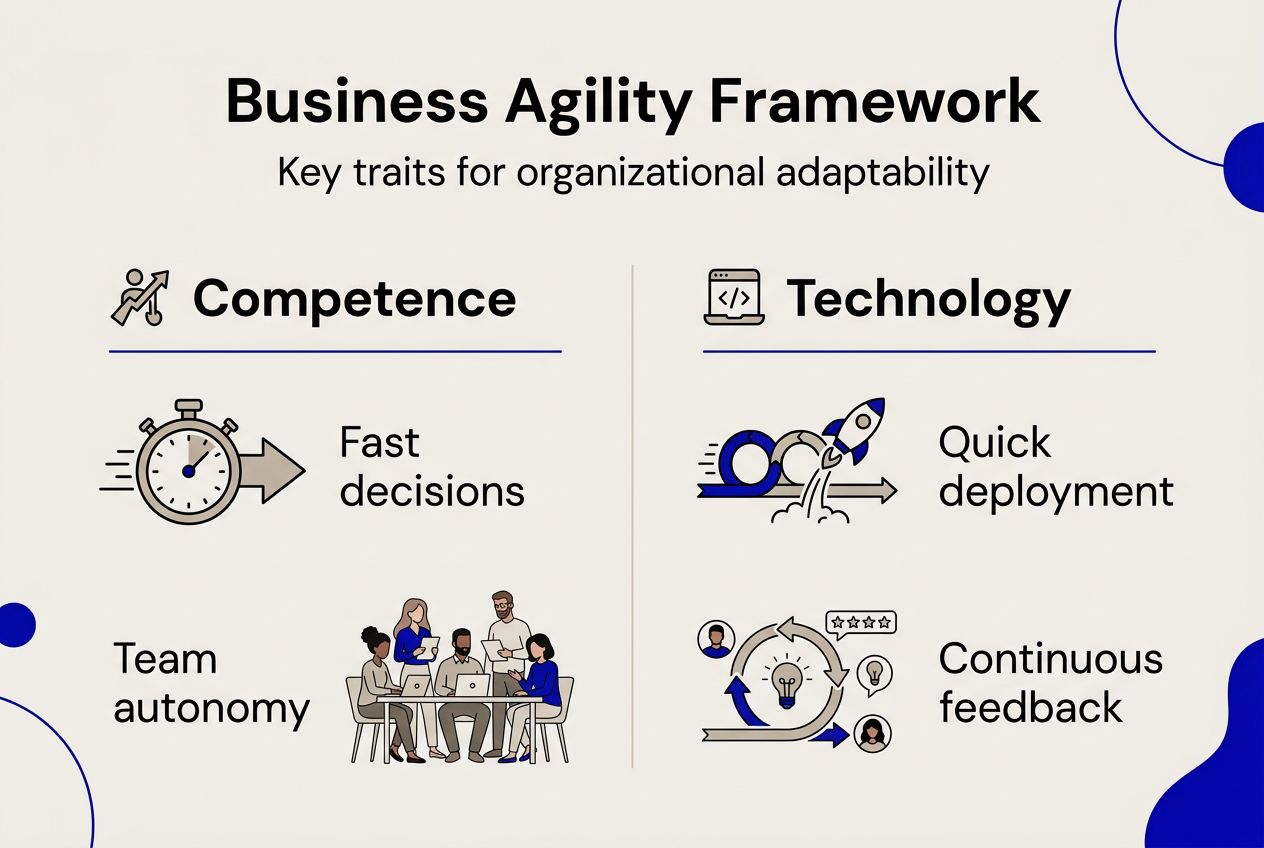
Low-code platforms improve agility by letting business teams configure workflows, automate processes, and build applications without waiting for IT development cycles. When your operations team can adjust a customer onboarding process in days instead of months, you’ve created genuine institutional agility.
For KSA and UAE organizations, consider regional context in your implementation:
- Regulatory environment varies by emirate and kingdom. Your agility framework must accommodate compliance requirements without creating rigidity.
- Talent availability influences how quickly you can build internal capabilities versus partnering with specialists.
- Cultural factors around hierarchy and decision-making require thoughtful change management that respects local norms while driving necessary evolution.
- Technology infrastructure maturity affects which digital enablers you can deploy immediately versus those requiring foundational investments.
Pro Tip: Start agility transformations with a single high-visibility initiative that demonstrates value quickly. Success builds organizational confidence and political capital for broader changes. Choose something with clear metrics, executive sponsorship, and manageable scope that can show results within 90 days.
Leadership commitment makes or breaks agility initiatives. Executives must model the behaviors they expect, celebrate intelligent failures that generate learning, and protect teams experimenting with new approaches from political backlash when experiments don’t pan out. Without this air cover, risk aversion kills agility before it takes root.
Measuring business agility impact: KPIs and continuous improvement
You can’t manage what you don’t measure. Business agility requires specific KPIs that track your organization’s adaptive capacity, not just operational efficiency. Continuous adaptation and value creation sustain business agility in uncertain environments, and measurement systems must reflect this reality.
Effective agility metrics span multiple dimensions:
| KPI Category | Specific Metrics | Target Benchmark |
|---|---|---|
| Adaptability speed | Time from opportunity identification to resource deployment | Under 30 days for non-capital decisions |
| Innovation rate | Percentage of revenue from products/services launched in past 24 months | 20% or higher |
| Customer responsiveness | Net Promoter Score and customer satisfaction trends | Positive trajectory quarter over quarter |
| Decision latency | Average time from proposal to approval for strategic initiatives | 50% reduction year over year |
| Learning velocity | Experiment cycle time and lessons documented per quarter | 10+ validated learnings per quarter |
| Resource flexibility | Percentage of budget available for reallocation based on emerging priorities | 15-20% of total budget |
These metrics tell you whether your agility investments translate into organizational capability. Rising innovation rates indicate you’re creating new value. Declining decision latency shows bureaucracy reduction. Improving customer scores validate that your adaptations address real market needs.
Beyond quantitative KPIs, track qualitative indicators through regular organizational health assessments:
- Psychological safety levels that determine whether teams feel safe proposing bold ideas and admitting failures
- Cross-functional collaboration quality measured through project retrospectives and stakeholder feedback
- Strategic clarity ensuring everyone understands organizational direction despite tactical flexibility
- Change fatigue monitoring to prevent burnout from continuous transformation
Implement continuous improvement cycles using these measurements. Monthly leadership reviews should examine agility metrics alongside traditional financial and operational KPIs. When metrics reveal problems, dig into root causes rather than treating symptoms.
For sector-specific applications, customize your measurement approach. Construction firms might emphasize project timeline variance and supplier relationship strength. Healthcare organizations track care model adaptation speed and patient outcome improvements. Banks focus on product launch velocity and regulatory compliance responsiveness.
The leadership role in transformation extends to championing these measurement systems and acting on insights they generate. When leaders ignore agility metrics or punish teams for honest reporting, measurement becomes theater rather than improvement fuel.
Communicate outcomes transparently to sustain stakeholder engagement. Share both successes and setbacks, highlighting what you learned and how you’re adjusting. This builds credibility and maintains resource allocation support for ongoing agility investments.
Pro Tip: Create a simple agility dashboard that executives review weekly, not buried in monthly board decks. Make it visible, make it actionable, and make it matter by tying resource decisions and recognition to performance against these metrics.
Align your agility measurement approach with broader technology strategy by incorporating insights from top ERP trends 2025 that emphasize real-time data visibility and predictive analytics. Modern systems provide the instrumentation needed to track agility metrics without creating reporting burdens.
Remember that measurement serves learning, not punishment. The goal is organizational improvement, not individual blame. When teams fear metric-based consequences, they game the system rather than genuinely building capability. Your measurement philosophy should emphasize curiosity and growth over judgment and control.
Explore tools and insights to enhance your business agility with Singleclic
Building genuine business agility requires more than good intentions. You need technology foundations, process expertise, and implementation partners who understand regional contexts and sector-specific challenges. Singleclic brings a decade of digital transformation experience across KSA, UAE, and Egypt, helping organizations like yours move from agility aspiration to operational reality.
Our approach starts with understanding where you are today. The ERP readiness assessment helps you evaluate whether your current systems support or hinder agility, identifying specific gaps that need addressing before major technology investments.
When you’re ready to implement, agile ERP methodologies let you deploy Odoo or Microsoft Dynamics 365 in iterative phases that build capability progressively rather than betting everything on a single launch. This approach reduces risk while accelerating time to value.
For organizations needing maximum flexibility, our low-code platform Cortex enables business teams to configure processes, automate workflows, and adapt operations without IT bottlenecks. It’s designed specifically for MENA enterprises with full Arabic support and on-premise deployment options that meet banking and government security requirements. Explore how we help construction, healthcare, and banking leaders across the region build the adaptive capacity that 2026 demands.
Frequently asked questions about business agility
What is business agility?
Business agility is your organization’s core competence for sensing environmental changes, making rapid decisions, and creating sustainable value despite complexity and uncertainty. It’s not a methodology you adopt but a capability you build through deliberate practice, supportive systems, and leadership commitment that enables continuous adaptation.
How does business agility differ from operational flexibility?
Operational flexibility focuses on adjusting existing processes efficiently, like shifting production schedules or reallocating staff. Business agility encompasses strategic adaptability, including pivoting business models, entering new markets, and fundamentally reimagining value creation when circumstances demand it. Flexibility optimizes what you do; agility transforms what you can become.
What are the biggest barriers to achieving business agility?
Bureaucratic decision-making structures, risk-averse cultures that punish intelligent failures, legacy technology systems that resist change, and leadership teams that preach agility while practicing command-and-control management represent the primary barriers. Overcoming them requires simultaneous work on governance, culture, technology, and leadership development.
How long does it take to build business agility?
Genuine business agility develops over 18 to 36 months through iterative capability building, not overnight transformations. You’ll see early wins within 90 days from focused initiatives, but embedding agility into organizational DNA requires sustained effort, continuous learning, and patience as new behaviors replace old habits across all levels.
Can business agility work in highly regulated industries?
Absolutely. Healthcare and banking organizations in KSA and UAE successfully build agility within regulatory constraints by separating compliance requirements from operational flexibility. You maintain rigorous controls in regulated areas while enabling rapid experimentation in customer experience, internal processes, and service delivery innovation that don’t compromise compliance obligations.
What role does technology play in business agility?
Technology serves as an enabler, not a silver bullet. Modern ERP systems, low-code platforms, and automation tools provide the infrastructure for rapid experimentation, data-driven decisions, and process adaptation. But technology alone doesn’t create agility without corresponding changes in governance, culture, and leadership practices that leverage these capabilities effectively.