Up to 84% of cloud migration projects run over budget or timeline due to lack of clear strategy. C-level executives and IT decision-makers in KSA and UAE face mounting pressure to migrate operations efficiently while controlling costs. This guide delivers a complete, step-by-step cloud migration workflow designed to reduce risk, accelerate timelines, and deliver measurable ROI through proven planning, security, execution, and monitoring practices.
Table of Contents
- Prerequisites And Assessment
- Planning And Strategy
- Security And Compliance
- Cost Estimation And Management
- Migration Execution
- Common Mistakes And Troubleshooting
- Expected Outcomes And Success Metrics
- Optimize Your Cloud Migration With Singleclic Solutions
- Frequently Asked Questions About Cloud Migration Workflow
Key Takeaways
| Point | Details |
|---|---|
| Clear strategy avoids 84% budget overruns | A comprehensive assessment and discovery phase forms the foundation for success. |
| Security compliance is critical | Encryption, IAM, and regulatory adherence prevent costly breaches during migration. |
| Phased execution reduces downtime | Automation can shorten migrations from months to weeks while minimizing operational disruption. |
| Post-migration monitoring boosts efficiency | Continuous oversight and FinOps practices deliver over 30% operational efficiency gains. |
Prerequisites and Assessment
Your migration success hinges on thorough preparation. Comprehensive assessment and discovery phase, including mapping applications, dependencies, and performance baselines, is foundational to successful cloud migration. Organizations that skip this stage encounter unexpected technical debt, compatibility issues, and extended downtime that derail budgets.
Start by inventorying every application, database, server, and integration point across your IT environment. Document version numbers, dependencies, and data flow patterns. Conduct performance baseline testing to establish current response times, throughput metrics, and resource consumption patterns.
Next, evaluate security posture and compliance readiness against regional regulations. KSA and UAE enterprises must verify data residency requirements, encryption standards, and audit trail capabilities before moving workloads. Assess ERP readiness early to identify gaps in system compatibility or configuration.
Pro Tip: Create a dependency map that visualizes how each application connects to others. This reveals hidden integration points that could break during migration, allowing you to plan remediation steps upfront.
Define clear migration objectives aligned with business goals. Specify target cost reduction percentages, acceptable downtime windows, and operational efficiency improvements. These concrete metrics guide every subsequent decision and provide objective success criteria for stakeholders.
Planning and Strategy
Once you understand your current state, develop a phased migration roadmap that manages complexity systematically. Lack of clear cloud migration strategy leads to scope creep, extended timelines, and misaligned stakeholder expectations, causing up to 84% of projects to exceed budgets or timelines. Your plan must translate technical requirements into business value that resonates with finance and operations teams.
Follow these planning steps:
- Set measurable objectives: Define success metrics including cost savings targets, performance benchmarks, and timeline milestones.
- Design migration waves: Group applications by criticality, dependency complexity, and resource requirements into distinct phases.
- Select cloud service models: Evaluate cloud vs on-premise ERP considerations to choose public, private, hybrid, or multi-cloud architectures that match your security, compliance, and performance needs.
- Establish governance frameworks: Create decision-making processes, escalation paths, and change control procedures.
- Build communication plans: Schedule regular stakeholder updates with clear status dashboards and risk registers.
Pro Tip: Start with a pilot migration of a non-critical application to validate your process, uncover hidden challenges, and refine procedures before tackling mission-critical systems.
Align technical and business teams around shared definitions of success. Finance needs cost projections, operations requires uptime guarantees, and security demands compliance verification. Your strategy document should address each perspective with specific commitments and accountability assignments.
Security and Compliance
Securing data and meeting regulatory requirements cannot be afterthoughts. Security and compliance frameworks including encryption, IAM, and regulatory adherence are critical to avoid data breaches and fines during cloud migration. KSA and UAE organizations face strict data sovereignty laws that mandate where information can reside and how it must be protected.
Implement these security essentials:
- Encryption everywhere: Protect data in transit using TLS 1.3 or higher and at rest using AES-256 encryption with customer-managed keys.
- Identity and access management: Deploy IAM with least-privilege principles, multi-factor authentication, and role-based access controls that limit exposure.
- Regulatory compliance: Verify adherence to GDPR, HIPAA, PCI DSS, and regional regulations including Saudi PDPL and UAE DIFC data protection laws.
- Continuous monitoring: Enable real-time security information and event management systems that detect anomalies and trigger automated responses.
Establish audit readiness by maintaining detailed logs of every access event, configuration change, and data movement. Follow cloud security best practices to build defense in depth with network segmentation, intrusion detection, and vulnerability scanning. Understand the importance of cloud security as a business enabler, not just a technical requirement.
Conduct security testing before, during, and after migration. Penetration testing reveals vulnerabilities in your cloud configuration, while compliance audits verify policy adherence. Document all security controls in a comprehensive security architecture diagram that maps data flows, trust boundaries, and protection mechanisms.
Cost Estimation and Management
Accurate cost forecasting separates successful migrations from budget disasters. 44% of cloud spend is wasted due to inaccurate cost estimation and poor cost control without FinOps. You must account for both one-time migration expenses and ongoing operational costs to build realistic financial models.
Identify these cost components:
- Migration costs: Professional services fees, data transfer charges, testing resources, and parallel run expenses during cutover periods.
- Cloud infrastructure: Compute instances, storage volumes, network bandwidth, and managed services based on actual usage patterns, not vendor estimates.
- Hidden expenses: Egress fees for data leaving cloud regions, API call charges, backup storage, and disaster recovery capacity that vendors rarely highlight upfront.
- Optimization opportunities: Reserved instances, spot instances, auto-scaling policies, and rightsizing recommendations that reduce waste.
Implement FinOps practices from day one. Assign dedicated teams to monitor spending daily using cloud cost management tools that provide granular visibility into consumption patterns. Set budget alerts at 50%, 75%, and 90% thresholds to trigger reviews before overruns occur. Tag every resource with cost center, project, and environment metadata to enable accurate chargeback and showback reporting.

Leverage business process automation for cost control by automating resource provisioning, scaling, and decommissioning based on actual demand rather than static capacity plans. This eliminates the common mistake of over-provisioning infrastructure “just in case” and paying for unused capacity month after month.
Migration Execution
Execution transforms plans into reality through disciplined, phased implementation. Phased migration starting with less critical workloads reduces downtime and risks while automation can shorten migrations from months to weeks. Your execution playbook must balance speed with safety, leveraging automation to accelerate repetitive tasks while maintaining human oversight of critical decisions.
Follow this execution sequence:
- Pilot non-critical workloads: Begin with development or test environments to validate procedures and build team confidence.
- Deploy automation tools: Use cloud migration platforms that automate discovery, replication, testing, and cutover to eliminate manual errors and compress timelines.
- Execute wave migrations: Move applications in planned groups with defined success criteria before proceeding to the next wave.
- Monitor continuously: Track performance metrics, error rates, and user experience in real time to detect issues immediately.
- Validate thoroughly: Conduct functional testing, performance testing, and user acceptance testing before declaring any migration complete.
Pro Tip: Schedule migrations during low-traffic periods and maintain rollback plans for every workload. If issues arise, you can quickly revert to the previous environment while troubleshooting.
| Migration Approach | Timeline | Risk Level | Best For |
|---|---|---|---|
| Lift and Shift | Weeks | Low | Legacy apps needing quick cloud presence |
| Replatforming | Months | Medium | Applications requiring cloud optimization |
| Refactoring | Quarters | High | Strategic systems demanding cloud-native benefits |
Maintain transparent communication throughout execution. Share daily status updates with stakeholders highlighting completed tasks, open issues, and upcoming milestones. Address common deployment risks proactively by conducting pre-migration rehearsals and documenting detailed runbooks for every procedure.
Common Mistakes and Troubleshooting
30 to 40% of cloud migration projects experience failures or delays due to common mistakes such as skipped assessments and poor communication. Learning from these pitfalls helps you avoid expensive detours and timeline extensions that frustrate stakeholders and damage credibility.
Watch for these frequent errors:
- Skipping discovery: Migrating without complete IT asset inventory and dependency mapping creates unexpected breakages when hidden integrations fail.
- Poor stakeholder communication: Infrequent updates or technical jargon alienate business leaders who control budgets and approvals, causing sudden project cancellations.
- Ignoring security early: Bolting on security after migration forces expensive rework and exposes data to breach risks during the transition period.
- Underestimating complexity: Treating migration as a simple move operation rather than a transformation project leads to inadequate resource allocation and timeline pressure.
When problems arise, respond systematically. Isolate the affected workload, review logs to identify root causes, and engage vendor support when needed. Maintain detailed incident documentation that captures symptoms, investigation steps, and resolution procedures for future reference. Avoid common cloud migration mistakes by building comprehensive runbooks before starting execution.
Establish clear escalation paths so teams know exactly when to elevate issues to senior leadership. Define severity levels based on business impact and response time expectations. This prevents small problems from festering into project-threatening crises.
Expected Outcomes and Success Metrics
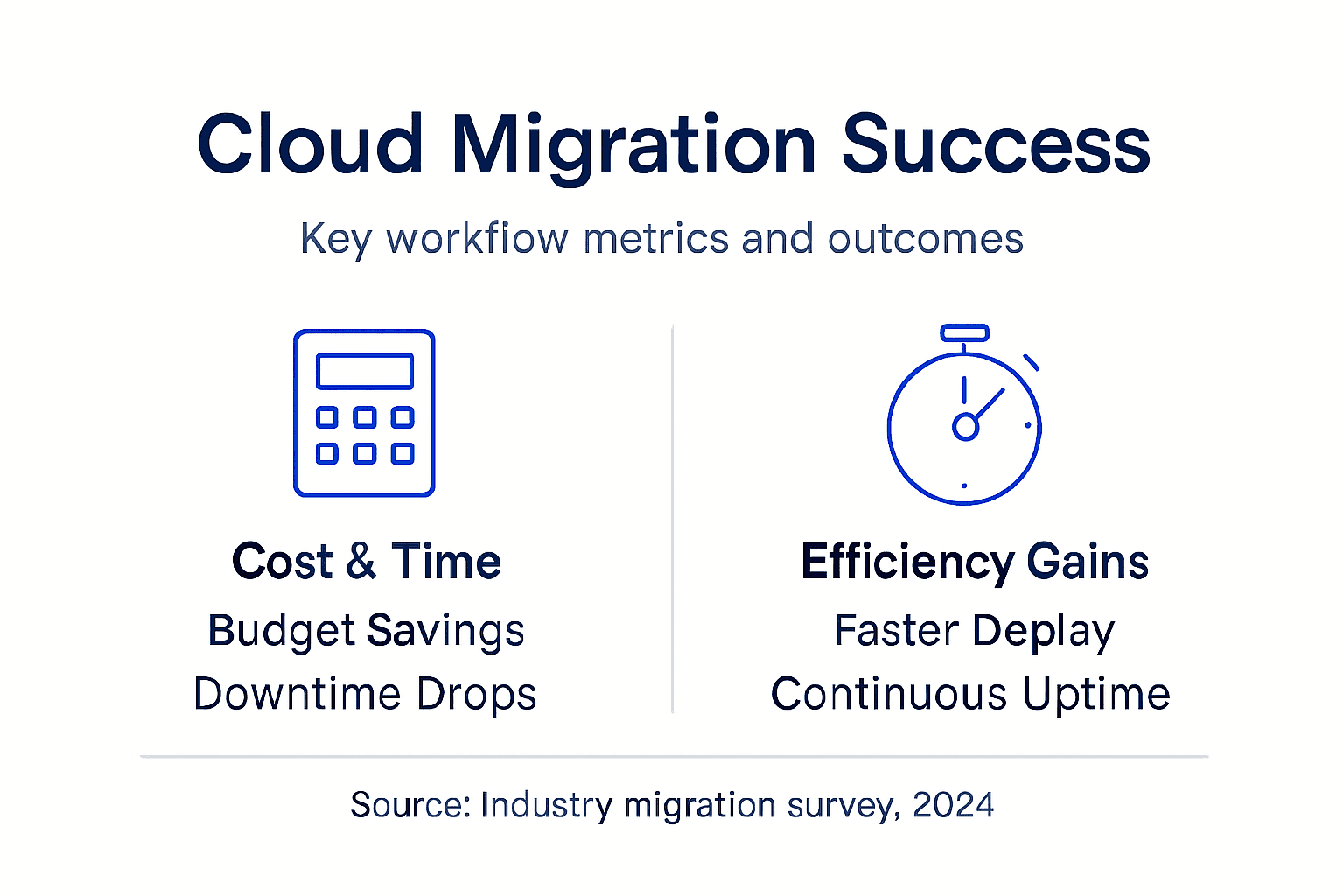
Successful cloud migration achieves 20 to 30% cost savings, improves operational efficiency over 30%, and reduces downtime by approximately 35%. These measurable outcomes validate your investment and demonstrate concrete business value to stakeholders who approved funding.
| Metric | Target | Timeframe |
|---|---|---|
| Cost Reduction | 20 to 30% | 6 to 12 months |
| Efficiency Improvement | Over 30% | 3 to 6 months |
| Downtime Reduction | 35% | Immediate |
| Resource Optimization | 40 to 50% | 6 months |
Monitor these indicators continuously through automated dashboards that provide real-time visibility. Track application performance metrics including response times, error rates, and throughput to verify that cloud environments meet or exceed on-premise baselines. Measure user satisfaction through surveys and support ticket volumes to ensure the migration enhances rather than disrupts daily operations.
Implement continuous optimization through regular reviews of cloud resource utilization. Identify idle resources, oversized instances, and unused services that inflate costs without delivering value. Apply business process management principles to refine workflows and eliminate inefficiencies exposed during migration.
Combine technical metrics with business KPIs to tell a complete success story. Demonstrate how faster application performance enables sales teams to close deals quicker, or how improved uptime reduces customer churn. These business outcomes resonate with executives far more than technical statistics alone.
Optimize Your Cloud Migration with Singleclic Solutions
Navigating cloud migration complexity demands expertise, proven methodologies, and reliable technology partnerships. Singleclic brings 10 years of digital transformation experience across KSA, UAE, and Egypt to help enterprises execute migrations that deliver measurable results.
Our business process automation guide helps you identify optimization opportunities before and after migration. We provide comprehensive ERP readiness assessment services that reveal gaps early when remediation costs less. Our team implements process automation for efficiency gains that compound the benefits of cloud infrastructure. Whether you need Odoo or Microsoft Dynamics 365 integration, IBM BAW automation, or custom application development, we deliver end-to-end solutions tailored to your industry requirements.
Frequently Asked Questions About Cloud Migration Workflow
What are the essential components of a cloud migration workflow?
A complete workflow includes assessment and discovery, strategic planning, security and compliance frameworks, cost estimation, phased execution with automation, continuous monitoring, and post-migration optimization. Each component builds on the previous stage to reduce risk systematically.
How can organizations prevent cloud migration cost overruns?
Implement FinOps practices from day one with dedicated cost monitoring teams, granular resource tagging, budget alerts, and regular optimization reviews. Accurate initial cost estimation that includes hidden fees prevents surprises, while continuous monitoring enables rapid response to spending anomalies.
What security measures are critical during cloud migration?
Encrypt data in transit and at rest, deploy IAM with least-privilege access, ensure compliance with regional regulations like Saudi PDPL and UAE DIFC laws, and maintain continuous security monitoring with automated incident response. Conduct penetration testing before and after migration to verify controls.
How do you measure cloud migration success?
Track cost reduction percentages, operational efficiency improvements, downtime reduction, resource optimization rates, and business KPIs like revenue impact or customer satisfaction. Establish baseline metrics before migration and monitor continuously after cutover to demonstrate ROI objectively.
What communication strategies work best during migration?
Provide daily status updates to technical teams and weekly executive summaries for leadership. Use visual dashboards that show progress against milestones, open risks, and upcoming activities. Translate technical details into business impact language that resonates with non-technical stakeholders.
Why do phased migrations reduce risk compared to big-bang approaches?
Phased approaches allow you to validate procedures with non-critical workloads, identify issues when stakes are low, refine processes based on lessons learned, and build team confidence before migrating business-critical systems. Failures impact smaller portions of operations and rollback remains feasible throughout.