Complex processes and rapid growth often strain even the most advanced organizations in Saudi Arabia and UAE. For CIOs and CTOs in healthcare and construction, the promise of hyperautomation offers more than just incremental improvement. By integrating technologies like Artificial Intelligence, Robotic Process Automation, and Business Process Management, enterprises can create adaptive systems that address legacy challenges and operational silos. Discover how a comprehensive, business-driven methodology can reshape efficiency and drive meaningful digital transformation.
Table of Contents
- Defining Hyperautomation And Core Concepts
- How Hyperautomation Differs From RPA And Automation
- Key Technologies Powering Hyperautomation Solutions
- Enterprise Use Cases In Construction And Healthcare
- Risks, Costs, And Change Management Challenges
Key Takeaways
| Point | Details |
|---|---|
| Hyperautomation Definition | Hyperautomation is a business-driven methodology that integrates advanced technologies to automate complex processes, transforming how organizations operate. |
| Difference from RPA | Unlike Robotic Process Automation, which focuses on single tasks, hyperautomation involves a holistic approach, enabling adaptive ecosystems that optimize entire business processes. |
| Key Technologies | Core technologies such as AI, RPA, and low-code platforms work together to create interconnected, intelligent systems that enhance operational efficiency. |
| Change Management Challenges | Successful hyperautomation requires addressing employee resistance, high costs, and skill gaps through strategic planning, transparent communication, and targeted training programs. |
Defining Hyperautomation and Core Concepts
Hyperautomation represents a transformative approach to enterprise technology that goes far beyond traditional automation strategies. At its core, hyperautomation is a comprehensive, business-driven methodology designed to systematically identify, evaluate, and automate complex business processes using an orchestrated combination of advanced technologies.
According to Gartner’s comprehensive definition, hyperautomation involves an intricate blend of multiple technological tools and platforms. These typically include:
- Artificial Intelligence (AI)
- Machine Learning
- Robotic Process Automation (RPA)
- Business Process Management (BPM)
- Integration Platforms
- Low-Code/No-Code Development Tools
Unlike traditional automation approaches that focus on single-task optimization, hyperautomation enables comprehensive digital transformation by breaking down technological and operational silos. This approach allows organizations, particularly in regions like Saudi Arabia and UAE, to rapidly transform legacy systems and create more intelligent, interconnected operational frameworks.
The strategic implementation of hyperautomation goes beyond mere task replacement. It represents a holistic reimagining of how enterprises can leverage technology to drive efficiency, reduce manual intervention, and unlock new levels of operational intelligence. By integrating multiple technologies, businesses can create adaptive, learning systems that continuously optimize processes and generate strategic value.
Pro tip: Start your hyperautomation journey by mapping existing business processes and identifying repetitive, rule-based tasks that are prime candidates for automation.
How Hyperautomation Differs from RPA and Automation
While Robotic Process Automation (RPA) represents an initial step in digital transformation, hyperautomation represents a quantum leap in technological capabilities. RPA versus hyperautomation fundamentally differ in their scope, complexity, and strategic potential for organizational optimization.
Traditional RPA focuses on narrow, repetitive tasks with predefined rules, essentially mimicking human digital interactions. In contrast, hyperautomation encompasses a more holistic approach by integrating multiple advanced technologies:
- Artificial Intelligence (AI)
- Machine Learning
- Natural Language Processing (NLP)
- Business Process Management
- Advanced Analytics
- Intelligent Workflow Orchestration
Where RPA acts like a digital worker performing specific, routine tasks, hyperautomation functions as an intelligent ecosystem that can adapt, learn, and optimize entire business processes. This approach is particularly transformative for enterprises in Saudi Arabia and UAE seeking comprehensive digital transformation strategies that extend beyond simple task automation.
The key distinction lies in intelligence and scope. RPA operates within strict, predefined parameters, whereas hyperautomation creates intelligent, interconnected systems capable of complex decision-making, continuous learning, and cross-functional process optimization. By integrating multiple technologies, hyperautomation enables organizations to develop adaptive, self-improving operational frameworks that can dynamically respond to changing business environments.
Here’s a concise comparison of RPA and hyperautomation across key attributes:
| Attribute | RPA | Hyperautomation |
|---|---|---|
| Scope | Single task focus | End-to-end business processes |
| Technology | Rule-based software bots | Multiple advanced technologies |
| Adaptability | Limited learning | Continuous self-optimization |
| Decision-Making | Predefined rules | Intelligent, data-driven decisions |
| Impact | Task efficiency | Enterprise-wide transformation |
Pro tip: Evaluate your current automation maturity by identifying processes that require more than rule-based repetition and could benefit from intelligent, adaptive technologies.
Key Technologies Powering Hyperautomation Solutions
Hyperautomation represents a complex technological symphony, integrating multiple advanced technologies to create intelligent, adaptive business solutions. Hyperautomation technologies transform organizational capabilities by addressing critical challenges like legacy system limitations and operational inefficiencies.
The core technologies driving hyperautomation include:
- Robotic Process Automation (RPA)
- Artificial Intelligence (AI)
- Machine Learning
- Business Process Management (BPM)
- Process Mining
- Low-Code/No-Code Platforms
- Advanced Analytics
Each technology plays a unique role in creating a comprehensive automation ecosystem. AI provides intelligent decision-making capabilities, RPA handles repetitive tasks, BPM optimizes workflows, and process mining offers deep insights into operational processes. In regions like Saudi Arabia and UAE, these technologies enable organizations to rapidly transform digital infrastructure and create more agile, responsive business models.
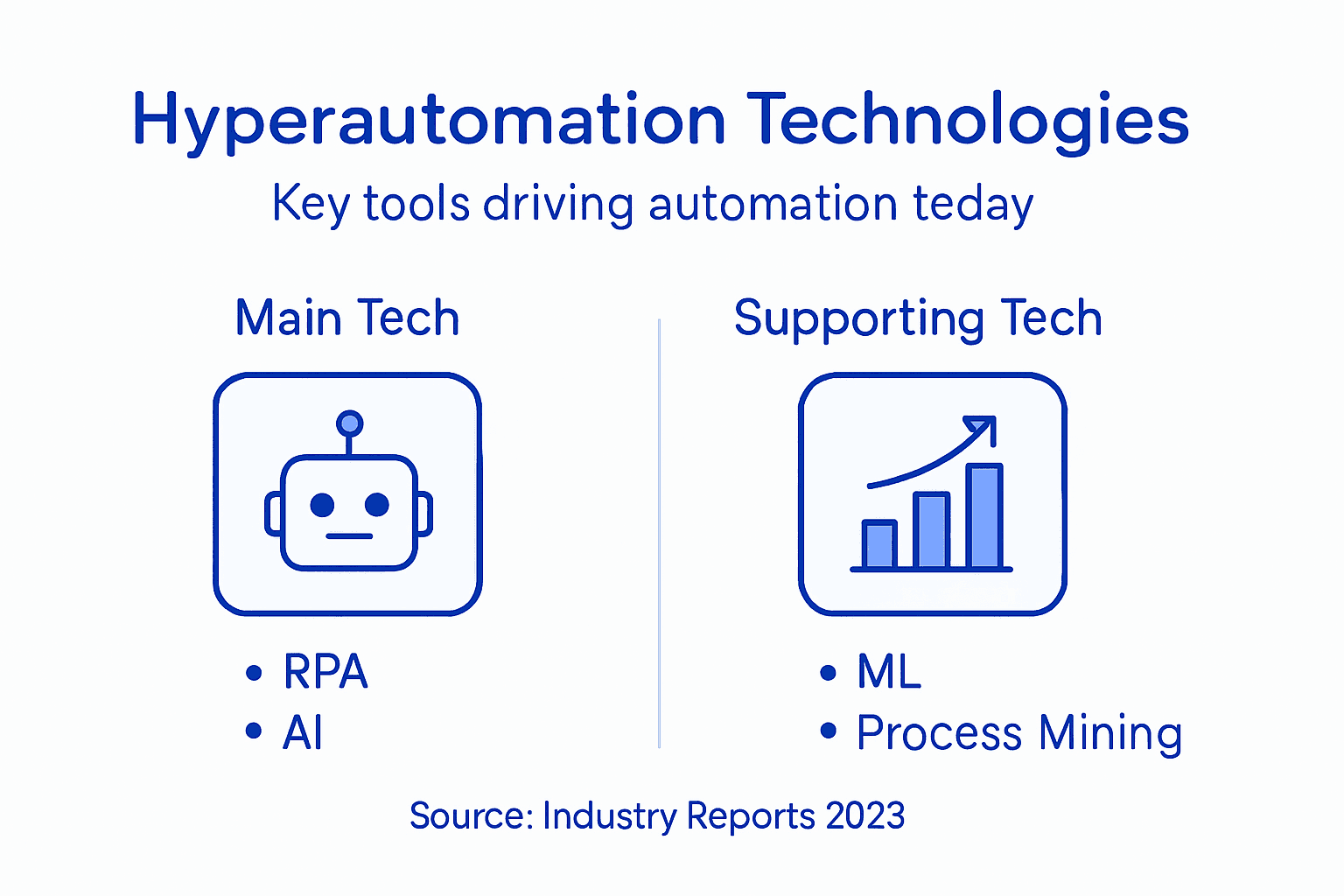
The true power of hyperautomation lies in its ability to integrate these technologies seamlessly. Unlike traditional automation approaches that work in silos, hyperautomation creates an interconnected technological framework that can learn, adapt, and continuously optimize business processes. This approach allows enterprises to move beyond simple task automation toward building intelligent, self-improving operational systems.
Pro tip: Conduct a comprehensive technology audit to identify potential integration points and automation opportunities across your existing technological ecosystem.
Enterprise Use Cases in Construction and Healthcare
Hyperautomation is revolutionizing critical industries by transforming complex operational landscapes in Saudi Arabia and UAE. Advanced technologies are reshaping healthcare and construction processes, offering unprecedented opportunities for efficiency and innovation.
In healthcare, hyperautomation delivers transformative solutions across multiple domains:
- Clinical Decision Support Systems
- Electronic Health Record Management
- Medical Imaging Analysis
- Telemedicine Facilitation
- Patient Workflow Optimization
- Predictive Healthcare Analytics
The construction industry similarly benefits from hyperautomation’s integrated technological approach. By combining AI, Internet of Things (IoT), and machine learning, organizations can address critical challenges such as resource optimization, worker safety, and project precision. Real-time monitoring, predictive maintenance, and intelligent resource allocation become achievable through sophisticated technological integration.

Key hyperautomation technologies are delivering tangible benefits in both sectors. Healthcare providers can reduce operational costs, minimize human errors, and enhance patient care quality. Construction firms can improve project scalability, sustainability, and worker safety while maintaining stringent performance standards. These technological interventions are particularly significant in regions like Saudi Arabia and UAE, where digital transformation is a strategic national priority.
Pro tip: Begin your hyperautomation journey by conducting a comprehensive process audit to identify high-impact automation opportunities within your specific organizational context.
Risks, Costs, and Change Management Challenges
Hyperautomation introduces complex organizational transformation that extends far beyond technological implementation. Successful adoption requires strategic change management, addressing both technological and human-centric challenges in enterprises across Saudi Arabia and UAE.
Key risks and challenges in hyperautomation implementation include:
- Employee Resistance and Job Insecurity
- High Initial Investment Costs
- Complex Technology Integration
- Skill Gap and Training Requirements
- Potential Process Disruption
- Data Privacy and Security Concerns
- Maintaining Human Oversight
Organizational leaders must recognize that hyperautomation is not about replacing human workers, but augmenting their capabilities. The financial investment can be substantial, with initial implementation costs potentially ranging from 5-15% of existing operational budgets. Strategic planning, phased rollouts, and transparent communication are critical to managing both technological and human dimensions of this transformation.
This table summarizes major risks and how organizations can address them:
| Risk Area | Impact on Organization | Mitigation Strategy |
|---|---|---|
| Employee Resistance | Reduced adoption, low morale | Transparent communication, reskilling |
| High Costs | Budget constraints | Phased rollout, ROI tracking |
| Skill Gaps | Implementation delays | Targeted training programs |
| Data Security | Compliance risks | Robust data governance |
In the context of Saudi Arabia and UAE’s digital transformation goals, hyperautomation represents a significant strategic investment. Companies must develop comprehensive change management strategies that include continuous training, transparent communication, and creating clear pathways for workforce reskilling and adaptation. By positioning hyperautomation as an enabling technology rather than a threat, organizations can mitigate resistance and foster a culture of technological innovation.
Pro tip: Develop a robust change management plan that includes regular employee communication, transparent skill transition strategies, and continuous learning opportunities to ease organizational adaptation.
Unlock the Full Potential of Hyperautomation for Your Business
The article highlights the critical challenge organizations face in moving beyond simple automation toward intelligent, adaptive hyperautomation that integrates AI, RPA, BPM, and process mining. This requires overcoming technological complexity, addressing employee resistance, and achieving seamless orchestration of end-to-end business processes. For enterprises in Saudi Arabia, UAE, and beyond, the goal is clear: transform legacy systems into agile, self-optimizing digital ecosystems that drive efficiency and innovation.
At Singleclic, we understand these pain points and deliver tailored solutions that empower your hyperautomation journey. Our expertise in Business Process Automation with IBM BAW and UiPath RPA reflects the article’s emphasis on integrating multiple technologies to break operational silos. Leveraging Cortex, our Arabic-enabled low-code platform, your teams can design and evolve complex workflows with real-time optimization and zero downtime. Whether it is healthcare, construction, or banking sectors, our scalable ERP and CRM implementations with Microsoft Dynamics 365 and Odoo enable a true enterprise-wide transformation fitting the hyperautomation vision.
Take the next step to elevate your organization by partnering with a regional leader who goes beyond digitalization to deliver complete optimization. Visit Singleclic today to explore how our intelligent automation solutions can unlock new levels of operational excellence and competitive advantage.
Frequently Asked Questions
What is hyperautomation?
Hyperautomation is a comprehensive, business-driven methodology that combines multiple advanced technologies to systematically identify, evaluate, and automate complex business processes.
How does hyperautomation differ from traditional automation and RPA?
Unlike traditional automation and Robotic Process Automation (RPA), which focus on specific tasks, hyperautomation enables end-to-end business process optimization by integrating technologies such as AI, machine learning, and business process management.
What are the key technologies involved in hyperautomation?
Key technologies driving hyperautomation include Robotic Process Automation (RPA), Artificial Intelligence (AI), Machine Learning, Business Process Management (BPM), Process Mining, and Low-Code/No-Code Platforms, among others.
What are the main challenges organizations face when implementing hyperautomation?
Organizations may encounter challenges such as employee resistance, high initial investment costs, complex technology integration, skill gaps, and data privacy concerns when implementing hyperautomation.