Over 80 percent of global enterprises now use Enterprise Resource Planning systems, but many American businesses still struggle to unlock their full potential. With modern markets demanding faster decisions and tighter integration, choosing the right ERP solution has become a critical factor for growth and efficiency. Whether you are seeking to streamline operations or improve collaboration across departments, understanding ERP can transform how your organization operates and competes.
Table of Contents
- What Is ERP and Why It Matters
- Types of ERP Systems for Modern Enterprises
- Core Features Driving Operational Excellence
- Real-World ERP Benefits in KSA and UAE
- Cost, ROI, and Risks to Consider
Key Takeaways
| Point | Details |
|---|---|
| Integrated Software Solutions | ERP provides a centralized platform that integrates core business processes across various departments for improved efficiency. |
| Real-Time Data Management | Modern ERP systems enable real-time insights and seamless communication, allowing for informed decision-making. |
| Variety of Deployment Models | Companies can choose from on-premise, cloud, hybrid, open-source, and industry-specific ERP systems based on their unique needs. |
| Strategic Investment | Implementing ERP is a crucial investment that enhances operational efficiency and positions organizations for competitive success in the market. |
What Is ERP and Why It Matters
Enterprise Resource Planning (ERP) represents a transformative approach to managing complex business operations through integrated software systems. At its core, ERP provides organizations with a centralized platform that unifies core business processes across finance, human resources, manufacturing, supply chain, and customer service departments.
Modern ERP systems are sophisticated technological solutions that enable real-time data management and seamless communication between different organizational units. Integrated information systems are designed to create a continuous, synchronized workflow where data flows smoothly between departments, eliminating information silos and reducing manual data entry. This integration allows businesses to make faster, more informed decisions based on comprehensive, up-to-the-minute insights.
The strategic importance of ERP extends far beyond simple software implementation. For businesses in Saudi Arabia and UAE, ERP represents a critical tool for digital transformation, offering capabilities that help organizations streamline operations, reduce operational costs, and enhance overall productivity. Our Cortex Low-Code Platform provides regional enterprises with a flexible solution that can be customized to meet unique organizational needs, supporting everything from workflow automation to complex process management.
Key benefits of implementing a robust ERP system include:
- Centralized data management
- Real-time operational insights
- Enhanced cross-departmental collaboration
- Improved decision-making capabilities
- Reduced operational inefficiencies
- Scalable business process optimization
By leveraging advanced ERP technologies, organizations can transform their operational landscape, turning technological investment into a strategic advantage that drives sustainable growth and competitive differentiation.
Types of ERP Systems for Modern Enterprises
Enterprise Resource Planning (ERP) systems have evolved to meet diverse organizational needs, offering multiple deployment models that cater to different business requirements and technological infrastructures. Understanding these variations is crucial for organizations seeking to optimize their operational efficiency and technological investment.

Typically, ERP systems can be classified into several key categories. On-Premise ERP systems involve installing software directly on a company’s internal servers, providing maximum control and customization but requiring significant upfront infrastructure investments. Cloud ERP solutions, in contrast, offer greater flexibility by hosting applications on remote servers, enabling seamless updates, reduced maintenance costs, and enhanced accessibility from multiple locations. Hybrid ERP approaches combine elements of both on-premise and cloud systems, allowing businesses to leverage the strengths of each deployment method.
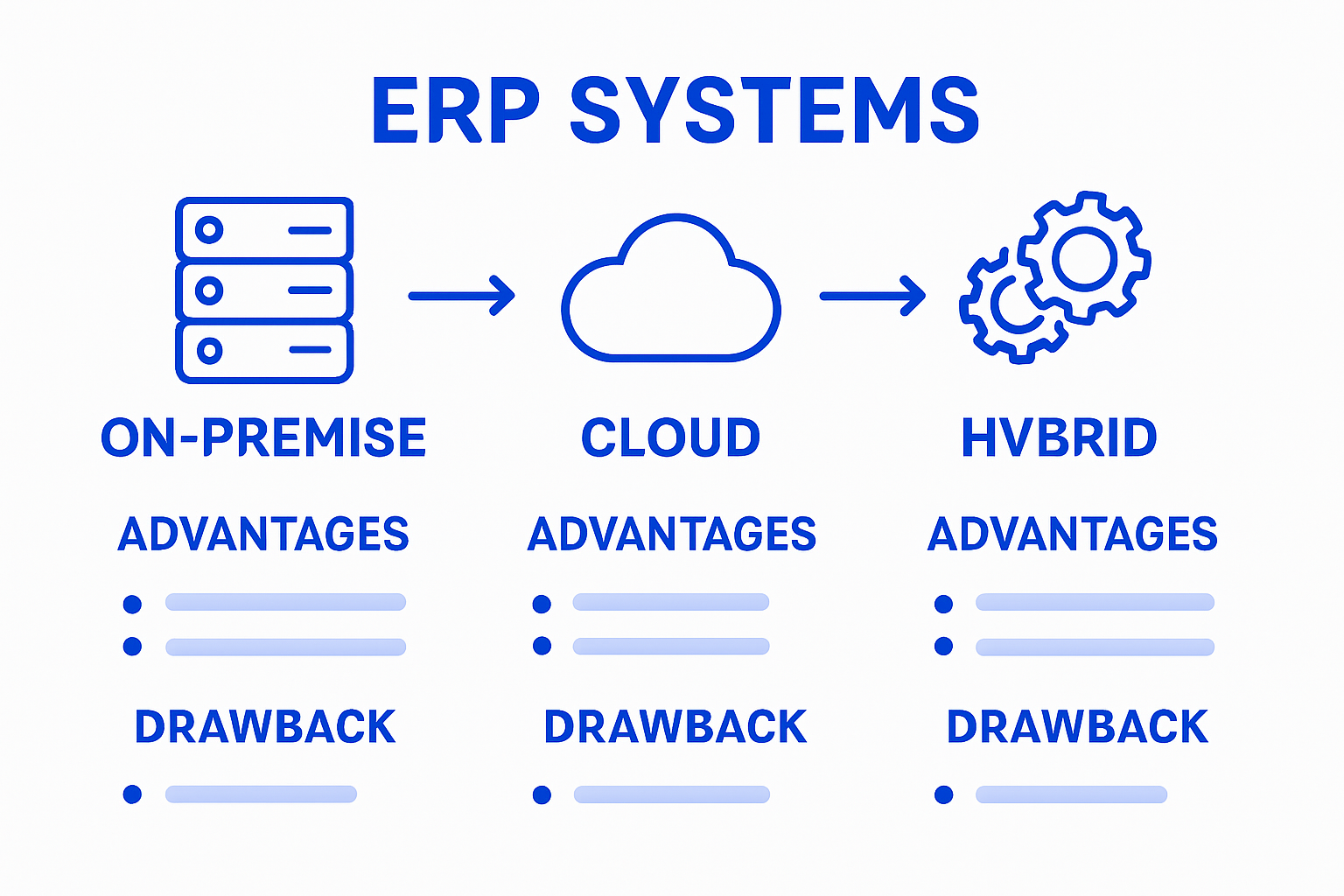
For organizations in Saudi Arabia and UAE, selecting the right ERP system involves careful consideration of scalability, security, and integration capabilities. Our Cortex Low-Code Platform supports businesses in navigating these complex choices by providing adaptable solutions that can be tailored to specific regional and industry requirements. ERP system examples demonstrate the versatility of these technological solutions across various sectors.
Key types of ERP systems include:
- On-Premise ERP: Complete in-house control and customization
- Cloud ERP: Remote hosting with flexible accessibility
- Hybrid ERP: Combination of on-premise and cloud technologies
- Open-Source ERP: Customizable solutions with community-driven development
- Industry-Specific ERP: Specialized systems for unique sector requirements
Choosing the right ERP system is more than a technological decision—it’s a strategic investment in your organization’s future, enabling improved operational efficiency, data-driven decision-making, and sustainable growth.
Core Features Driving Operational Excellence
Enterprise Resource Planning (ERP) systems represent a comprehensive technological solution that integrates core business activities into a unified platform, transforming how organizations manage their most critical operational processes. By consolidating finance, supply chain, operations, reporting, and human resource management into a single centralized system, ERP platforms enable businesses to achieve unprecedented levels of efficiency and strategic alignment.
The architecture of modern ERP systems is designed to provide organizations with robust, flexible capabilities that support comprehensive business functionality. Key characteristics include open system architecture, standardized data definitions, and the ability to provide a common access point to a single, integrated dataset. This approach allows businesses to simulate real-world operational scenarios, support complex organizational functions, and make data-driven decisions with remarkable precision and speed.
For businesses in Saudi Arabia and UAE, ERP solutions offer transformative potential by breaking down traditional departmental silos and creating a more interconnected operational environment. Our Cortex Low-Code Platform further enhances these capabilities by providing customizable solutions that can be tailored to specific regional and industry requirements. The platform enables organizations to design, automate, and optimize complex business processes with unprecedented agility.
Critical features driving operational excellence include:
- Real-Time Data Integration: Instant access to comprehensive organizational insights
- Automated Workflow Management: Streamlined processes across multiple departments
- Advanced Reporting Tools: Comprehensive analytics and performance tracking
- Scalable Architecture: Flexible systems that grow with your business
- Cross-Departmental Collaboration: Unified communication and information sharing
By implementing a sophisticated ERP system, organizations can transcend traditional operational limitations, creating a more responsive, intelligent, and competitive business ecosystem that adapts quickly to changing market dynamics.
Real-World ERP Benefits in KSA and UAE
Enterprise Resource Planning (ERP) systems have become transformative technological solutions for businesses across Saudi Arabia and the United Arab Emirates, delivering unprecedented operational capabilities that drive strategic growth and competitive advantage. Cloud ERP software has emerged as a critical tool for organizations seeking to modernize their technological infrastructure and enhance business performance in these rapidly evolving regional markets.
In the context of Saudi Arabia and UAE, ERP implementations are particularly powerful for addressing unique regional business challenges. Enterprises are leveraging these systems to streamline complex operational processes, enhance regulatory compliance, and create more agile, data-driven organizational structures. Our Cortex Low-Code Platform provides specialized solutions that support the specific technological and cultural nuances of businesses in the Gulf Cooperation Council (GCC) region, enabling seamless digital transformation.
The tangible benefits of ERP adoption in KSA and UAE extend across multiple critical business dimensions. Organizations are experiencing significant improvements in operational efficiency, financial management, and strategic decision-making. By implementing robust ERP systems, businesses can achieve:
- Enhanced Operational Transparency: Real-time insights into business performance
- Improved Financial Management: Accurate budgeting and resource allocation
- Regulatory Compliance: Simplified adherence to local and international standards
- Cross-Departmental Integration: Unified communication and data sharing
- Scalable Infrastructure: Technology that grows with business complexity
Moreover, for forward-thinking enterprises in Saudi Arabia and the UAE, ERP systems represent more than technological upgrades—they are strategic investments that position organizations to compete effectively in increasingly digital and interconnected global markets.
Cost, ROI, and Risks to Consider
Investing in an Enterprise Resource Planning (ERP) system requires a comprehensive understanding of the financial implications and strategic considerations that drive long-term business value. ERP modernization represents a significant technological investment that demands careful analysis of potential returns and potential challenges across financial, operational, and technological dimensions.
The financial landscape of ERP implementation encompasses multiple critical factors. While initial costs can be substantial, organizations can expect significant returns through improved operational efficiency, reduced manual processing expenses, and enhanced decision-making capabilities. Our Cortex Low-Code Platform helps businesses in Saudi Arabia and UAE mitigate implementation risks by providing flexible, scalable solutions that adapt to specific organizational requirements and minimize potential disruption during digital transformation processes.
Understanding the potential risks is crucial for successful ERP adoption. Organizations must carefully evaluate:
- Initial Investment Costs: Comprehensive budgeting for software, hardware, and implementation
- Integration Complexity: Potential challenges in merging existing systems
- Change Management: Training and cultural adaptation requirements
- Data Migration Risks: Ensuring accuracy and continuity of historical data
- Cybersecurity Considerations: Protecting sensitive organizational information
The return on investment (ROI) for ERP systems extends beyond immediate financial metrics. Successful implementations can deliver strategic advantages, including enhanced operational transparency, improved regulatory compliance, and the ability to make data-driven decisions that drive competitive differentiation in rapidly evolving markets.
Accelerate Your Business Growth with Tailored ERP Solutions
In today’s fast-paced markets like Saudi Arabia and the UAE, investing in ERP means overcoming challenges such as fragmented data, slow decision-making, and inefficient workflows. This article highlights how an integrated ERP system delivers real-time insights, operational transparency, and scalable growth—goals that every forward-thinking business strives to achieve. By leveraging terms like centralized data management, cross-departmental collaboration, and workflow automation, it becomes clear that ERP is not just software but a strategic enabler for sustained success.
At Singleclic, we understand these critical pain points and offer specialized ERP and automation solutions designed for your exact needs. With over 10 years of regional experience and expertise in Odoo, Microsoft Dynamics 365, and IBM BPM tools, we help you move beyond digitalization to true optimization. Our Arabic-enabled, low-code Cortex Platform empowers you to design and evolve workflows in real-time without downtime, ensuring your business stays agile and competitive.
Explore how our scalable solutions can transform your organization today. ERP & CRM Implementation combined with intelligent automation delivers real impact across sectors like healthcare, banking, and government.
Ready to accelerate growth and improve operational excellence? Discover how Singleclic’s expert teams and innovative platforms can make your ERP investment a game changer today. Visit us at Singleclic and take the first step toward seamless digital transformation.
Frequently Asked Questions
What is ERP and how does it benefit businesses?
Enterprise Resource Planning (ERP) is an integrated software system that streamlines core business processes across various departments, providing real-time data management and enhanced collaboration, leading to better decision-making and operational efficiency.
What types of ERP systems are available to organizations?
ERP systems can be classified into several types including On-Premise ERP, Cloud ERP, Hybrid ERP, Open-Source ERP, and Industry-Specific ERP, each offering unique benefits in terms of control, customization, and flexibility.
What core features should a modern ERP system have?
Key features of modern ERP systems include real-time data integration, automated workflow management, advanced reporting tools, scalable architecture, and cross-departmental collaboration to enhance operational excellence.
What factors should be considered when investing in an ERP system?
Organizations should consider initial investment costs, integration complexity, change management requirements, data migration risks, and cybersecurity concerns to ensure a successful ERP implementation that delivers a strong return on investment.
Recommended
- Best ERP Applications for Businesses | Singleclic
- Benefits of ERP: Streamline Business Processes | Singleclic
- Best ERP Solutions for Businesses | SingleClic
- ERP for Small Businesses | SingleClic
- Tech for Small Businesses: Complete Guide for 2025 – Projector Display