TL;DR:
- Saudi Arabia’s strategic focus on technology has propelled it to sixth place in the UN E-Government Development Index, demonstrating successful digitization efforts. The UAE aims to deploy autonomous agentic AI across 50% of government services within two years, requiring workforce training and responsible oversight. Effective governance, shared data standards, and citizen-centric, transparent digital platforms are crucial for sustainable public sector modernization.
Saudi Arabia’s leap to 6th place globally in the UN E-Government Development Index is not a coincidence. It is the result of deliberate, policy-driven decisions that placed the role of technology in government at the center of national strategy. The UAE is pushing further, targeting agentic AI integration across 50% of federal services within two years. For government officials and policymakers in both countries, this is the moment to move from awareness to action. This guide breaks down exactly how technology reshapes public administration, where the real efficiency gains are, and what leadership decisions will determine who succeeds.
Table of Contents
- Key takeaways
- The role of technology in government operations
- Agentic AI and automation in public services
- Governance frameworks and data standards
- How technology strengthens transparency and citizen engagement
- My perspective on getting this right
- Build faster with the right platform
- FAQ
Key takeaways
| Point | Details |
|---|---|
| Saudi Arabia leads globally | Saudi Arabia ranks 6th in the UN E-Government Index, with most citizen services fully digitized. |
| Agentic AI is arriving fast | The UAE plans to deploy autonomous AI across 50% of government services by 2028, requiring trained workforce to govern it. |
| Governance frameworks matter more than tools | Without shared data standards and institutional coordination, technology investments produce fragmented results. |
| Transparency drives citizen trust | Unified portals and open data initiatives directly improve accountability and public confidence in government. |
| Low-code accelerates modernization | Platforms that require no coding allow agencies to build and adapt solutions faster without lengthy procurement cycles. |
The role of technology in government operations
The shift from paper-based government to digital service delivery is not just an efficiency story. It is a fundamental change in how public institutions relate to citizens and how decisions get made internally. Saudi Arabia’s Unified National Platform (my.gov.sa) and Absher are among the clearest examples in the region: a citizen can renew a license, check visa status, and access social services through a single interface without visiting a government office.
What makes this work is not the portal itself. It is the back-end integration that aggregates data from multiple ministries and presents it as one coherent experience. That level of interoperability requires both technical infrastructure and institutional coordination. Many governments in the region are still working through this challenge.
The efficiency numbers are compelling. AI-powered systems in Honolulu reduced residential permit processing times by 70%. Tennessee automated over 100,000 staff work hours annually through strategic IT investments. These are not pilot projects. They are production systems delivering measurable outcomes.
Here is how technology in public administration concretely changes operational performance:
- Reduced processing time: Automated document workflows eliminate manual data entry and approval bottlenecks.
- Fewer errors: Digital validation at the point of data entry catches mistakes before they enter core systems.
- Cost reduction: Fewer physical touchpoints mean lower operational costs per transaction.
- Auditability: Digital records create traceable, time-stamped histories for every decision.
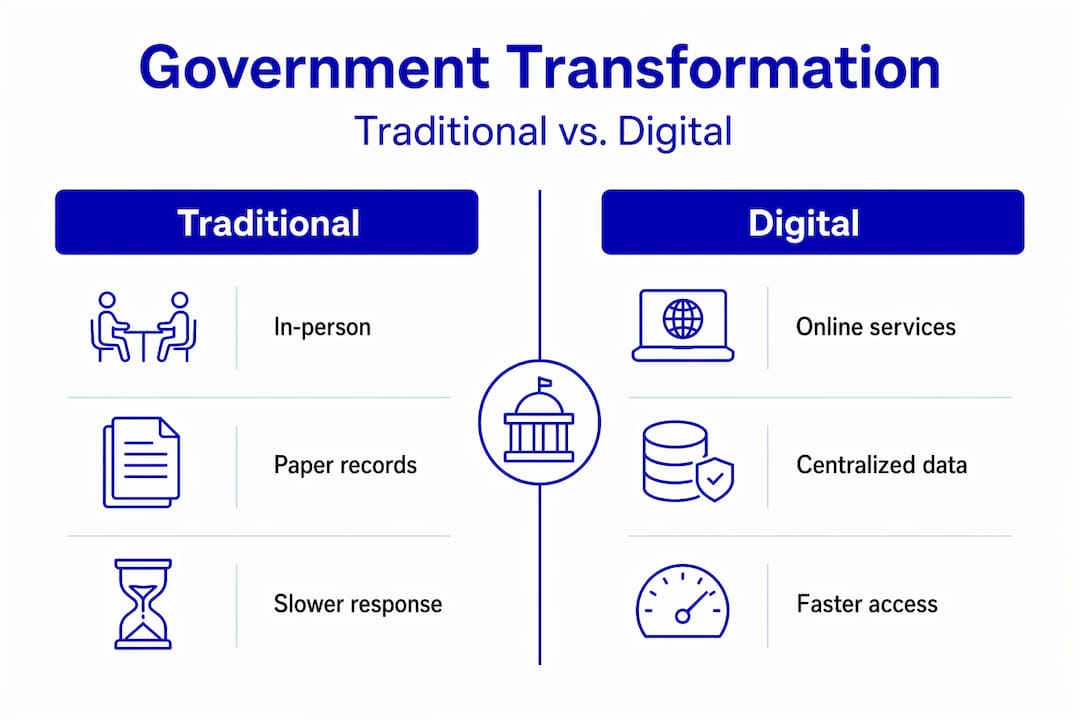
| Dimension | Traditional government | Technology-enabled government |
|---|---|---|
| Service delivery | In-person, paper-based | Digital portals, 24/7 availability |
| Processing speed | Days to weeks | Hours to real-time |
| Citizen interaction | Single-channel | Omnichannel with AI support |
| Data visibility | Siloed per department | Integrated across agencies |
| Accountability | Manual audit trails | Automated, timestamped records |
Pro Tip: Before procuring any new government technology solution, map your current service delivery process end-to-end. Most inefficiencies are process problems, not technology problems. Technology applied to a broken process only makes the broken process faster.
Agentic AI and automation in public services
The conversation around the digital trends shaping KSA and UAE in 2026 is increasingly dominated by one concept: agentic AI. Unlike conventional AI tools that respond to commands, agentic AI systems independently monitor inputs, analyze data, make decisions, and execute multi-step processes without continuous human oversight. In a government context, that translates to services that anticipate needs, resolve cases, and route requests without a civil servant manually intervening at every step.

The UAE’s ambition is specific and aggressive. The plan to integrate agentic AI across 50% of services within two years is paired with a workforce training program targeting 80,000 federal employees. That pairing is deliberate. Autonomous AI systems require human oversight, not human replacement. Someone needs to set the rules, monitor outputs, and intervene when the system encounters edge cases.
Here is a practical sequence for how government agencies can think about deploying emerging technology responsibly:
- Identify high-volume, rule-based tasks. These are the best candidates for automation. Document processing, application routing, status notifications, and eligibility checks are ideal starting points.
- Deploy supervised AI first. Begin with AI that supports human decision-makers before moving to fully autonomous systems. This builds institutional confidence and surfaces data quality issues early.
- Build a governance layer. Define who is accountable for AI decisions, how errors are logged, and what the escalation path looks like when the system produces unexpected outcomes.
- Train for oversight, not just use. The workforce skills required for governing AI are different from basic digital literacy. Officials need to understand what AI can and cannot do, how to audit its outputs, and how to communicate its limitations to citizens.
- Measure and iterate. Set baseline metrics before deployment. Track processing times, error rates, and citizen satisfaction. Use the data to refine the system continuously.
Conversational AI agents are one of the most visible applications in this space. Citizens in UAE can already interact with AI-powered chat interfaces for common government queries. The next generation of these systems will not just answer questions. They will complete transactions on the citizen’s behalf.
Pro Tip: When evaluating AI vendors for government deployment, ask specifically about explainability. You need to be able to tell a citizen or an auditor why the system made a particular decision. Systems that cannot provide that audit trail create governance risk, regardless of how accurate they are.
Governance frameworks and data standards
Technology alone does not produce digital transformation in government. Saudi Arabia’s progress on the UN E-Government Index is not just a story about portals and apps. It reflects years of institutional work by bodies like the Digital Government Authority, which coordinates technical standards, API protocols, cloud adoption frameworks, and interoperability requirements across ministries.
Without this coordination, agencies build isolated systems that cannot talk to each other. This is the “parallel system” trap: every ministry procures its own platform, duplicates data, and creates a fragmented user experience that forces citizens to interact with six different interfaces to complete one life event.
The Saudi Data and Artificial Intelligence Authority adds another critical layer. It governs data quality standards, oversees AI deployment frameworks, and administers the Personal Data Protection Law. This matters because digital transformation success depends more on shared data standards and institutional ability to orchestrate data across agencies than on any standalone technology product.
| Challenge | Consequence without governance | Outcome with governance |
|---|---|---|
| Data silos | Citizens re-enter the same information repeatedly | Single source of truth shared across agencies |
| No API standards | Systems cannot integrate; custom builds multiply | Reusable integrations reduce cost and time |
| Weak data protection | Citizen data exposed to security and privacy risks | Legal compliance builds public trust |
| Fragmented procurement | Budget wasted on duplicate or incompatible tools | Coordinated investment in shared platforms |
The World Economic Forum’s 2026 GovTech Compass reinforces this point: digital government is increasingly defined by accountability, accessibility, and human-centered design, not just technical deployment. Policymakers who treat technology as an institutional capability rather than a procurement exercise build systems that last.
How technology strengthens transparency and citizen engagement
One of the most underappreciated e-governance benefits is what happens to public trust when government services become genuinely easier to use. When a citizen can track the status of a permit application in real time, they stop wondering whether their request has been lost. That single feature does more for confidence in government than a communication campaign ever could.
Saudi Arabia’s approach to citizen-centric service design organizes digital services around life events rather than agency structures. Instead of navigating to the Ministry of Interior for one task and the Ministry of Health for another, citizens find what they need under categories like “starting a business” or “having a child.” This is not just a UX improvement. It reflects a philosophical shift: government organized around citizen needs rather than bureaucratic convenience.
Transparency extends beyond service delivery. The Saudi Open Data Portal publishes budget data, economic indicators, and service performance metrics. That kind of openness supports several outcomes simultaneously:
- Researchers and businesses can build services on top of government data, creating economic value.
- Citizens and media can scrutinize government performance using verified official data.
- Policymakers can benchmark against published metrics, creating internal accountability pressure.
- Innovation in public service design accelerates when data is available to identify gaps.
Digital identity infrastructure is the backbone of all of this. When a citizen’s identity is securely verified once, every subsequent interaction across different government services becomes faster and more trustworthy. The UAE’s digital identity framework and Saudi Arabia’s National Identity Platform are direct enablers of the citizen engagement improvements both countries have achieved.
AI’s role in public administration goes beyond efficiency. When embedded properly within institutional governance systems, AI enables proactive service delivery: notifying citizens when they qualify for a benefit, flagging documents nearing expiration, or routing complex cases to the right specialist automatically. The shift is from reactive government to anticipatory government.
My perspective on getting this right
I’ve worked with government entities and large enterprises across Saudi Arabia, UAE, and Egypt long enough to know one thing with certainty: the agencies that struggle with digital transformation are almost never struggling because of technology. They are struggling because of culture, coordination, and clarity of ownership.
What I’ve seen work is when a senior leader treats the digital program as an institutional change initiative with technology as the tool, not the other way around. The ministries that move fastest are the ones where someone in a position of authority has decided that the old way of working is simply no longer acceptable and has given their teams both the mandate and the protection to redesign processes from scratch.
The other thing I keep coming back to is the value of low-code platforms for government. I’m not talking about toy applications. I’m talking about serious workflow automation, inter-agency service integration, and citizen-facing applications built in weeks instead of months. In my experience, the faster a team can build a working prototype, the faster the entire organization aligns around what the product should actually do. Feedback loops that used to take a year now take a week.
The workforce piece is the one I worry most about. Everyone talks about AI adoption. Fewer people are talking about what it means to govern AI, to audit it, to be accountable for it when it gets something wrong. That conversation needs to start now, not after deployment.
— Tamer
Build faster with the right platform
If you are a policymaker or government technology leader in Saudi Arabia or UAE evaluating how to accelerate your digital transformation without getting locked into years-long custom development cycles, this is worth your attention.
Singleclic’s Cortex platform is an Arabic-enabled, on-premise low-code platform built specifically for MENA enterprises and governments. It allows your team to design, automate, and modify complex workflows without writing code, with full Arabic UI support, unlimited users, and on-premise deployment suited for government security requirements. If you want to understand how low-code platforms can accelerate your agency’s modernization, or if you need to assess your ERP readiness before your next major investment, Singleclic has the regional expertise and implementation experience to guide you through both.
FAQ
What is the role of technology in government?
Technology in government improves service delivery, reduces administrative costs, increases transparency, and enables more responsive citizen engagement. In Saudi Arabia and UAE, it has driven measurable gains in processing speed, interoperability, and public satisfaction with government services.
How does agentic AI differ from standard government AI tools?
Agentic AI operates autonomously across multi-step government tasks without requiring continuous human input, unlike conventional AI tools that only respond to direct commands. The UAE plans to deploy it across 50% of federal services within two years.
Why do data governance frameworks matter for digital government?
Without shared data standards and interoperability protocols, government agencies build isolated systems that fragment the citizen experience and waste budget on duplicate tools. Bodies like Saudi Arabia’s Digital Government Authority exist specifically to prevent this.
How does technology improve citizen engagement in government?
Unified portals organize services around citizen life events, open data initiatives increase government accountability, and AI enables proactive notifications and faster case resolution. These changes shift the relationship between government and citizen from transactional to anticipatory.
What should policymakers prioritize before deploying AI in public services?
Policymakers should identify high-volume rule-based processes first, build an AI governance layer with clear accountability, and invest in workforce training focused on AI oversight rather than just basic digital skills.