Low-code legacy modernization means keeping the systems that still run your core transactions while rebuilding the workflows, portals and integrations around them on a visual, governed platform. You do not rewrite everything. You decouple what changes often (approvals, forms, dashboards, customer and employee journeys) from what changes rarely (the ledger, the policy engine, the mainframe batch), then replace or retire pieces in waves. This guide explains where that approach works, where it does not, and which UAE governance questions to settle before you pick a platform.
TL;DR
- Low-code is a portfolio decision. It suits approval workflows, case management, portals, integrations and process orchestration, and it is not automatically right for every performance-critical core (Gartner).
- Modular, API-first modernization is safer than a big-bang rewrite. In BCG’s Middle East public-sector survey, 86% of unsuccessful transformations underestimated the platform changes required.
- In the UAE, check data classification, data location, portability and auditability before you choose a platform, not after.
- Start with one pilot that has a measurable business result, expose legacy functions through APIs, and migrate in waves.
- Budget for architecture, data cleanup, security and training, not only for building screens.
Table of Contents
- What low-code legacy modernization actually means
- Where low-code fits, and where it does not
- The UAE governance questions to settle first
- Why regional demand is moving past pilots
- Use cases that work well
- A modernization sequence you can follow
- Our perspective
- How Singleclic helps
- Common mistakes to avoid
- Next step
- SEO details
- FAQ
- Sources
What low-code legacy modernization actually means
A legacy system is not simply an old one. It is a system that limits what you can do next: it cannot integrate with new applications, it depends on a few people who understand it, or it blocks cloud and modern development tools. A 2025 study on organizations managing multiple legacy applications describes exactly this: legacy applications restrict integration and hinder the use of modern development technologies.
Low-code answers that problem in three ways:
- Encapsulate. Wrap the legacy system with APIs or integration services so new applications can use its data and functions without touching its code.
- Rebuild the edges. Replace the screens, forms and manual hand-offs around it with workflows built visually, with business owners and IT working on the same model.
- Retire in waves. Once a function runs reliably on the new layer, switch off the old component.
The difference from a classic rewrite is where the risk sits. A rewrite bets everything on one cutover date. A layered approach lets you prove value in weeks on one process and then decide what to do next. If you want the broader strategic frame first, our legacy system modernization guide for leaders covers the options (rehost, replatform, refactor, replace) in more depth.
Where low-code fits, and where it does not
The research is consistent on one point: low-code works best on the right use cases. Gartner’s August 2025 research on when and how to use low-code for software modernization says AI-augmented low-code delivers its best outcomes when applied to suitable use cases. Academic work presented at AMCIS 2025 on low-code versus high-code decision criteria points to application complexity and third-party integration as leading selection factors.
Here is a practical way to apply that:
| Legacy situation | Low-code fit | Why |
|---|---|---|
| Paper or email approval chains sitting on top of an old ERP | Strong | Workflow logic changes often and needs business ownership |
| Customer or employee portal reading data from a legacy database | Strong | The portal is a new experience layer, the data stays put |
| Case management for permits, claims or complaints | Strong | Rules, SLAs and routing are process problems, not computation problems |
| Integration between five systems that do not talk to each other | Strong, if the platform has deep connectors | Orchestration is a core low-code capability |
| Real-time transaction core with extreme throughput | Weak | Performance and engineering control matter more than speed of build |
| Highly specialized algorithms or proprietary calculation engines | Weak | Better kept as services and called through APIs |
The pattern in the table is the one that matters: low-code owns the process layer, and professional engineering owns the heavy core. HFS Research makes a similar point, presenting low-code and generative AI as complements to professional delivery teams, with training and internal and external support as conditions for getting value.
Five early decision gates
Before you choose a platform, run your candidate applications through these questions. They follow the criteria identified in the 2025 low-code adoption research:
- Complexity: Is the logic mostly workflow and rules, or deep computation?
- Third-party integration: Does the platform connect to your ERP, CRM, identity provider and legacy databases without custom code for every link?
- Flexibility: How often do requirements change? Frequent change favors low-code.
- Access control: Can you enforce role-based access, segregation of duties and audit trails at the level your regulator expects?
- Licensing economics: Does the pricing model still work when you add users, applications and environments?
One more check we add ourselves: can the platform run where your data is allowed to live? That leads to the UAE-specific part.
The UAE governance questions to settle first
In the UAE, a modernization project is also a data governance project. The exact obligations depend on your sector, your data and whether you are a designated critical entity, so treat the following as a checklist for your legal and security teams, not as legal advice.
- Cloud policy. The UAE National Cloud Security Policy covers data classification, data security across the lifecycle, and requirements for cloud infrastructure and application security. Use it to frame contracts and architecture reviews.
- Critical entities. The UAE Information Assurance Regulation provides management and technical security controls for entities that TDRA designates as critical. If you are one, it applies to your modernized systems too.
- Personal data. Federal Decree-Law No. 45 of 2021 requires processing to be fair, transparent and lawful, and requires technical and organizational measures suited to the risk. It also sets conditions for transferring personal data across borders, which matters if a low-code platform is hosted outside the country.
In practice, this turns into six questions for any platform vendor: where is data stored and processed, how is it encrypted, who can administer the environment, what is logged and for how long, can you export your applications and data if you leave, and can the platform be deployed on premise or in a sovereign environment if your data classification requires it. Our related guides on UAE data residency for enterprises and cloud security for IT leaders in KSA and UAE go deeper on these points.
A platform that cannot expose APIs, keep audit trails or support your deployment choice can create a new silo instead of removing the old one. That is the quiet failure mode of many modernization projects.
Why regional demand is moving past pilots
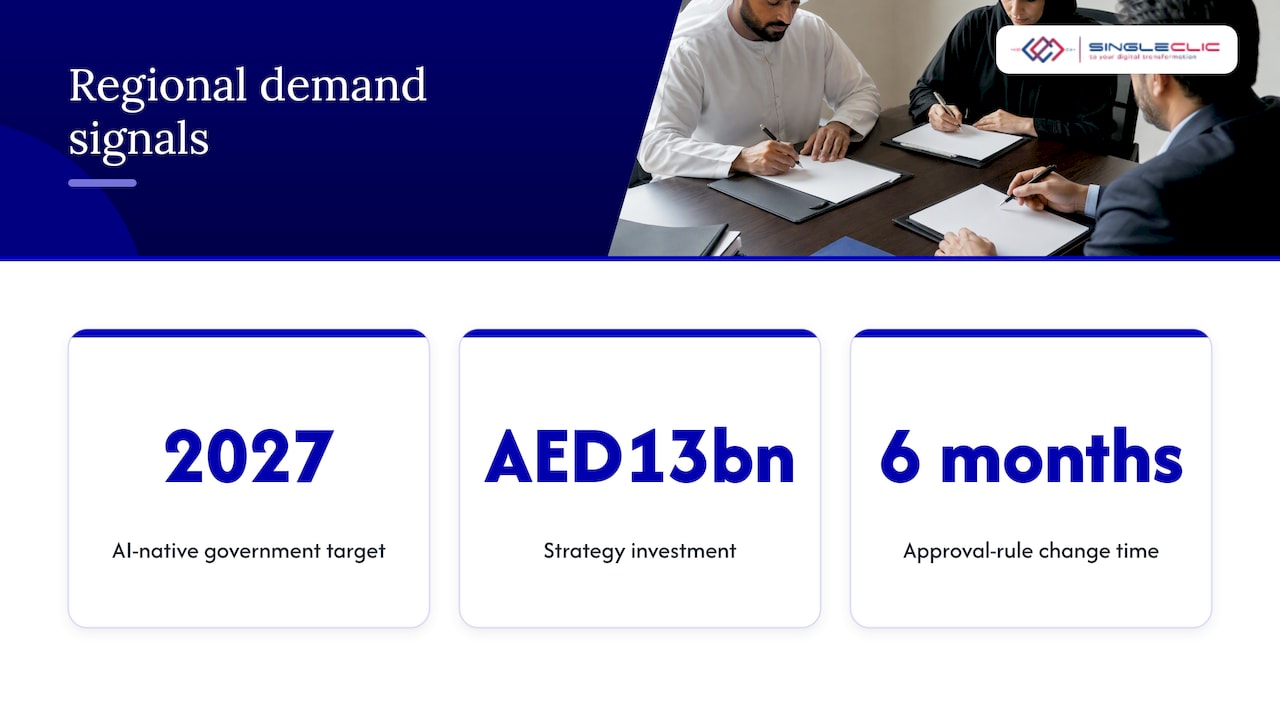
UAE public-sector targets show the direction of travel. Abu Dhabi’s Government Digital Strategy 2025-2027 aims for an AI-native government by 2027 and is backed by AED13 billion of investment, with sovereign cloud, unified digital foundations and cybersecurity among its priorities. At GITEX Global 2025, Abu Dhabi also launched a no-code AI platform intended to let government employees build AI solutions themselves.
These are government targets and announcements, not proof that every UAE enterprise has reached the same maturity. But they set expectations: banks, healthcare groups and large private operators now work alongside agencies that expect integration, auditability and faster delivery. A legacy estate that takes six months to change a single approval rule becomes a competitive problem.
Use cases that work well
Approvals and workflow on top of ERP
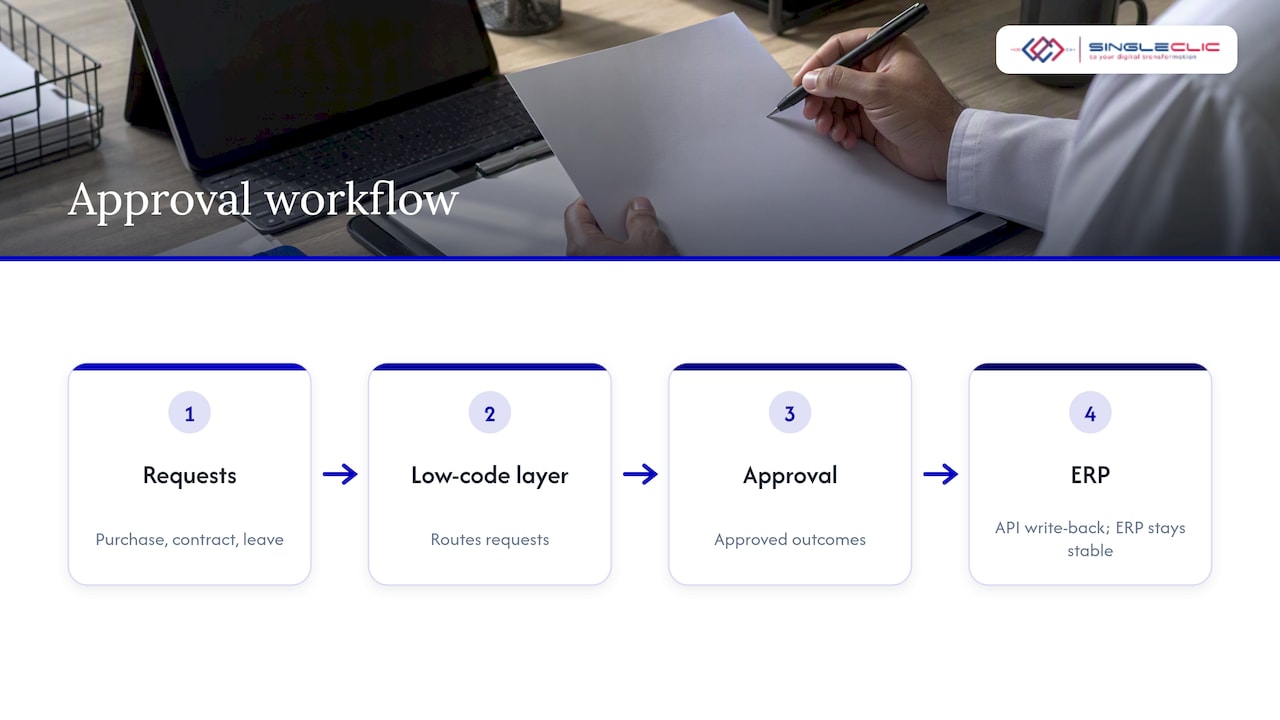
Many organizations run finance, procurement and HR on an older ERP and handle exceptions through email and spreadsheets. A low-code process layer can route purchase requests, contract approvals and leave requests, and write the results back to the ERP through an API. The ERP stays stable. The process becomes visible and measurable. For leaders weighing process work in more depth, see our business process automation guide for C-level leaders.
Citizen and customer portals
Healthcare providers, municipalities and banks often have rich data in legacy systems but poor front ends. A portal built on low-code can read from the legacy database through a governed integration layer, add identity checks and show status to the user, without a rewrite of the underlying system.
Case management
Permit applications, insurance claims, complaints and onboarding all follow the same shape: intake, validation, routing, decision, notification. Rules and service levels change with policy, so a platform where business analysts adjust workflow while IT governs security is a good match.
Integration and orchestration
When CRM, ERP, document management and legacy databases each hold a piece of the truth, the real work is orchestration. This is where low-code earns its place in a modernization program, as long as connectors are real and APIs are first class. Our article on ERP and CRM integration shows what this looks like in practice.
A modernization sequence you can follow
The following order reflects the capability-building and integration discipline described in the 2025 research on low-code adoption. The research does not establish a universal duration or price, so we do not promise one here.
- Inventory applications and dependencies. List every system, its owner, its interfaces and the people who truly understand it.
- Map business-critical processes. Follow a process end to end, across systems, rather than application by application.
- Classify data and regulatory constraints. Decide what can leave the building, what must stay in the UAE and what needs on-premise deployment.
- Select a pilot. Choose a process with a clear metric, such as approval cycle time or backlog size, and a willing business owner.
- Expose legacy capabilities. Publish APIs or integration services so the new layer never reaches into the old database directly.
- Build the new workflow or experience in low-code. Keep business and IT in one design room.
- Run parallel testing and reconciliation. Compare outputs from old and new until they match.
- Train owners and users. HFS Research highlights training as critical to realizing value.
- Migrate, retire or encapsulate in waves. Decide component by component, based on risk and value.
Why not a big-bang rewrite?
BCG’s analysis of digital transformation in the Middle East found that all successful public-sector transformations in its survey used flexible, modular, interoperable platforms. Among the unsuccessful ones, 86% underestimated the technology-platform changes required and 72% underestimated IT investment. BCG also reports that layered data and digital platforms can reduce cost by up to 50% compared with legacy technology, which it frames as potential, not a guaranteed project result. The lesson for executives: fund architecture, data cleanup, security, change management and operating-model redesign, not just application construction.
Our perspective
We have delivered digital projects across Saudi Arabia, the UAE and Egypt for more than ten years, and the same pattern repeats. Teams ask whether low-code can replace their legacy system. The better question is which part of the legacy estate is slowing the business today, and what is the smallest governed layer that removes that bottleneck.
We treat low-code as a way to put business logic back in the hands of the people who own it, while IT keeps control of integration, security and deployment. That is why we built Cortex, our Arabic-enabled, on-premise low-code and BPM platform. Banks and government entities often cannot send process data to a public cloud, so we designed Cortex for on-premise deployment, with full Arabic UI, unlimited users, runtime workflow changes without downtime and deep integration with enterprise systems.
Our advice is simple. Do not buy speed alone. Ask how the platform handles audit, access, APIs and exit. If a vendor cannot answer in the first meeting, the speed will cost you later.
— Tamer Badr
How Singleclic helps
We help enterprises, healthcare groups, banks and government organizations in the UAE and Saudi Arabia modernize around their legacy systems rather than through them. Our work typically combines:
- Cortex, our low-code and Open BPM platform connecting approvals, ERP, CRM, data, legacy systems and workflows, deployable on premise.
- Business process automation with IBM BAW and other BPM tools, covering workflow design, rules and monitoring.
- ERP and CRM implementation and integration on Microsoft Dynamics 365 and Odoo, so the new process layer connects cleanly to your system of record.
- AI and data analytics applications built on top of the integrated data.
Our clients include Emirates Health Services, Dubai Healthcare City, QNB and AlBaraka, among 100+ enterprise clients served by 70+ consultants and engineers across KSA, the UAE and Egypt. If you want to see the full range, explore our low-code, automation and AI services, or start with the Cortex platform overview.
For platform selection, our guides on enterprise low-code with governance, low-code versus traditional development and how low-code helps enterprises modernize legacy systems give you decision criteria. If governance is your main concern, read low-code at enterprise scale.
Common mistakes to avoid
- Treating it as code conversion. Modernization is an organizational capability: sensing legacy constraints, picking suitable opportunities and changing development practice. Converting screens one for one just moves the mess.
- Skipping the API layer. Direct database access from a new application recreates the coupling you wanted to remove.
- Ignoring licensing at scale. A pilot with 20 users is not the same cost profile as a rollout to 5,000.
- Letting business build without IT governance. Speed without access control and testing creates shadow systems.
- Underfunding training. Tools do not change habits. People do.
Next step
If you are mapping a modernization program, begin with a short assessment of one process and the systems it touches. We can help you classify the data, choose the integration approach and design a pilot you can measure. Talk to our team through the Singleclic services page.
SEO details
- SEO title: Low-code legacy modernization: a practical guide for UAE enterprises
- Slug: low-code-legacy-modernization
- Keyword: low-code legacy modernization
- Secondary keywords: legacy system modernization, Cortex low-code, Open BPM, workflow automation, system integration, cloud-native apps
- Pillar cluster: Low-code and enterprise process automation (pillar: legacy system modernization; this article is a supporting article)
FAQ
What does legacy modernization mean?
It means updating or replacing outdated systems so they support current business needs, integrate with modern tools and meet today’s security expectations. It can range from wrapping old systems with APIs to full replacement. Most successful programs mix several approaches, applied in waves.
Can low-code replace a legacy system completely?
Sometimes, but not always. Low-code is strongest for workflows, portals, case management and integration. For high-throughput transaction cores or specialized calculation engines, the safer pattern is to keep them as services and modernize the layers around them.
Does low-code have a future?
The evidence points to yes, in partnership with professional engineering. Gartner’s 2025 research says AI-augmented low-code gives its best results on the right use cases, and HFS Research describes low-code and generative AI as complementing professional teams. Governance, training and integration decide whether it pays off.
How do UAE data rules affect a low-code platform choice?
They affect where data is hosted, how it is classified, encrypted and logged, and whether you can export it. The National Cloud Security Policy, the Information Assurance Regulation for designated critical entities and Federal Decree-Law No. 45 of 2021 may apply depending on your sector and data. Ask your legal and security teams to review the platform before the pilot.
Where should we start?
Pick one process with a measurable pain, such as approval turnaround, and map the systems behind it. Expose the needed legacy functions through APIs, build the new workflow in low-code and run it in parallel with the old one before switching. That gives you proof of value and a template for the next wave.
Sources
- When and How to Use Low Code for Software Modernization, Gartner
- Digital transformation in the Middle East, BCG
- Overcoming Multi-legacy Application Challenges through Building Dynamic Capabilities for Low-code Adoption
- Low-Code vs. High-Code: Decision Criteria for Developing Business Applications
- The low-code imperative, HFS Research
- Abu Dhabi Government Digital Strategy 2025-2027, Department of Government Enablement
- Abu Dhabi Government Pavilion at GITEX Global 2025, Department of Government Enablement
- National Cloud Security Policy, UAE Government
- Federal Decree-Law No. 45 of 2021 on Personal Data Protection