Nearly 60 percent of enterprise leaders say manual reporting slows critical decisions, even as American technology sets new automation standards. For CIOs and CTOs in Saudi Arabia and UAE, legacy reporting often drains valuable time and resources. This article delivers actionable guidance on evaluating, automating, and optimizing your reporting processes so your teams spend less time on manual work and gain sharper operational insights.
Table of Contents
- Step 1: Assess Current Reporting Processes
- Step 2: Select the Right Automation Tools
- Step 3: Integrate Automation with Business Systems
- Step 4: Configure Automated Report Workflows
- Step 5: Test and Validate Report Accuracy
- Step 6: Optimize Ongoing Reporting Processes
Quick Summary
| Key Takeaway | Explanation |
|---|---|
| 1. Understand Current Processes | Evaluate current reporting methods to identify inefficiencies and data sources. Engage stakeholders for insights. |
| 2. Choose Suitable Automation Tools | Select automation solutions that integrate well with existing systems and offer customization and scalability. |
| 3. Ensure Smooth Integration | Map data flows and prioritize compatibility to prevent silos, ensuring diverse data formats are managed effectively. |
| 4. Configure Workflows Strategically | Create automated workflows that streamline data retrieval, formatting, and report distribution for efficiency. |
| 5. Regularly Test and Optimize | Implement rigorous testing for accuracy and continuous improvements to adapt reporting to changing business needs. |
Step 1: Assess Current Reporting Processes
Before automating your business reporting, you need a comprehensive understanding of your existing processes. This step involves a systematic evaluation of how your organization currently collects, generates, and distributes reports across different departments.
Start by mapping out your current reporting workflows through a detailed audit. Talk to stakeholders in finance, operations, sales, and other key teams to understand their current reporting methods. Look for critical details such as data sources, report generation frequency, distribution channels, and time spent on manual reporting tasks. Pay special attention to pain points where current processes feel inefficient or time consuming.
As you assess your processes, evaluate the credibility and accuracy of your reporting sources. Verify the transparency of data origins and check the qualifications of report creators. In Saudi Arabia and UAE, where enterprise reporting standards are increasingly sophisticated, this step is crucial for ensuring high quality insights. Use tools like spreadsheet tracking, workflow diagrams, and stakeholder interviews to build a comprehensive picture of your current reporting landscape.
Pro tip: Involve representatives from each department during your assessment to get a holistic view and build early buy-in for reporting automation initiatives.
Step 2: Select the Right Automation Tools
Selecting the appropriate automation tools is critical for transforming your reporting processes and generating meaningful business insights. Your goal is to find solutions that seamlessly integrate with your existing systems while providing robust reporting capabilities.
When evaluating automation tools, focus on solutions that offer comprehensive workflow automation capabilities and flexible data integration. Look for platforms that support multiple data sources, enable scheduled report delivery, and provide intuitive customization options. In the Saudi Arabian and UAE markets, where enterprise technology standards are rapidly evolving, prioritize tools that can handle complex reporting requirements across different business units.
Consider key selection criteria such as ease of use, scalability, integration potential, and advanced features like automated data blending and multi client management. Your chosen tool should reduce manual reporting effort while delivering accurate, timely insights. For regional enterprises, platforms like our Cortex low code solution can provide powerful automation capabilities tailored to Middle Eastern business environments.
Pro tip: Request live demonstrations and free trials from potential automation tool providers to thoroughly assess their real world performance and compatibility with your specific reporting needs.
Here is a summary of key considerations when selecting an automation tool for business reporting:
| Selection Criterion | Why It Matters | Business Impact |
|---|---|---|
| Ease of Use | Reduces training time and errors | Faster user adoption |
| Integration Capability | Works with current systems | Improved data consistency |
| Scalability | Supports business growth | Handles increasing data and users |
| Customization Options | Adapts to unique requirements | Greater reporting flexibility |
| Advanced Features | Enables automation, analytics | Enhanced decision-making capabilities |
Step 3: Integrate Automation with Business Systems
Successfully integrating automation tools with your existing business systems requires a strategic and methodical approach. Your goal is to create a seamless technological ecosystem that enhances reporting efficiency without disrupting current workflows.
Start by mapping the intricate connections between your business process automation tools across different departments. Identify critical integration points where data flows between systems such as customer relationship management platforms, enterprise resource planning software, financial reporting tools, and specialized departmental applications. In the Saudi Arabian and UAE markets, where enterprise technology landscapes are complex, careful mapping helps prevent potential data silos and ensures smooth information exchange.

Prioritize compatibility and data standardization during integration. Ensure your chosen automation platform supports robust API connections, can handle diverse data formats, and provides real time synchronization capabilities. For regional enterprises, platforms like our Cortex low code solution offer flexible integration options that can adapt to unique organizational requirements while maintaining security and performance standards.
Pro tip: Conduct comprehensive integration testing in a controlled environment before full deployment to identify and resolve potential compatibility issues in advance.
Step 4: Configure Automated Report Workflows
Configuring automated report workflows transforms your reporting process from manual labor to strategic insight generation. This crucial step turns raw data into meaningful business intelligence that drives decision making across your organization.
Designing comprehensive automated reporting workflows involves strategic planning and precise technical execution. Start by mapping out your reporting requirements, identifying data sources, and establishing clear objectives for each report type. Leverage tools that support end to end workflow configuration, including AI powered insight generation, automatic data collection, and customizable report templates. For enterprises in Saudi Arabia and UAE, this means creating workflows that can handle complex multilingual and multicurrency reporting needs while maintaining strict data integrity.
Pay close attention to workflow setup details including data validation, formatting rules, and distribution methods. Configure your automation platform to retrieve data automatically, apply consistent formatting, and distribute reports through preferred channels such as email or collaborative platforms. Our Cortex low code platform enables organizations to build sophisticated reporting workflows that adapt to changing business requirements without extensive programming knowledge.
Pro tip: Implement a staged rollout of your automated reporting workflows, starting with less critical departments to refine your approach before full enterprise deployment.
Below is a comparison of manual vs. automated reporting workflows:
| Aspect | Manual Reporting | Automated Reporting |
|---|---|---|
| Data Collection | Time consuming, error prone | Fast, consistent, accurate |
| Report Frequency | Infrequent, scheduled | Real-time or scheduled, on demand |
| Formatting | Inconsistent, manual edits | Standardized, template driven |
| Distribution | Email or printed copies | Automated emails, dashboards |
Step 5: Test and Validate Report Accuracy
Ensuring the reliability of your automated reporting system requires rigorous testing and validation processes. Your goal is to create a robust verification mechanism that catches potential errors before they impact critical business decisions.
Data quality testing involves implementing comprehensive validation techniques across multiple dimensions of your reporting workflow. Focus on verifying source data integrity, checking data transformation accuracy, and performing thorough completeness checks. In the Saudi Arabian and UAE enterprise environments, where data precision is paramount, develop a multi layer testing strategy that includes automated boundary value tests, outlier detection, and cross referencing with original data sources. Pay special attention to scenarios that might introduce complexity such as multilingual data handling, currency conversions, and cross departmental reporting.
Implement a systematic approach to validation that combines automated testing protocols with periodic manual review. Configure your testing framework to run continuous monitoring checks that flag anomalies in real time. For regional enterprises, platforms like our Cortex low code solution provide flexible testing capabilities that can be customized to your specific organizational requirements without requiring extensive technical expertise.
Pro tip: Create a comprehensive test matrix that maps different data scenarios and validation rules, ensuring you cover both expected and edge case reporting conditions.
Step 6: Optimize Ongoing Reporting Processes
Continuous improvement of your reporting system is crucial for maintaining its relevance and effectiveness. Your objective is to create a dynamic reporting framework that adapts to changing business needs and delivers increasingly precise insights.
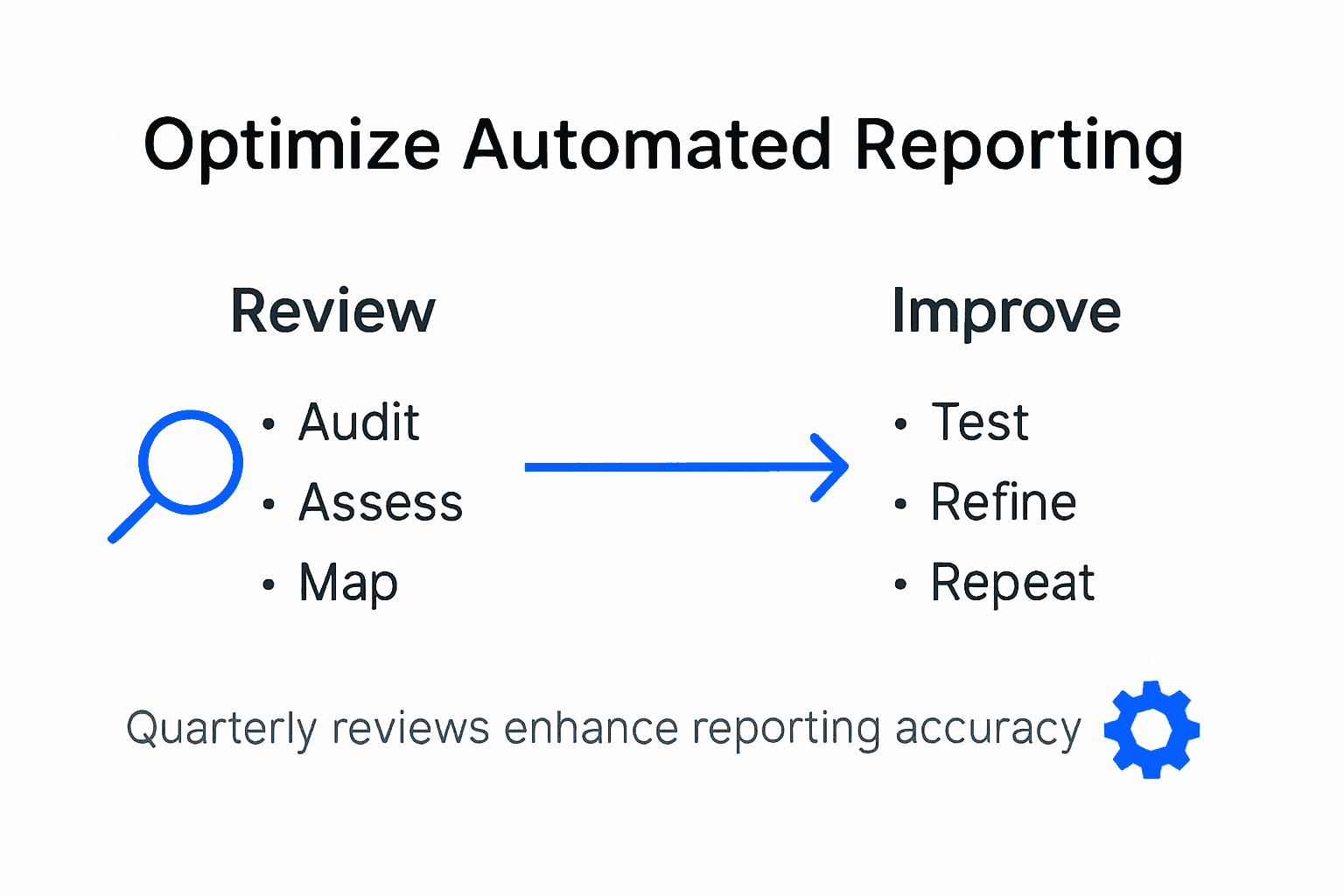
Defining clear objectives and establishing systematic optimization strategies will transform your reporting from a static process to a strategic asset. In Saudi Arabia and UAE’s competitive business environments, focus on aligning your reporting processes with specific organizational goals. This means regularly reviewing key performance indicators, standardizing data inputs, and creating flexible report formats that can be quickly adjusted based on emerging business requirements.
Implement best practices that enhance reporting efficiency and user accessibility. This includes developing standardized report templates, automating data collection processes, and creating exception based alert systems. For regional enterprises, our Cortex low code platform provides the flexibility to build reporting systems that can be easily modified without extensive technical intervention. Establish feedback loops with key stakeholders to ensure your reporting continues to deliver actionable insights that drive strategic decision making.
Pro tip: Schedule quarterly review sessions to assess reporting effectiveness, gathering input from different departments to continuously refine and improve your automated reporting approach.
Unlock Seamless Reporting Automation With Singleclic
Automating your business reporting requires more than just software it demands an expert partner who understands your unique pain points like manual errors inefficiency and integration challenges. This article revealed crucial steps such as assessing current reporting processes selecting the right tools and configuring automated workflows all within the context of complex enterprise environments in Saudi Arabia and UAE. At Singleclic we specialize in delivering tailored business process automation and ERP/CRM implementations that directly address these challenges while enabling scalable growth and operational excellence.
Discover how our Arabic-enabled low-code platform Cortex can transform your reporting by providing full integration with existing systems real-time process optimization and support for multilingual data. Benefit from a true regional leader with over 10 years of experience and a strong track record across healthcare banking telecom and government sectors. Get started with Singleclic today and elevate your enterprise reporting to deliver faster more accurate insights that drive smarter decisions. Visit us now at https://singleclic.com and explore how our Business Process Automation solutions can be your next step forward.
Frequently Asked Questions
How can I assess my current reporting processes before automating?
To assess your current reporting processes, conduct a detailed audit of how reports are collected, generated, and distributed across departments. Map out reporting workflows and gather input from stakeholders to identify inefficiencies and pain points, which will help you develop a clear understanding of what needs to change.
What criteria should I consider when selecting automation tools for reporting?
When selecting automation tools, focus on criteria such as ease of use, integration capability, scalability, customization options, and advanced features. Choose a tool that fits well with your existing systems and reduces manual reporting efforts, ensuring that it meets your specific reporting requirements.
How do I integrate automation tools with my existing business systems?
To integrate automation tools effectively, start by mapping out the connections between your current business processes and the new tools. Identify key integration points to ensure data flows seamlessly while maintaining accuracy and avoiding data silos throughout the organization.
What steps are involved in configuring automated report workflows?
Configuring automated report workflows involves defining your reporting requirements, mapping data sources, and setting clear objectives for each report type. Use tools that facilitate end-to-end workflow configuration to automate data collection and establish consistent formatting and distribution methods.
How can I ensure the accuracy of my automated reports?
To ensure the accuracy of your automated reports, implement comprehensive testing and validation processes. Focus on data integrity, transformation accuracy, and completeness checks using a systematic approach that combines automated testing with periodic manual reviews.
What practices can I adopt for optimizing ongoing reporting processes?
For optimizing ongoing reporting processes, define clear objectives and regularly review key performance indicators to align your reporting with business needs. Establish feedback loops with stakeholders and continuously refine your reporting approaches to enhance efficiency and deliver actionable insights.
Recommended
- Unlocking Business Growth with Odoo CRM: 6 Key Benefits for CEOs and SMBs | Singleclic
- Boost Efficiency with Analytical Automation | singleclic
- Elevating Workforce Insights: HR Reporting Software for Smarter Decisions | Singleclic
- Integrating Power BI with Odoo ERP: Your Guide to Fast and Accurate Data | Singleclic