TL;DR:
- Enterprise mobility enables employees to securely access corporate data and applications from any device and location.
- It goes beyond device management by integrating app, content, and identity controls, especially with unified endpoint management.
Enterprise mobility is defined as the practice of enabling employees to securely access corporate data, applications, and services from any device, at any location, to support a flexible and productive workforce. Far beyond issuing company phones, it is a business framework that integrates mobile technology into core operations. The global enterprise mobility market is projected to grow from $19.65 billion in 2019 to $151.51 billion by 2027 at a 29.3% CAGR. That growth rate signals a fundamental shift in how organizations in the UAE, Saudi Arabia, and across the region structure their workforce and operations.
What is enterprise mobility and how does it differ from MDM?
Understanding enterprise mobility requires separating three related but distinct concepts: Mobile Device Management (MDM), Enterprise Mobility Management (EMM), and Unified Endpoint Management (UEM). Most business leaders use these terms interchangeably. That is a costly mistake.
MDM focuses narrowly on configuring and securing the hardware and operating system of a mobile device. It controls settings, enforces passcodes, and enables remote wipe. That is where its authority ends.
EMM goes significantly further. EMM encompasses device, application, content, and identity management, extending well beyond MDM’s device-only focus. It includes Mobile Application Management (MAM), Mobile Content Management (MCM), and Mobile Identity Management (MIM). In practice, EMM lets your IT team push approved apps to employee phones, restrict which documents can be shared, and verify user identity before granting access to a CRM record.
UEM extends the scope even further. UEM brings laptops, desktops, and IoT devices under a single management console alongside mobile devices. For organizations running hybrid workforces across offices in Riyadh, Dubai, and remote field sites, UEM provides a single control plane for every endpoint.
| Capability | MDM | EMM | UEM |
|---|---|---|---|
| Device configuration and wipe | Yes | Yes | Yes |
| App management (MAM) | No | Yes | Yes |
| Content and document control | No | Yes | Yes |
| Identity and access management | No | Yes | Yes |
| Laptops and desktops | No | No | Yes |
| IoT device management | No | No | Yes |
Pro Tip: If your organization manages more than 200 endpoints across multiple device types, start with a UEM evaluation rather than MDM. Retrofitting a broader solution later costs significantly more in time and integration work.
What business benefits does enterprise mobility offer in the UAE and Saudi Arabia?
Enterprise mobility delivers measurable gains across three categories: workforce productivity, operational efficiency, and risk reduction. Each matters differently depending on your sector.

Workforce productivity
Mobile-enabled employees complete tasks without returning to a desk or waiting for a desktop session. A field engineer in Abu Dhabi can log a service report, check inventory levels in Microsoft Dynamics 365, and escalate a fault ticket from the job site. That single workflow change removes hours of lag from a process that previously required office access. The role of mobile solutions in driving this kind of productivity gain is well established across construction, healthcare, and field services.
Operational efficiency in logistics and field services
The efficiency gains are most visible in logistics. Logistics companies adopting GPS-enabled enterprise mobility solutions reported a 25% increase in on-time delivery performance. That improvement comes directly from real-time vehicle tracking, mobile proof-of-delivery capture, and instant dispatch updates replacing phone calls and paper forms. For organizations managing smart supply chain operations across the GCC, this is a concrete, measurable return.
Security and compliance benefits
Mobile access without proper controls creates serious exposure. Enterprise mobility management tools address this by enforcing policies at the application and data layer, not just the device layer. Key security benefits include:
- Selective remote wipe that removes corporate data from a lost device without erasing personal content
- App-level encryption that protects data in transit and at rest on every enrolled device
- Role-based access controls that limit which employees can view sensitive financial or patient records
- Compliance audit trails that log every data access event for regulatory review
For organizations in regulated sectors like banking and healthcare, these controls are not optional. Emirates Health Services and similar institutions require documented evidence of data access governance before approving mobile deployments.
How do you design an effective enterprise mobility strategy?
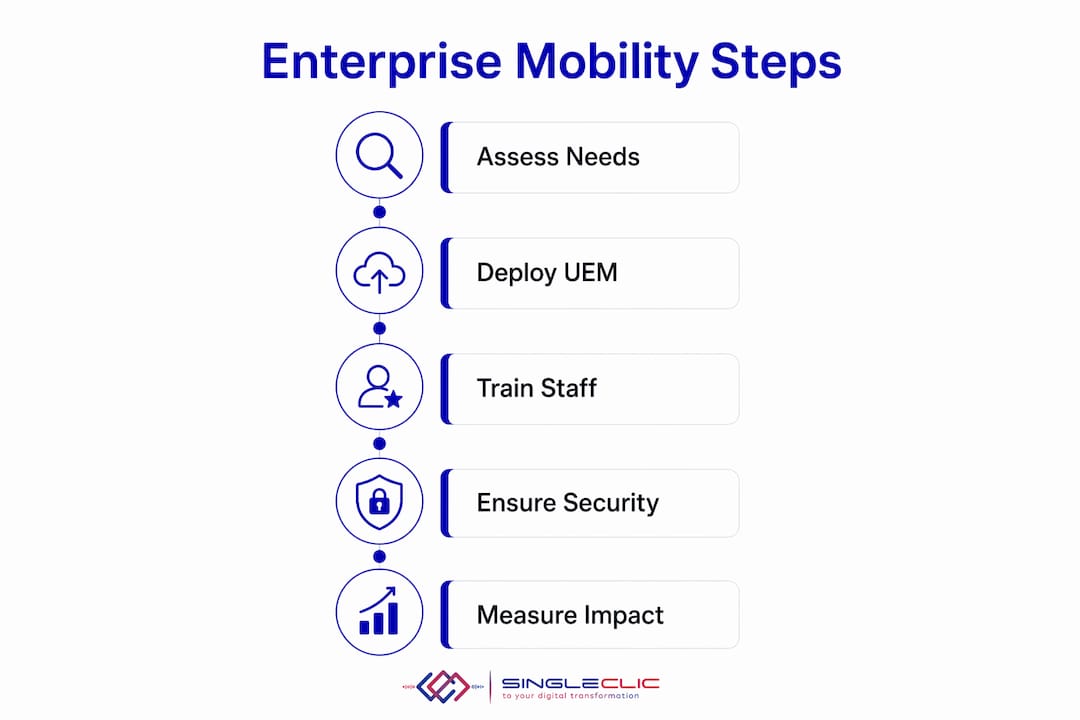
An enterprise mobility strategy that is not connected to your broader business goals will produce isolated tools and poor adoption. Aligning mobility initiatives with digital transformation programs avoids low ROI from disconnected deployments. The sequence below reflects what actually works in practice.
-
Define the business problem first. Identify which processes are slowed by lack of mobile access. Approval workflows, field data collection, and customer-facing service delivery are the most common starting points in UAE and Saudi enterprises.
-
Audit your current endpoint environment. Catalog every device type, operating system, and application your workforce uses. This baseline determines whether MDM, EMM, or UEM fits your situation.
-
Re-engineer processes for mobile, not just mobile-enable them. Workplaces that mobile-enable processes rather than simply shrinking desktop apps to phone screens see higher adoption and real productivity gains. A purchase approval that takes 12 steps on a desktop should take 3 taps on a phone.
-
Build offline capability into critical apps. Connectivity is intermittent on construction sites in NEOM and in remote field locations across Saudi Arabia. Offline-first capabilities keep mobile apps functional when network access drops, which is the single biggest driver of field worker adoption.
-
Integrate Telecom Expense Management (TEM) from day one. TEM is a critical but often overlooked factor in controlling costs as mobile data usage grows. Unmanaged roaming charges across GCC borders can erode the financial case for mobility within the first quarter of deployment.
-
Establish governance and a rollout roadmap. Define who owns mobility policy, how devices are enrolled, and how exceptions are handled. Pilot with one department before scaling across the organization.
Pro Tip: Assign a mobility program owner at the VP or director level, not just an IT administrator. Mobility decisions touch HR policy, legal compliance, and business process design. Without executive ownership, programs stall at the IT department boundary.
Tracking digital trends shaping KSA and UAE helps leaders anticipate which mobile capabilities will matter most in the next 18 months, including AI-assisted field apps and IoT-connected device management.
What security challenges does enterprise mobility introduce?
Mobile access expands the attack surface of your organization. Every enrolled device is a potential entry point for data loss or unauthorized access. The risks are specific and manageable when addressed with layered controls.
The primary threats in a mobile environment include:
- Device loss or theft, which exposes corporate data if encryption and remote wipe are not pre-configured
- Unsecured Wi-Fi connections, which allow attackers to intercept data transmitted from coffee shops, airports, and hotel networks
- Shadow IT, where employees install unapproved apps that bypass corporate security policies and create unmonitored data flows
- Credential theft, where stolen passwords grant full access to corporate systems if multi-factor authentication is absent
- Jailbroken or rooted devices, which disable the operating system controls that EMM policies depend on
Effective mitigation uses a layered approach. Enterprise mobility solutions integrate biometric login, role-based access, and encrypted storage to protect data while keeping the user experience practical. Biometric authentication removes the friction of complex passwords while maintaining strong identity verification. Role-based access controls mean a sales representative in Jeddah can access customer records but cannot view payroll data. Encrypted storage protects files even if a device is physically compromised.
Balancing accessibility and security with invisible layers like biometrics and role-based access is the key to user acceptance. Security that frustrates employees gets bypassed. Security that works quietly in the background gets followed. The goal is a mobile environment where the right people access the right data with zero friction, and unauthorized access is blocked without the user ever noticing the controls.
Key Takeaways
Enterprise mobility is a business framework, not a technology purchase. Success depends on aligning mobile enablement with process redesign, security governance, and organizational strategy.
| Point | Details |
|---|---|
| EMM extends beyond MDM | EMM manages apps, content, and identity. MDM only controls device hardware and OS settings. |
| Process redesign drives adoption | Re-engineering workflows for mobile, not just shrinking desktop apps, produces real productivity gains. |
| Logistics gains are measurable | GPS-enabled mobility solutions delivered a 25% improvement in on-time delivery performance. |
| TEM prevents cost overruns | Integrating Telecom Expense Management from day one controls roaming and data costs before they compound. |
| Security requires layered controls | Biometric login, role-based access, and encrypted storage together protect data without blocking legitimate users. |
Enterprise mobility in the MENA region: what I’ve learned from the field
After working with enterprises across the UAE and Saudi Arabia for over a decade, the pattern I see most often is this: organizations invest in mobile devices and then wonder why productivity did not improve. The devices were not the problem. The processes were.
The most successful mobility programs I have been part of did not start with a device policy. They started with a process audit. The team asked: which decisions are delayed because someone is not at a desk? Which data is captured on paper and re-entered later? Those answers defined the mobile use cases worth building.
I also see leaders underestimate the cultural dimension. In the GCC, field workers and operational staff often have higher smartphone proficiency than the desktop-centric workflows they are asked to use. Meeting them with mobile-first tools is not a concession. It is the faster path to adoption.
The next wave of enterprise mobility in this region will be shaped by IoT integration and AI-assisted decision support at the edge. A field technician’s phone will not just log a fault. It will suggest the most likely cause based on asset history and order the replacement part before the technician finishes the inspection. That is where the real value lies, and the organizations building that capability now will hold a significant operational advantage in three years.
— Tamer Badr
How Singleclic supports enterprise mobility for UAE and Saudi organizations
Singleclic works with enterprises across the UAE, Saudi Arabia, and Egypt to connect mobile workflows with the back-office systems that run the business.
Through Microsoft Dynamics 365 implementations, Singleclic connects field teams, sales staff, and operations managers to live ERP and CRM data from any device. The Cortex low-code platform extends this further, allowing organizations to build Arabic-enabled mobile workflows without writing code, with on-premise deployment for banks and government entities that require data sovereignty. With 70+ consultants across the region and clients including Emirates Health Services, QNB, and Emaar Misr, Singleclic brings the implementation depth that enterprise mobility programs require. If you are ready to move from device deployment to genuine mobile enablement, explore Singleclic’s Dynamics 365 solutions built for organizations like yours.
FAQ
What is enterprise mobility in simple terms?
Enterprise mobility is the practice of giving employees secure access to corporate systems, data, and applications from mobile devices outside the office. It combines device management, app controls, and security policies into one framework.
What is the difference between MDM and EMM?
MDM manages device hardware and operating system settings only. EMM extends to application, content, and identity management, providing comprehensive control over how corporate data is accessed and shared across mobile devices.
Why is enterprise mobility important for businesses in Saudi Arabia and the UAE?
The GCC’s distributed workforce, Vision 2030 digitization mandates, and high smartphone penetration make mobile enablement a direct operational priority. Organizations that connect field teams to live business data reduce delays, errors, and manual re-entry across every process they touch.
What are the biggest security risks in enterprise mobility?
Device loss, unsecured Wi-Fi use, shadow IT, and credential theft are the primary risks. Layered controls including biometric authentication, encrypted storage, and role-based access address each risk without blocking legitimate users.
How do you start building an enterprise mobility strategy?
Start by identifying which business processes are slowed by lack of mobile access, then audit your current device environment. Align your mobility roadmap with your broader digital transformation goals before selecting any platform or management tool.