Dynamics 365 is a cost-effective ERP choice for most UAE mid-market and enterprise organizations, but only when buyers model the full five-year picture rather than the license quote alone. Three factors decide the outcome: how licensing and Copilot credits are structured, how much customization the implementation carries, and how UAE e-invoicing compliance and hosting choices are built into the plan from day one.
TL;DR:
- Licensing costs vary significantly based on user types, with full licenses being more expensive than team members or task-based options, affecting long-term TCO.
- Implementation expenses can double if discovery and process mapping are rushed or if scope creep occurs during build and testing phases.
- UAE-specific compliance deadlines, such as e-invoicing ASP onboarding and adapter development, must be factored into budgets at least a year in advance to avoid penalties.
- Post-go-live costs for support, upgrades, and customizations often surpass initial licensing and implementation budgets if maintenance is not planned proactively.
- Building a flexible five-year TCO model that includes ranges for uncertainties helps prevent cost overruns caused by change orders, customization, and compliance work.
Table of Contents
- TCO snapshot: the cost buckets that make up Dynamics 365 total cost of ownership in the UAE
- Licensing and pricing: how Microsoft licensing shapes TCO for UAE organizations
- Implementation cost drivers and the role of Success by Design in controlling TCO
- Hosting, infrastructure and deployment choices: cloud vs on-premise and Azure cost considerations in UAE
- UAE-specific compliance impact: e-invoicing deadlines, ASP accreditation and administrative penalties
- Operational and support costs after go-live: maintenance, upgrades, and the true ongoing spend
- A practical 5-year TCO framework and worked example (UAE scenario)
- How Singleclic helps UAE organizations manage Dynamics 365 TCO
- What most UAE budgets get wrong about Dynamics 365 cost
- Get a Dynamics 365 TCO assessment built for your UAE operation
- FAQ
- Sources
TCO snapshot: the cost buckets that make up Dynamics 365 total cost of ownership in the UAE
A Dynamics 365 budget built only from license fees understates the real number, often by a wide margin. True total cost of ownership spans eight buckets, and each one scales with a different variable in your organization.
- Licensing: scales with user count, user type (full, team member, or task-based), and Copilot/agent credit consumption.
- Implementation: scales with the number of legal entities, business units, and how far your processes deviate from standard Dynamics 365 workflows.
- Integration and data migration: scales with the number of legacy systems, data volume, and the quality of your source data.
- Hosting and infrastructure: scales with transaction volume, storage needs, and disaster recovery requirements.
- Compliance and adapters: scales with your revenue band under UAE e-invoicing rules and the complexity of your tax setup.
- Training and change management: scales with headcount and how many departments touch the new system.
- Support and maintenance: scales with the volume of customizations and the pace of Microsoft’s release cycle.
- Upgrades and third-party apps: scales with how deeply embedded your add-on marketplace apps are in core processes.
Three line items are consistently underestimated in UAE budgets: post-go-live refactoring after Microsoft’s biannual releases, Copilot credit consumption once teams start relying on AI-assisted workflows, and multi-entity VAT handling when a group structure spans several UAE trade licenses or GCC subsidiaries. Each of these can add a meaningful percentage to year-two and year-three costs if they are not planned for at the outset.
Pro Tip: Build your TCO model with ranges, not single numbers, for implementation and support. A single-point estimate hides the risk that change orders and refactoring will push costs past the ceiling you presented to your board.
Licensing and pricing: how Microsoft licensing shapes TCO for UAE organizations
Dynamics 365 licensing is not one price, it is a mix of user types and consumption-based add-ons, and the mix you choose has more influence on five-year TCO than almost any other decision. Full users get complete functional access, team members get light-touch approval and reporting access at a fraction of the cost, and task-based or concurrent access can further cut spend for occasional users who only need to log hours or approve requests.
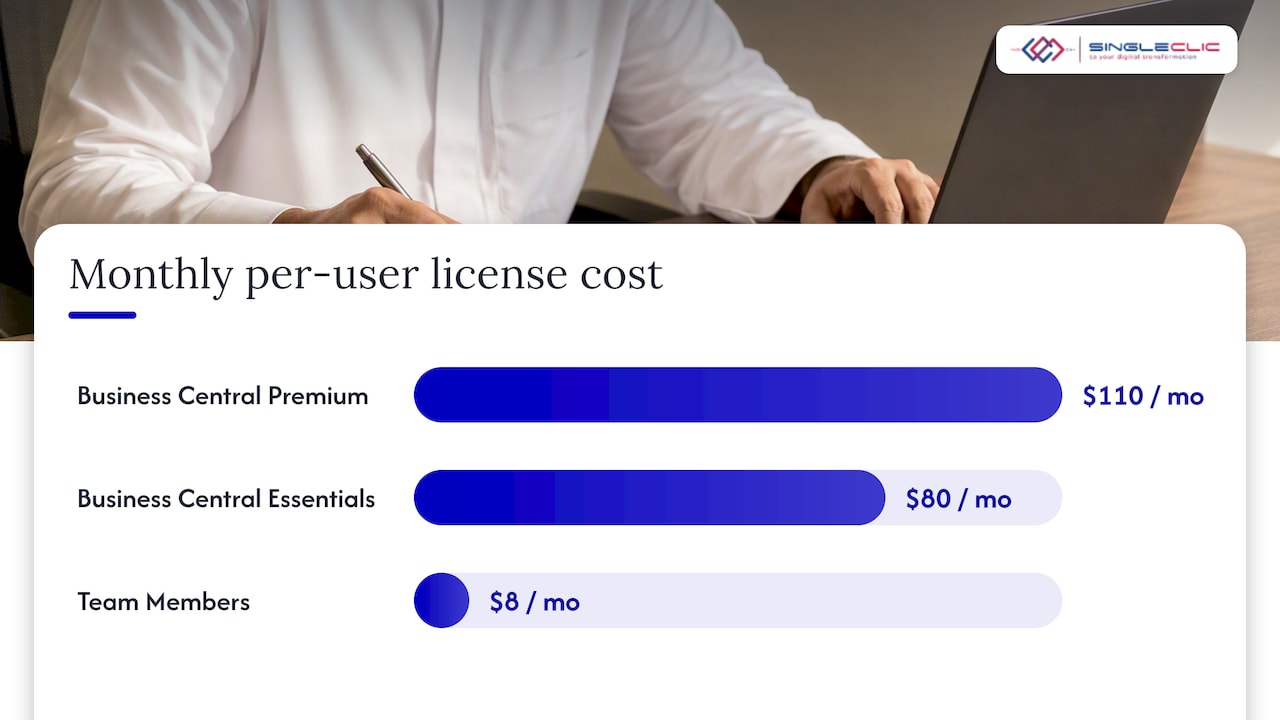
For Business Central, Microsoft’s own pricing page lists Essentials at $80 per user per month and Premium at $110 per user per month, with Team Members priced at $8 per user per month, and Copilot or agent credits billed separately on a pay-as-you-go or prepaid basis according to Dynamics 365 Business Central pricing. Finance and Operations (F&O) licensing follows a different structure built around base and attach licenses, which is worth understanding before you commission a quote, since UAE partners typically re-quote in AED and may bundle implementation hours differently.
Three licensing moves consistently reduce TCO for UAE buyers:
- Match license type to actual usage: audit who truly needs full-user access versus team-member or task-based tiers before renewal.
- Separate Copilot budgeting from seat budgeting: credit consumption varies by workload and should be tracked and capped independently.
- Bundle thoughtfully: combining Dynamics 365 with other Microsoft services can reduce per-seat cost, but only when the added services are genuinely used.
Getting the base-and-attach mix wrong is one of the most common sources of licensing waste we see in the region, and it is covered in more depth in our guide to cutting Dynamics 365 licensing TCO.
Implementation cost drivers and the role of Success by Design in controlling TCO
Implementation, not licensing, is usually the largest single line in a Dynamics 365 five-year budget, and the gap between a disciplined rollout and an undisciplined one can be substantial, as detailed in our guide to CRM data migration which covers planning and execution essential for integration and data migration cost control. Microsoft’s own implementation framework, Success by Design, structures delivery around five phases, Discover, Initiate, Implement, Prepare, and Operate, and leans on a business process catalog to keep the solution close to standard functionality rather than custom-built from scratch, according to Microsoft’s guidance on Success by Design. The catalog approach matters because every custom extension you add during implementation becomes a line item in every future upgrade cycle.
A related Microsoft account of the methodology notes that projects using the business process catalog have cut discovery timelines, in one case from two to three months down to six weeks, while also reducing the customizations that later drive maintenance cost, according to Microsoft’s Dynamics 365 blog on Success by Design. Shorter discovery sounds like a saving, but the real value is upstream: a tighter discovery phase forces fit-to-standard decisions early, before expensive build work locks in bespoke code.
For a typical UAE mid-market rollout, cost concentrates in three phases:
- Discovery and process mapping: where requirements are gathered and fit-to-standard decisions are made; under-investing here is the single biggest cause of scope creep later.
- Build and configuration: where customizations, integrations, and data migration scripts are developed; this phase grows in direct proportion to how many deviations from standard process were approved in discovery.
- Testing and go-live preparation: where regression testing, user acceptance, and cutover planning happen; compressed timelines here often produce the post-go-live defects that cost more to fix than they would have cost to prevent.
Scope and change control discipline during build is what separates a project that holds its budget from one that drifts. Every change request should be costed against both immediate build hours and the ongoing maintenance burden it creates, not just the one-time development fee.
Pro Tip: Insist on a documented fit-to-standard review before any custom development is approved. A one-page justification requirement alone filters out a large share of “nice to have” customizations that never earn back their maintenance cost.
Our Dynamics 365 implementation guide for UAE leaders walks through licensing, hosting, and delivery choices in more detail for teams building their business case.
Hosting, infrastructure and deployment choices: cloud vs on-premise and Azure cost considerations in UAE
Hosting decisions shape the operating-cost half of your TCO model, and UAE organizations generally choose among three patterns. Azure-hosted Dynamics 365 online is the default for most commercial organizations: Microsoft manages infrastructure, updates apply automatically, and cost scales with consumption. Partner-managed cloud deployments add a managed-services layer on top of Azure, useful when internal IT capacity is thin. On-premise or private cloud deployments remain relevant for regulated UAE sectors, particularly banking and government entities with data residency or sovereignty requirements that push them toward local or on-premise infrastructure.
Azure consumption is the OPEX line that catches budgets off guard, since it moves with storage growth, backup retention, compute scaling at peak transaction periods, and bandwidth for integrations. Disaster recovery adds another layer: a secondary region or failover environment increases both storage and compute cost but is often mandatory for regulated entities.
- Azure-hosted (cloud): lowest upfront infrastructure cost, consumption-based OPEX, fastest to deploy.
- Partner-managed cloud: adds a managed-services fee on top of Azure consumption, reduces internal IT burden.
- On-premise or private cloud: higher upfront capital cost and ongoing infrastructure staffing, chosen mainly for data residency or regulatory reasons.
If your organization sits in banking, healthcare, or government, budget for the premium that on-premise or private cloud hosting implies, including dedicated infrastructure staff and hardware refresh cycles, rather than assuming cloud-equivalent pricing will apply.
UAE-specific compliance impact: e-invoicing deadlines, ASP accreditation and administrative penalties
UAE e-invoicing compliance is now a budget line with a hard deadline attached, not a future consideration. Under Ministerial Decision No. 244 of 2025 on the implementation of the electronic invoicing system, the pilot program begins on 1 July 2026. Entities with revenue of AED 50,000,000 or more must appoint an Accredited Service Provider (ASP) by 30 October 2026 and be fully implemented by 1 January 2027, with later deadlines phased in for smaller entities. The Federal Tax Authority’s e-invoicing page confirms the structured-format requirement and maintains the official list of pre-approved service providers.
Missing these deadlines carries a direct financial cost. Cabinet Decision No. 106 of 2025 sets administrative penalties for non-compliance:
| Violation | Penalty |
|---|---|
| Missing e-invoice | AED 100 per invoice, up to AED 5,000 per month |
| Delay in appointing an Accredited Service Provider | AED 5,000 |
| Failure to notify a system outage | AED 1,000 per day |
For a company inside the first revenue band, ASP onboarding, adapter development, and testing are not optional future-phase work, they belong in the 2026 budget alongside core implementation.
- Confirm your revenue band and the deadline it carries under Ministerial Decision No. 244 of 2025.
- Budget for adapter development and testing inside Dynamics 365 Finance well ahead of your ASP onboarding date.
- Plan evidence retention processes now, since outage notification and record-keeping failures carry daily penalties.
Our UAE e-invoicing readiness checklist walks through ASP onboarding steps and the technical tasks needed to prepare Dynamics 365 Finance ahead of these deadlines.
Operational and support costs after go-live: maintenance, upgrades, and the true ongoing spend
Go-live is the midpoint of a Dynamics 365 cost curve, not the end of it. Support models in the UAE generally fall into two shapes: a monthly retainer that guarantees a set number of hours for break-fix and minor enhancement work, or a pay-as-you-go arrangement billed against actual tickets. Retainers suit organizations with steady customization activity, while pay-as-you-go suits stable, close-to-standard deployments with infrequent change requests.
The largest hidden cost after go-live is maintaining customizations through Microsoft’s regular update cycle. Every custom extension needs regression testing against each release, and heavily customized environments can see a meaningful share of their annual support budget consumed by update-related rework alone rather than new functionality.
- Support retainer vs pay-as-you-go: match the model to your customization volume and change frequency, not to upfront cost alone.
- Regression testing cadence: schedule testing around Microsoft’s release calendar, not reactively after issues appear.
- Copilot and AI consumption governance: set usage alerts and monthly caps so credit spend does not scale unnoticed as adoption grows.
Pro Tip: Treat post-go-live customization maintenance as ongoing operating cost, not occasional project work. Organizations that budget it as a line item in the annual IT operating plan rarely get surprised by it; organizations that treat it as ad hoc project work almost always do.
A practical 5-year TCO framework and worked example (UAE scenario)
A usable five-year model separates capital and license cost in year zero from recurring operational cost in years one through five, then applies an escalation factor and a sensitivity range to each bucket.
- Year 0: license setup, implementation fees, data migration, integration build, and initial training.
- Years 1 to 5: annual license renewal, support retainer, Azure consumption, Copilot credits, and periodic upgrade or refactor work.
- Escalation: apply a modest annual increase to license and support costs to reflect typical renewal uplifts.
- Sensitivity knobs: vary customization volume, user count growth, and Copilot consumption to see which lever moves total cost the most.
Say a mid-market UAE distribution company plans for 60 full users and 40 team-member users on Business Central. Using Microsoft’s listed pricing of $80 and $8 per user per month respectively, annual license cost before Copilot credits comes to $80 x 60 x 12, or $57,600, plus $8 x 40 x 12, or $3,840, for a combined $61,440 per year in base licensing. Over five years, before any escalation, that is $307,200 in licensing alone, illustrative of license cost only and excluding implementation, support, hosting, and compliance spend, which in a typical mid-market UAE project often match or exceed the licensing total.
- Run the model twice: once with a lean customization scope and once with the scope your business stakeholders are actually requesting.
- Negotiate with your implementation partner on fixed-price phases for discovery and build, since this is where scope and cost drift the most.
Our guide to ERP implementation cost, TCO, and ROI budgeting with Dynamics 365 and Odoo covers how UAE tax and e-invoicing requirements specifically affect this kind of model.
How Singleclic helps UAE organizations manage Dynamics 365 TCO
We bring regional delivery experience and a consultant and engineering team across the UAE, Saudi Arabia, and Egypt, with client work including healthcare and government entities. That regional depth matters for TCO because it means fewer discovery surprises: we have already mapped the fit-to-standard patterns that work for UAE finance, healthcare, and government operations.
Concretely, we run fit-to-standard workshops before any build work starts, so customization decisions are costed against their five-year maintenance impact, not just their build hours. We handle ASP onboarding and e-invoicing readiness as a defined workstream rather than a bolt-on, we offer managed support retainers sized to your actual customization volume, and where your processes need orchestration across Dynamics 365, legacy systems, and manual approvals, our Arabic-enabled low-code platform, Cortex, connects those workflows without the ongoing custom-code maintenance burden that drives TCO upward over time.
Our Dynamics 365 Business Central implementation page outlines our delivery approach and relevant UAE client work in more detail.
What most UAE budgets get wrong about Dynamics 365 cost
The most common budgeting error we see is treating the implementation quote as the whole project cost and leaving post-go-live customization maintenance, Copilot consumption, and e-invoicing adapter work as unbudgeted future items. The governance step that prevents this is simple: require every proposed customization to carry a documented five-year maintenance estimate before it gets approved, not just a build-hours estimate. That single discipline catches most of the drift we see in UAE Dynamics 365 projects before it happens.
If your organization is approaching an e-invoicing deadline or a licensing renewal, engage an experienced local partner early enough to build the compliance work into the implementation plan rather than bolting it on afterward.
— Tamer Badr
Get a Dynamics 365 TCO assessment built for your UAE operation
We offer a focused TCO assessment that produces two concrete deliverables: a five-year cost model calibrated to your license mix, user count, and hosting choice, and an e-invoicing readiness gap analysis scoped to your revenue band and ASP deadline. Rather than a generic audit, it is built around the fit-to-standard review and compliance workstreams described above, so the output maps directly to budget decisions you need to make this year.
- Typical turnaround runs a few weeks from kickoff to delivered model, depending on the number of legal entities and integrations involved.
- The assessment works equally well as a pre-renewal check for existing Dynamics 365 customers or as a business case input for a new implementation.
Visit our Microsoft Dynamics 365 services page to request an assessment, or explore our broader services overview if your project spans ERP, CRM, and process automation together.
This article is general information, not a substitute for advice from a qualified financial advisor. Consult a qualified financial professional about your own circumstances before acting on anything here.
FAQ
What is the average TCO for Dynamics 365 in the UAE?
There is no single average figure, because TCO depends heavily on user count, license mix, customization volume, and hosting choice. Microsoft’s published Business Central pricing gives a starting point for license cost, but implementation, support, and UAE compliance work typically add as much or more on top.
Who is a Dynamics 365 partner in the UAE?
A Dynamics 365 partner is a Microsoft-certified integrator that handles licensing, implementation, customization, and ongoing support for the platform. We deliver Dynamics 365 implementation, customization, integration, and support across the UAE as part of our regional Microsoft Dynamics 365 practice.
How does UAE e-invoicing affect Dynamics 365 implementation cost?
E-invoicing adds adapter development, testing, and Accredited Service Provider onboarding as distinct cost items tied to firm deadlines under Ministerial Decision No. 244 of 2025. Entities with revenue of AED 50,000,000 or more face the earliest deadlines, with ASP appointment required by 30 October 2026.
What happens if a UAE company misses an e-invoicing deadline?
Missing e-invoicing obligations triggers administrative penalties under Cabinet Decision No. 106 of 2025, including AED 100 per missing invoice up to AED 5,000 per month and AED 5,000 for delayed ASP appointment. These penalties make early compliance budgeting cheaper than remediation after the fact.
Does Singleclic offer a Dynamics 365 cost assessment for UAE companies?
Yes, we offer a TCO assessment that produces a five-year cost model and an e-invoicing readiness gap analysis tailored to your revenue band and license mix. Request one through our Microsoft Dynamics 365 services page.
Sources
- Ministerial Decision No. 244 of 2025 on The Implementation of the Electronic Invoicing System
- Dynamics 365 Business Central pricing | Microsoft Dynamics 365
- An inside look at Success by Design – Dynamics 365 | Microsoft Learn