Construction project controls are the processes, data and systems that tell you, while there is still time to act, whether a project is delivering what it promised on cost, schedule and scope. For a UAE owner or contractor the practical question is not which report to produce. It is whether your budget, commitments, progress, changes and approvals sit in one connected system or in five disconnected files. We build the connected version on ERP, workflow and low-code platforms, and this guide explains what that version needs to contain.
TL;DR
- Project controls measure, forecast and report performance. Project management plans and delivers the work. You need both, and the controls only work if they read from the same data.
- In GCC megaprojects, fragmented reporting creates blind spots because cost, schedule, changes and progress live in separate systems.
- Five components carry the load: baseline, earned value, cost forecasting, risk and change control. Each must update the others.
- The most common failure is not missing technique but disconnected data. ERP, workflow automation and dashboards fix that at the source.
- Start with one baseline, one change register and one monthly dashboard, then automate the data feeds behind them.
Table of Contents
- What construction project controls are
- Why controls matter on UAE projects
- The five components and how they connect
- Who runs controls and what they need
- Implementing controls step by step
- Contract rules that shape your reporting
- Use cases for UAE and Saudi organizations
- How Singleclic helps
- Article details
- FAQ
- Sources
What construction project controls are
The Association for Project Management (APM), the UK professional body, describes project controls as assessing whether work is worth doing, preparing before it starts, anticipating what could go wrong, and then measuring, forecasting and recommending corrective action once work is under way. It lists the core elements as time, cost, risk, change, reporting and decision making, and information management.
In plain terms, controls answer four questions every month:
- Where should we be, and where are we?
- What have we spent and committed, and what does that say about the final cost?
- What could still go wrong, and what is it worth in money and days?
- What has changed since the baseline, and who approved it?
A baseline is the approved version of scope, budget and programme that every later number is measured against. Without a locked baseline, a variance is only an opinion.
Project controls versus project management
Project management plans, coordinates and executes the work. Project controls measure it and tell the project manager what the numbers imply. The two share an objective, and in many organizations the same people do both. The distinction matters at executive level because it tells you what to ask for: not more activity updates, but a forecast you can trust and a clear view of what is pending approval.
Why controls matter on UAE projects
MEED, the Middle East business publication, notes that in GCC megaprojects complex contractor networks, procurement dependencies, design changes, evolving scope and compressed timelines can turn minor variances into significant commercial problems. Boards, investors and government stakeholders need evidence that cost, schedule and scope are under control, and enough warning to intervene before the problem becomes expensive.
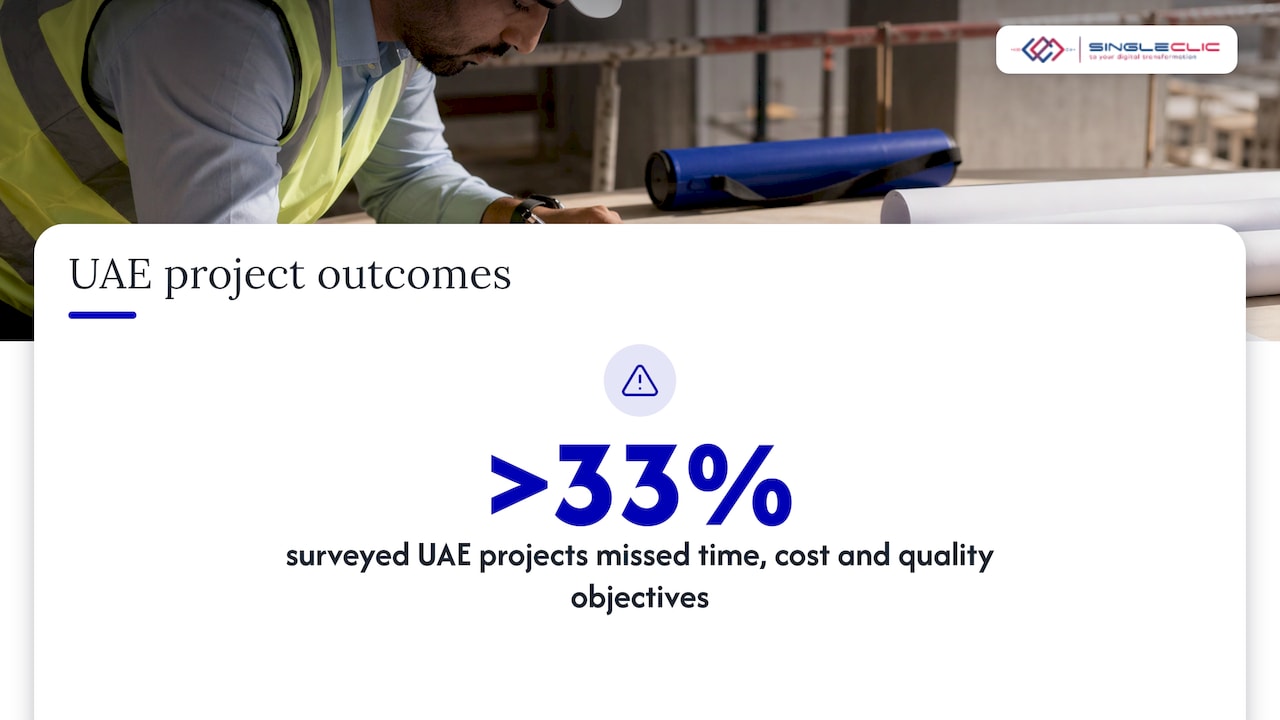
The local evidence on discipline is sobering. A study published by the American Society of Civil Engineers found that over 33% of surveyed UAE projects failed to meet their time, cost and quality objectives. It also found many project managers had no knowledge of, or saw no practical use for, established control techniques. The study is from 2014, but the lesson holds: technique has to be built into how the organization works, not left to individuals.
Commercial pressure points the same way. PwC’s Strategy& report observes that the shift from cost-plus to lump-sum contracts pushes contractors to carry more risk, which requires them to manage costs more closely. When the contractor carries the overrun, a late forecast is a direct hit to margin. When you are the owner, it is a hit to your budget approval.
The APM’s Senior Managers’ Guide frames the executive benefit as a ‘single source of truth’: integrated datasets that improve the basis on which projects are launched and help you spot and mitigate issues early.
The five components and how they connect
| Component | What it does | What it must read from |
|---|---|---|
| Baseline management | Locks approved scope, budget and programme | Approved contract, BOQ, tender programme |
| Earned value management | Compares planned value, earned value and actual cost | Progress measurement, cost ledger |
| Cost forecasting | Estimates final cost with a stated basis | Commitments, actuals, pending changes |
| Risk management | Owns a register and prices exposure into the forecast | Risk owners, programme logic |
| Change control | Logs, prices and approves every change | Change register, approvals, budget |
The components only work as a set. Every approved change must move the programme and the budget. Risk exposure must flow into the forecast. Variances should be broken down by package before anyone acts.
Earned value in one worked example
MEED explains earned value management as a comparison of three numbers: planned value (the budgeted value of work that should be done), earned value (the budgeted value of work actually done) and actual cost (money spent). Here is an illustrative project, with figures we made up to show the arithmetic.
- Budget at completion: AED 200 million
- Planned value at month 10: AED 80 million
- Earned value at month 10: AED 72 million
- Actual cost at month 10: AED 85 million
The schedule performance index is earned value divided by planned value: 72 / 80 = 0.90. You are completing 90% of planned work. The cost performance index is earned value divided by actual cost: 72 / 85 = 0.85. You are getting AED 0.85 of value for every dirham spent. If that efficiency continues, the estimate at completion is 200 / 0.85, roughly AED 236 million, a gap of about AED 36 million.
None of this is hard. What is hard is getting a trustworthy earned value figure every month, because it depends on site progress, cost postings and approved changes all being current at the same cut-off date.
Who runs controls and what they need
A Project Management Institute (PMI) case study of a mega multi-region construction programme describes teams of four mobilized into every department and region: a project control manager, a contract specialist, a planning engineer and a document controller, supported by a central core team. The same study lists the systems behind them: a project management information system with a unified work breakdown structure and coding, defined data-collection layouts, user roles and security levels, and reporting layouts.
It also argues that the schedule is the best integrating point, since it contains scope, cost, time and risk, and it sets indicators such as the schedule and cost performance indices at both component and programme level.
For a C-level reader, the takeaways are organizational:
- Own it at program level. A central office sets one coding structure and one reporting calendar. Contractors report into it.
- Make the data entry boring. If site progress needs retyping into three systems, it will be late.
- Define what each report is for. The PMI study uses a schedule communication plan to say which reports exist and how data is gathered.
Implementing controls step by step
1. Fix the baseline and the structure
Agree one work breakdown structure and one cost-code structure across packages. Lock the approved budget and programme as the baseline. The usual failure here is multiple codings, so that procurement, site and finance cannot reconcile. Putting the structure into your ERP means every commitment and invoice is tagged against it automatically. Our construction ERP software page covers how we approach this for construction.
2. Define a schedule standard
The PMI case applied a 5+3 standard to every schedule. It had to be complete, traceable, transparent, statused and predictive, plus usable, resourced and controlled. You can adopt a simpler version: every contractor programme covers the full contract, has logical links, and is updated on the same date each cycle. Local approval durations belong in the programme as real activities with predecessors, not as assumptions.
3. Measure progress the same way everywhere
Set the progress-measurement rule per work type before the job starts, such as percentage of quantities installed or weighted milestones. Then capture it at site and push it into cost control. Our guide to construction progress tracking in ERP shows how MENA site data feeds cost control.
4. Control cost against the bill of quantities
Commitments, not just invoices, are what predict the final cost. Track them against the BOQ line by line, with approved and pending changes visible. See how this works in BOQ cost control for UAE owners on Odoo.
5. Run change and document control as workflows
A change that lives in email is a change that does not reach the forecast. Route requests for information, submittals and variations through defined approval workflows with owners and deadlines. Two of our guides go deeper: construction document control and the change management process workflow.
6. Report on one page, monthly
Owners rarely need more data. They need a view they can act on. A dashboard that covers cost, schedule, risk and changes, reviewed in a short meeting with decisions recorded afterward, beats a long pack nobody reads. Our article on the role of dashboards in ERP explains how to build this from live data rather than manual compilation.
Contract rules that shape your reporting
In the UAE, your contract form shapes what controls must prove. On FIDIC-based contracts, the monthly progress report compares actual with planned progress and supports each interim payment application. Abu Dhabi government capital projects use their own General Conditions, which the Abu Dhabi Projects and Infrastructure Centre updated in 2024 to include dispute boards. A controls system that stores a dated, baselined record of progress and approved changes gives you the evidence base for payment, extension-of-time and variation discussions. Confirm the details of your specific contract with your legal adviser.
Use cases for UAE and Saudi organizations
- Developers with several towers or plots. One portfolio view of budget, committed cost and forecast across projects, with drill-down to package.
- Main contractors on lump-sum work. Margin protection through commitment tracking and early variance alerts on subcontract packages.
- Government and semi-government owners. Auditable approval trails for changes and payments, with on-premise deployment where data rules require it.
- Healthcare and infrastructure programs. Standard reporting across many contractors, so one packages’s delay is visible in the program picture quickly.
How Singleclic helps
Project controls fail where data is disconnected, and that is the problem our platforms address. We implement ERP for construction and real estate on Microsoft Dynamics 365 and Odoo, build CRM and integrations, and automate approvals with business process management. Our construction solutions page shows the sector offer, and our services cover ERP, process automation, AI and data analytics, and low-code development.
Cortex is our Arabic-enabled, on-premise low-code platform for MENA enterprises. It lets organizations design and change business processes without writing code, supports full Arabic UI, unlimited users and runtime workflow changes without downtime, and integrates with enterprise systems. For controls, that means the change request, the approval and the budget update can be one connected flow instead of three handoffs.
If you want to see how your cost, progress, change and approval data could feed a single controls view, talk to our team about your project portfolio.
How we see project controls
Most executives we meet do not lack a project controls method. They lack a connected system under it. The cost sits in finance, progress sits with site engineers, changes sit in inboxes, and a person rebuilds the picture by hand every month. By the time it reaches you, it describes the past.
Our view is that controls should be a by-product of how work is processed. When a purchase order, a progress measurement or a variation approval is entered once, in an ERP and workflow layer built for construction, the forecast updates itself. That is why we pair Dynamics 365 and Odoo with Cortex: the ERP holds the cost and commitment record, and the workflow layer carries approvals across ERP, CRM, data and legacy systems.
For regulated owners in Saudi Arabia and the UAE, on-premise deployment and a full Arabic interface are not extras. They decide whether the whole organization uses the system.
Tamer Badr
Article details
- SEO title: Construction project controls: a UAE leader’s guide
- Slug: construction-project-controls
- Keyword: construction project controls
- Secondary keywords: project controls in construction, earned value management, construction cost control, construction ERP, workflow automation, Cortex low-code
- Pillar cluster: Construction ERP and process automation in MENA
FAQ
What are construction project controls?
They are the processes, data and systems used to plan, measure, forecast and report project performance across cost, schedule, scope, risk and change. Their purpose is early warning, so leaders can intervene while options remain open.
How are project controls different from project management?
Project management plans and executes the work. Project controls measure it objectively, forecast the outcome and recommend corrective action. In many organizations the same people do both, but the controls function should read from the same shared data.
What are the seven stages of a construction project, and where do controls apply?
A common breakdown is feasibility, design, preconstruction, tender and procurement, construction, commissioning and handover, and operation. Controls start at preconstruction with the baseline programme and risk register. They become most intensive during construction, through progress measurement, valuation and change management.
Which metrics should an owner see monthly?
Budget at completion, earned value, actual cost, estimate at completion, and the cost and schedule performance indices. Add the variation log, the critical-path activities and the top risks. A single page is enough if the numbers come from live data.
Can ERP and workflow software handle project controls?
Yes, when cost, commitments, progress, changes and approvals are captured in one system. We implement Dynamics 365 and Odoo for construction and use Cortex for approval workflows, so these inputs reach the dashboard without manual rework.
Sources
- MEED: mitigating cost and schedule risk across GCC megaprojects
- APM: what is project controls
- APM: Senior Managers’ Guide to Project Controls
- ASCE: project management performance in the UAE construction industry
- PwC Strategy&: mastering construction cost and capabilities
- PMI: controlling system for mega multi-region construction programs