Odoo fleet management gives a company one record for every vehicle, driver, contract, service job and running cost, inside the same system that already holds its purchasing, accounting and HR. The value for a GCC business is rarely the vehicle list itself. It is what happens when a service request becomes a purchase order, a fuel receipt becomes an expense, and a lease renewal becomes an approval, without anyone re-typing data. That connection is what we build at Singleclic, as an Odoo Silver Partner working with organizations in Saudi Arabia and the UAE.
This guide explains what the Fleet app covers, how to set it up properly, where UAE and Saudi operators need to adapt it, and how to decide who should run the project.
TL;DR
- The Odoo Fleet app tracks vehicles, drivers, contracts, services, odometer readings and costs in one place, and it connects to the rest of the ERP.
- Its real return comes from integration: maintenance to purchasing, fuel and tolls to expenses, contracts to finance, costs to dashboards.
- UAE and Saudi fleets need local setup: Arabic and English records, tolls, fines, lease and insurance renewals, and approval chains that match your delegation of authority.
- A well-planned rollout starts with the data model and the approvals, not with screens.
- We implement and customize Odoo for fleets of all shapes, and connect it to workflows through our Cortex low-code platform.
Table of Contents
- Article details
- What Odoo fleet management actually covers
- Who needs it, and for what
- Use cases we see fit best in the Gulf
- Setting up Odoo fleet management step by step
- Adapting the Fleet app to UAE and Saudi operations
- Connecting fleet data to the rest of the business
- What to measure once you are live
- How Singleclic helps
- Our perspective
- Start with your fleet process
- FAQ
- Sources
Article details
- SEO title: Odoo fleet management: a guide for UAE and Saudi operators
- Slug: odoo-fleet-management
- Primary keyword: odoo fleet management
- Secondary keywords: fleet management odoo, odoo vehicle management, Odoo fleet app, fleet cost tracking, fleet maintenance automation
- Pillar cluster: Odoo ERP implementation and customization, with fleet as a use case
What Odoo fleet management actually covers
The Fleet app is a module inside the Odoo suite. It is not a separate product, and that matters. A standalone tracking tool tells you where a vehicle is. An ERP module tells you what the vehicle costs, who is responsible for it, what is due next and who must approve the spend.
Out of the box, the app is built around a few records:
- Vehicles. Plate number, make and model, chassis number, fuel type, acquisition date, value, and the current driver. Categories and models can be created to match your own fleet structure.
- Drivers. The current driver is linked to the vehicle, and the history of assignments is kept, which helps when a vehicle changes hands between shifts or departments.
- Contracts. Leases, insurance and other recurring agreements with start and end dates, so renewals do not depend on someone’s calendar.
- Services. Repairs, inspections, tire changes and other jobs, each with a date, a vendor and a cost.
- Odometer logs. Mileage readings that allow cost per kilometer to be calculated.
- Reporting. Cost views by vehicle, by driver, by service type or by period.
For many companies this is enough to replace the spreadsheet that currently tracks plates, expiry dates and garage invoices. The bigger step is connecting those records to the rest of the business.
Who needs it, and for what
The reader who asks about Odoo fleet management is usually one of a few people, each with a different problem.
| Role | The problem | What the Fleet app changes |
|---|---|---|
| CEO or business owner | Vehicle costs are spread across departments and nobody sees the total | One cost view per vehicle, driver and period |
| CIO or CTO | Fleet data lives in a tracker, a spreadsheet and the finance system | One record linked to ERP, with integrations to telematics |
| Supply chain manager | Delivery vehicles are unavailable for reasons the planner learns late | Service schedules and contract status visible next to operations |
| HR manager | Company cars, allowances and driver assignments are managed by email | Driver assignment and vehicle benefits tied to the employee record |
| Finance lead | Fuel, tolls and repairs arrive as receipts weeks later | Costs posted against the vehicle and approved through a defined route |
Use cases we see fit best in the Gulf
Contractors and developers with mixed fleets
Construction and real estate firms run pickups, light trucks, buses and site vehicles across several projects. The question is rarely “where is the truck” but “which project should carry this cost”. Because Odoo ties the vehicle to analytic accounts, a service bill can be charged to the project that used the vehicle. We already implement Odoo for real estate and construction, so this is a natural extension of that work. If you manage leased property alongside vehicles, our piece on Odoo real estate leasing for MENA property managers shows how the contract logic carries across.
Delivery and distribution
Where vehicles move stock, the fleet record is only half the picture. The other half is the warehouse and the order. Linking vehicle availability with warehouse management in Odoo keeps dispatch decisions based on what is actually ready to leave.
Field service teams
Technician vans are part of the service promise. When a van is in the garage, jobs must be reassigned. Connecting the fleet to service management keeps the schedule honest.
Agriculture and large estates
Tractors, pumps and utility vehicles count by hours as much as by kilometers. We have written separately on agriculture fleet management software for this kind of operation.
Corporate car programs
For HR, the fleet is a benefit. Assignment, renewal and return of company cars are handled as a process with approvals, which is where workflow automation helps most.
Setting up Odoo fleet management step by step
A fleet project goes wrong when it starts by configuring screens. It goes right when it starts by deciding what each record must answer. This is the sequence we follow.
- Define the questions first. Write down the five reports your management actually asks for: cost per vehicle, cost per kilometer, renewals due in 30 days, vehicles out of service, cost by department. Every field you add later must feed one of them.
- Clean the vehicle register. Collect plates, chassis numbers, registration and insurance expiry dates from the traffic authority documents and your leasing agreements. Duplicates and missing expiry dates are the most common cause of a failed import.
- Set categories and ownership. Decide how vehicles are grouped: by department, project, branch or legal entity. In a group with entities in more than one emirate or in Saudi Arabia, this decision also drives the accounting.
- Load contracts with their renewal rules. Lease, insurance and maintenance contracts need an end date, a cost, a responsible person and a reminder window.
- Define the service workflow. Who can request a service, who approves it above a given amount, and which vendors are allowed. Without this, the app records costs but does not control them.
- Connect costs to finance. Decide which expenses are posted automatically and to which accounts. Fuel cards, toll accounts and garage invoices should land against the vehicle.
- Train drivers and supervisors on the odometer habit. A cost-per-kilometer report is only as good as the mileage entries. Mobile entry or integration with a tracker removes the manual step.
- Go live with one site, then extend. Start with a branch or a vehicle class, check the reports against the previous spreadsheet for a month, then roll out.
On a project like this, we take on the data model, the approval design, the integrations and the training, so your team gets a working process rather than a configured form. That is the point where an Odoo implementation partner earns its fee: the software is the easy part, and the rules of your organization are the hard part.
Adapting the Fleet app to UAE and Saudi operations
A standard installation assumes a generic fleet. Gulf operations have specifics that are worth designing in from the start.
Tolls, fines and transaction costs
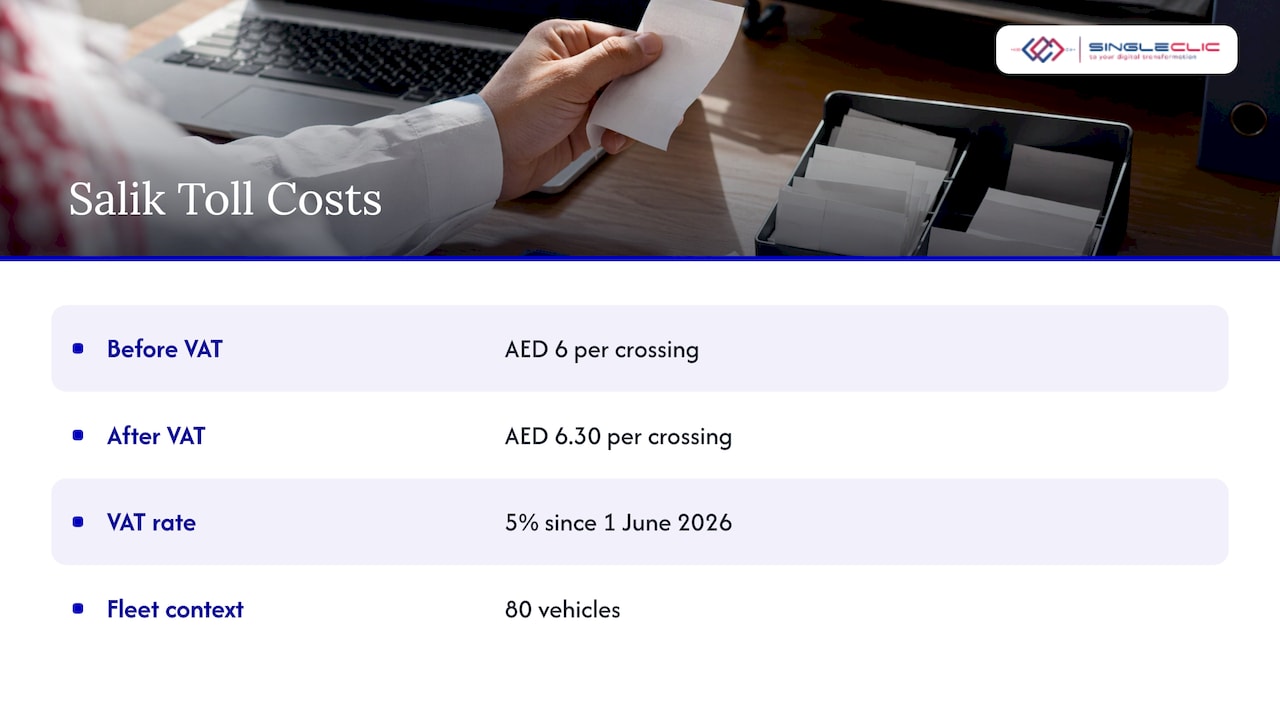
In Dubai, road tolls are charged per crossing, and the amount depends on the time of day. According to one published guide to Salik and Darb tolls, a 5% VAT has applied to Salik tolls since 1 June 2026, so a AED 6 crossing becomes AED 6.30. For a fleet of 80 vehicles making several crossings a day, this is a real line in the budget. The practical answer is to post toll statements against each vehicle, so the cost per vehicle includes them, and to match traffic fines to the driver assigned at the time. Odoo’s driver history is what makes that assignment possible.
Arabic and English records
Drivers, mechanics and garage vendors work in Arabic, while management reports may be in English. Odoo supports multiple languages, and your vehicle categories, service types and print templates should be set up in both from day one.
Registration, insurance and lease renewals
Vehicle registration and insurance renewals are time-bound, and a lapse can take a vehicle off the road. Contract end dates with automatic reminders to a named owner are more reliable than a shared inbox. Where leasing companies issue contracts per vehicle, importing them in bulk is worth the effort.
Approval chains that mirror your authority matrix
Large organizations, banks and government entities usually have a formal delegation of authority: a supervisor approves a tire change, a department head approves an engine overhaul, finance approves anything over a threshold. This is not something the Fleet app does alone. It is a workflow, and workflows are where we connect Odoo to our Cortex platform.
Data location
Regulated organizations often want data to stay in-country or on-premise. Cortex supports on-premise deployment, which suits banks and government bodies, and that matters when fleet data is part of a wider process that must stay inside your network.
Connecting fleet data to the rest of the business
This is where the project stops being a vehicle register and becomes a management tool.
- Maintenance to purchasing. A service request above a set amount triggers a purchase order and an approval, and the invoice matches back to the vehicle.
- Fuel and toll data to expenses. Card statements are imported and posted by vehicle, rather than keyed in by finance.
- Telematics to odometer. A GPS or tracker feed updates mileage automatically, and service intervals trigger from real usage.
- Fleet cost to dashboards. Cost per kilometer, downtime and renewals due are shown to management. We have covered how to do this in our guide to integrating Power BI with Odoo ERP.
- Fleet to HR. Company car assignment ends when employment ends, and the return is a task, not a memory.
Each of these connections removes a manual handover, and each handover is where cost and delay hide.
What to measure once you are live
A fleet system earns its place through a handful of numbers. Pick them before go-live so you can compare against the baseline.
- Cost per kilometer by vehicle class. Fuel, service, tires, tolls and lease, divided by distance.
- Downtime. Days a vehicle was unavailable because of repair or paperwork.
- Preventive versus corrective share. The more work is scheduled, the fewer breakdowns interrupt operations.
- Renewals handled before expiry. Ideally every one.
- Cost variance by department or project. Where one team spends far more per vehicle than a comparable team, you have a conversation to have.
If you cannot get these from your current spreadsheet without a day of work, that is the strongest case for moving the fleet into the ERP.
How Singleclic helps
We are an Odoo Silver Partner with more than 70 consultants and engineers across KSA, UAE and Egypt, and over ten years of digital delivery in the region. For fleet management, our work covers:
- Odoo implementation and customization, including fields, reports and views specific to your fleet. See our Odoo ERP customization services.
- Integration with finance, purchasing, HR, warehouse and service modules, so fleet data is not isolated.
- Workflow design for approvals and renewals through Cortex, our Arabic-enabled low-code platform, which connects approvals, ERP, CRM, data, legacy systems and workflows.
- Data analytics and reporting on fleet cost and utilization.
If you are comparing Odoo with other ERP options, our Odoo software overview explains how the modules scale as your business grows.
Our perspective
Most fleet projects we are asked about start with a tracking question and end up as a process question. A company wants to know where its vehicles are, and within a month the real issue is that a repair is approved by email, paid by finance two weeks later, and never linked to the vehicle that caused it.
That is why we treat Odoo fleet management as an ERP and workflow project rather than a standalone application. The Fleet app gives you the right records. The value comes when those records connect to purchasing, accounting, HR and your approval chain, and when the chain can change without a developer.
This is the reason we pair Odoo with Cortex. Your authority matrix will change, your vendors will change, and your regulators will ask for new reports. A platform that lets your team adjust workflows at runtime, in Arabic and English, keeps the fleet process alive after the consultants leave. For banks and government bodies, the option to run it on-premise keeps the conversation with your security team short.
If you are a CIO or business owner in Saudi Arabia or the UAE, start with the five questions your management asks about the fleet. Everything else follows from the answers.
Tamer Badr
Start with your fleet process
If your fleet is still managed through spreadsheets, garage invoices and email approvals, we can map the process and show how it would run in Odoo, connected to your finance, procurement and HR. Our team works across Saudi Arabia, the UAE and Egypt.
Explore our business process automation services and Odoo implementation or go to Singleclic to talk to a consultant about your fleet.
FAQ
Is the Odoo Fleet app enough for a large fleet?
The Fleet app gives you the core records: vehicles, drivers, contracts, services, odometer and costs. For a large fleet, the work is in the integration with finance, purchasing and approvals, and in the reports your management needs. We design those around your structure so the app scales with your fleet.
Does Odoo fleet management include GPS tracking?
The Fleet app manages the vehicle record, costs and schedules. Live positions come from a telematics device or platform, which can be integrated so that mileage and alerts feed the vehicle record. That integration is part of the scope we define at the start of a project.
Can Odoo handle Arabic and English fleet records?
Yes. Odoo supports multiple languages, so vehicle categories, service types and documents can be maintained in Arabic and English. Where workflows are involved, our Cortex platform offers a full Arabic interface.
How long does an Odoo fleet implementation take?
It depends on the number of vehicles, entities, integrations and approval rules. A single-site rollout with clean data is much faster than a multi-entity group with several integrations. We give a timeline after a short discovery of your process and data.
Who should own the fleet system inside the company?
Usually operations or supply chain owns the process, finance owns the cost data, and IT owns the integrations. HR joins where company cars are a benefit. We help you define these roles and the approval chain during implementation, so responsibility is clear on the first day.