A healthcare CRM on Dynamics 365 gives a hospital or clinic group one connected view of each patient: appointments, communications, care plans and service requests sit in one place instead of in separate departmental tools. In the UAE, the decision rests on two questions: which Microsoft capabilities fit your care model, and whether the design respects health-data residency and interoperability rules. This guide covers both, and shows what to assess before you commit to an implementation.
TL;DR
- Dynamics 365 combined with Microsoft Cloud for Healthcare covers patient engagement, care team collaboration and operational insight on one platform.
- A healthcare CRM complements your EHR. It manages the relationship and the workflow around the patient, not the clinical record itself.
- UAE health-data law generally restricts transfers of health data outside the country, so hosting and integration design must be settled before build.
- DHA and Abu Dhabi DoH standards point to HL7 and FHIR-based exchange, which should shape every integration.
- Most projects succeed or fail on data migration, process mapping and staff adoption, not on licences.
Table of Contents
- What a Dynamics 365 healthcare CRM is
- CRM and EHR: who does what
- Core capabilities that matter to patients and staff
- Use cases for UAE healthcare organizations
- UAE compliance: design for it from day one
- What to assess before you implement
- Beyond CRM: automation, analytics and AI
- Our perspective
- How Singleclic helps
- Plan your healthcare CRM with Singleclic
- FAQ
- Sources
- SEO details
What a Dynamics 365 healthcare CRM is
Dynamics 365 is Microsoft’s business application suite. On its own it handles customer relationship management, service and finance. For care providers, Microsoft packages it with other tools in Microsoft Cloud for Healthcare, which brings together Microsoft 365, Azure, Dynamics 365 and Power Platform with partner healthcare solutions to improve patient engagement, health team collaboration and clinical and operational insight.
So when people search for a healthcare CRM on Dynamics 365, they usually mean a patient-centered layer built from several pieces:
- Dynamics 365 Customer Service and Customer Insights for cases, communications and segmentation.
- Power Apps and Power Automate for patient-facing apps and automated workflows.
- Care Management for care plans, goals and team coordination.
- Microsoft Teams for virtual appointments.
- Azure services for data, analytics and interoperability.
If you want a broader primer on the suite first, our guide to what Microsoft Dynamics 365 is explains how ERP, CRM and automation fit together.
CRM and EHR: who does what
The most common misunderstanding in healthcare IT planning is treating CRM as a replacement for the electronic health record. It is not. The EHR holds clinical documentation and orders. The patient CRM holds everything about how the patient interacts with your organization: enquiries, referrals, bookings, reminders, feedback, follow-up tasks and the preferences that make each contact feel personal.
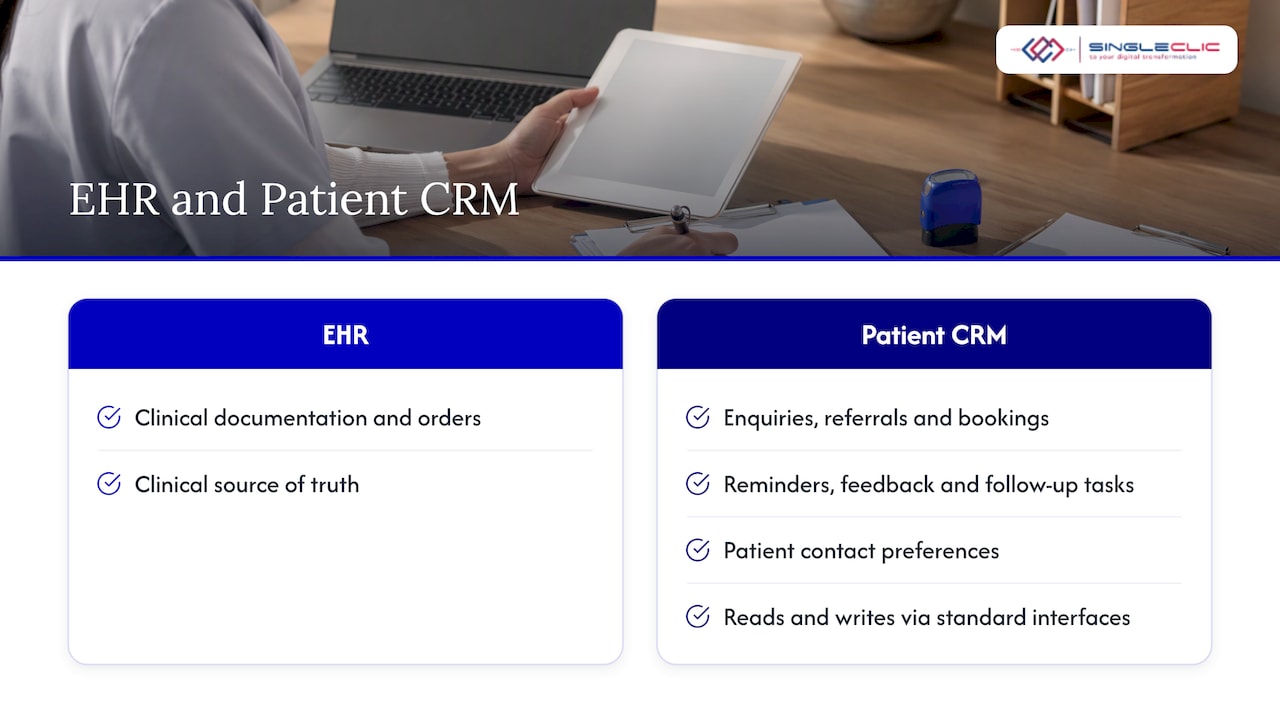
That split is why many MENA IT teams prefer a connected approach over a rip-and-replace one. We cover it in detail in Dynamics 365 healthcare: 5 wins without replacing the EHR. The CRM reads from and writes back to clinical systems through standard interfaces, and your EHR stays the clinical source of truth.
Core capabilities that matter to patients and staff
Patient engagement and self-service
Microsoft Cloud for Healthcare includes a Patient Access solution. According to Microsoft, it lets patients schedule appointments, view medical history and communications, interact with bots and reach live agents, and it is built on Power Apps and Power Automate. For a UAE provider, this is where Arabic and English portals, WhatsApp-style messaging and reminder journeys typically attach.
Care coordination
Microsoft states that organizations can create and personalize care plans, manage care team members, schedule home visits and ingest patient and clinical data from disparate sources into a single longitudinal patient record. Care Management gives care team members, including home health teams, full visibility into care plans, goals, medical history and preferences. Chronic disease programs, post-discharge follow-up and home care are natural fits.
Virtual care
With the meetings platform in Microsoft Teams, providers can schedule, manage and conduct virtual appointments such as surgery follow-ups, and integrate with Cerner or Epic EHR systems. The same pattern applies to other clinical systems through an integration layer.
Service management and operations
Beyond the patient journey, a healthcare CRM handles the requests that clog front desks: insurance queries, complaint handling, referral tracking, document requests and internal service tickets. When Dynamics 365 sits next to finance and supply chain modules, those requests can trigger billing or inventory actions automatically. Our overview of Dynamics 365 for healthcare shows how these layers connect.
Use cases for UAE healthcare organizations
| Use case | What the CRM does | Who benefits |
|---|---|---|
| Appointment and referral management | Unifies booking requests from web, phone and referrers; tracks no-shows and follow-ups | Contact center, clinic managers |
| Chronic care programs | Care plans, goals, reminders and task assignment across the care team | Nurses, care coordinators |
| Home health | Schedules visits and gives field teams a full view of the patient | Home care teams |
| Patient feedback and complaints | Logs cases, routes them, tracks resolution times | Patient experience, quality teams |
| Corporate and insurer relationships | Manages accounts, contracts and service-level follow-up | Business development, finance |
| Medical tourism enquiries | Captures and nurtures international leads with consent tracking | Marketing, international desk |
If your growth plan also includes outside campaigns to attract patients, a healthcare marketing agency comparison shows how providers weigh agency options. The CRM then closes the loop by tracking which enquiries become booked and completed visits.
UAE compliance: design for it from day one
This is where a UAE project differs most from a generic Dynamics 365 rollout.
Health-data residency
Federal Law No. 2 of 2019 covers the collection, processing and circulation of health data and sets processing, security and retention requirements. According to the US International Trade Administration, it generally restricts transfers outside the UAE, with ten case-by-case exceptions under Ministerial Resolution 51 of 2021. The exceptions include telemedicine, insurance claims administration, treatment overseas and clinical research.
PwC explains that Article 13 is a general prohibition on transferring health data outside the UAE unless authorized, and that it affects organizations relying on cloud or hosting services outside the country. Practically, you should confirm the hosting region, backups and any third-party processors for every component that stores patient data. Our roadmap on UAE data residency and 25-year health retention goes deeper on architecture choices.
Which data law applies
The UAE’s general personal data law (PDPL) entered into force on 2 January 2022, but it does not apply to health personal data where separate legislation regulates it. For a healthcare CRM, the health data law and emirate-level rules lead. Have your legal and compliance team confirm how each data category is classified.
Patient consent for cross-border care
The DHA Policy for Health Data and Information Sharing (2024) says patient consent is needed when patients are treated outside the UAE, within the limits of necessary treatment procedures. Build consent capture and status into the patient record so that staff can see it at the point of action.
Interoperability standards
In Dubai, the DHA’s interoperability standards recommend HL7v2 and state that health information systems should also support FHIR and IHE messaging standards. In Abu Dhabi, the DoH’s data sharing and interoperability standard requires entities to adopt and comply with its data interoperability standards to support health data discovery and exchange, and it also expects training for relevant stakeholders. On the Microsoft side, the Azure API for FHIR connecting to Common Data Service enables electronic access and exchange of health information between patients, providers and health plans. Confirm the current version of each regulator’s standard with your compliance team before you finalize the integration design.
What to assess before you implement
Projects in this category tend to follow the same path. Use this checklist to scope yours.
- Define the patient journeys first. Map referral to booking, booking to visit, visit to follow-up. Decide which steps the CRM owns and which belong to the EHR.
- Inventory your data sources. List the EHR, laboratory and radiology systems, billing, call center tools, insurer portals and spreadsheets that hold patient contact data.
- Plan data migration and cleansing. Duplicate patient records, inconsistent Arabic and English name spellings and missing Emirates ID fields are common. Agree matching rules before loading anything.
- Decide the hosting and residency model. Settle where data lives, who can access it and how backups are handled, in line with the rules above.
- Design integrations around standards. Use HL7 and FHIR interfaces where your clinical systems support them, and document every interface.
- Customize with discipline. Keep standard Dynamics 365 functionality where it fits, and customize only for workflows that are specific to your care model.
- Plan adoption. Name clinical champions, train by role, and measure usage in the first 90 days. A CRM that front-desk staff bypass will not deliver a single patient view.
- Set measures. Examples: appointment no-show rate, time to first response on enquiries, complaint resolution time, and the share of patients with a complete contact profile.
For a wider view of the CRM options a CIO may weigh, see 7 key types of CRM systems every healthcare CIO must know and our guide to the best CRM for healthcare.
Beyond CRM: automation, analytics and AI
A CRM becomes more valuable when it is connected to the processes around it. Approval flows for referrals and pre-authorizations, case handling for complaints, and escalation rules between departments are all business process automation problems. Analytics then turns the combined data into operational insight: waiting times, capacity, patient satisfaction trends and campaign results. Our articles on AI and data analytics in healthcare and AI and analytics in healthcare and government operations show how this works in practice.
Our perspective
Healthcare leaders in the UAE rarely ask us for a CRM for its own sake. They ask how to stop patients falling between departments, and how to do it without putting regulated data at risk.
Our view is that Dynamics 365 works best as the connected layer around the patient, with the EHR left in place as the clinical record. We design the integrations to standards such as HL7 and FHIR, and we treat data residency as an architecture decision made in week one, not a checklist item at go-live.
Where a process does not fit standard CRM functionality, such as multi-step approvals, legacy system hand-offs or Arabic-first workflows, our Cortex low-code platform lets teams build and change those workflows at runtime without downtime. The combination gives a hospital group one patient view and the freedom to keep improving it.
Tamer Badr
How Singleclic helps
Singleclic is a regional Microsoft Dynamics 365 integrator with more than 10 years of delivery across KSA, UAE and Egypt and over 70 consultants and engineers. Our healthcare clients include Emirates Health Services, Dubai Healthcare City and Saba medical clinics in Jeddah. For a healthcare CRM project, we typically support:
- D365 consultancy and implementation: process mapping, solution design and rollout.
- D365 customization and integration: connecting the CRM to clinical, finance and supply chain systems.
- Business process automation: approvals and case workflows using IBM BAW or Cortex.
- Data analytics and AI: dashboards and AI-powered applications on top of your consolidated data.
- Support and maintenance: ongoing support after go-live.
You can see the full scope on our Microsoft Dynamics 365 services page.
Plan your healthcare CRM with Singleclic
Cortex is our Arabic-enabled, on-premise low-code platform for MENA enterprises. It supports full Arabic UI, unlimited users, on-premise deployment for banks and governments, and runtime workflow changes without downtime. Paired with Dynamics 365, it gives healthcare organizations a way to connect approvals, ERP, CRM, data and legacy systems in one flow.
If you are scoping a patient CRM, talk to our team through the Singleclic site and bring your list of systems, journeys and compliance questions. We will help you turn them into a phased plan.
FAQ
Is Dynamics 365 a CRM for healthcare?
Dynamics 365 includes CRM applications that you can adapt for healthcare, and Microsoft Cloud for Healthcare adds capabilities such as care management and patient access. Together they support patient engagement, care team collaboration and operational insight. Your EHR remains the clinical record.
Can a healthcare CRM in the UAE be hosted outside the country?
UAE health-data law generally restricts transfers of health data outside the UAE, with limited case-by-case exceptions approved by health authorities. Your hosting and integration design should be confirmed with legal counsel and the relevant authority, DHA, DoH or the Ministry of Health and Prevention, before build.
Does the CRM replace our EHR?
No. The CRM manages the patient relationship and the workflows around it, such as bookings, follow-ups, feedback and service requests. It connects to clinical systems through standards-based interfaces, and the EHR continues to hold clinical documentation.
Which standards should the integration follow?
DHA guidance recommends HL7v2 and expects support for FHIR and IHE messaging, and the Abu Dhabi DoH requires entities to comply with its interoperability standards. Design interfaces around these standards and check the current versions with your compliance team.
What usually decides whether a project succeeds?
Clear patient journeys, clean migrated data and staff adoption. Technology choices matter, but projects stall most often when processes are not mapped, duplicate records are carried over, or teams are not trained by role.
Sources
- Transforming patient experiences with Microsoft Cloud for Healthcare (Microsoft Dynamics 365 Blog)
- Enhance patient care and health team collaboration (Microsoft Learn)
- United Arab Emirates regulations limit cross-border health data flows (trade.gov)
- Healthcare data protection in the UAE: a new federal law (PwC)
- Doing business in the UAE: navigating the data protection regime (Pinsent Masons)
- DHA Policy for Health Data and Information Sharing
- DHA Standards for Interoperability and Data Exchange
- Abu Dhabi DoH Data Sharing, Integration and Interoperability Standard
- Healthcare marketing agency comparison
SEO details
- SEO title: Healthcare CRM with Dynamics 365: a UAE guide
- Slug: healthcare-crm-dynamics-365-uae
- Primary keyword: healthcare CRM Dynamics 365
- Secondary keywords: healthcare patient CRM UAE, Microsoft Cloud for Healthcare, patient engagement, UAE health data residency, HL7 FHIR integration
- Pillar cluster: Dynamics 365 and CRM for healthcare in MENA