Government case management in the UAE is the set of systems and rules that let a federal, emirate-level or local entity receive a request, complaint or legal claim, route it to the right owner, track it against a deadline and close it with a recorded outcome. For residents and businesses, it means a reference number and a status you can check online. For government leaders, it means a workflow platform that connects intake, approvals, documents, data and reporting. This guide covers both sides.
TL;DR
- UAE entities already run structured case flows: 171Tawasul for federal queries and complaints, TAMM in Abu Dhabi, and entity portals such as the Ministry of Justice, ICP, GDRFA Dubai and Dubai Land Department.
- To check a case, use the portal of the entity that owns it and keep your reference number, full contact details and supporting documents ready.
- Published service levels are short. Dubai Land Department, for example, sets 1 working day to receive a complaint, 3 to review and respond, and 1 to review the response.
- Confidentiality is built in: access permissions and signed commitments protect complainant data.
- For entities building or modernizing case handling, a low-code BPM platform such as Cortex connects intake, approvals, ERP, CRM and legacy systems in one traceable workflow.
Table of Contents
- What government case management means in the UAE
- How UAE entities receive, assign, track and resolve cases
- The court path: the Case Management Office
- How to check the status of a case online
- Privacy and recordkeeping rules
- Where case management projects usually break
- Use cases for UAE government and regulated entities
- Our perspective
- How Singleclic helps
- Build your case management workflow with Cortex
- Article details
- FAQ
- Sources
What government case management means in the UAE
The phrase covers two related things, and readers searching for it usually mean one of them.
The first is case management as a citizen or business experience: you file a complaint, a service request or a legal claim and follow it. The second is case management as an operating model inside an entity: the platform, roles, rules and service levels that move each case from intake to closure.
The types of cases vary widely:
- Customer complaints and queries about government services, suggestions and feedback.
- Service requests such as visas, permits, property and licensing transactions.
- Legal and court matters, including civil, labour and personal-status cases.
- Internal cases, such as HR grievances, audit findings and procurement exceptions.
Even the court system builds in a pre-litigation layer. Before filing a civil, labour or personal-status case, the UAE Government portal describes alternative dispute resolution through commercial dispute resolution committees, family guidance committees, mediation and conciliation centres, and labour dispute resolution committees. That is a form of triage: resolve what can be resolved early, and send only the rest to a judge.
How UAE entities receive, assign, track and resolve cases
Published procedures from several entities show a common pattern. Each follows the same lifecycle, even though the systems differ.
Intake and classification
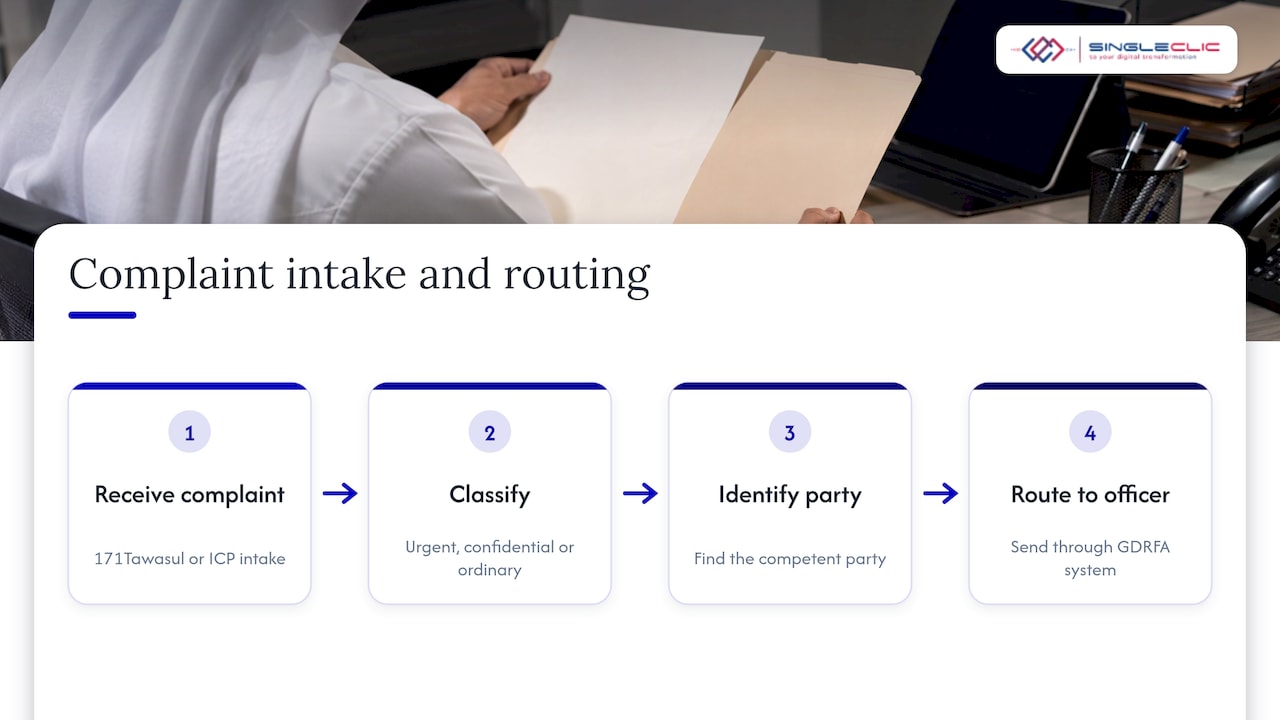
The UAE Government portal describes 171Tawasul as the federal government’s customer relationship management platform for receiving queries, suggestions and complaints, and managing customer relations for federal services. It is a single front door for many federal entities.
Entities also run their own intake. The Federal Authority for Identity, Citizenship, Customs and Port Security (ICP) launched a Customer Complaint System that receives and processes complaints about its services, channels and jurisdictions, and lets customers submit and track them at any time.
Classification comes next. Under its complaint handling mechanism, GDRFA Dubai classifies complaints as urgent, confidential or ordinary, identifies the competent party and sends the complaint through its electronic system to that party’s complaints officer. Classification drives routing, priority and who may see the file.
Assignment and service levels
A case without an owner and a clock stalls. Dubai Land Department publishes its complaints handling process with explicit time limits: 1 working day to receive and transfer a complaint, 3 working days to review and respond, and 1 working day to review the response and inform the customer.
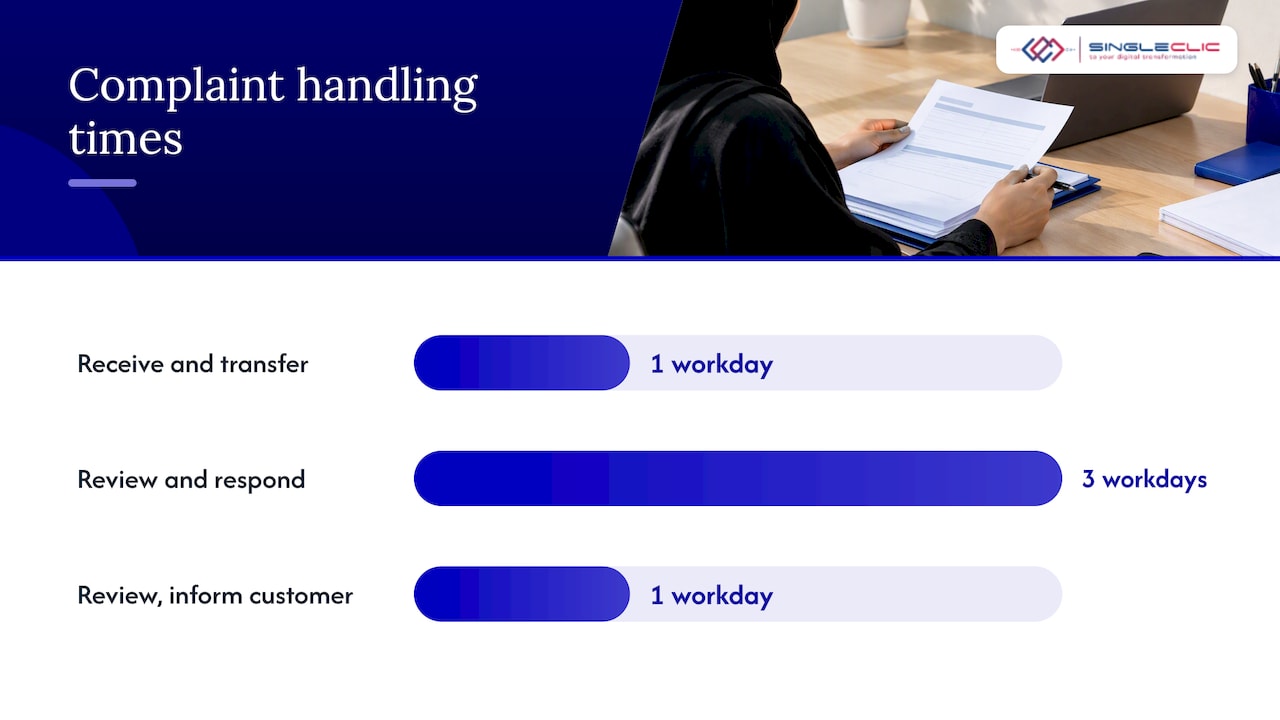
These limits are what a case management platform has to enforce: due dates per step, reminders before a breach, and escalation when a deadline passes.
Tracking and proactive support
Abu Dhabi’s TAMM 3.0 includes TAMM Care, which offers responsive and proactive support powered by real-time dashboards and a Customer-360 view drawn from the Abu Dhabi Government’s Unified CRM. The Department of Government Enablement says TAMM teams actively monitor interactions and step in to pre-empt or address potential challenges.
The Department of Health follows the same logic at a sector level. Its eServices dashboard is a central system to request, track and amend services, organized into modules with alerts and tabs for completed or active requests.
Resolution and review
Resolution is more than a reply. At GDRFA Dubai, if additional evidence calls for re-examination, the complaint goes back to the concerned party. If the complainant disagrees with a response that needs no re-examination, they may raise a grievance with the Director General, according to the same published mechanism. A good platform records each of these loops so nothing is lost between teams.
The court path: the Case Management Office
Court cases have their own version. In civil matters, the statement of claim goes to the Case Management Office. The UAE Government portal says the statement must include the personal details and addresses of plaintiff and defendant, the subject matter, the requests and grounds, the submission date, the court, and the signature of the plaintiff or representative.
The lesson for system design is that structured intake prevents rework. Required fields, document checklists and validation at submission remove the back-and-forth that slows a case later.
How to check the status of a case online
The right place depends on who owns the case. Start with the entity, not a search engine.
- Federal queries and complaints. On the 171Tawasul website, customers can track request status and read responses from federal entities.
- Identity, residency and border matters. Use the entity’s own complaint portal, such as the ICP system above, and keep your reference number.
- Justice matters. The Ministry of Justice’s case management menu lets users view cases, create and submit cases or drafts, and represent cases, with options to add a lawyer and file documents. Gulf News reported in 2022 that users can follow requests such as travel ban cancellations through a personal case dashboard on the Ministry’s website.
- Abu Dhabi and health services. Use TAMM or the Department of Health dashboard.
What you need ready
For a complaint, the ICP user manual says you provide your full name, phone number, email, preferred communication method and language, and country of residence. You then select the department and service type and describe the complaint in detail, attaching supporting documents. Write the description once, clearly, with dates and reference numbers. A vague first submission is the most common cause of a returned file.
If the status is unclear or delayed
- Check that your submission reached the right department and service type.
- Compare the elapsed time with the entity’s published service level, where one exists.
- Add the evidence the entity asks for, since missing evidence can send a complaint back for re-examination.
- Use the escalation route the entity publishes, such as a grievance to the Director General at GDRFA Dubai.
For legal matters, such as a court claim or an execution file, speak to a licensed lawyer before you file or respond.
Privacy and recordkeeping rules
Case files hold personal data, so access control is part of the design, not an add-on. GDRFA Dubai states that it enforces strict confidentiality through specified access permissions for its electronic systems, and that employees involved in the process sign declarations committing them to protect the privacy of complainant data and documents.
For a platform, that translates into practical requirements:
- Role-based access, so each handler sees only the cases they need.
- A confidential classification that restricts the file further.
- An audit trail of who opened, changed or forwarded each case.
- Document storage with retention rules agreed with the entity’s legal team.
On the document side, a structured repository matters as much as the workflow. Teams comparing approaches to document management software usually look for versioning, archiving and search tied to each case record.
Where case management projects usually break
Most problems are not about the portal. They sit behind it.
| Weak point | What happens | What fixes it |
|---|---|---|
| Email and spreadsheets for intake | Cases lose owners and deadlines | One intake channel with automatic case numbers |
| Manual routing | Complaints bounce between teams | Classification rules and assignment by role |
| No service-level clock | Delays go unnoticed | Due dates, reminders and escalation |
| Disconnected systems | Staff retype data from ERP, CRM or legacy tools | Integration into one case record |
| No reporting | Leaders cannot see backlogs | Real-time dashboards by entity, type and handler |
Use cases for UAE government and regulated entities
- Citizen complaints and service requests. Intake from web, app and call centre into one queue, with classification (urgent, confidential, ordinary), owner, deadline and a status the customer can follow.
- Licensing and permit exceptions. Cases that fall outside the standard flow, routed to approvers with a complete document pack.
- Health service claims and disputes. Requests and appeals moving between providers, regulators and payers. See our practical guide to healthcare claims automation in the UAE.
- Legal and compliance cases. Internal investigations and regulatory requests with strict access control and audit trails.
- HR and supply chain cases. Grievances, vendor disputes and procurement exceptions that need approvals across departments.
Our perspective
Government case management is a workflow problem before it is a software problem. The entities that do it well decide who owns each step, how long it may take, and what the customer sees, and only then pick the tooling.
In our work across the region, we see the same gap repeatedly: the portal is modern, but approvals, ERP, CRM and legacy systems sit behind it and do not talk to each other. A case then depends on people copying data. We built Cortex, our Arabic-enabled, on-premise low-code platform, to close that gap. It lets teams design and change business processes without writing code, supports a full Arabic interface, and connects approvals, data and enterprise systems in one flow. Workflow changes can be made at runtime without downtime, which matters when a service level or regulation changes.
On-premise deployment also matters for the sensitive case files that banks and government bodies hold. Our advice is to start with one high-volume case type, measure cycle time and backlog, and extend from there.
Tamer Badr
How Singleclic helps
We are a regional integrator for Microsoft Dynamics 365, Odoo and IBM, with 70+ consultants and engineers across KSA, UAE and Egypt and 100+ enterprise clients, including Emirates Health Services and Dubai Healthcare City. For case management programs, our work typically falls into four areas:
- Workflow and case design. Mapping intake, classification, routing and escalation, then building them on IBM BAW case management or on Cortex.
- Automation. Removing manual hand-offs with business process automation, including AI-assisted classification and document handling.
- Integration. Connecting the case record to ERP, CRM and legacy systems so staff stop retyping data.
- Analytics. Dashboards for backlog, cycle time and service-level compliance through our data analytics services.
Where an entity also manages customer relationships at scale, our guide to CRM solutions in the UAE explains how a CRM and a case platform fit together.
Build your case management workflow with Cortex
Cortex is our low-code and BPM platform for MENA enterprises. It supports unlimited users, Arabic UI/UX, on-premise deployment for banks and governments, real-time process optimization and deep integration with enterprise systems. If you are planning a case management or complaint handling project, explore Cortex and our platform offering or review our low-code development services.
Talk to our team about your first case type, and we will help you scope the workflow, the integrations and the reporting you need.
Article details
- SEO title: Government case management in the UAE: how it works
- Slug: government-case-management-uae
- Keyword: government case management uae
- Secondary keywords: UAE complaint handling system, case tracking UAE, workflow automation for government, Open BPM, Cortex low-code
- Pillar cluster: Business process management and workflow automation for MENA government and enterprise
FAQ
What is the Case Management Office in the UAE courts?
It is the stage that handles a civil claim before it reaches a judge. The UAE Government portal describes the statement of claim being submitted to this office with party details, subject matter, requests, grounds, date, court and signature. Speak to a licensed lawyer for advice on your own claim.
How do I track a complaint to a federal entity?
Use 171Tawasul, the federal customer relationship management platform. Customers can track the status of a request and read responses from federal entities on its website. Keep your reference number from submission.
What information do I need to file a government complaint?
The ICP complaint system, for example, asks for your full name, phone number, email, preferred contact method and language, and country of residence. You also select the department and service type, describe the issue in detail and attach supporting documents.
How fast should an entity respond?
It depends on the entity. Dubai Land Department publishes 1 working day to receive and transfer a complaint, 3 working days to review and respond, and 1 working day to review the response and inform the customer. Check your entity’s own page for its current times.
Can a case management platform run on-premise in the UAE?
Yes. Cortex, our low-code platform, supports on-premise deployment for banks and governments, with Arabic UI/UX and integration with existing enterprise systems. Contact us to discuss deployment for your entity.
Sources
- Civil cases, UAE Government portal
- Guidance and tutorials on eServices, UAE Government portal
- ICP Customer Complaint System user manual
- GDRFA Dubai complaint handling mechanism
- Dubai Land Department complaints handling process
- Department of Government Enablement, TAMM 3.0
- Department of Health eServices dashboard user guide
- Ministry of Justice case management guide
- Gulf News, travel ban cancellation with the Ministry of Justice