A data lake stores raw data in native formats for machine learning and exploratory analytics, while a data warehouse stores cleaned, structured data optimized for fast SQL and business intelligence. Choose based on workload and team skills: SQL-first teams doing reporting need a warehouse, code-first teams doing ML need a lake, and organizations needing both increasingly adopt a lakehouse.
TL;DR:
- A team’s existing skills and workload types should drive the choice between a data lake, warehouse, or lakehouse, not platform features alone.
- Data lakes excel for machine learning workloads with raw, unstructured data, using schema-on-read and cloud object storage, but require strong governance to prevent data swamps.
- Data warehouses are better for structured data, high concurrency, and predictable SQL performance, making them suitable for BI and reporting tasks.
- Lakehouses combine the best of both worlds but demand mature governance and data engineering discipline, often used when duplicated pipelines cost too much.
- A proof-of-concept should focus on a representative dataset with clear success criteria, and organizational skills must match platform complexity to ensure long-term success.
Table of Contents
- Data lake vs data warehouse: the fundamentals
- Data warehouse vs data lake: key differences side by side
- When should you use a data lake or a data warehouse?
- Architecture and technical considerations that shape the decision
- How should CIOs choose between a data lake and a data warehouse?
- Is a lakehouse the right convergence point?
- Singleclic’s regional perspective on data platform integration
- The real decision isn’t lake vs warehouse, it’s what your team can actually run
- Sources
Data lake vs data warehouse: the fundamentals
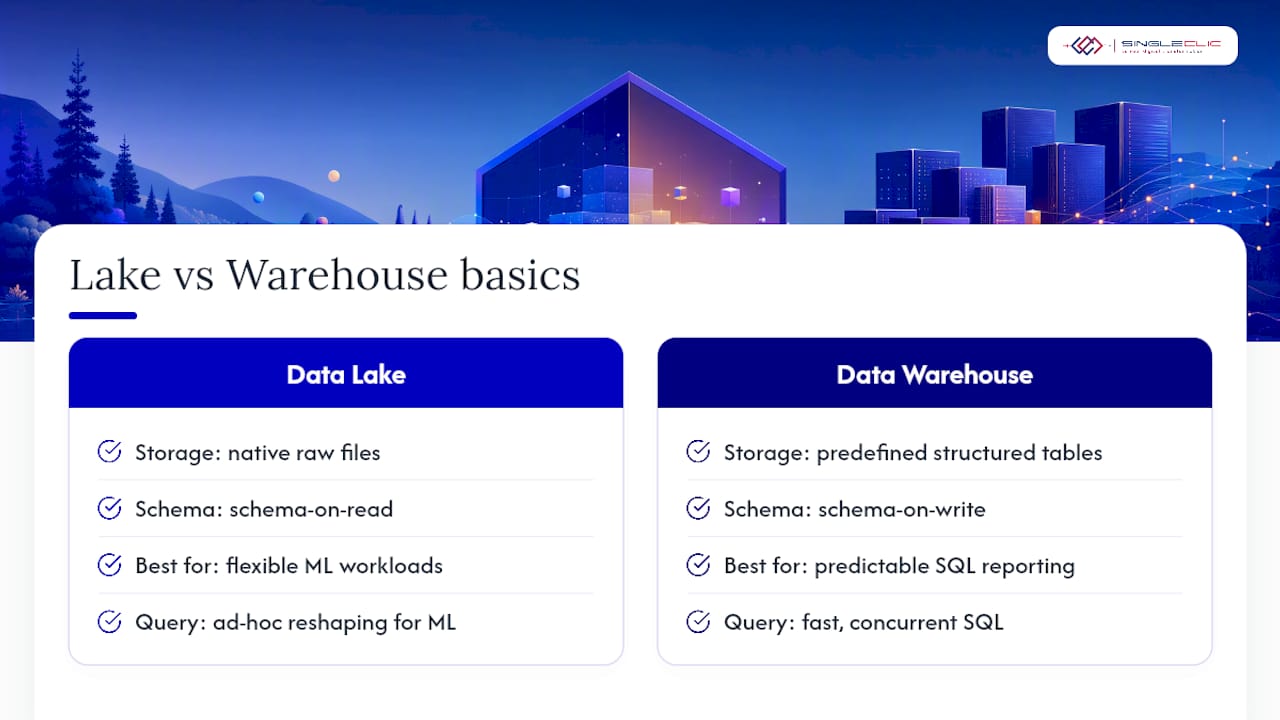
A data lake is a storage repository that holds raw structured, semi-structured, and unstructured data in its native format, from JSON logs to video files to sensor streams. It uses schema-on-read, meaning the structure gets applied only when someone queries the data, not when it lands in storage. This is what makes lakes so flexible for machine learning workloads, since data scientists can reshape raw data however a given model requires without waiting for a data engineering team to define a table structure first.
A data warehouse works the opposite way. It uses schema-on-write, which means data gets cleaned, transformed, and mapped into a predefined structure before it ever gets stored. A retail chain loading yesterday’s point-of-sale transactions into fixed sales and inventory tables is a textbook case. This upfront rigor is exactly why warehouses deliver faster, more predictable SQL performance for business users running dashboards and standard reports.
The technical backbone differs too. Lakes typically run on cloud object storage such as Azure Data Lake Storage, often paired with open table formats like Parquet, Delta Lake, or Apache Iceberg. Warehouses tend to rely on proprietary columnar storage engines tuned for concurrent SQL queries. Data engineers and data scientists gravitate toward lakes; business analysts and finance teams live in warehouses.
Data warehouse vs data lake: key differences side by side
The two platforms diverge across six practical axes that matter to anyone building a technology roadmap, not just a whiteboard diagram.
- Data types: warehouses handle structured, tabular data; lakes accept structured, semi-structured, and unstructured data without conversion.
- Ingestion model: warehouses generally follow ETL, transforming data before loading; lakes follow ELT, loading raw data first and transforming later, on demand.
- Query performance and concurrency: warehouses are built for high-concurrency SQL with predictable latency; lakes historically struggled here, though modern query engines have narrowed the gap.
- Cost model: warehouses often couple storage and compute, which can raise costs at scale; lakes decouple the two, letting you store petabytes cheaply and pay for compute only when you run a job.
- Governance and data quality: warehouses enforce structure and constraints at write time, which naturally improves data quality; lakes require deliberate governance layers or they degenerate into what practitioners call a data swamp.
- SLAs: warehouses support tighter uptime and performance guarantees for reporting; lakes prioritize scale and flexibility over strict latency commitments.
Cost-to-performance is where the picture gets genuinely nuanced. Open-format lakehouses tend to win on data-heavy transformation workloads, while modern cloud warehouses can actually be cheaper for steady, predictable reporting workloads that run the same queries every day. There is no universal winner. The right answer depends on how your workload actually behaves, not on which platform has the better marketing deck.
When should you use a data lake or a data warehouse?
Workload shape, not platform preference, should drive the decision. Here is how the mapping typically plays out:
- BI and financial reporting run best on a warehouse. Monthly close processes, executive dashboards, and regulatory reports need consistent schemas and fast joins across curated tables, exactly what curated enterprise analytics platforms are built to deliver.
- Machine learning and data science favor a lake. Training a fraud-detection model or a demand-forecasting algorithm often means pulling in years of raw transaction logs, clickstream data, and unstructured text that a warehouse was never designed to hold cheaply.
- Large-scale ingestion from IoT or telemetry sources belongs in a lake first. A construction firm streaming sensor data from heavy equipment across a dozen job sites needs cheap, elastic storage before anyone decides what analysis to run on it.
- Hybrid patterns are increasingly the default rather than the exception. A common architecture lands raw data in the lake, curates a subset into warehouse-ready marts, and lets operational dashboards draw from the clean layer while data scientists keep working against the raw layer. Splunk and AWS both document this lake-to-warehouse-to-marts pattern as the practical middle ground for organizations that outgrow a single-platform answer.
Architecture and technical considerations that shape the decision
Storage location is the first fork in the road. Cloud object storage (AWS S3, Azure Data Lake Storage, Google Cloud Storage) dominates lake deployments because it scales elastically and costs a fraction of traditional block storage. Banks and government entities in regulated markets, however, often need on-premise or sovereign-cloud deployments to satisfy data residency rules, which is a real constraint that cloud-only vendors tend to gloss over.
Open table formats matter more than most procurement conversations give them credit for. Parquet’s columnar layout speeds up analytical queries dramatically compared to row-based formats. Iceberg and Delta Lake add something Parquet alone lacks: transaction support. That is not a minor footnote. ACID transactions, schema enforcement, and time-travel queries used to be warehouse-exclusive features. Now they run natively on lake storage, which is the technical development that made the lakehouse pattern viable in the first place.
Metadata and cataloging deserve equal weight. A lake without a catalog, lineage tracking, and access controls becomes unmanageable within a year, regardless of how cheap the storage is. Streaming versus batch processing is the last major fork: batch still covers most reporting needs, but fraud detection, real-time personalization, and operational monitoring increasingly demand streaming ingestion, which lakes and lakehouses handle more natively than traditional warehouses.
How should CIOs choose between a data lake and a data warehouse?
Start with your team, not your technology catalog. A SQL-first team, heavy on business analysts and light on data engineering, will get productive faster on a warehouse. A code-first team with data scientists and platform engineers on staff will extract more value from a lake or lakehouse, because platform choice should follow the skills already on your roster rather than forcing a retraining cycle.
Beyond skills, run the decision through this checklist before committing budget:
- Map your top five workloads and classify each as reporting, ML, or hybrid.
- Estimate expected concurrency: how many analysts or applications will query simultaneously at peak.
- Model total cost of ownership across a three-year horizon, including storage growth and compute spikes, not just list price.
- Bring governance and compliance requirements into the conversation from day one, not after the pilot.
- Check whether your regulatory environment requires on-premise or sovereign storage before you assume public cloud is the default.
For the proof-of-concept itself, scope it narrowly: pick one representative dataset, define success criteria in advance (query latency, cost per terabyte, time to insight), and cap the timeline at six to eight weeks. A POC that drifts past two months usually signals unclear requirements, not platform complexity.
Pro Tip: Run your POC against your messiest real dataset, not a clean sample. A platform that handles your worst data well will handle everything else easily; a platform that only survives clean demo data will fail in production within a quarter.
Is a lakehouse the right convergence point?
A lakehouse combines lake-scale, low-cost storage with warehouse-grade governance, ACID transactions, and query performance on a single platform. The core benefit is eliminating the duplicate pipelines that many enterprises build, one feeding BI tools and a separate one feeding ML models, which reduces data duplication and lets both teams work from the same governed source.
That convergence is not free. Lakehouses demand stronger data engineering discipline and more mature governance practices than a plain lake, because you are now enforcing warehouse-level quality standards on lake-scale data volumes. The signal to migrate is usually organizational before it is technical: when your BI team and your data science team are maintaining separate copies of overlapping data, or when duplicated pipelines are consuming more engineering time than the actual analysis, that friction is the trigger to unify rather than maintain two systems in parallel.

Singleclic’s regional perspective on data platform integration
Data platform decisions rarely happen in isolation from ERP and CRM systems already in place in sectors such as construction, real estate, healthcare, banking, and government. Our Cortex low-code platform connects lakes, warehouses, and legacy systems into unified approval and workflow chains without ripping out existing infrastructure. Combined with our Microsoft Dynamics 365 integration work, the practical path we recommend is a short gap assessment, followed by a scoped proof of concept, followed by phased integration tied to measurable deliverables, not a platform swap for its own sake.
The real decision isn’t lake vs warehouse, it’s what your team can actually run
Most vendor content treats this as a technology comparison. It isn’t. It’s an organizational readiness question wearing a technology costume. A warehouse in the hands of a team with no SQL discipline fails as badly as a lake in the hands of a team with no data engineering maturity. The platform rarely causes the failure; the mismatch between platform and team does.
The conventional advice, “pick a lake for flexibility, pick a warehouse for speed,” is not wrong, but it’s incomplete enough to be dangerous. It skips the governance tax that lakes impose the moment more than one team starts using them, and it skips the ceiling that warehouses hit the moment someone wants to train a model on five years of raw clickstream data. Lakehouse convergence is real progress, but I’d push back on treating it as a default. It earns its complexity only when duplicated pipelines are already costing you engineering hours you can measure.
If you take one thing from this: audit your team’s actual skills before you audit vendor feature lists. The org chart tells you more about which platform will succeed than any benchmark report will.
— Tamer Badr
Meta Title: Data Lake vs Data Warehouse: A 2026 CIO Decision Guide
Meta Description: Data lake vs data warehouse compared: definitions, cost, governance, and a workload-driven checklist to help CIOs choose or converge on a lakehouse.
Slug: data-lake-vs-data-warehouse
Primary Keyword: data lake vs data warehouse
Secondary Keywords: data warehouse vs data lake, lakehouse vs data warehouse, data lake architecture, data warehouse benefits, snowflake vs databricks, databricks vs snowflake
Pillar Cluster: Data Analytics & Enterprise AI Applications
How Singleclic Helps: Singleclic integrates data lake, warehouse, and lakehouse architectures with Microsoft Dynamics 365 ERP/CRM and Cortex low-code workflows, connecting analytics platforms to real business processes across construction, real estate, healthcare, banking, and government sectors. Explore how Microsoft Dynamics 365 connects your ERP, CRM, and analytics stack into one governed system, or talk to Singleclic about a scoped data platform assessment for your organization.
Sources
- Cribl glossary: schema-on-read
- Promethium guide: data lakehouse vs data warehouse vs data fabric (2026)