TL;DR:
- Effective data migration relies on thorough discovery, filtering only necessary data, and testing rollback procedures. Following a structured checklist and involving stakeholders early helps ensure project success and minimizes risks. Proper planning, documentation, and validation are essential for a smooth transition and ongoing operational stability.
Successful data migration comes down to one discipline: discover everything, move only what you need, and never cut over without a tested rollback. The projects that finish on time share a common structure: a complete inventory, profiled and cleaned datasets, versioned transformation rules, automated validation, and a rehearsed cutover runbook. Before your team writes a single ETL script, run through this non-negotiable checklist:
- Inventory first: catalog every source system, owner, row count, refresh frequency, schema, and sensitive field.
- Profile and clean: measure null rates, duplicates, encoding issues, and value ranges; remove redundant, obsolete, or trivial data before extraction.
- Document transformation rules: write field-level mapping logic in versioned rule files, not in someone’s head.
- Validate in three tiers: row counts, checksums, and business-query behavior.
- Build and test rollback: script the restore path and run it in staging before cutover day.
- Get stakeholder sign-off at every gate: scope, acceptance criteria, and go/no-go are business decisions, not just technical ones.
Three first steps you can take in the next 48–72 hours:
- Schedule a 90-minute stakeholder interview with each system owner to capture undocumented integrations and data dependencies.
- Run a quick inventory scan across your source systems to produce a preliminary list of datasets, owners, and estimated row counts.
- Select a representative pilot dataset (use stratified sampling, not the first rows in the table) and run an initial profiling pass to expose data quality issues early.
Table of Contents
- What do the best practices for data migration look like as a step-by-step plan?
- How do you inventory and scope data so you don’t migrate what you don’t need?
- How do you document mapping rules and avoid hidden transformation errors?
- What security and compliance controls belong in every migration project?
- Which migration approach fits your project, and what should any tool support?
- How do you design a validation plan and a rollback strategy that actually works?
- What should your cutover runbook include to minimize downtime?
- How do you confirm the migration worked and hand it over to operations?
- Who owns what? Assigning RACI and running stakeholder interviews
- What timelines, cost drivers, and team roles should you plan for?
- What are the most common migration mistakes and how do you prevent them?
- Practical templates and three expert recommendations to apply now
- Key Takeaways
- Why the conventional wisdom on data migration underestimates the human side
- How Singleclic helps you migrate with confidence
- Useful sources and further reading
What do the best practices for data migration look like as a step-by-step plan?
A migration without phases is a migration without gates, and gates are what keep a project recoverable. The playbook below maps to how enterprise PMOs actually sequence this work, with realistic duration ranges and the exit criteria that let you move forward with confidence.
-
Discovery and inventory (2–4 weeks for mid-size projects, 4–8 weeks for enterprise). Catalog all source systems, including ERPs, CRMs, SaaS tools, file stores, and shadow IT. Exit criterion: a signed-off inventory document with owners, row counts, schemas, and sensitive-field flags.
-
Dependency mapping (1–2 weeks). Identify upstream producers and downstream consumers for every dataset. A billing job that reads from a table you just moved out of sequence will fail silently. Exit criterion: a dependency graph reviewed by both technical leads and business owners.
-
Design and transformation rules (2–4 weeks). Write field-level mapping rules, normalization logic, and deduplication strategies in versioned files. Exit criterion: rules reviewed, version-controlled, and unit-tested against sample data.
-
Build and test (3–6 weeks). Build ETL/ELT pipelines, run unit tests on transformation logic, and execute integration tests in a staging environment at representative data volumes. Exit criterion: all test cases pass; reconciliation reports match source counts within defined thresholds.
-
Dry run at production volume (1–2 weeks). Execute the full migration against a production-scale copy of the source data in staging. Measure throughput, identify bottlenecks, and confirm rollback scripts restore the environment cleanly. Exit criterion: dry run completes within the cutover window; rollback tested and timed.
-
Cutover (hours to days, depending on approach). Execute the final sync, apply the freeze window, run go/no-go checks, and switch traffic. Exit criterion: post-cutover validation passes; business owners confirm reports and APIs behave correctly.
-
Post-migration audit and decommission (2–4 weeks). Monitor error rates, reconciliation drift, and business KPIs. Run entitlement reviews. Archive source data per retention policy, then decommission temporary infrastructure. Exit criterion: audit window closes with no unresolved reconciliation issues; decommission sign-off from legal and operations.
For small migrations (a single application, under 50 GB), you can compress phases 1–3 into two weeks and run a single dry run. For large enterprise moves involving multiple ERP modules, legacy databases, and cross-regional data residency requirements, a phased migration approach that migrates one domain at a time reduces blast radius and keeps the business running during the transition.
How do you inventory and scope data so you don’t migrate what you don’t need?
The most expensive mistake in any migration is moving data that should have been retired. Practitioner surveys consistently find that a significant portion of enterprise data is redundant, obsolete, or trivial, meaning a third of your transfer time, storage cost, and validation effort may be wasted on data nobody uses.

What a defensible inventory must capture
A database name and a row count are not an inventory. Every source system entry needs:
| Field | What to capture |
|---|---|
| System name and type | ERP module, CRM, SaaS, file store, legacy DB |
| Data owner | Named individual, not just a team |
| Row / record count | Current and historical volume |
| Refresh frequency | Real-time, daily batch, ad hoc |
| Schema version | Table structure, field types, known changes |
| Sensitive fields | PII, PHI, financial data, regulated categories |
| Downstream consumers | Reports, APIs, integrations that read this data |
| Retention requirement | Legal hold, regulatory minimum, business policy |
A complete inventory must also surface hidden integrations: middleware connectors, scheduled jobs, and spreadsheet-based feeds that no one documented when the system was built.
Classifying data before you move it
A simple three-tier taxonomy keeps scoping decisions defensible:
- Critical: transactional records, master data, and anything a regulator or auditor will ask for. Migrate with full validation.
- Operational: active reference data and recent history needed for day-to-day reporting. Migrate with standard validation.
- Archival: data older than the retention window, superseded records, and test data. Archive to cold storage or retire; do not migrate into the new production system.
Items that belong in the “retire” column include duplicate customer records created by system mergers, test accounts created during UAT cycles, and historical log data beyond the legal retention period.
Profiling metrics to collect before you write a single mapping rule
Run profiling against every dataset in the critical and operational tiers. The metrics that matter most:
- Null rates per field (a field that is 80% null rarely needs a transformation rule)
- Distinct value counts (expose unexpected enumerations and encoding mismatches)
- Value range and distribution (catch outliers that will break type conversions)
- Encoding and character set issues (especially relevant for Arabic-language data in MENA deployments)
- Referential integrity violations (orphaned foreign keys that will fail on insert)
Pro Tip: Use stratified sampling when selecting test records, not the first N rows. Pull samples across date ranges, business units, and edge-case value distributions. A sample that only covers recent records will miss legacy encoding issues that surface at scale.
How do you document mapping rules and avoid hidden transformation errors?
Transformation logic is the most common source of hidden migration errors. Rules that live in a developer’s notebook or an undocumented script will break when that developer is unavailable and the migration is halfway through cutover.
The discipline is straightforward: treat every transformation rule like application code.
-
Build a field-level mapping document. For every source field, record: source table and column, target table and column, data type conversion, default value when source is null, and any conditional logic. A shared spreadsheet works for small projects; a formal data contract or schema registry works better at scale.
-
Write transformation rules in versioned files. Store ETL/ELT logic in a version-controlled repository (Git is the standard). Every change gets a commit message, a reviewer, and a tag. This means you can roll back a bad transformation rule the same way you roll back application code.
-
Apply normalization and deduplication rules explicitly. Common examples: standardizing phone number formats to E.164, deduplicating customer records using a deterministic matching key (email plus tax ID, not just name), and converting date fields from regional formats to ISO 8601. Write each rule as a named, testable function.
-
Run unit tests on representative samples. For each transformation rule, define at least three test cases: a happy-path record, a null or missing-value record, and an edge-case record (special characters, maximum field length, boundary dates). Automate these tests so they run on every pipeline change.
-
Add schema contract tests. Before the pipeline runs in any environment, assert that the source schema matches what the pipeline expects. Schema drift (a column renamed, a type changed) is a silent killer in long-running migrations.
-
Conduct a peer review of all mapping documents. A second engineer and a business analyst should review the mapping document together. Business analysts catch semantic errors (a field labeled “revenue” that actually stores gross margin) that engineers miss.
Pro Tip: Version control for ETL logic is not optional on enterprise projects. A transformation bug discovered during a dry run is a one-hour fix. The same bug discovered post-cutover, with no version history, can mean days of forensic work to isolate and correct.

What security and compliance controls belong in every migration project?
Data in motion is data at risk. The attack surface during a migration is larger than in steady-state operations: data moves through staging environments, test accounts, and temporary infrastructure that may not carry the same controls as production. Compliance-by-design means building these controls into the project plan, not bolting them on at the end.
Essential controls checklist:
- Encryption in transit: TLS 1.2 or higher for all data movement between source, staging, and target environments. No unencrypted file drops.
- Encryption at rest: staging databases and file stores must use the same encryption standard as production.
- Role-based access control (RBAC): migration team members get least-privilege accounts scoped to the datasets they need. No shared admin credentials.
- Audit trails: log every read, write, and transformation operation with timestamps and user IDs. These logs are your evidence in a compliance review.
- Temporary infrastructure hardening: staging servers, VPNs, and jump hosts created for the migration must be patched, access-controlled, and decommissioned on schedule.
Handling sensitive data in test environments:
Never use live PII in a non-secure test environment. The practical options are:
- Data masking: replace real values with realistic but fictitious ones (a real name becomes a randomly generated name; a real SSN becomes a valid-format but non-real number).
- Synthetic datasets: generate test data that matches the statistical profile of production data without containing any real records.
- Anonymization: for analytics testing, aggregate or hash identifying fields so individual records cannot be reconstructed.
Compliance checkpoints at project gates:
Build a compliance review into the exit criteria for at least three phases: after inventory (confirm data classification and retention requirements), before cutover (confirm access controls and audit logging are active in the target), and during the post-migration audit window (confirm entitlements, run access reviews, and verify retention policies are enforced in the new system).
Pro Tip: Create a named sanitized copy of each sensitive dataset for testers. Label it clearly as non-production data. A tester who accidentally queries a sanitized copy and finds realistic-looking data should be able to confirm immediately that it is not real. Ambiguity here creates compliance risk.
Which migration approach fits your project, and what should any tool support?
The right migration pattern depends on how much downtime you can tolerate, how large the dataset is, and how tightly coupled your source and target systems are. There is no universally correct answer, but the trade-offs are well understood.
Big-bang migration moves all data in a single cutover window. It is the simplest to execute and the easiest to validate, but it requires a maintenance window long enough to complete the transfer and run post-cutover checks. Appropriate for smaller datasets, systems with low transaction volumes, or migrations where a clean break is operationally preferable.
Phased (trickle) migration moves data domain by domain or module by module over weeks or months. It keeps the business running during the transition and limits the blast radius of any single failure. The cost is complexity: you must manage a period where data lives in two systems simultaneously, and your integration layer must route traffic correctly throughout. This is the right choice for large ERP migrations, multi-region moves, and any project where a full maintenance window is not feasible.
Parallel run with change-data-capture (CDC) keeps source and target in sync during the transition period by streaming incremental changes. Automating CDC pipelines reduces engineering overhead and helps maintain sync during cutover. This approach suits high-transaction systems where even a short freeze window is unacceptable, but it requires tooling that supports CDC and a team experienced in managing dual-write consistency.
The IBM framework of the 7 R’s of cloud migration (rehost, replatform, refactor, repurchase, retire, retain, relocate) provides a useful decision heuristic for whether to lift-and-shift or re-architect workloads before migrating. Applying this framework early prevents teams from migrating technical debt they should have retired.
Tool capabilities to require from any migration stack:
- Schema drift detection and alerting (not just schema validation at pipeline start)
- Idempotent retry logic (a failed run can restart without duplicating records)
- Reversible transforms (the ability to re-run a transformation with corrected logic against the same source extract)
- Observable data lineage (trace any target record back to its source)
- Automated reconciliation reporting (row counts, checksums, and business-rule checks on a schedule)
Proof-of-concept checklist before committing to a tool:
- Measure actual data throughput against your production volume estimate. For bulk cross-cloud transfers, overlay routing and relay-region planning can yield 2–5× speedups while controlling egress costs.
- Confirm dry-run support: the tool must be able to simulate a full migration run without writing to the target.
- Test rollback automation: trigger a simulated failure mid-run and confirm the tool can restore the source state cleanly.
How do you design a validation plan and a rollback strategy that actually works?
Validation is not a single check at the end of the migration. It is a three-tier discipline that runs throughout the project, and the rollback strategy is its mirror image: equally scripted, equally tested, and ready to execute under pressure.
Three-tier validation framework
-
Count-level validation. Row counts in the target must match the source after accounting for intentional exclusions (retired records, filtered date ranges). Run this check immediately after each load batch and again at the end of the full migration.
-
Value-level reconciliation. Compare checksums on key fields (total revenue, total record count by status, sum of financial balances). Pull random sample rows and compare field by field against the source. This tier catches transformation errors that count-level checks miss entirely.
-
Behavior-level testing. Run the reports, API calls, and business queries that the organization uses every day against the migrated data. If the monthly revenue report produces a different number in the new system, something is wrong regardless of whether the row counts match.
Validation automation
Define acceptance thresholds before the migration starts, not after. For example: row count variance must be under 0.01%, checksum variance on financial fields must be zero, and all business-critical reports must produce results within 5% of the prior-period baseline. Automate reconciliation jobs that run on a schedule and alert the team when a threshold is breached.
A rollback plan that has never been tested is not a rollback plan. It is a hope. Script the restore path, time it in staging, and confirm that the old system can be brought back to a known-good state within your recovery time objective. Test this before the dry run, not during cutover.
Rollback playbook essentials
- Snapshot the source system before any write operation begins. For databases, this means a point-in-time backup with a verified restore test. For file-based sources, a versioned archive.
- Define decision criteria for rolling back during cutover. Examples: if post-cutover validation fails on any Tier 1 dataset within two hours, initiate rollback. If a critical business report produces results more than 10% outside the expected range, escalate to the go/no-go authority.
- Time the rollback. Run the restore in staging and record how long it takes. If your rollback takes six hours and your maintenance window is four, you have a problem to solve before cutover day.
- Keep the source system recoverable until the post-migration audit window closes, typically 2–4 weeks after cutover.
A tested, versioned rollback strategy must be part of the migration plan and exercised with the same rigor as the migration scripts themselves.
What should your cutover runbook include to minimize downtime?
The cutover runbook is the document that turns a high-risk event into a scripted procedure. Every step is pre-written, every role is assigned, and every decision threshold is defined before the window opens. If your team is making judgment calls in real time during cutover, the runbook was not complete enough.
What a cutover runbook must include:
- Freeze window definition: the exact time at which writes to the source system are halted, who authorizes it, and how it is communicated to users.
- Pre-cutover checks: a signed-off list of conditions that must be true before the migration starts (backup verified, staging validation passed, rollback tested, all team members confirmed available).
- Final delta sync steps: the sequence of commands or pipeline runs that capture changes made since the last full extract.
- Go/no-go gate: a named decision authority (role, not person) who reviews the pre-cutover checklist and gives explicit approval to proceed.
- Post-cutover validation steps: the specific checks (counts, checksums, report runs, API tests) that must pass before the source system is taken offline.
- Rollback trigger criteria: explicit thresholds that automatically escalate to the go/no-go authority for a rollback decision.
Minimizing downtime during cutover:
- Use CDC to reduce the final delta to minutes rather than hours.
- Put the source system in read-only mode rather than full offline during the final sync. Users can still query data; writes are queued or blocked.
- Pre-stage as much data as possible in the target before the freeze window opens, so the cutover window only needs to handle the final delta.
Communication checklist for cutover day:
- Internal technical teams: confirmed on a shared channel with escalation contacts listed.
- Business owners: notified of the freeze window at least 48 hours in advance, with a plain-language description of what will be unavailable and for how long.
- External stakeholders (partners, customers, regulators): notified per the project communication plan, with a status page or contact point for questions.
Escalation roles template:
| Role | Responsibility | Decision authority |
|---|---|---|
| Migration lead | Executes runbook steps, monitors pipeline | Escalates to go/no-go authority |
| Go/no-go authority | Reviews validation results at each gate | Approves proceed or rollback |
| Security/compliance reviewer | Confirms access controls active in target | Blocks cutover if controls not confirmed |
| Business validator | Runs business-query checks post-cutover | Signs off on behavior-level validation |
| Communications lead | Manages stakeholder notifications | Authorizes external status updates |
Pro Tip: Rehearse the cutover runbook at least once during the dry run, with the actual team members who will execute it. Timing each step in a rehearsal exposes gaps (a step that takes 45 minutes instead of 10) that would be catastrophic to discover during the real window.
How do you confirm the migration worked and hand it over to operations?
Passing the post-cutover validation checks is not the end of the migration. The 30/60/90-day period after go-live is when subtle data quality issues, performance regressions, and access control gaps surface in production conditions. A structured monitoring plan and a clean handover to operations are what separate a finished migration from an ongoing incident.
Post-migration validation checklist (first 72 hours):
- Reconcile all Tier 1 reports against the pre-migration baseline.
- Run the business queries defined in the acceptance criteria and confirm results are within threshold.
- Execute API sanity checks for every downstream consumer identified in the dependency map.
- Confirm that all user access controls in the target match the approved entitlement matrix.
- Verify backup jobs are running on schedule in the new environment.
30/60/90-day monitoring plan:
- Days 1–30: daily reconciliation jobs on all Tier 1 datasets; alert on any row count or checksum variance. Track error rates in ETL pipelines and latency on critical queries. Review open support tickets for data-related issues.
- Days 31–60: shift to weekly reconciliation for stable datasets. Review business KPIs (revenue reports, operational dashboards) for drift from expected trends. Conduct a formal entitlement review.
- Days 61–90: close the audit window. Confirm all reconciliation issues are resolved. Prepare the decommission plan for source systems and temporary infrastructure.
Handover checklist for operations:
- Updated runbooks reflecting the production configuration of the new system.
- Access control documentation and the process for requesting changes.
- Backup schedules, retention policies, and restore procedures.
- Contact list for escalation (data owners, platform team, security).
- Known issues log with resolution status.
Decommissioning steps:
Archive source data to cold storage per the legal retention policy before any deletion. Get written sign-off from legal and compliance on the retention period and the archive location. Remove temporary migration infrastructure (staging servers, VPN tunnels, jump hosts) within the agreed decommission window. Document the decommission in the project closure report.
For operations digitization teams taking ownership of a newly migrated system, the handover package is the difference between a smooth transition and a six-month support burden.
Who owns what? Assigning RACI and running stakeholder interviews
Migration projects fail when ownership is ambiguous. A RACI model makes accountability explicit before the project starts, and focused stakeholder interviews surface the hidden integrations and tribal knowledge that no inventory tool will find automatically.
Example RACI for core migration activities:
| Activity | Responsible | Accountable | Consulted | Informed |
|---|---|---|---|---|
| Inventory and discovery | Data engineer | Migration PM | System owners | IT leadership |
| Dependency mapping | Data engineer | Migration PM | Business analysts | Operations |
| Transformation mapping | Data engineer | Data architect | Business owners | QA lead |
| Validation and testing | QA lead | Migration PM | Business validators | IT leadership |
| Go/no-go decision | Migration PM | Executive sponsor | Security, legal | All stakeholders |
| Cutover execution | Migration lead | Migration PM | System owners | Business owners |
Decision points that require business owner sign-off:
- Scope definition (what is in and out of the migration)
- Acceptance criteria for each validation tier
- Go/no-go at each phase gate
- Rollback trigger thresholds
- Decommission authorization
Aligning migration objectives with operational KPIs requires business owners to define what “success” looks like in terms they measure every day, not just in terms of row counts and pipeline uptime.
Running effective stakeholder interviews:
Schedule 60–90 minute sessions with each system owner in the first two weeks of the project. The goal is not a status update; it is intelligence gathering. Ask specifically about:
- Systems that feed data into this one that are not in the official architecture diagram.
- Reports or jobs that run against this system that are not in the IT service catalog.
- Data quality issues the team works around manually.
- Seasonal or event-driven spikes that affect data volume or timing.
Pro Tip: Script the stakeholder interview with three specific questions: Who else reads from or writes to this system? What would break first if this system were unavailable for 24 hours? Are there any manual processes that depend on this data that IT does not know about? These three questions surface more hidden dependencies than any automated discovery tool.
What timelines, cost drivers, and team roles should you plan for?
Migration budgets fail when teams underestimate the validation and parallel-run phases. The table below gives rough timeline ranges by project size; treat them as planning inputs, not commitments.
| Project size | Scope | Typical timeline |
|---|---|---|
| Small | Single application, under 50 GB, one source system | 6–12 weeks |
| Medium | 2–5 systems, 50 GB–1 TB, some integrations | 3–6 months |
| Large | Multi-system ERP/CRM, 1 TB+, cross-regional | 6–18 months |
Primary cost drivers to budget for:
- Data volume and transfer costs: bulk cross-cloud transfers carry egress fees that scale with volume. Plan for these explicitly.
- Parallel run infrastructure: running source and target simultaneously during a phased migration doubles infrastructure costs for the overlap period.
- Tooling and licensing: ETL/ELT platforms, CDC tools, and data quality tools carry licensing costs that vary by data volume and connector count.
- External consulting: specialist data engineers and migration architects are often the fastest path to reducing project risk, particularly for complex ERP migrations.
- Validation effort: business validators and QA engineers are frequently underestimated. Budget for dedicated validation time, not just a few hours of spot-checking.
For ERP and CRM migrations specifically, the CRM implementation cost guide provides a useful framework for budgeting TCO across implementation phases.
Recommended resourcing model:
- Migration PM (1 FTE): owns the plan, gates, and stakeholder communication throughout.
- Data engineers (2–4 FTE depending on complexity): build and test pipelines, write transformation rules, execute dry runs.
- QA/validation lead (1 FTE): owns the test plan, reconciliation jobs, and acceptance criteria.
- Security/compliance reviewer (0.5 FTE): reviews controls at each gate; full-time during cutover week.
- Business validators (1–2 FTE from the business side): run business-query checks and sign off on behavior-level validation.
Build vs. buy guidance:
Build migration automation only when your use case is genuinely unique (a proprietary legacy format with no standard connector, for example). For standard ERP-to-cloud or CRM-to-CRM migrations, managed ELT platforms with pre-built connectors reduce build time and ongoing maintenance cost. Augment with external specialists when the internal team lacks CDC experience or when the migration involves regulated data categories that require documented compliance evidence.
What are the most common migration mistakes and how do you prevent them?
Most migration failures trace back to a small set of recurring mistakes. Each one has a known mitigation, and each mitigation has a specific point in the project where it must be applied.
Top pitfalls and mitigations:
-
Skipping data profiling. Teams that move directly from inventory to mapping discover data quality issues during cutover, when fixing them is expensive. Mitigation: run profiling on every Tier 1 and Tier 2 dataset before writing a single mapping rule.
-
Missing dependencies. A report that reads from a table you migrated last, after the job that populates it, breaks silently. Mitigation: complete the dependency map in Phase 2 and sequence the migration accordingly.
-
Under-testing transformation logic. A rule that works on 1,000 sample rows may fail on the 50,000th row with an edge-case value. Mitigation: test against stratified samples that include edge cases, and run schema contract tests on every pipeline change.
-
No tested rollback. A rollback plan that exists only as a document is not a control. Mitigation: execute the rollback in staging during the dry run and record the time it takes.
-
Poor stakeholder buy-in. When business owners are not engaged until cutover week, acceptance criteria are vague and sign-off is delayed. Mitigation: involve business owners in scope definition, acceptance criteria, and go/no-go gates from the start.
-
Migrating ROT data. Moving redundant, obsolete, or trivial records inflates transfer time, storage cost, and validation effort. Mitigation: classify and retire archival data before extraction.
Two illustrative scenarios:
A financial services team skipped the dependency mapping phase to save two weeks. On cutover day, a nightly reconciliation job that read from a table migrated in the final batch failed to run. The team spent three days diagnosing the issue, which turned out to be a foreign key reference to a table that had been renamed during migration. A completed dependency map would have flagged the rename as a breaking change before the pipeline was built.
A healthcare organization ran validation only on row counts, not on business queries. Post-cutover, the clinical reporting team discovered that a date field conversion had shifted all appointment timestamps by one hour due to a timezone handling error in the transformation rule. The error affected six weeks of historical reports before it was caught. Value-level reconciliation on the date field would have caught the offset during the dry run.
Action checklist to add to your project plan immediately:
- Add profiling as a formal deliverable in Phase 1, with sign-off required before Phase 3 begins.
- Add dependency map review as a Phase 2 exit criterion.
- Add rollback execution to the dry-run agenda.
- Add business-query validation to the post-cutover checklist.
- Schedule stakeholder interviews in the first two weeks of the project.
Practical templates and three expert recommendations to apply now
The artifacts below give your team reusable starting points. Adapt them to your environment; the structure matters more than the exact column names.
Template: inventory CSV columns
A minimal inventory spreadsheet should include these columns: system_name, system_type, data_owner, row_count_estimate, refresh_frequency, schema_version, sensitive_fields_flag, downstream_consumers, retention_requirement, migration_tier (critical/operational/archival), notes.
Template: mapping document columns
For each field: source_table, source_column, source_type, target_table, target_column, target_type, transformation_rule, default_on_null, referential_integrity_check, test_case_ids, reviewer, version.
Template: validation query checklist
- Row count comparison:
SELECT COUNT(*) FROM source.tablevs.SELECT COUNT(*) FROM target.table - Checksum on financial fields:
SELECT SUM(amount) FROM source.transactionsvs. target equivalent - Null rate check:
SELECT COUNT(*) WHERE key_field IS NULLin target vs. expected threshold - Referential integrity:
SELECT COUNT(*) FROM target.orders WHERE customer_id NOT IN (SELECT id FROM target.customers) - Business query: run the top five operational reports and compare output to the pre-migration baseline
Template: rollback script outline
1. STOP all write operations to target system (timestamp: __)
2. VERIFY source system backup integrity (checksum: __)
3. RESTORE source system from point-in-time backup (estimated time: __ minutes)
4. VALIDATE source system row counts against pre-migration snapshot
5. RE-ENABLE source system for production traffic
6. NOTIFY stakeholders of rollback completion (template: __)
7. LOG rollback event with timestamp, trigger reason, and recovery time
Three expert recommendations
Engage business stakeholders before the first line of ETL code is written. Migration success is defined by whether the business can operate normally after cutover, not by whether the pipelines ran without errors. Acceptance criteria set by IT alone will miss the business queries that matter most.
Aligning data work with business objectives from the start of the project is what separates migrations that close on schedule from those that drag into extended parallel-run periods.
Test your rollback before you need it. A rollback plan that has never been executed is an assumption. Run it in staging, time it, and confirm it restores the source system to a known-good state within your recovery time objective.
Treat the migration as the start of an ongoing integration program, not a one-time event. Design pipelines for schema drift and evolving APIs. A migration that creates a new data silo because the pipeline was built for a point-in-time schema will require another migration in 18 months.
Singleclic’s Cortex platform is built specifically for this kind of ongoing integration work: connecting ERP, CRM, legacy systems, and approval workflows in a single orchestration layer that handles schema changes at runtime without downtime. For organizations running Dynamics 365 or Odoo migrations in MENA, Cortex reduces the gap between cutover and steady-state operations by keeping integration logic visible, versioned, and modifiable without code changes.
For a zero-downtime legacy modernization blueprint that complements these templates, Singleclic’s published guides cover the operational sequencing in detail.
Key Takeaways
Successful data migration requires a complete inventory, profiled and cleaned datasets, versioned transformation rules, automated three-tier validation, and a tested rollback plan executed before cutover day.
| Point | Details |
|---|---|
| Inventory and classify first | Capture owners, schemas, sensitive fields, and downstream consumers before writing any mapping rules. |
| Remove ROT before migrating | Practitioner surveys and migration playbooks consistently find that 30–40% of enterprise data is redundant, obsolete, or trivial; retiring it before extraction cuts transfer time and validation effort. |
| Version and test all transforms | Store transformation rules in version control and test against stratified samples, including edge cases, not just happy-path records. |
| Test rollback before cutover | Execute the restore procedure in staging, time it, and confirm it completes within your recovery time objective. |
| Singleclic for ERP/CRM migrations | Singleclic’s Cortex platform and Dynamics 365/Odoo expertise reduce cutover risk by keeping integration logic versioned and modifiable at runtime. |
Why the conventional wisdom on data migration underestimates the human side
Most migration playbooks are technically sound and organizationally naive. They tell you to profile your data, version your scripts, and test your rollback, and all of that is correct. What they underestimate is how much of the risk in a migration lives not in the data itself but in the people who understand it.
The hidden integrations that break on cutover day are almost never undiscoverable. They are undiscovered because no one asked the right person the right question early enough. The acceptance criteria that cause a two-week sign-off delay are almost never genuinely ambiguous. They are vague because the business owner was not in the room when they were written.
The organizations that run clean migrations are not necessarily the ones with the best tooling. They are the ones that treat stakeholder interviews as a technical control, not a soft skill. They are the ones that define “done” in terms the business uses, not in terms the pipeline dashboard shows.
For organizations in KSA and UAE, this human dimension carries additional weight. Data in MENA enterprises often lives in Arabic-language systems, in locally built integrations that were never formally documented, and in workflows that were designed around regulatory requirements specific to the Gulf. A migration playbook that does not account for Arabic character encoding, local data residency requirements, or the approval workflows embedded in government-facing systems will produce a technically correct migration that the business cannot actually use.
The playbook in this article is designed to surface those issues before they become cutover-day surprises. The templates, the stakeholder interview script, and the three-tier validation framework are all structured to force the human knowledge out into the open where it can be managed.
How Singleclic helps you migrate with confidence
Running a migration across ERP, CRM, and legacy systems is one of the highest-risk projects an IT organization takes on. The difference between a clean cutover and a multi-week incident is almost always preparation: a complete inventory, tested rollback, and business owners who defined acceptance criteria before the pipeline was built.
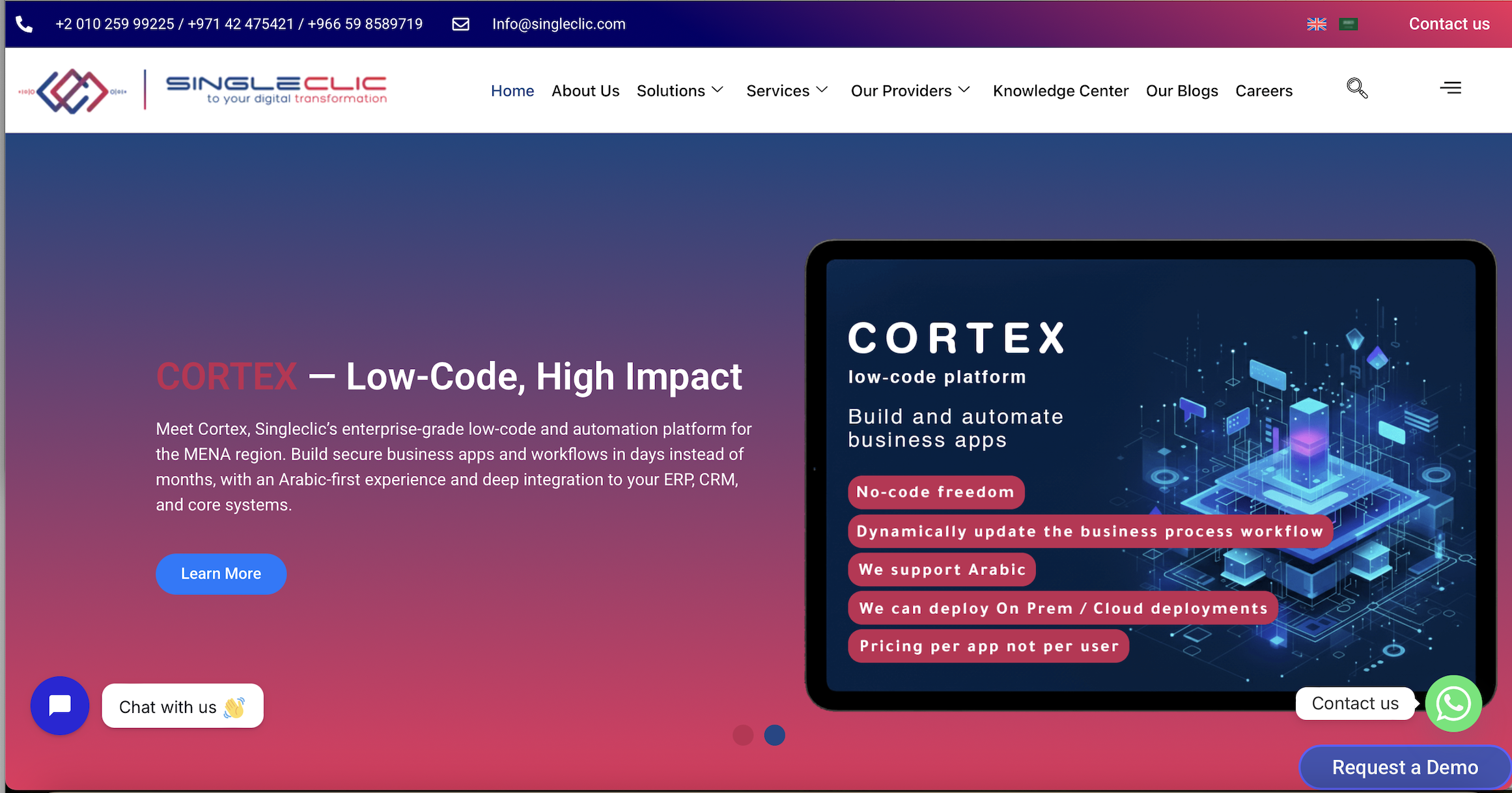
Singleclic delivers end-to-end migration services for Microsoft Dynamics 365, Odoo, and custom enterprise systems, with Cortex as the integration layer that keeps workflows, approvals, and data pipelines connected after cutover. For organizations in construction, healthcare, banking, telecom, and government, Singleclic’s team of 70+ engineers brings the regional context that generic migration tools cannot provide: Arabic-language data handling, local regulatory checkpoints, and integration patterns specific to MENA enterprise environments.
The starting point is a migration readiness assessment: a structured review of your current data estate, integration dependencies, and compliance posture that produces a prioritized migration plan and a risk register before any code is written. From there, Singleclic’s team can execute the full playbook or augment your internal team at the phases where specialist depth matters most.
Explore Singleclic’s Dynamics 365 and ERP implementation services or review the ERP implementation playbook to see how the migration framework maps to a full deployment. To request a readiness assessment or download the runbook templates, contact the Singleclic team directly.
Useful sources and further reading
The references below back the technical claims in this article and provide deeper reading on specific topics.
- Data Migration Best Practices: 12 Steps, 7 Mistakes (Filefeed) — Practitioner-focused guide on ROT data, transformation errors, and pre-migration cleaning as the highest-ROI step.
- The 7 R’s of Cloud Migration (IBM) — Strategic framework for deciding whether to rehost, replatform, refactor, or retire workloads before migrating.
- Skyplane: Optimizing Transfer Cost and Throughput Using Cloud-Aware Overlays (USENIX NSDI 2023) — Research paper on overlay routing and relay-region planning for bulk cross-cloud transfers; relevant for large-volume migrations.
- Top 10 Best Practices for Data Migration (GeeksforGeeks) — Accessible overview covering validation, testing, and rollback fundamentals.
- Data Migration Best Practices (ITRC EDM) — Environmental data management context; useful for regulated-industry teams with specific data integrity requirements.
- Cloud Migration Process Guide for MENA IT Leaders (Singleclic) — Regional guidance on migration sequencing, Arabic-language data handling, and compliance touchpoints for KSA and UAE.
- Why Cloud Migration Is Imperative to Your Business (ChristianSteven) — Strategic justification for cloud migration with business-value framing; useful for building the executive case.