TL;DR:
- Low-code development enables Saudi enterprises to build applications faster by reducing reliance on scarce developers.
- Selecting a platform with deep ERP integration and Arabic support is essential for operational success in the region.
What is low-code application development and why does it matter for KSA enterprises?
Low-code application development lets your teams build, automate, and deploy business applications through visual drag-and-drop interfaces rather than hand-written code. For enterprises and government bodies in Saudi Arabia, this means functional applications can reach production in weeks rather than months, with far less dependency on scarce developer talent.
The speed advantage is real and well-documented. Industry research shows low-code development can be 5 to 10 times faster than traditional coding approaches. For KSA organizations racing to meet Vision 2030 digitalization targets, that compression in delivery time changes what is actually achievable within a budget cycle.
Three forces make this especially relevant right now:
- Legacy system modernization: Most large Saudi enterprises run complex ERP and CRM environments, often across Microsoft Dynamics 365, Odoo, and IBM BAW. Low-code platforms that integrate across these systems reduce the cost and risk of connecting them.
- Citizen developer participation: Business users with domain knowledge but no coding background can contribute directly to application development, closing the gap between IT capacity and business demand.
- Governance from day one: Citizen developers working without professional oversight carry real risk. Up to 85% of citizen-developed apps fail within two years when architecture and governance are absent.
The distinction between low-code and no-code matters here. No-code platforms require zero programming knowledge and suit simpler use cases. Low-code platforms support pro-code extensions for complex enterprise logic, making them the right fit for organizations running multi-system ERP/CRM environments.
What features should you require from an enterprise low-code platform?
Choosing the wrong platform is the most common and most expensive mistake in this space. The features below separate enterprise-grade platforms from tools that work fine for simple forms but collapse under real operational load.
- Deep ERP/CRM integration: The platform must connect natively or via API to Microsoft Dynamics 365, Odoo, IBM BAW, and legacy databases. Complex technology landscapes in KSA enterprises demand this as a baseline, not a bonus.
- Arabic UI/UX support: Full right-to-left interface support is non-negotiable for regional enterprise deployments in Saudi Arabia and the UAE.
- Unlimited user scalability: Per-user pricing models become prohibitive at enterprise scale. Platforms with unlimited user licensing give you predictable costs as adoption grows.
- On-premise deployment option: Banks, government agencies, and healthcare organizations in KSA often cannot send sensitive data to public cloud environments. On-premise deployment preserves data sovereignty.
- Identity management and encryption: Role-based access, secure encryption, and audit trails are the floor for any platform handling financial or patient data.
- Runtime workflow changes: The ability to modify live workflows without taking systems offline is critical for organizations that cannot afford downtime during process updates.
- Pro-code extensibility: When business logic exceeds what visual tools can express, developers need a clean path to write custom code within the same platform.
Pro Tip: Evaluate platforms using a hybrid model from the start. Low-code handles the 80% of workflows that are visual and repeatable; pro-code extensions handle the 20% that require custom logic. Locking yourself into a pure low-code environment creates the same vendor dependency you were trying to avoid with traditional development.

Benefits and real challenges of low-code adoption in Saudi enterprises
Low-code delivers genuine advantages for KSA organizations, but the path is not without friction. Understanding both sides helps you build a realistic business case.
Benefits that show up in practice:
- Faster time to market, with functional MVPs often delivered within a few weeks using agile methods
- Improved collaboration between IT and business teams, since low-code bridges the gap between technical and operational staff
- Reduced technical debt when platforms replace manual workarounds and disconnected spreadsheet processes
- Lower cost per application when reusable components replace custom builds for standard workflows
Challenges you need to plan for:
- Vendor lock-in: Proprietary platforms can trap your data and processes. Always verify data portability and migration paths before signing.
- Shadow IT: When business teams build apps outside IT governance, security risks multiply. Governance frameworks must be established before citizen development begins, not after an incident.
- Scalability ceilings: Some platforms handle departmental tools well but struggle with enterprise-wide transaction volumes or complex multi-system orchestration.
- Customization limits: Visual builders cannot always express complex business rules. Without pro-code extensibility, teams hit walls on sophisticated workflows.
The mitigation strategy for most of these challenges is the same: professional architecture from day one, a platform selected for your specific ERP/CRM stack, and governance policies that give citizen developers a safe lane without removing IT oversight. You can read more about low-code’s strategic impact on enterprise teams to see how leading organizations structure this.
How Cortex, Singleclic’s Arabic-enabled BPM platform, serves MENA enterprises
Singleclic built Cortex specifically for the operational realities of Saudi and MENA enterprises. It is not a generic platform adapted for the region. It was designed from the ground up with full Arabic UI/UX, on-premise deployment, and deep integration with the ERP and CRM systems that large organizations in KSA already run.
Cortex supports unlimited users, which removes the per-seat cost barrier that makes other platforms impractical at government scale. Real-time process optimization means workflows can be adjusted as operational conditions change, not during the next maintenance window.
Singleclic has deployed Cortex across more than 100 enterprise clients, including Miahona in Saudi Arabia, Saba Medical Clinics in Jeddah, and Al Weddad Charity in Saudi Arabia. The team behind these deployments includes 70+ consultants and engineers across KSA, UAE, and Egypt, with over 10 years of regional delivery experience.
Pro Tip: Cortex reduces shadow IT risk by giving business teams a governed, IT-approved environment to build workflows. When the platform is Arabic-enabled and connected to your existing ERP, business users have no reason to build outside the system.
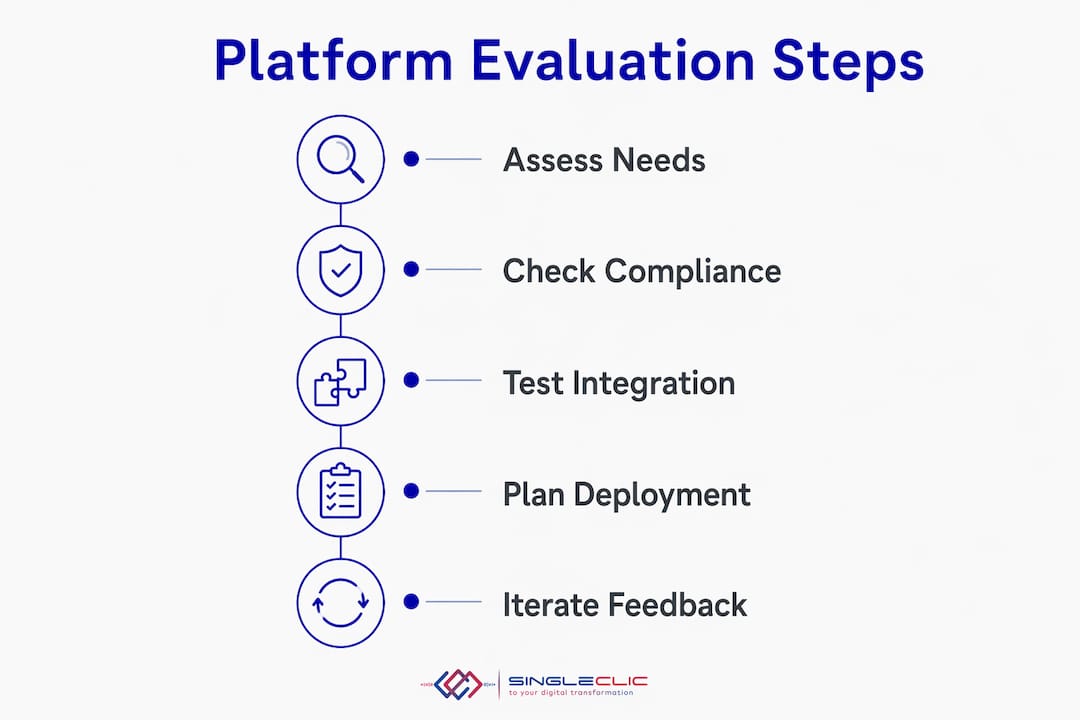
How to evaluate and implement a low-code platform in KSA
The evaluation process for enterprise low-code platforms in KSA requires more rigor than a standard software procurement. The stakes are higher because these platforms touch ERP data, process approvals, and often regulatory workflows.
Evaluation criteria to apply:
- Map your current ERP/CRM landscape first. A platform that cannot connect to Microsoft Dynamics 365 or Odoo without expensive custom middleware is not enterprise-ready for most KSA organizations.
- Verify data sovereignty compliance for KSA and UAE regulatory requirements. On-premise deployment or in-country cloud hosting may be required depending on your sector.
- Test Arabic UI/UX with actual end users, not just IT staff. A platform that feels foreign to Arabic-speaking employees will face adoption resistance regardless of its technical capabilities.
- Assess the vendor’s regional presence. A partner with consultants on the ground in Riyadh or Jeddah responds differently than a remote team working across time zones.
Implementation best practices:
- Start with a pilot project that has a clear, measurable outcome. A procurement approval workflow or an HR onboarding process makes a better first deployment than a full ERP integration.
- Use agile sprints with two-week cycles. This keeps stakeholders engaged and surfaces integration issues before they compound.
- Establish governance policies before citizen developers start building. Define who can publish to production, who reviews security, and how data access is controlled.
Pro Tip: The Microsoft 365 development ecosystem offers pre-built connectors that can accelerate your first integration sprint significantly, especially if your organization already runs Dynamics 365.
Regional considerations that shape low-code decisions in KSA and MENA
Saudi Arabia’s regulatory environment adds layers that generic low-code guidance ignores. The National Data Management Office (NDMO) sets data classification and localization requirements that affect where application data can be stored and processed. Government entities and regulated industries like banking and healthcare face the strictest requirements, often mandating on-premise or in-country deployment.
Arabic language support goes beyond right-to-left text rendering. It includes date formats, number formatting, and workflow terminology that must feel native to Arabic-speaking users. Platforms that treat Arabic as an afterthought create friction that slows adoption and increases training costs.
Vision 2030 has accelerated government digitalization across Saudi Arabia, creating demand for platforms that can handle high transaction volumes, multi-agency workflows, and citizen-facing services simultaneously. The KSA and UAE enterprise context rewards platforms built for this scale from the start.
Delivery timelines and scalability you should realistically expect
A well-governed low-code project in KSA typically moves through three phases. A feasibility and architecture sprint takes roughly one to two weeks. Core application assembly, including integrations with existing ERP or CRM systems, runs two to four weeks for a focused scope. Continuous iteration follows from there, with new features added in two-week sprints rather than quarterly releases.
Scalability depends heavily on platform architecture. Platforms built on shared cloud infrastructure may perform well at departmental scale but degrade under enterprise transaction loads. On-premise deployments give your infrastructure team direct control over performance tuning, which matters for banks and government agencies processing thousands of transactions per hour.
The agile delivery approach used by experienced regional partners keeps timelines honest by delivering working software at the end of every sprint rather than at the end of a multi-month project.
How leading platforms compare for KSA and MENA enterprise deployments
| Platform | Deployment model | Arabic UI/UX | ERP/CRM integration | Best fit |
|---|---|---|---|---|
| Singleclic Cortex | On-premise or hybrid | Full, native | Dynamics 365, Odoo, IBM BAW, legacy | Government, banking, large enterprise |
| Microsoft Dynamics 365 | Cloud or hybrid | Supported | Native Microsoft ecosystem | Organizations already in Microsoft stack |
| Odoo | Cloud or on-premise | Supported | Modular ERP/CRM suite | Mid-market and construction/real estate |
| IBM BAW | On-premise or cloud | Configurable | Enterprise BPM and legacy systems | Complex process orchestration |
Singleclic operates as a Microsoft Dynamics 365 integrator, Odoo Silver Partner, and IBM BAW specialist, which means Cortex connects to all three rather than competing with them. For KSA enterprises running mixed environments, that integration depth is the practical differentiator. You can explore Odoo’s capabilities for KSA and Dynamics 365’s connected ERP and CRM model to understand how each fits your existing architecture.
Singleclic delivers low-code BPM built for KSA enterprise reality
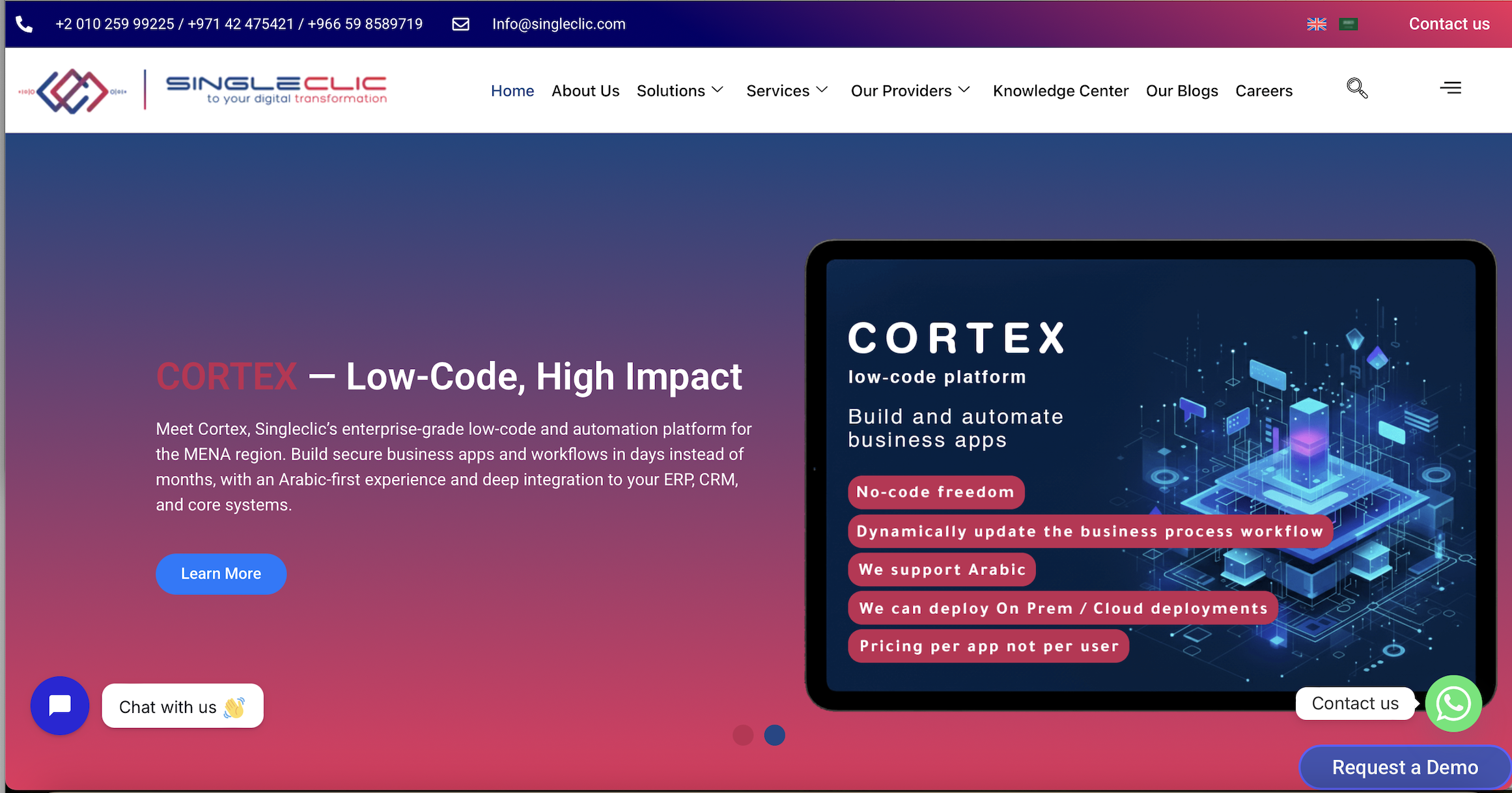
If your organization needs a low-code BPM platform that works in Arabic, deploys on-premise, and connects directly to your existing Dynamics 365, Odoo, or IBM BAW environment, Cortex is built for exactly that. Generic platforms require months of configuration to reach what Cortex delivers at deployment. Singleclic’s 70+ regional consultants have already solved the integration, compliance, and Arabic localization challenges that slow other implementations down.
Clients like Miahona, Saba Medical Clinics, and Al Weddad Charity in Saudi Arabia are running live workflows on Cortex today. The business process automation guide for C-level leaders is a practical starting point if you want to map your automation priorities before a conversation. When you are ready to see Cortex in your environment, contact Singleclic for a scoped demonstration.
Key Takeaways
Low-code application development in KSA delivers its full value only when the platform is selected for regional compliance, Arabic language support, and deep ERP/CRM integration from the start.
| Point | Details |
|---|---|
| Speed advantage is proven | Low-code development runs 5 to 10 times faster than traditional coding, compressing delivery from months to weeks. |
| Governance prevents failure | Up to 85% of citizen-developed apps fail within two years without professional architecture and oversight. |
| Regional requirements are non-negotiable | KSA deployments require on-premise options, Arabic UI/UX, and NDMO-aligned data sovereignty controls. |
| Integration depth determines ROI | Platforms must connect natively to Dynamics 365, Odoo, and IBM BAW to serve complex KSA enterprise environments. |
| Singleclic Cortex | Arabic-enabled, on-premise BPM platform with unlimited users, deployed across 100+ enterprise clients in KSA, UAE, and Egypt. |
Recommended
- Low-Code, Enterprise-Ready: Balancing Speed, Control, and Scale | Singleclic
- Low-Code, High Control: Accelerate Internal App Delivery with Enterprise Governance | Singleclic
- Why Low-Code Development Is Now Essential for Enterprise Agility | Singleclic
- Low-Code, High Impact: Why Enterprise Teams Are Making It a Strategic Priority | Singleclic