TL;DR:
- AI ERP systems incorporate artificial intelligence to automate business processes and support data-driven decision-making. Most companies in the Gulf currently use AI-enabled ERP, which adds AI features to existing platforms, while full AI-native solutions are still emerging. Implementing AI ERP requires clean data, phased adoption, and clear governance to deliver measurable operational and financial benefits.
An AI ERP system is an enterprise resource planning platform embedded with artificial intelligence capabilities designed to optimize business processes through automation, predictive analytics, and intelligent workflow execution. Traditional ERP platforms record and report. An AI-driven system acts: it reads unstructured documents, flags anomalies before they become losses, and executes multi-step workflows with minimal human input. For business leaders in the UAE and Saudi Arabia, where Vision 2030 and UAE Centennial 2071 are pushing enterprises toward data-driven operations, this distinction is not academic. It is the difference between reacting to your business and running ahead of it. McKinsey research shows that early AI ERP adopters report EBIT improvements of 5% or more, with program effort and duration cut by half.
How does an AI ERP system actually work?
The term “AI ERP” covers five distinct technology layers, and conflating them leads to bad purchasing decisions. The five layers are machine learning, natural language processing (NLP), generative AI, predictive analytics, and agentic AI. Each one does a different job inside your ERP.
- Machine learning detects patterns in historical data. It flags a supplier invoice that deviates from the norm before your finance team sees it.
- Natural language processing lets your team query ERP data in plain English or Arabic. Instead of building a report, a manager types a question and gets an answer.
- Generative AI drafts purchase orders, summarizes contract terms, and produces first-draft financial narratives from raw ledger data.
- Predictive analytics runs demand forecasting, cash flow projections, and maintenance scheduling based on live operational data.
- Agentic AI is the most significant shift. Agentic workflows execute multi-step business processes autonomously, moving the ERP from a system of record to a system of outcome.
The architectural shift matters here. An AI-enabled ERP bolts AI features onto an existing platform. An AI-native ERP is built from the ground up with AI as the execution layer. Most enterprises in the Gulf region are currently in the AI-enabled phase, which is the right starting point. Jumping straight to AI-native without clean data and mature processes creates more problems than it solves.
Pro Tip: Before evaluating any AI ERP vendor, map your five most manual, high-volume processes. These are your AI entry points. If you cannot name them, your data is not ready for AI either.
For construction and real estate firms in the UAE, AI in project ERP is already being applied to cost estimation, subcontractor billing reconciliation, and materials forecasting. These are exactly the high-frequency, error-prone processes where AI delivers measurable returns fastest.

What are the main benefits of AI-driven ERP solutions?
The benefits of AI in ERP are real, but they are not evenly distributed. The highest returns come from specific use cases, not from AI adoption in general.
-
Reduced manual exceptions in finance. The highest ROI from AI in ERP comes from automating the extraction of unstructured data such as vendor bills and receipts. This turns external, messy inputs into structured ERP records without human rekeying. Finance teams in large Saudi enterprises processing thousands of vendor invoices monthly see the impact within weeks.
-
Faster implementation timelines. AI agents cut implementation effort by at least 50% and halve program duration. That is a direct reduction in consulting fees, internal resource drain, and business disruption during go-live.
-
Accelerated revenue cycles. A documented case from AWS shows that deploying an agentic AI billing solution reduced manual exceptions and accelerated revenue recognition within five weeks. Five weeks is a timeline most finance leaders in the Gulf can act on.
-
Better scenario planning. Predictive analytics inside an intelligent ERP runs multiple demand and cash flow scenarios simultaneously. A CFO in Riyadh can model the impact of a 15% raw material price increase across three supply chain configurations before the board meeting, not after.
-
Stronger compliance and audit trails. AI-native ERP platforms log every automated decision with a timestamp and a reason code. This is directly relevant to Zakat, Tax and Customs Authority (ZATCA) e-invoicing requirements in Saudi Arabia and the UAE Federal Tax Authority’s VAT audit processes.
The pattern across all five benefits is the same: AI removes the friction between data and decision. It does not replace judgment. It gives your team the time and information to exercise better judgment.
What are the risks of implementing an AI ERP system?
The risks are real and underreported in vendor marketing. Understanding them before you sign a contract is the most valuable thing you can do.
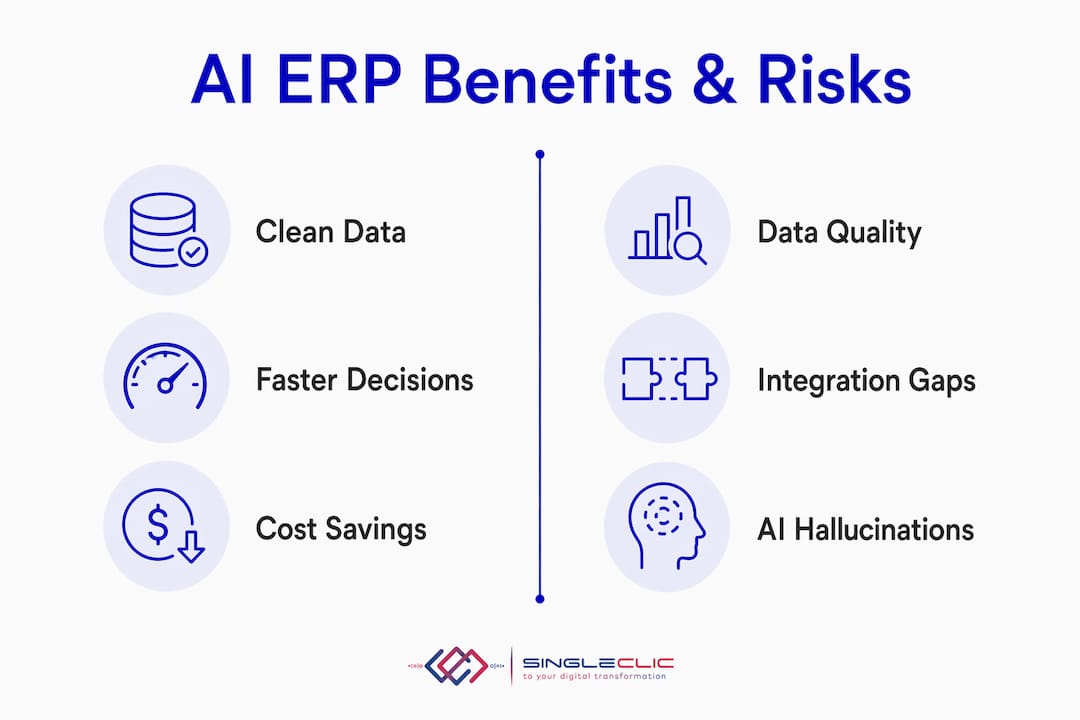
- AI hallucinations in financial data. Without strict schema definitions and guardrails, AI agents can generate inaccurate financial records. Role-based access controls and immutable source-of-truth hierarchies are not optional features. They are the foundation that prevents AI from becoming a liability.
- Data governance gaps. AI is only as accurate as the data it trains on. If your ERP holds duplicate vendor records, inconsistent cost center codes, or unreconciled intercompany balances, the AI will amplify those errors at scale. Clean data is a prerequisite, not a post-implementation task.
- Legacy system integration friction. Most enterprises in the UAE and Saudi Arabia run a mix of modern cloud applications and older on-premise systems. Connecting AI agents to legacy ERP modules requires careful API design and data mapping. Skipping this step produces an AI layer that operates on incomplete information.
- Employee resistance. Finance and operations teams often interpret AI automation as a threat to their roles. The human-in-the-loop model addresses this directly: AI handles repetitive execution while employees shift to higher-value decision-making and exception management. Communicating this shift clearly before go-live determines whether your team supports or undermines the rollout.
- Agentic AI without guardrails. Agentic AI agents require carefully defined permission models and audit trails. An agent with overly broad permissions can execute procurement actions, modify financial records, or trigger approvals without the oversight your governance framework requires.
Pro Tip: Run a data quality audit on your three core ERP modules before any AI implementation begins. Identify duplicate records, missing fields, and inconsistent categorizations. Fix these first. Your AI will be only as reliable as the data it reads.
Sound data governance practices are the single most important factor in determining whether your AI ERP investment delivers returns or creates new audit risks.
How should organizations in UAE and Saudi Arabia approach AI ERP adoption?
A phased approach is the most reliable path to measurable returns. Baker Tilly’s research supports a crawl, walk, run methodology that starts with passive AI features and expands toward intelligent execution as organizational readiness matures.
-
Crawl: activate embedded AI features. Most enterprise ERP platforms already include AI-assisted features such as anomaly detection, duplicate invoice flagging, and basic demand forecasting. Activate these first. They require no custom development and deliver immediate value while your team builds confidence in AI-generated outputs.
-
Walk: automate high-volume document processing. Vendor invoice extraction, purchase order matching, and expense receipt reconciliation are the highest-ROI targets at this stage. These processes are high-frequency, rule-bound, and painful to do manually. Automating them frees your finance team for analysis rather than data entry.
-
Run: deploy agentic workflows for complex processes. At this stage, AI agents execute multi-step processes such as procurement approvals, inventory replenishment triggers, and customer credit assessments. This requires mature data governance, tested permission models, and a workforce that understands how to supervise AI outputs rather than simply accept them.
For enterprises in Saudi Arabia and the UAE, two additional factors shape this roadmap. First, on-premise deployment is often required for banking, government, and healthcare organizations due to data residency regulations. Second, Arabic language support in AI interfaces is not a nice-to-have. It is a functional requirement for any organization where Arabic is the primary working language. Singleclic’s Cortex platform addresses both: it is an Arabic-enabled, on-premise low-code platform that connects ERP, CRM, approvals, and AI workflows without requiring custom code for each integration.
The ERP and CRM integration layer matters as much as the AI layer itself. AI agents that can read both operational ERP data and customer CRM data produce far more accurate forecasts and recommendations than agents working from a single data source.
Aligning your AI ERP initiative with a specific business outcome, not a technology milestone, is what separates successful deployments from expensive experiments. Define the metric you want to move: invoice processing time, days sales outstanding, inventory carrying cost, or procurement cycle time. Build your AI roadmap backward from that number.
Key takeaways
An AI ERP system delivers measurable returns only when built on clean data, clear governance, and a phased adoption plan aligned to specific business outcomes.
| Point | Details |
|---|---|
| Start with data quality | Clean your ERP data before activating AI features to prevent errors from scaling. |
| Target document extraction first | Automating vendor invoice and receipt processing delivers the fastest, most measurable ROI. |
| Use the crawl-walk-run model | Phase AI adoption from passive features to agentic workflows as readiness grows. |
| Governance is non-negotiable | Role-based access controls and audit trails prevent AI from creating financial or compliance risks. |
| Align AI to business outcomes | Define the metric you want to move before selecting any AI ERP tool or feature. |
What I have learned after a decade of AI ERP deployments in the Gulf
The most common mistake I see from business leaders evaluating AI ERP is treating it as a software purchase rather than an organizational change program. You can buy the most advanced AI-native ERP platform on the market and still see zero return if your data is dirty, your processes are undocumented, and your team does not understand what the AI is doing or why.
The second mistake is chasing AI-native architectures before the organization is ready. I have seen enterprises in Riyadh and Dubai rush to replace their existing ERP with an AI-native platform, only to spend 18 months rebuilding the data foundations they should have fixed before the migration. The crawl-walk-run model is not conservative thinking. It is the fastest path to real returns.
What actually works is starting with the processes that hurt the most: the ones where your team spends hours on manual exceptions, reconciliations, and data rekeying. Automate those first. Build trust in the AI outputs. Then expand. The role of AI in ERP is not to replace your operations team. It is to give them leverage.
The governance piece is where I am most direct with clients. If you cannot answer the question “who is responsible when the AI makes a wrong decision,” you are not ready to deploy agentic workflows. Human-in-the-loop oversight is not a temporary workaround. It is the correct operating model for AI in high-stakes financial and operational processes.
For organizations in Saudi Arabia and the UAE specifically, the Arabic language requirement and data residency considerations are real constraints that most global AI ERP vendors have not fully solved. This is where regional expertise matters more than global brand recognition.
— Tamer Badr
How Singleclic delivers AI ERP for enterprises in UAE and Saudi Arabia
Singleclic has spent over a decade implementing enterprise technology across the Gulf, with more than 100 enterprise clients including Emirates Health Services, QNB, AlBaraka, and Emaar Misr.
As a Microsoft Dynamics 365 integrator and Odoo Silver Partner, Singleclic deploys AI-driven ERP solutions that connect finance, operations, supply chain, and customer management into a single data environment. The Cortex low-code platform sits above these systems, connecting approvals, workflows, AI agents, and legacy integrations without custom development for each connection point. For organizations in banking, government, or healthcare that require on-premise deployment and full Arabic UI, Cortex is built for exactly that environment. If you are ready to define the business outcome you want AI to move, Singleclic’s team of 70+ consultants across KSA, UAE, and Egypt can build the roadmap with you.
FAQ
What is an AI ERP system?
An AI ERP system is an enterprise resource planning platform that embeds artificial intelligence capabilities such as machine learning, predictive analytics, and agentic workflows to automate operations and support data-driven decisions. It goes beyond recording transactions to executing and optimizing business processes.
What are the biggest benefits of AI in ERP?
The highest-return benefits include automated document extraction, faster implementation timelines, improved demand forecasting, and stronger compliance audit trails. McKinsey research shows early adopters report EBIT improvements of 5% or more.
What risks should leaders watch for in AI ERP implementation?
The primary risks are AI hallucinations in financial data, poor data governance, legacy system integration gaps, and employee resistance. Role-based access controls and a human-in-the-loop oversight model are the most effective safeguards.
How long does an AI ERP implementation take?
AI agents can cut ERP implementation effort by at least 50% and halve program duration compared to traditional deployments. Actual timelines depend on data readiness, process complexity, and the scope of AI features being activated.
Is AI ERP suitable for organizations in Saudi Arabia and the UAE?
AI ERP is well-suited for Gulf enterprises, provided the solution supports Arabic language interfaces, on-premise deployment where required, and compliance with ZATCA and UAE Federal Tax Authority regulations. Regional implementation expertise is critical to navigating these requirements successfully.