TL;DR:
- UAE Dynamics 365 implementation requires specific localization and compliance configuration to ensure regulatory adherence. Proper planning, phased deployment, and choosing a certified local partner are essential for success. Continuous support and updates are crucial for maintaining compliance and maximizing long-term value.
Dynamics 365 implementation UAE is defined as the deployment and configuration of Microsoft’s connected ERP and CRM platform, tailored to UAE regulatory requirements, Arabic language support, and multi-currency operations. For business leaders across Dubai, Abu Dhabi, and the broader Emirates, this is not a generic software rollout. It is a compliance-critical, localization-specific project that touches finance, operations, payroll, and customer engagement simultaneously. Getting it right from day one determines whether your organization gains a competitive edge or spends the next two years fixing avoidable problems.
What are the UAE-specific compliance requirements for Dynamics 365?
UAE implementations carry regulatory obligations that global deployment guides rarely address in full. Dynamics 365 supports UAE-specific VAT configuration, Arabic right-to-left UI, AED multi-currency, and Federal Tax Authority compliance out of the box. That built-in support matters, but it still requires deliberate configuration by a team that understands local law.
The core compliance requirements every UAE deployment must address include:
- VAT at 5%: The system must calculate VAT correctly across all transactions, generate bilingual Arabic and English tax invoices, and produce FTA-compliant VAT returns. Misconfigured VAT logic creates audit exposure from day one.
- Corporate tax reporting: The UAE introduced a 9% corporate tax on profits above AED 375,000. Dynamics 365 must be configured to track taxable income, apply exemptions correctly, and support the reporting formats the FTA requires.
- Wage Protection System (WPS): The WPS payroll mandate requires salaries to be processed through approved UAE financial institutions using compliant Salary Information File formats. Payroll integration must produce SIF files that pass Central Bank validation.
- FTA e-invoicing readiness: The FTA’s phased e-invoicing rollout begins in 2027. Organizations that configure their Dynamics 365 environment for e-invoicing now avoid a costly retrofit later.
- Arabic UI and right-to-left layout: Arabic RTL support must be activated from the start of the project. Retrofitting it after go-live disrupts user workflows and requires retesting every form and report.
- Multi-currency and GCC chart of accounts: AED must be the functional currency, with GCC currencies mapped correctly. The chart of accounts should follow UAE-localized structures that align with local audit and reporting norms.
Each of these requirements has a direct impact on system architecture. Skipping any one of them during the design phase creates rework that costs more than getting it right upfront.
How to plan and budget for Dynamics 365 deployment in the UAE
Realistic planning separates successful deployments from expensive failures. Only about 30% of ERP projects globally complete on time and within budget. That statistic reflects what happens when scope is underestimated and local requirements are treated as afterthoughts.
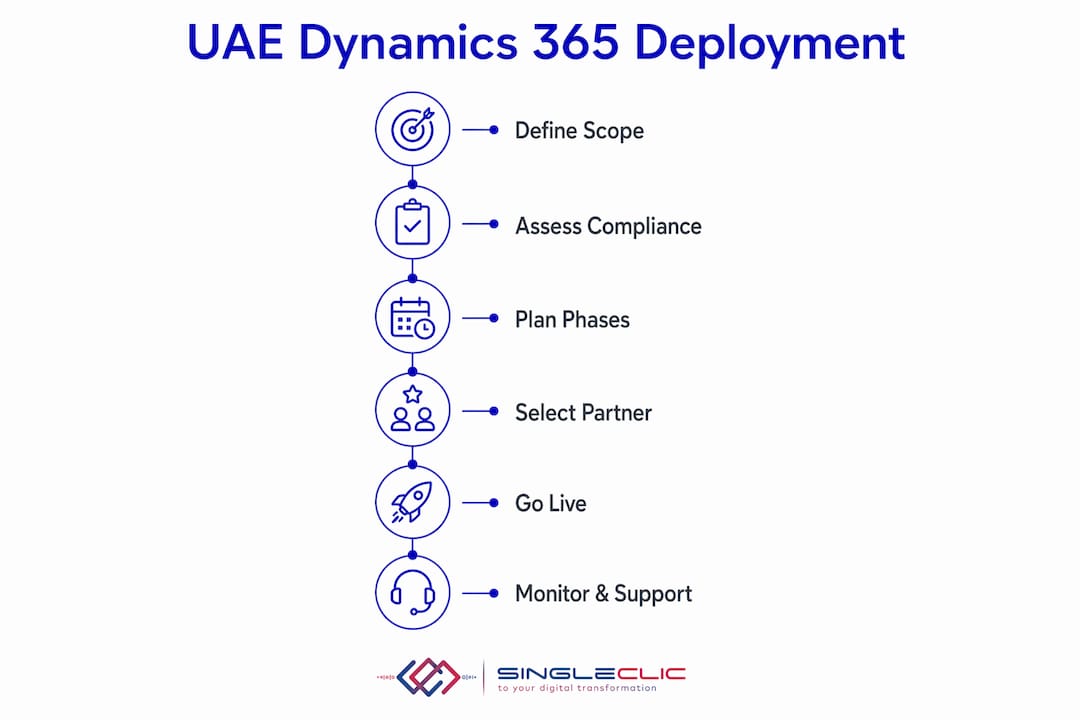
A structured approach to planning follows these steps:
-
Define go-live criteria before anything else. Identify which modules must be live on day one. VAT calculation, payroll, and core financials are non-negotiable for most UAE businesses. Advanced modules like field service or project operations can follow in a second phase.
-
Set a realistic timeline. Business Central projects in the UAE typically run between 2 and 9 months depending on complexity. A single-entity finance deployment sits at the lower end. Multi-entity, multi-currency, and custom integration projects push toward the upper range.
-
Budget with full cost visibility. Implementation costs in the UAE range from AED 90,000 to AED 550,000 or more. The primary cost drivers are licensing fees, customization scope, third-party integrations, data migration, user training, and ongoing support contracts. Leaders who budget only for licensing routinely face cost overruns.
-
Adopt a phased rollout strategy. Phased deployments that start with finance and add operations modules later reduce risk and give teams time to build confidence with the system. Trying to go live with everything at once increases the chance of a failed cutover.
-
Prioritize UAE localization in the first sprint. VAT, Arabic UI, and WPS payroll configuration must be completed and tested before any other module goes live. Deferring localization creates a false sense of progress and guarantees rework.
-
Plan for data migration early. Historical financial data, customer records, and open transactions need to be cleaned, mapped, and validated before cutover. Poor data migration is one of the top causes of post-go-live instability.
Pro Tip: Ask your implementation partner to produce a localization checklist that maps every UAE regulatory requirement to a specific configuration task and a named owner. If they cannot produce that document in the first week of the project, treat it as a warning sign.
You can also use the ERP implementation checklist developed for Dynamics 365 and Odoo deployments to structure your own project phases.

What criteria should UAE businesses use to select a Dynamics 365 partner?
Partner selection is the single highest-leverage decision in any Dynamics 365 consulting UAE engagement. The right partner reduces risk, accelerates compliance configuration, and provides support when regulations change. The wrong partner costs you time, money, and operational stability.
Evaluate every candidate against these criteria:
- Microsoft certification with UAE market depth. General Microsoft partner status is not enough. The team must demonstrate hands-on experience with GCC VAT, WPS payroll, Arabic UI, and FTA reporting. Ask for the names of UAE clients they have taken live, not just logos on a slide.
- Local support presence. Your partner must have consultants operating in UAE time zones. Remote-only support from distant offices creates response delays that hurt go-live stability and post-launch troubleshooting.
- Proof-of-concept with local documents. Before signing a contract, ask the partner to demonstrate VAT invoice generation and SIF payroll file output using your own test data. A partner who cannot do this in a pre-sales environment will not do it faster under project pressure.
- Industry-specific case studies. Generic ERP experience does not transfer automatically to construction, healthcare, or government sectors. Request references from UAE clients in your industry and call them.
- Clear implementation methodology. The partner should articulate a defined project methodology, including how they handle scope changes, compliance updates, and user acceptance testing. Vague answers about “agile flexibility” without a structured framework are a red flag.
- Post-go-live governance plan. Ask how the partner manages regulatory updates after go-live. VAT rules, corporate tax guidance, and WPS formats change. Your partner must have a process for pushing those updates to your environment without disrupting operations.
Pro Tip: Request a written statement of work that separates UAE localization tasks from standard configuration tasks. This forces the partner to show their local knowledge in writing before the project starts.
For a detailed partner evaluation framework, the Dynamics 365 partner selection guide covers the key questions to ask across methodology, compliance, and support.
How can UAE businesses maximize value after Dynamics 365 goes live?
Go-live is not the finish line. The organizations that extract the most value from their Dynamics 365 solutions UAE investment treat post-implementation as a continuous improvement program, not a project closeout.
The highest-impact post-go-live actions are:
- Structured user training and change management. Adoption drives ROI. User adoption requires more than a one-day training session. It requires role-specific training, reinforcement over the first 90 days, and a named internal champion who owns adoption metrics.
- Power Platform and low-code extensions. Microsoft Power Platform apps extend Dynamics 365 without heavy development. Singleclic’s Cortex low-code platform adds Arabic-enabled workflow automation, approval routing, and process management for organizations that need on-premise control or deeper MENA-specific customization.
- KPI dashboards and governance. Define the metrics that matter before go-live and build dashboards that surface them daily. Finance leaders should see cash flow, VAT liability, and payroll costs in real time. Operations leaders should see procurement cycle times and inventory turnover.
- Regulatory update planning. The FTA will continue to evolve e-invoicing requirements through 2027 and beyond. Corporate tax guidance is still maturing. Build a quarterly review cycle with your partner to assess regulatory changes and apply system updates before deadlines arrive.
- Multi-entity and GCC scalability. Multi-company and multi-currency structures configured at the start of the project allow you to add new legal entities across the GCC without rebuilding your chart of accounts or integration architecture. Organizations that skip this step pay for restructuring later.
The CRM adoption best practices guide for UAE and Saudi Arabia leaders covers the change management side of this in practical detail.
Key takeaways
Successful Dynamics 365 implementation UAE requires UAE-specific compliance configuration, phased deployment, and a certified partner with proven local experience from day one.
| Point | Details |
|---|---|
| UAE compliance is non-negotiable | VAT, WPS payroll, corporate tax, and FTA e-invoicing must be configured before any module goes live. |
| Budget and timeline vary widely | Projects run 2–9 months and cost AED 90,000–AED 550,000 or more depending on scope and integrations. |
| Partner selection determines outcomes | Choose a partner with UAE client references, local support teams, and a written localization task list. |
| Phased rollout reduces risk | Start with finance and payroll, then add operations modules to avoid a failed all-at-once cutover. |
| Post-go-live investment sustains ROI | Structured training, governance dashboards, and regulatory update cycles protect your implementation investment. |
What I have learned from UAE Dynamics 365 projects
The most common mistake I see UAE business leaders make is treating localization as a configuration checkbox rather than a project pillar. They approve a project plan, the partner starts building finance workflows, and VAT setup gets scheduled for “later in the sprint.” By the time the team realizes the bilingual invoice format does not match FTA requirements, they are three months in and the go-live date is already slipping.
The second pattern I see is over-customization in the first phase. A leader walks into a discovery session with a list of 40 custom reports and 15 workflow modifications. The partner, eager to win the deal, says yes to all of it. Six months later, the project is over budget, the custom code is blocking a Microsoft update, and the team is exhausted. The better path is to go live on standard functionality with UAE localization complete, then add customization in phase two when you understand how your team actually uses the system.
Transparent communication and realistic timelines significantly increase first-time implementation success. That finding matches everything I have seen in the field. The projects that succeed are the ones where the partner says “this will take four months” and means it, not the ones where the partner says “we can do it in six weeks” to win the contract.
My honest advice: treat your Dynamics 365 partner as a long-term operational relationship, not a one-time vendor. The UAE regulatory environment will keep changing. Corporate tax guidance is still evolving. E-invoicing mandates are coming. You need a partner who is invested in your compliance posture two years after go-live, not just on cutover day.
— Tamer Badr
How Singleclic supports Dynamics 365 implementation across the UAE
Singleclic brings over 10 years of regional delivery experience and a team of 70+ consultants across the UAE, Saudi Arabia, and Egypt to every Dynamics 365 engagement. The team has taken live implementations for organizations including Emirates Health Services and Dubai Healthcare City, with full UAE localization covering VAT, WPS payroll, Arabic UI, and FTA readiness built into every project scope.
For organizations that need adaptive workflow automation beyond standard Dynamics 365 capabilities, Singleclic’s Cortex platform delivers Arabic-enabled, on-premise process management with no-code configuration and runtime workflow changes. Whether you are planning your first deployment or migrating from a legacy system, Singleclic’s customized Dynamics 365 solutions give you a clear path from scoping to go-live to ongoing optimization. Explore the full Dynamics 365 capabilities guide to see how connected ERP and CRM drives measurable results for UAE enterprises.
FAQ
What does Dynamics 365 implementation in the UAE include?
Dynamics 365 implementation in the UAE covers ERP and CRM deployment configured for UAE VAT, WPS payroll, Arabic right-to-left UI, AED multi-currency, and FTA compliance. It includes data migration, user training, and post-go-live support.
How long does a Dynamics 365 project take in the UAE?
UAE projects typically run between 2 and 9 months depending on the number of modules, integrations, and compliance requirements involved. Single-entity finance deployments complete faster than multi-entity, multi-currency rollouts.
What does Dynamics 365 implementation cost in the UAE?
Implementation costs in the UAE range from AED 90,000 to AED 550,000 or more. The main cost drivers are licensing, customization scope, third-party integrations, data migration, and ongoing support.
Is Dynamics 365 ready for UAE e-invoicing requirements?
The FTA’s phased e-invoicing mandate begins in 2027. Dynamics 365 can be configured for e-invoicing readiness now, which avoids a costly retrofit when the mandate takes effect.
How do I choose the right Dynamics 365 partner in the UAE?
Select a partner with Microsoft certification, proven UAE client references, local support teams, and a written localization task list covering VAT, WPS payroll, and Arabic UI. Ask for a proof-of-concept with your own test documents before signing any contract.