TL;DR:
- Odoo is a modular, open-source ERP and CRM platform that unifies business functions in a single real-time system. Its flexible architecture allows businesses to activate only what they need, supporting rapid implementation and real-time updates across departments. Proper localization, especially for Saudi Arabia and UAE compliance, requires certified partners to customize workflows and meet regional tax regulations.
Odoo is defined as an integrated, open-source ERP and CRM platform that unifies sales, accounting, inventory, manufacturing, and human resources within a single real-time system. Developed and maintained by Odoo S.A., the platform runs on a PostgreSQL database and follows a modular architecture that lets businesses activate only the functions they need. For decision-makers in Saudi Arabia and UAE evaluating how to consolidate fragmented business tools, Odoo offers a structured path from basic operations to full enterprise management without switching platforms as the company grows.
How does Odoo’s modular architecture work?
Odoo is built on a modular design with over 70 core applications and thousands of additional modules for specific industries and country requirements. Each module operates as a standalone app, yet shares a single database with every other active module. That shared database is what makes the system genuinely integrated rather than just loosely connected.

The practical benefit is significant. When a sales order is confirmed, Odoo automatically updates inventory levels, triggers an invoice, and records the accounting entry. No manual data transfer. No third-party connector. This is what Odoo calls a single source of truth, and it eliminates the data silos that slow down most mid-market operations in the region.
The table below shows how Odoo’s modular design differs from traditional ERP architecture:
| Dimension | Modular ERP (Odoo) | Traditional ERP |
|---|---|---|
| Activation | Enable apps as needed | Full suite installed upfront |
| Customization | Per-module, no re-implementation | Requires vendor engagement |
| Upgrades | Module-level updates | System-wide, high-risk upgrades |
| Cost model | Per user, all apps included | Per module or per license |
| Time to value | Weeks to months | 12+ months typical |
Traditional ERP systems force you to buy and configure the entire platform before going live. Odoo lets you start with CRM and accounting, then add manufacturing or HR when the business is ready. That flexibility is especially valuable for growing companies in KSA and UAE that need to scale without re-implementing from scratch.
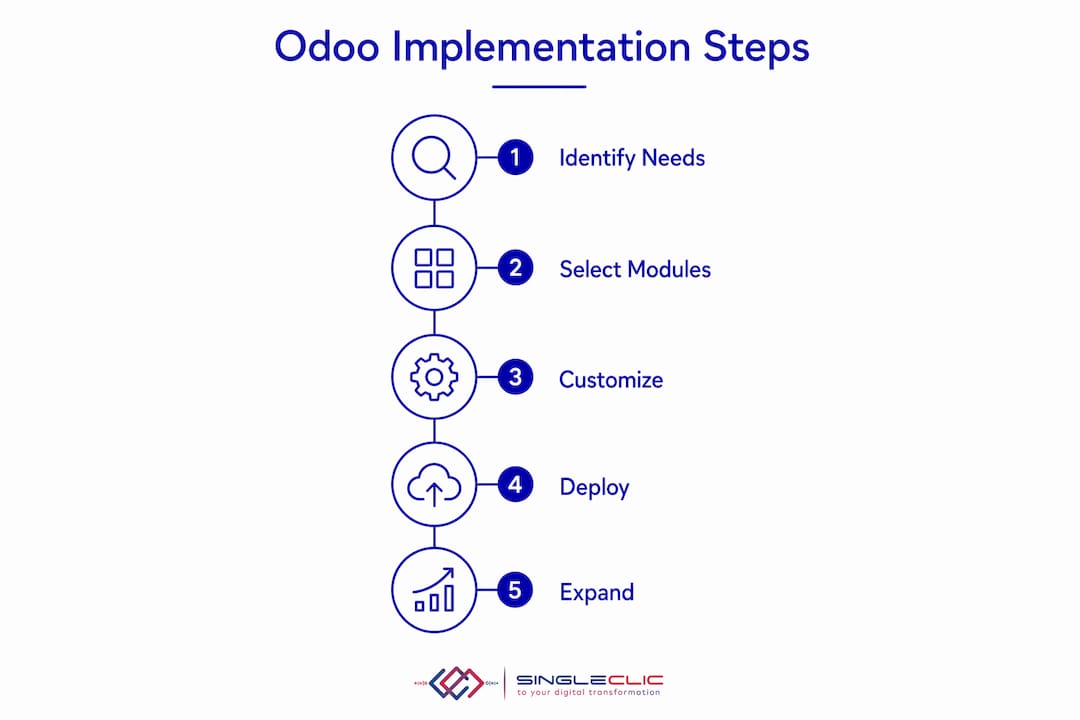
Pro Tip: Start your Odoo rollout with two or three modules that address your most painful operational gaps. Add modules in phases rather than activating everything at once. Phased adoption reduces training time and accelerates user acceptance.
What key features does Odoo cover?
Odoo’s native application library covers the full range of business operations. The core apps most relevant to enterprises in Saudi Arabia and UAE include:
- Sales and CRM: Pipeline management, quotation automation, customer segmentation, and sales forecasting in one view.
- Accounting and invoicing: Multi-currency support, automated bank reconciliation, and tax reporting aligned with local requirements.
- Inventory and warehouse management: Real-time stock tracking, multi-location visibility, and automated reordering rules.
- Manufacturing: Production orders, bill of materials management, and quality control workflows.
- Human resources: Employee records, leave management, payroll processing, and recruitment pipelines.
- Project management: Task tracking, timesheets, Gantt charts, and budget monitoring per project.
- eCommerce and Point of Sale: Online storefront connected directly to inventory and accounting, plus in-store POS for retail operations.
Beyond the standard apps, Odoo Enterprise includes Odoo Studio, a drag-and-drop customization tool that lets non-technical users modify screens, build custom workflows, and generate tailored reports without writing code. That capability matters for businesses with unique approval chains or reporting requirements that standard configurations do not cover.
AI-powered automation runs across the platform. Odoo can auto-classify incoming emails as leads, suggest reorder quantities based on historical demand, and flag invoice anomalies before they reach the finance team. Real-time dashboards pull live data from every active module, giving executives a single view of operations across multiple locations or legal entities.
For companies operating across cities in Saudi Arabia or across both KSA and UAE simultaneously, the multi-company and multi-location features provide consolidated reporting without manual consolidation. Each entity maintains its own books while the parent view aggregates everything automatically.
How is Odoo priced and what makes it cost-effective?
Odoo’s Enterprise edition uses a flat per-user pricing model that includes unlimited access to all apps, hosting, maintenance, and support. There are no per-module fees and no usage-based charges. That structure is a direct contrast to traditional ERP vendors, where each functional module carries a separate license cost that compounds quickly as the business grows.
The Community edition is fully open-source with no licensing fees. It requires self-hosting and technical expertise to maintain, but it gives organizations complete data ownership through standard PostgreSQL databases and full source code access. For banks, government entities, or any organization with strict data residency requirements, Community on-premises is a viable path.
Deployment options span three models:
- Odoo.sh (cloud SaaS): Managed hosting by Odoo S.A., automatic updates, and built-in staging environments.
- Third-party cloud hosting: Deployed on AWS, Azure, or a regional data center of your choice.
- On-premises: Full control over infrastructure, preferred by regulated industries in KSA and UAE.
Implementation timelines follow a predictable pattern. Small to mid-market companies typically go live in 2–4 months. Larger organizations with complex workflows and multiple integrations require 6–12 months. That speed advantage over traditional ERP deployments reduces disruption and accelerates the point at which the investment starts generating returns.
Pro Tip: When budgeting for Odoo, include implementation partner fees alongside the license cost. The software price is transparent, but partner-led configuration, data migration, and training typically represent the larger share of total investment. Build that into your business case from day one.
For a detailed breakdown of total cost of ownership, the ERP implementation cost guide from Singleclic covers budgeting frameworks specific to Dynamics 365 and Odoo projects in the region.
What should Saudi Arabia and UAE businesses know before implementing Odoo?
Odoo out of the box does not arrive pre-configured for ZATCA e-invoicing in Saudi Arabia or FTA tax compliance in the UAE. Successful implementation in these markets requires partner-led customization to map local tax rules, invoice formats, and regulatory workflows directly into the system. Treating Odoo as plug-and-play SaaS in a GCC context is the most common and costly mistake decision-makers make.
The key regional considerations are:
- ZATCA compliance in KSA: Phase 2 e-invoicing mandates specific XML formats and real-time reporting to the Zakat, Tax and Customs Authority. A certified implementation partner configures these workflows before go-live.
- FTA compliance in UAE: VAT return formats, tax group configurations, and audit trail requirements must be built into the accounting module during setup.
- Arabic language support: Odoo supports Arabic UI and right-to-left layouts, but localization depth varies by module. Verify coverage for your specific use cases before signing off on a project scope.
- Data residency: Organizations in banking, healthcare, or government may require on-premises or in-country cloud hosting to meet data protection regulations.
- Integration with legacy systems: Many enterprises in KSA and UAE run legacy HR or payroll systems alongside a new ERP. Plan integration architecture before implementation begins, not after.
The single source of truth architecture that Odoo provides is particularly valuable for MENA businesses with operations spread across multiple cities or countries. Real-time visibility across warehouses, sales offices, and finance teams eliminates the weekly reconciliation calls that drain management time in distributed organizations.
Pro Tip: Ask any prospective Odoo partner to show you a live demo of ZATCA Phase 2 e-invoicing within their configured environment. If they cannot demonstrate it, they have not solved it yet.
Odoo’s open-source foundation also protects you from vendor lock-in. Because the source code is accessible and data lives in a standard PostgreSQL database, you can migrate to a different hosting provider or implementation partner without losing your data or customizations. That flexibility is a meaningful risk reduction for long-term enterprise planning. For a broader view of how cloud ERP systems compare on deployment flexibility, Singleclic’s expert comparison covers the key evaluation criteria.
Key takeaways
Odoo is the most cost-effective modular ERP for Saudi Arabia and UAE businesses when implemented with a qualified local partner who covers ZATCA, FTA, and Arabic localization requirements.
| Point | Details |
|---|---|
| Modular architecture | Activate only the apps you need and add more as the business grows, without re-implementing. |
| Single source of truth | All modules share one database, so sales, inventory, and finance update in real time automatically. |
| Flat pricing model | Enterprise edition charges per user with all apps included, eliminating per-module license fees. |
| Regional compliance | ZATCA and FTA requirements must be configured by a certified partner before go-live in KSA and UAE. |
| Implementation speed | Small to mid-market companies typically go live in 2–4 months, faster than traditional ERP deployments. |
Odoo in the GCC: what I’ve learned from the ground
Working with enterprises across Saudi Arabia and UAE for over a decade, I have seen Odoo succeed and fail for the same reason: the quality of the implementation partner. The platform itself is genuinely capable. The modular architecture solves a real problem for growing businesses that cannot afford to over-invest in software they will not use for years.
What surprises most decision-makers is how much of the value comes from configuration, not the software license. I have seen companies go live in eight weeks with three modules and immediately cut their monthly reporting cycle from five days to one. I have also seen companies spend six months on a poorly scoped project and end up with a system their teams refuse to use.
The GCC market adds a layer of complexity that generic Odoo guides ignore. ZATCA Phase 2 is not optional. FTA audit trails are not optional. Arabic UI is not a nice-to-have for your warehouse staff. These are baseline requirements, and they require a partner who has already solved them, not one who will figure it out during your project.
My advice to any decision-maker evaluating Odoo right now: treat the partner selection as seriously as the software selection. Ask for reference clients in your industry and your country. Ask to see compliance configurations running in a live environment. The software will deliver. The question is whether your implementation will.
— Tamer Badr
How Singleclic helps businesses get Odoo right
Singleclic is an Odoo Silver Partner with over 10 years of delivery experience across KSA, UAE, and Egypt. The team has implemented Odoo for real estate and construction clients, configuring ZATCA-compliant e-invoicing, Arabic workflows, and multi-entity reporting from day one. For organizations that need Odoo to connect with legacy systems or complex approval chains, Singleclic’s Cortex low-code platform integrates directly with Odoo to automate workflows without custom development. Whether you are evaluating Odoo for the first time or recovering from a failed implementation, Singleclic’s 70+ consultants and engineers are ready to scope a project that fits your budget and your compliance requirements. Explore how ERP and CRM integration with Odoo delivers a single source of truth for your operations across the region.
FAQ
What is Odoo used for in business?
Odoo is used to manage sales, CRM, accounting, inventory, manufacturing, HR, and eCommerce within a single integrated platform. It replaces multiple disconnected tools with one system that updates in real time across all functions.
Is Odoo suitable for small businesses in Saudi Arabia?
Odoo is well suited for small and mid-market businesses in Saudi Arabia because its modular pricing means you pay only for the users you have, with all apps included. Implementation typically completes in 2–4 months for smaller organizations.
Does Odoo support ZATCA e-invoicing compliance?
Odoo supports ZATCA Phase 2 e-invoicing when configured by a certified implementation partner. The compliance workflows are not active by default and must be built into the system before go-live.
What is the difference between Odoo Community and Odoo Enterprise?
Odoo Community is free and open-source but requires self-hosting and technical maintenance. Odoo Enterprise adds Odoo Studio, AI features, managed hosting, and official support under a flat per-user monthly fee.
How long does an Odoo implementation take?
Small to mid-market companies typically go live in 2–4 months. Larger organizations with complex integrations and multi-entity requirements generally require 6–12 months for a full deployment.