TL;DR:
- Microsoft Dynamics 365 Business Central is a cloud-native ERP platform that unifies finance, supply chain, sales, and operations for small and mid-sized businesses. It offers rapid deployment, native Microsoft 365 integration, and modular architecture, making it suitable for companies in Saudi Arabia and UAE to expand efficiently.
Microsoft Dynamics 365 Business Central is defined as a cloud-native ERP platform that unifies finance, supply chain, inventory, sales, and operations into a single application for small and mid-sized businesses. Built on Microsoft Azure, it serves organizations with revenues ranging from $5 million to $500 million or more, making it the most practical Microsoft ERP solution for growing companies in Saudi Arabia and UAE. Unlike legacy systems that require years to deploy, Business Central delivers a full operational foundation with built-in Microsoft Copilot AI, native Microsoft 365 connectivity, and modular architecture that lets you start small and expand as your business grows.
What is Microsoft Dynamics 365 Business Central?
Microsoft Dynamics 365 Business Central is a cloud-based ERP application designed specifically for businesses with 10–500 users. It replaces disconnected spreadsheets, standalone accounting software, and siloed department tools with one unified system. Every transaction, from a purchase order to a customer invoice, flows through a single data model.

The platform was rebuilt from scratch on Microsoft Azure using the modern AL programming language, which separates it fundamentally from its predecessor, Dynamics NAV. That architectural decision enables automatic cloud updates, mobile access from any device, and integrations that do not require custom code. For IT teams in Saudi Arabia and UAE managing lean infrastructure, this matters enormously.
Business Central targets the gap between basic accounting tools and full enterprise ERP systems. Entry-level accounting tools cannot handle multi-entity consolidation, inventory valuation, or production planning. Full enterprise platforms carry implementation costs and timelines that most mid-sized businesses cannot absorb. Business Central sits precisely between those two categories, delivering enterprise-grade capabilities at a pace and cost that fits the SMB reality.
What are the main features and capabilities of Business Central?
Business Central organizes its capabilities into functional modules. You activate the modules your business needs and leave the rest dormant, which keeps the interface clean and reduces user training time.
Core financial management covers the general ledger, accounts payable, accounts receivable, bank reconciliation, budgeting, and multi-currency transactions. The system handles intercompany postings natively, which is critical for holding structures common in Gulf family businesses.
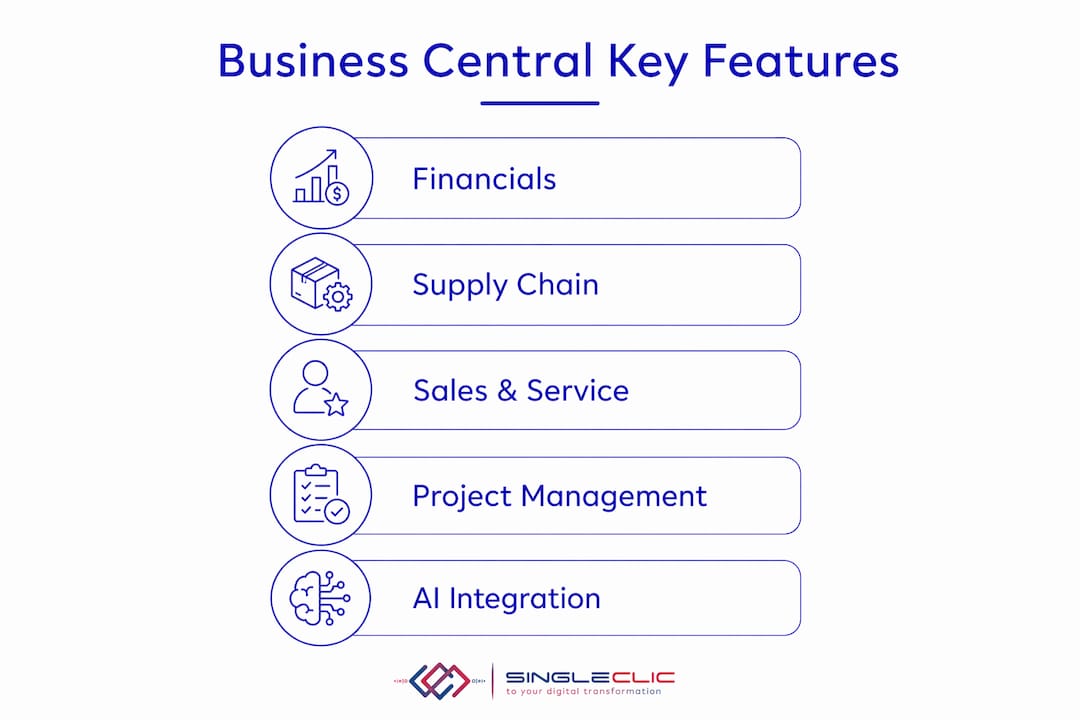
Supply chain and inventory gives you full purchase order management, vendor tracking, item costing methods (FIFO, average, standard), and warehouse management. Inventory forecasting powered by Microsoft Copilot flags potential stockouts before they affect operations.
Sales and customer management includes quote-to-cash processing, customer credit management, and sales order fulfillment. It connects directly to Dynamics 365 Sales for teams that need a full CRM layer on top.
Built-in AI through Microsoft Copilot delivers capabilities that previously required separate tools or custom development:
- Late payment predictions on outstanding invoices
- Automated bank reconciliation suggestions
- Marketing text generation for item descriptions
- Workflow recommendations based on historical patterns
- Financial summaries and predictive analytics
Microsoft 365 integration is native, not bolted on. You can process a vendor invoice directly from Outlook, update a sales order from Excel, or share a financial report through Teams without leaving the Business Central context.
Modular architecture is the top reason organizations choose Business Central over monolithic ERP alternatives. You deploy only what you need at launch, then expand modules as your operations grow. This phased approach reduces disruption and keeps early adoption costs predictable.
Pro Tip: When scoping your initial deployment, activate only the modules your finance and operations teams will use in the first 90 days. Adding modules later is straightforward. Overloading users at launch is the most common reason adoption stalls.
How does Business Central integrate with Microsoft 365 and AI?
Business Central’s integration with Microsoft 365 is not a connector or middleware layer. It is built into the product at the data level. This distinction matters because connector-based integrations break during updates and require maintenance. Business Central’s native connections do not.
The practical integrations your teams will use daily include:
- Outlook: Create customers, post invoices, and view account balances without leaving your inbox.
- Excel: Pull live Business Central data into Excel for ad hoc analysis, then push edits back to the system.
- Teams: Share Business Central records, approve transactions, and receive workflow notifications inside Teams channels.
- Word: Generate formatted quotes, contracts, and reports using Word templates populated with live Business Central data.
- OneDrive: Attach and share documents linked directly to Business Central records.
- Power BI: Connect to Business Central data through Dataverse virtual entities and build dashboards without writing a single line of code.
Power Platform connectivity extends this further. Power Apps lets you build lightweight field apps that read and write Business Central data. Power Automate handles approval workflows, notifications, and cross-system triggers. Neither requires developer involvement for standard use cases.
Microsoft Copilot inside Business Central has expanded significantly. By 2026, Copilot enhancements cover financial summaries, predictive analytics, and workflow recommendations built directly into the user interface. These AI capabilities come at no extra cost as part of the Business Central license. That pricing model is a genuine differentiator compared to platforms that charge separately for AI add-ons.
Key insight: Business Central acts as a single source of truth for your business data. Power BI and Power Apps consume that data through Dataverse virtual entities, which means your reports always reflect live operational data. No data warehouse. No nightly sync. No lag.
Is Business Central the right fit for Saudi Arabia and UAE businesses?
Business Central’s cloud architecture gives businesses in Saudi Arabia and UAE access to enterprise-grade ERP without building on-premise server infrastructure. The system runs on Microsoft Azure, which operates regional data centers in the UAE. Data residency requirements for many Gulf organizations are met through Azure’s regional footprint.
Localization modules for Saudi Arabia and UAE address VAT compliance, e-invoicing requirements (ZATCA in Saudi Arabia), and Arabic language support. The quality of localization varies by market, so verifying that your specific compliance requirements are covered before go-live is non-negotiable. A qualified implementation partner handles this verification as part of the scoping process.
Deployment speed is a practical advantage. Business Central frequently goes live within 90 days for tightly scoped projects. That timeline assumes a focused initial scope covering finance and core operations, with additional modules phased in afterward. Enterprise ERP systems typically require 12–24 months for comparable functionality.
Customization uses the AL programming language, which is cloud-native and extension-based. This means customizations do not break during Microsoft’s automatic updates, unlike legacy systems where every update required regression testing of custom code. For IT teams managing Business Central in Saudi Arabia or UAE, this reduces the ongoing maintenance burden significantly.
One area that requires careful planning is data migration. Moving from legacy systems like Dynamics GP is a re-implementation, not an upgrade. The data models are different. Budgeting for expert-led data migration is not optional. Organizations that underestimate this step consistently face delays and cost overruns.
Pro Tip: Scope your data migration separately from your functional implementation. Treat them as two parallel workstreams with their own timelines and budgets. This single decision prevents the majority of Business Central go-live delays.
| Deployment factor | Business Central | Legacy on-premise ERP |
|---|---|---|
| Typical go-live timeline | 90 days (scoped) | 12–24 months |
| Infrastructure requirement | None (Azure cloud) | On-premise servers |
| Update management | Automatic | Manual, costly |
| Customization stability | AL extensions (update-safe) | Custom code (breaks on updates) |
| Localization for KSA/UAE | Available via modules | Varies by vendor |
What are the practical benefits of using Business Central?
The most direct benefit is replacing fragmented data with one system of record. Finance sees the same inventory figures as operations. Sales sees the same credit limits as accounting. Decisions made on outdated or inconsistent data are the single largest source of operational waste in mid-sized businesses, and Business Central eliminates that problem at the source.
Reporting through Power BI accelerates business intelligence without requiring a data engineering team. You connect Power BI to Business Central’s Dataverse virtual entities and build dashboards that refresh in real time. A finance director in Riyadh can monitor cash flow, aging receivables, and budget variance from a single screen updated to the minute.
The cost comparison with full enterprise ERP is significant. Enterprise platforms carry licensing, implementation, and infrastructure costs that are prohibitive for most SMBs. Business Central delivers comparable financial management, supply chain, and reporting capabilities at a fraction of the total cost of ownership. The modular deployment model also means you pay for what you use, not for a monolithic license covering features you will never activate.
Faster ROI follows directly from shorter implementation. A 90-day go-live means your finance team is operating on the new system within a quarter. The productivity gains from eliminating manual reconciliations, duplicate data entry, and disconnected reporting start accruing immediately after go-live, not 18 months later.
For businesses in Saudi Arabia and UAE operating across multiple entities or geographies, Business Central’s multi-currency, multi-entity, and multi-language capabilities handle the complexity without requiring custom development. The Microsoft Dynamics 365 ecosystem extends this further when you need CRM, field service, or advanced analytics alongside your ERP.
Key takeaways
Microsoft Dynamics 365 Business Central is the most practical cloud ERP choice for mid-sized businesses in Saudi Arabia and UAE that need enterprise-grade finance and operations management without enterprise-scale implementation timelines or costs.
| Point | Details |
|---|---|
| Cloud-native on Azure | Business Central runs on Microsoft Azure, eliminating on-premise infrastructure and enabling automatic updates. |
| 90-day deployment | Tightly scoped projects go live within 90 days, delivering faster ROI than traditional ERP timelines. |
| Built-in Copilot AI | Microsoft Copilot is included at no extra cost, covering bank reconciliation, forecasting, and workflow automation. |
| Modular architecture | Activate only the modules you need at launch and expand as your business grows, reducing complexity and training time. |
| Regional localization | ZATCA compliance, Arabic language support, and UAE VAT modules address Gulf regulatory requirements directly. |
My view on Business Central for Gulf businesses
Working with organizations across Saudi Arabia and UAE for over a decade, I have seen the same pattern repeat. A business outgrows its accounting software, evaluates a full enterprise ERP, gets a 24-month implementation quote, and then does nothing. That paralysis costs more than the ERP ever would have.
Business Central breaks that cycle. The 90-day go-live is real, but only when the scope is honest. The organizations I have seen struggle are the ones that tried to replicate every process from their old system on day one. The ones that succeed pick their top three pain points, go live fast, and expand from there.
The AI capabilities deserve more attention than they typically get in regional conversations. Copilot’s late payment predictions alone have measurable impact on cash flow management for businesses with large receivables books. That is not a future feature. It is available today, included in the license.
My strongest advice for IT teams in Saudi Arabia and UAE: do not underestimate localization. ZATCA e-invoicing compliance is not a checkbox. It requires configuration, testing, and ongoing alignment with regulatory updates. Choose an implementation partner who has done this before in your specific market, not one who is learning on your project.
Business Central is not the right tool for every organization. Businesses with highly complex manufacturing, project-based billing across dozens of entities, or government-specific reporting requirements may need a more specialized platform. But for the majority of mid-sized businesses in the Gulf looking to replace fragmented systems with one reliable foundation, Business Central is the clearest path forward.
— Tamer Badr
How Singleclic helps you get Business Central right
Deploying Business Central in Saudi Arabia or UAE is not just a technology project. It requires localization expertise, regulatory knowledge, and a structured implementation approach that protects your go-live timeline.
Singleclic is a Microsoft Dynamics 365 integrator with 10+ years of delivery experience across KSA, UAE, and Egypt. With 70+ consultants and engineers and 100+ enterprise clients including Emirates Health Services, QNB, and Miahona in Saudi Arabia, Singleclic brings regional depth that generic implementation partners cannot match. The team handles everything from ZATCA compliance configuration to Power BI dashboard setup and Cortex low-code integration for workflow automation beyond what Business Central covers natively. Read Singleclic’s leader’s guide to Dynamics 365 to understand how Business Central fits within the broader Microsoft ecosystem, or explore customized Dynamics 365 solutions built specifically for your industry and region.
FAQ
What is Microsoft Dynamics 365 Business Central used for?
Business Central is used to manage finance, supply chain, inventory, sales, and operations in one cloud-based platform. It replaces disconnected accounting tools and spreadsheets for small and mid-sized businesses.
Is Business Central cloud-based?
Yes. Business Central is a cloud-native SaaS application built on Microsoft Azure. It requires no on-premise servers and receives automatic updates from Microsoft.
How long does a Business Central implementation take?
Tightly scoped projects typically go live within 90 days. More complex deployments with extensive customization or data migration take longer depending on scope.
Does Business Central support ZATCA e-invoicing for Saudi Arabia?
Business Central includes localization modules for Saudi Arabia that cover VAT and ZATCA e-invoicing compliance. Proper configuration and testing by a qualified implementation partner is required before go-live.
What is the difference between Business Central and Dynamics 365 Finance?
Business Central targets small and mid-sized businesses with 10–500 users. Dynamics 365 Finance and Operations targets large enterprises with more complex multi-entity, multi-country, and regulatory reporting requirements. The two products share the Microsoft ecosystem but serve different organizational scales.
Recommended
- What Is Microsoft Dynamics 365? A Leader’s Guide to Connected ERP, CRM, and Intelligent Automation | Singleclic
- Dynamics 365 Implementation, Done Right: A Proven Playbook to Unlock ROI Fast | Singleclic
- CRM Implementation Cost: A Clear Guide to Budgeting, TCO, and ROI with Dynamics 365 and Odoo | Singleclic
- Microsoft Dynamics: Transforming Enterprise Operations