TL;DR:
- User adoption involves employees integrating new technology into their daily workflows with confident, stable use. It requires a structured program focused on behavioral change, not just initial access or onboarding. Effective strategies include role-based segmentation, phased rollouts, and visible leadership support to ensure long-term success.
User adoption is defined as the process by which employees or end users integrate new technology or systems into their daily workflows, resulting in consistent, confident use that changes how work gets done. This goes well beyond onboarding or a first login. True adoption means behavioral change and stable use without prompting, not just access to a tool. For business leaders, IT professionals, and change managers in Saudi Arabia, UAE, and Egypt, understanding the user adoption process is the difference between a technology investment that delivers ROI and one that collects dust. This article covers why adoption matters, what blocks it, and how to build strategies that work in real enterprise environments.
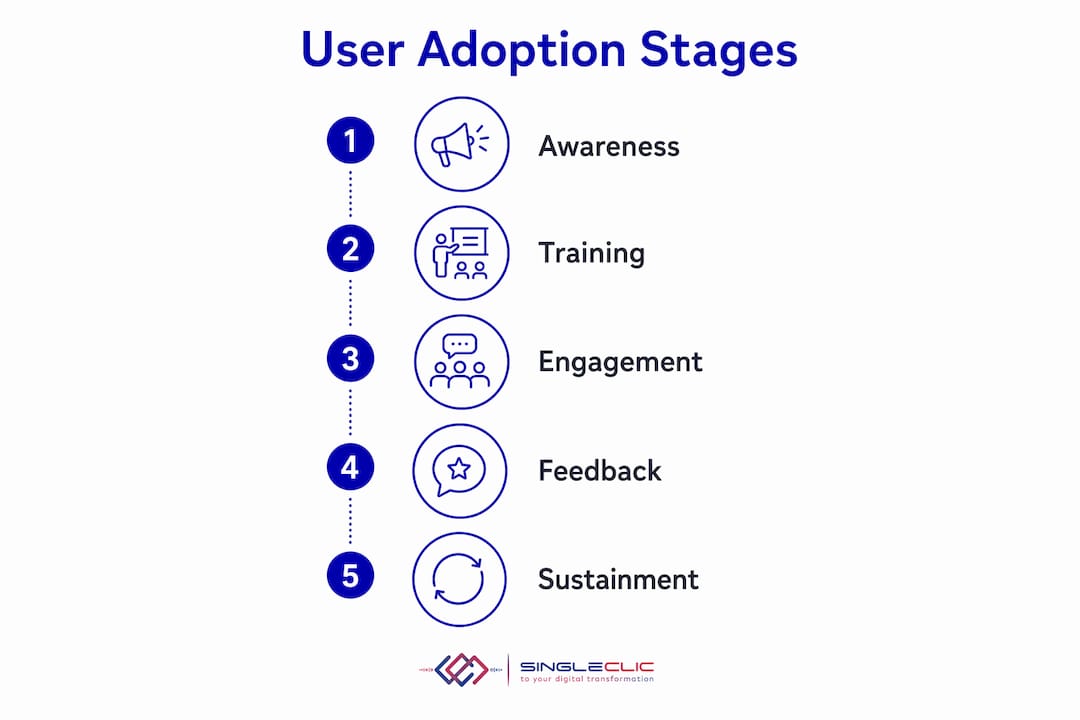
What is user adoption and why does it matter?
User adoption is the recognized industry term for the process of moving users from initial exposure to a new system through to consistent, productive use in their daily work. It is distinct from user activation, which describes the moment a user first experiences value, and from onboarding, which is the structured introduction to a product. Adoption is the outcome. Activation and onboarding are steps toward it.

The importance of user adoption becomes clear when you look at the numbers. The average SaaS activation rate is 37.5%, with top-performing companies targeting 40–60% by mapping clear user journeys. That gap between average and top performance represents real revenue left on the table. A tool like Microsoft Dynamics 365 or Odoo, fully deployed but poorly adopted, delivers a fraction of its potential value.
Adoption also drives retention. Products leading in 7-day activation also maintain that lead in 3-month retention 69% of the time. Early adoption behavior predicts long-term engagement. Organizations that treat adoption as a one-time event rather than a continuous process consistently underperform on both metrics.
“Adoption success is not about delivering documentation or completing a go-live checklist. It is about achieving behavior change and stable workflows under real work conditions.”
What common challenges prevent successful user adoption?
The most common misconception in enterprise technology is that purchasing and deploying a system equals adoption. It does not. The user adoption process fails most often because organizations focus on technical milestones and ignore human behavioral factors.
Here are the core challenges that block adoption in practice:
- Treating go-live as the finish line. IT teams declare success at deployment. Users revert to spreadsheets and legacy tools within weeks.
- One-size-fits-all onboarding. Generic onboarding programs fail because a finance manager, a field technician, and a customer service rep have entirely different workflows and goals. Segmenting by role and use case is not optional.
- Ignoring skeptics. Organizations pilot new tools with enthusiastic early adopters. This produces misleading results. Pilot projects should involve skeptical users to uncover realistic friction points before a full rollout.
- Measuring vanity metrics. Login counts and license utilization tell you nothing about whether users are actually changing how they work. Real adoption shows up in task completion rates, process cycle times, and error reduction.
- Cultural and organizational resistance. In Saudi Arabia and UAE, digital transformation requires cultural sensitivity and active leadership engagement. Top-down mandates without visible executive sponsorship consistently fail in hierarchical organizational cultures.
Pro Tip: Before your next technology rollout, identify your three most skeptical users in each department and involve them in the pilot. Their objections will reveal the real friction points your enthusiasts will never surface.
What strategies drive effective user adoption?
Effective user adoption strategies share one characteristic: they treat adoption as a structured program, not a side effect of good software. The following approach works for enterprise technology rollouts in complex organizations.
-
Segment your users before you design anything. Group users by role, workflow, and adoption readiness. A Microsoft Dynamics 365 CRM rollout at a bank in Riyadh requires a different journey for a relationship manager than for a compliance officer. Segmenting by user role and goals produces measurably better outcomes than a single training program for all.
-
Run a phased rollout over 90–120 days. A structured 90–120 day adoption strategy includes a pilot phase, feedback loops, and iterative scaling. Compressing this timeline is the single most common cause of failed rollouts in the MENA region.
-
Communicate the specific “why” for each user group. Telling a team that the new ERP will “improve efficiency” is not motivation. Telling accounts payable that it will eliminate the manual reconciliation they do every month-end is. Specificity drives behavior change.
-
Introduce gentle friction on legacy tools. Minor intentional friction on legacy systems can ease the transition without coercion. Slowing down access to old spreadsheet workflows or adding an extra confirmation step nudges users toward the new system without a mandate.
-
Use in-app guidance and low-code platforms to simplify workflows. Platforms like Singleclic’s Cortex, an Arabic-enabled on-premise low-code platform built for MENA enterprises, allow organizations to adapt workflows in real time without waiting for IT development cycles. This removes a major adoption blocker: the gap between how the system works out of the box and how your teams actually work.
-
Secure visible executive sponsorship. Users in Saudi Arabia and UAE respond to leadership signals. When a C-level leader visibly uses the new system and references it in meetings, adoption rates across their teams accelerate.
| Approach | What it addresses | Typical impact |
|---|---|---|
| Role-based segmentation | Generic onboarding failure | Higher task completion rates |
| 90–120 day phased rollout | Premature go-live declarations | Sustained behavior change |
| Skeptic-first piloting | Unrealistic pilot results | Realistic friction identification |
| Low-code workflow adaptation | System-workflow mismatch | Faster time to confident use |
| Executive sponsorship | Cultural resistance | Accelerated team-level adoption |
Pro Tip: Build a digital onboarding workflow that branches by user role from day one. A single onboarding path for all users is a structural guarantee of partial adoption.
How to measure and improve user adoption continuously
Measuring user adoption requires distinguishing it from related but different concepts. User adoption focuses on initial integration; user engagement focuses on long-term retention and depth of use. Both matter, but they require different metrics and different interventions.
The metrics that actually reflect adoption progress are behavioral, not transactional:
- Activation rate: The percentage of users who reach a defined “first value” milestone within a set time window. The industry average sits at 37.5%. Your target should be 40–60%.
- Sustained use rate: The percentage of users still actively using core features at 30, 60, and 90 days post-launch. This is the clearest signal of real adoption.
- Behavioral milestones: Specific actions that indicate a user has changed how they work. For an ERP system, this might be completing a purchase order end-to-end without reverting to a manual process.
- Retention correlation: Track whether high early activation predicts 90-day retention in your own user base, consistent with the 69% correlation seen across SaaS products.
- Support ticket volume: A declining volume of “how do I” tickets over time is a strong proxy for growing user confidence.
For organizations in Saudi Arabia and UAE pursuing adoption across complex, multi-department structures, a digital transformation roadmap that ties adoption metrics to business outcomes is not optional. It is the mechanism that keeps leadership aligned and investment justified.
Continuous improvement in adoption requires closing the feedback loop. Run structured check-ins at 30, 60, and 90 days. Identify users who have stalled at a specific stage and intervene with targeted support, not another generic training session. Tools that support automated adoption workflows can trigger these interventions at scale without manual oversight.
Key takeaways
User adoption succeeds when organizations treat it as a structured behavioral change program, not a technical deployment milestone.
| Point | Details |
|---|---|
| Adoption is behavioral, not technical | Success means stable, confident use without prompting, not just system access or login counts. |
| Early activation predicts retention | Products with high 7-day activation maintain that lead in 3-month retention 69% of the time. |
| Segment users by role and readiness | Generic onboarding fails; tailored journeys for each user group produce measurably better outcomes. |
| Phase your rollout over 90–120 days | Structured timelines with feedback loops and skeptic pilots prevent premature go-live failures. |
| Measure behavior, not vanity metrics | Track activation rates, sustained use, and behavioral milestones rather than login counts alone. |
What I have learned about adoption after a decade in the MENA region
By Tamer Badr
After working with organizations across Saudi Arabia, UAE, and Egypt on ERP, CRM, and process automation implementations, I have reached one firm conclusion: most adoption failures are not technology failures. They are change management failures that the technology gets blamed for.
The pattern repeats itself. A leadership team approves a Microsoft Dynamics 365 or Odoo implementation. The technical delivery goes well. Go-live happens on schedule. Six months later, half the users are back to their old workflows, and the system is being used as an expensive data entry tool rather than a decision-making platform.
What I have found actually works is treating the first 90 days after go-live as the most critical phase of the entire project, not the least. That is when behavior either solidifies or reverts. Executive visibility during this window matters more than any training program.
I also want to push back on the idea that generic digital approaches work in large organizations. They do not. In the MENA context specifically, adoption strategies that ignore language, hierarchy, and cultural norms around authority and change will underperform every time. An Arabic-first interface on a low-code platform like Cortex is not a nice-to-have for a government agency in Riyadh. It is a prerequisite for adoption.
The organizations I have seen achieve the highest adoption rates share one trait: they measure behavior, not activity. They do not celebrate 500 logins. They celebrate the first month where the old spreadsheet process was not used at all.
— Tamer Badr
How Singleclic helps organizations achieve real adoption
If your organization is preparing for an ERP, CRM, or process automation rollout in Saudi Arabia, UAE, or Egypt, the gap between deployment and adoption is where most projects lose their value. Singleclic has supported over 100 enterprise clients, including Emirates Health Services, QNB, and Emaar Misr, through exactly this challenge.
Singleclic’s Cortex low-code platform allows your teams to adapt workflows in real time, with full Arabic UI support and on-premise deployment for regulated industries. For organizations starting an ERP implementation, the ERP implementation checklist for Middle East success is a practical starting point for building adoption into your project plan from day one. For CRM-specific rollouts, the CRM adoption best practices guide covers the Saudi Arabia and UAE context in detail. Singleclic’s team of 70+ consultants and engineers is available to assess your readiness and build a phased adoption strategy that delivers measurable results.
FAQ
What is the difference between user adoption and user onboarding?
User onboarding is the structured introduction to a new system. User adoption is the outcome: consistent, confident use that changes how work gets done. Onboarding is a step in the adoption process, not the destination.
What is a realistic user adoption rate for enterprise software?
The average SaaS activation rate is 37.5%, with top companies achieving 40–60% through role-based user journey mapping. Enterprise adoption rates vary by industry and change management investment.
How long does a successful user adoption process take?
A structured adoption program typically runs 90–120 days, including a pilot phase, feedback loops, and iterative scaling. Compressing this timeline is the most common cause of adoption failure.
Why do user adoption strategies fail in large organizations?
The most common reasons are generic onboarding that ignores role differences, piloting only with enthusiastic users, measuring login counts instead of behavioral milestones, and insufficient executive sponsorship during the critical post-go-live period.
How is user adoption different from user engagement?
User adoption focuses on the initial integration of a new system into daily workflows. User engagement measures the depth and frequency of use over the long term. Both are necessary, but they require different metrics and different interventions to improve.