TL;DR:
- Most organizations are stuck at Industry 3.5 with isolated digital tools, not full Industry 4.0 integration.
- Industry 4.0 involves real-time data sharing among machines, software, and people for autonomous decision-making.
- Success depends on strong leadership focus on system integration, measurement, upskilling, and strategic planning.
Most organizations in KSA, UAE, and Egypt believe they are on the Industry 4.0 journey. The reality? The majority are stalled at “Industry 3.5”, sitting in a partial digitalization limbo where isolated tools exist but true integration never happens. The efficiency gains executives expect, sometimes as high as 50%, remain out of reach. This guide cuts through the noise. You will walk away with a clear definition of Industry 4.0, a realistic picture of where the region stands, and a practical framework for moving your organization from confusion to confident action.
Table of Contents
- Defining Industry 4.0: The fourth industrial revolution explained
- Key components and technologies driving Industry 4.0
- Industry 4.0 adoption in KSA, UAE, and Egypt: Opportunities and barriers
- Challenges, misconceptions, and the evolution toward Industry 5.0
- How executive focus unlocks Industry 4.0 value: Lessons learned
- Next steps: Accelerate your Industry 4.0 journey
- Frequently asked questions
Key Takeaways
| Point | Details |
|---|---|
| Clear definition | Industry 4.0 is more than automation—it’s the integration of digital and physical systems for smart, self-optimizing operations. |
| Regional perspective | KSA and UAE lead MENA adoption, but most firms still face integration and skills barriers. |
| Barriers and best practices | Success requires system integration, upskilling, and measuring real outcomes rather than following tech trends. |
| Looking ahead | Industry 5.0 will demand a balance of human ingenuity, resilience, and smart automation. |
Defining Industry 4.0: The fourth industrial revolution explained
Before you can lead a transformation, you need a precise definition, not a marketing tagline. Industry 4.0 is the fourth industrial revolution, characterized by the integration of cyber-physical systems, IoT, AI, cloud computing, big data, and advanced robotics into manufacturing and operations. That is the technical definition. In plain language, it means your machines, software, and people share data in real time, and decisions happen automatically at the point where they are needed most.
To appreciate why this matters, consider the industrial timeline:
| Revolution | Driver | Era |
|---|---|---|
| Industry 1.0 | Steam power | Late 1700s |
| Industry 2.0 | Electricity and mass production | Late 1800s |
| Industry 3.0 | Computing and automation | 1960s onward |
| Industry 4.0 | Smart, connected, autonomous systems | 2010s onward |
Each revolution did not simply add technology. It fundamentally changed how work was organized and how value was created. Industry 4.0 is no different. The tech revolution it enables is about systems that sense, analyze, and act, without waiting for a human to pull a report.
The foundational technologies include:
- Internet of Things (IoT): Sensors embedded across equipment, logistics, and facilities
- Artificial Intelligence and Machine Learning: Algorithms that learn from operational data and improve over time
- Cyber-physical systems (CPS): Digital models that mirror and control physical processes
- Cloud and edge computing: Infrastructure that stores and processes data at scale and at speed
- Advanced robotics: Flexible, collaborative machines that work alongside people
- Real-time analytics: Dashboards and engines that surface insights as events unfold
“Industry 4.0 is not an IT upgrade. It is a fundamental reimagining of how operations create value, where data flows freely across every layer of the business.” — Tamer Badr, Singleclic
The most common misconception is treating Industry 4.0 as a synonym for automation or software modernization. Buying a new ERP or installing sensors alone does not get you there. Understanding why Industry 4.0 matters starts with recognizing that the value comes from integration, not from individual tools sitting in silos.
Key components and technologies driving Industry 4.0
Understanding Industry 4.0’s principles, let’s examine the tech that powers smart factories and modern operations.
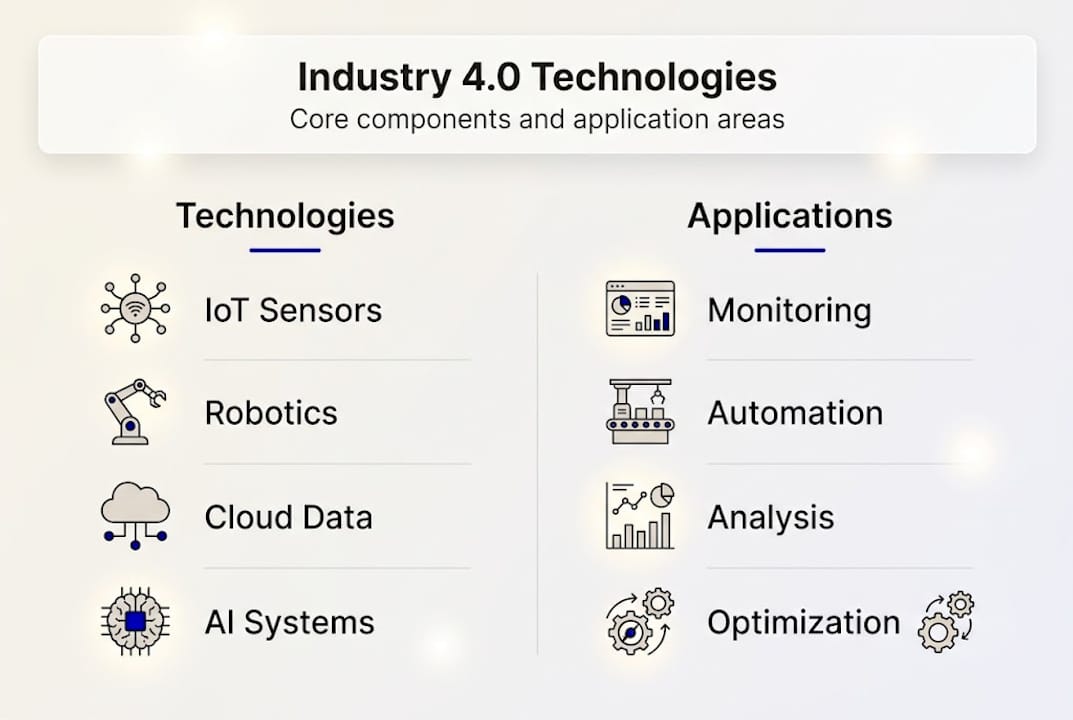
Core technologies in Industry 4.0 include IoT for connectivity, AI and ML for predictive analytics, cyber-physical systems for autonomy, and cloud and edge computing for data management. Here is how each one actually works in practice:
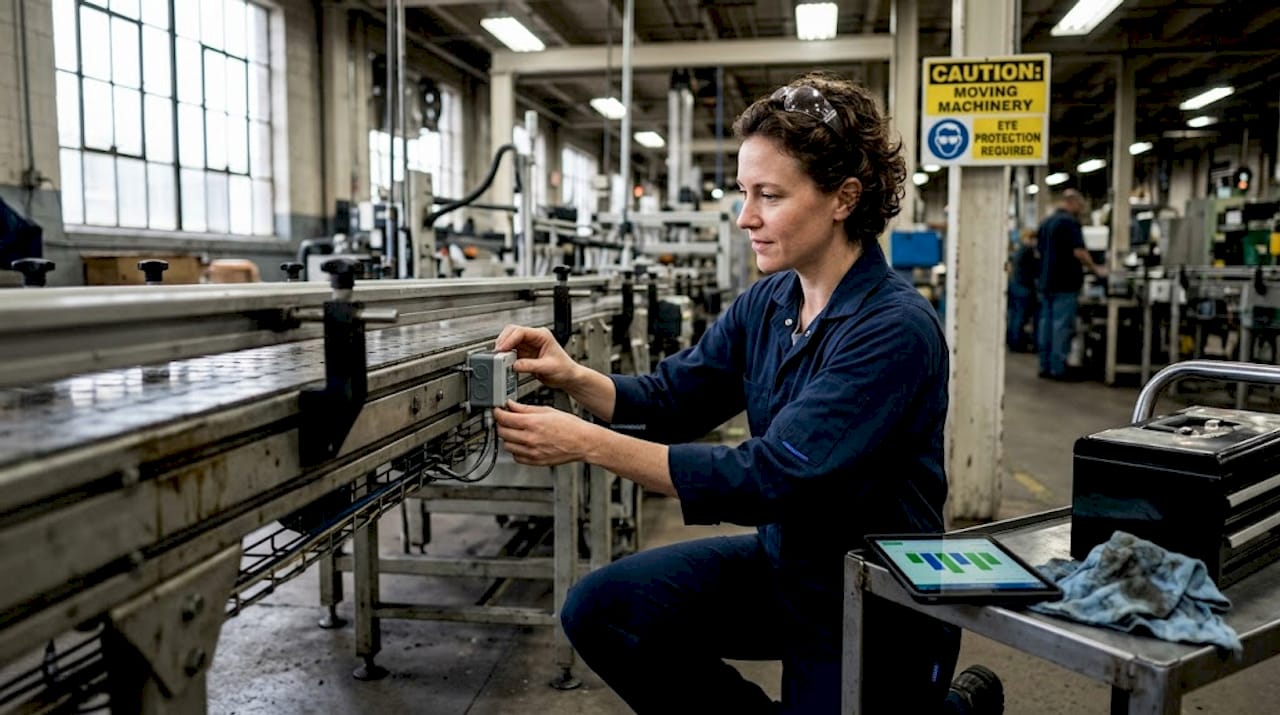
- IoT and factory-wide connectivity: Sensors on machines, conveyors, and environmental systems feed a continuous stream of data into a central platform. This means you know the real-time status of every asset, not just what was recorded in last week’s maintenance log.
- AI and machine learning: These systems analyze historical and live data to predict equipment failures before they occur, flag quality defects mid-production, and optimize scheduling automatically. Predictive maintenance alone typically cuts unplanned downtime by 30 to 50%.
- Cyber-physical systems: A CPS creates a digital twin of your physical operations. Changes tested in the digital model can be validated before being applied on the floor, reducing risk dramatically.
- Cloud and edge computing: Cloud handles large-scale storage and analytics. Edge computing processes data locally, at the machine level, so latency-sensitive decisions happen in milliseconds rather than seconds.
- Advanced robotics: Modern collaborative robots, known as cobots, work safely alongside human operators, handling repetitive or hazardous tasks while people focus on judgment-intensive work.
| Technology | Primary benefit | Typical application |
|---|---|---|
| IoT sensors | Real-time visibility | Asset monitoring, energy management |
| AI and ML | Predictive intelligence | Maintenance, quality control |
| Cyber-physical systems | Risk-free simulation | Process optimization, digital twins |
| Edge computing | Low-latency decisions | Robotics control, safety systems |
| Advanced robotics | Flexibility and safety | Assembly, logistics, inspection |
Pro Tip: Do not try to deploy all five technology layers simultaneously. Start with IoT connectivity and a clear data strategy. Without clean, reliable data flowing from your assets, AI and analytics have nothing meaningful to work with.
Exploring IoT and robotics in smart factories reveals that the most successful deployments treat data infrastructure as the foundation, not an afterthought. The technologies shaping manufacturing are only as powerful as the integration layer beneath them.
Industry 4.0 adoption in KSA, UAE, and Egypt: Opportunities and barriers
Now that you know the enabling technologies, let’s see what this looks like on the ground in the region.
Adoption levels vary significantly across KSA, UAE, and Egypt. Regional adoption data shows moderate uptake in SMEs across all three markets, with KSA advancing through the SIRI framework, UAE making large-scale investments such as Emirates Global Aluminium’s $100M+ commitment, and Egypt seeing widespread ERP adoption but limited penetration of advanced technologies in smaller manufacturers.
Where each market stands:
- KSA: The Smart Industry Readiness Index (SIRI) is being used as a national benchmarking tool. Pilot programs in petrochemicals and manufacturing have demonstrated 30 to 50% reductions in unplanned downtime. Vision 2030 is a direct policy driver.
- UAE: Large enterprises are leading with significant capital investment. EGA’s transformation is a regional benchmark for what integrated Industry 4.0 looks like at scale.
- Egypt: ERP systems are broadly adopted, but advanced technologies such as AI-driven analytics and IoT remain limited outside of large industrial players and multinationals.
Statistic: Organizations in KSA that have piloted integrated IoT and AI programs report throughput gains of 10 to 30% within 18 months of deployment.
The barriers are consistent across all three markets:
- Technical skills shortages at both the operator and engineering levels
- High initial capital requirements for sensors, platforms, and integration work
- Resistance to change from middle management and frontline staff
- Legacy system complexity that makes integration expensive and time-consuming
Pro Tip: Before committing capital to new technology, map your current integration gaps. Many organizations in the region spend heavily on platforms that cannot communicate with their existing ERP or SCADA systems. Reviewing digital trends for KSA and UAE helps you benchmark against what leading organizations are actually prioritizing. A solid digital strategy for MENA always starts with an honest audit of your current state.
Challenges, misconceptions, and the evolution toward Industry 5.0
Armed with a regional perspective, it’s crucial to get real about common challenges and what’s next.
The most dangerous assumption in any boardroom is that deploying more technology automatically generates ROI. Hype versus reality in Industry 4.0 is stark: organizations that collect data without acting on it, or stack technologies without integrating them, consistently fail to see meaningful returns. This is exactly why so many firms remain stuck at “Industry 3.5.”
The common pitfalls include:
- Technology stacking without integration: Buying IoT sensors, an AI platform, and a new analytics dashboard that do not share data with each other
- Underestimating change management: Deploying tools without training people, updating processes, or securing buy-in from operations leadership
- Skipping measurement baselines: Launching pilots without first establishing OEE, downtime, or throughput benchmarks, making it impossible to prove value
- Cybersecurity blind spots: Every connected device is a potential entry point. As operational technology connects to IT networks, attack surfaces expand significantly
“The organizations that struggle most with Industry 4.0 are not the ones that lack technology. They are the ones that lack a coherent integration strategy and a culture willing to act on data.” — Tamer Badr, Singleclic
Looking ahead, digital disruption in MENA is already pointing toward Industry 5.0, the next evolution. Where Industry 4.0 prioritizes automation and data integration, Industry 5.0 brings human-machine collaboration, environmental sustainability, and organizational resilience to the center of the conversation. It is not a replacement for Industry 4.0. It is the next layer, built on top of a solid Industry 4.0 foundation. Leaders who get the integration right today will be positioned to lead that transition tomorrow.
How executive focus unlocks Industry 4.0 value: Lessons learned
Here is the deeper reality that few discuss openly: the organizations seeing the most meaningful gains from Industry 4.0 are not the ones with the most advanced technology stacks. They are the ones where the C-suite has made integration, measurement, and people development non-negotiable priorities.
The pattern we see repeatedly across KSA, UAE, and Egypt is that leaders who chase the newest platform without measuring OEE and downtime baselines first are essentially flying blind. You cannot optimize what you have not measured. SIRI assessments and equivalent benchmarking exercises are not bureaucratic checkboxes. They are the diagnostic tools that tell you where your real leverage points are.
Pilot projects matter enormously, but only when they are designed to test integration, not just functionality. A sensor that works in isolation proves nothing. A sensor whose data flows into your ERP, triggers a maintenance work order, and reduces downtime by a measurable percentage proves everything your board needs to see.
Upskilling is the variable most executives underestimate. Technology without capable people to interpret and act on it is expensive furniture. Investing in business process automation for leaders means investing in the people who will run those processes, not just the software that powers them. The organizations that get this right build internal champions at every level, from the plant floor to the finance function.
Next steps: Accelerate your Industry 4.0 journey
Ready to move from understanding to action? Here’s how top leaders progress their Industry 4.0 initiatives.
The gap between knowing and doing is where most transformation programs stall. Singleclic works with C-level leaders across KSA, UAE, and Egypt to close that gap with structured assessments, integration roadmaps, and hands-on implementation support.
Start with the Digital Transformation Office Guide to understand how leading organizations structure their transformation governance. Then use the C-Level Digital Transformation Roadmap to sequence your investments for maximum impact. Whether you are benchmarking readiness, piloting IoT integration, or scaling AI across operations, Singleclic brings 10+ years of regional expertise and 70+ engineers ready to accelerate your progress. Learn more at Singleclic and take the next step with confidence.
Frequently asked questions
What are the main benefits of Industry 4.0 for manufacturers?
Industry 4.0 can drive 10 to 30% throughput gains in the near term, with long-term potential for 20 to 50% efficiency improvements, major downtime reduction, and smarter, data-driven decision making across operations.
Why do most companies stall at Industry 3.5 instead of full Industry 4.0?
Firms typically focus on acquiring technology but struggle with integration and upskilling, leaving systems disconnected and transformation value unrealized.
How does Industry 5.0 differ from Industry 4.0?
Industry 5.0 adds human-machine collaboration and resilience as core priorities, while Industry 4.0 focuses primarily on automation and data integration across operations.
What is the first step for C-level leaders to implement Industry 4.0?
Start by completing a SIRI assessment or equivalent benchmarking exercise, then design a pilot project that specifically tests system integration rather than standalone technology functionality.