TL;DR:
- Connecting enterprise systems requires careful planning due to high failure risks caused by schema mismatches and organizational misalignment. Effective integration enhances decision-making, automates workflows, and improves operational efficiency, especially in MENA organizations. Success depends on proactive governance, executive sponsorship, and choosing the right strategy, not just the technology.
Most executives assume connecting two enterprise systems is simply a matter of flipping a switch. The reality is far more disruptive. Transformation programs fail at an alarming rate, with legacy integration complexities, data schema mismatches, and silent failures derailing initiatives that looked perfectly reasonable on paper. For technology leaders in KSA and UAE, where Vision 2030 and digital transformation mandates are accelerating the pressure to connect ERP platforms, CRMs, HR tools, and BI systems, understanding system integration is not optional. It is one of the highest-leverage decisions you will make this year.
Table of Contents
- System integration explained: Connecting business functions
- Key system integration approaches: Methods and frameworks
- Common system integration challenges and roadblocks
- Unlocking business value: Integration’s impact on efficiency and growth
- The real integration hurdle: It’s not the technology, it’s alignment
- Accelerate transformation with guided integration strategies
- Frequently asked questions
Key Takeaways
| Point | Details |
|---|---|
| Integration is a business enabler | Effective system integration turns siloed software into seamless, automated business processes. |
| Approach matters for scale | Choosing the right integration method prevents technical bottlenecks and reduces failure risk. |
| Major risks are avoidable | Most project failures stem from preventable issues like schema mismatches and organizational misalignment. |
| Value depends on alignment | The greatest gains come when business and IT leaders are strategically aligned from the start. |
| Expert guidance accelerates success | Leveraging proven integration frameworks and expert support dramatically improves ROI. |
System integration explained: Connecting business functions
Now that we understand why failure rates are so high, let’s clarify what system integration actually is and how it creates business value.
System integration is the process of linking separate software applications, databases, and platforms so they operate as a unified whole. It is not simply moving data from one system to another. True integration means that business processes flow continuously across functions without manual handoffs, redundant data entry, or information silos that slow decisions and introduce errors.
Think about a large healthcare organization in the UAE operating Microsoft Dynamics 365 for financials, a separate HR platform for workforce management, and a clinical records system for patient data. Without integration, staff manually reconcile payroll against departmental budgets, procurement teams request data from IT, and leadership waits days for accurate financial snapshots. With proper integration, those systems communicate automatically. Data moves in real time. Decisions happen faster, and errors drop sharply.
“Point-to-point integration seems manageable at first, but at enterprise scale it creates a spaghetti architecture that is extremely difficult to maintain, debug, or extend. Silent data failures become your biggest hidden cost.” — Tamer Badr, Singleclic
Business drivers for system integration typically fall into three categories:
- Operational efficiency: Eliminating manual processes and redundant data entry across departments
- Decision visibility: Enabling leadership to see a single, real-time version of business performance
- Process automation: Triggering workflows automatically when specific data conditions are met across multiple systems
The systems most commonly integrated in large MENA enterprises include ERP platforms like Odoo and Microsoft Dynamics 365, CRM tools, HR and payroll systems, business intelligence dashboards, procurement platforms, and customer portals. When these systems work together, they stop being isolated tools and become a connected operational backbone.
Modernizing legacy systems is often the first practical step before any integration work begins, particularly when older platforms use outdated data formats or lack modern API support.
Key system integration approaches: Methods and frameworks
With a definition in hand, it is essential to examine the actual strategies companies use to integrate their systems and where they can go right or wrong.
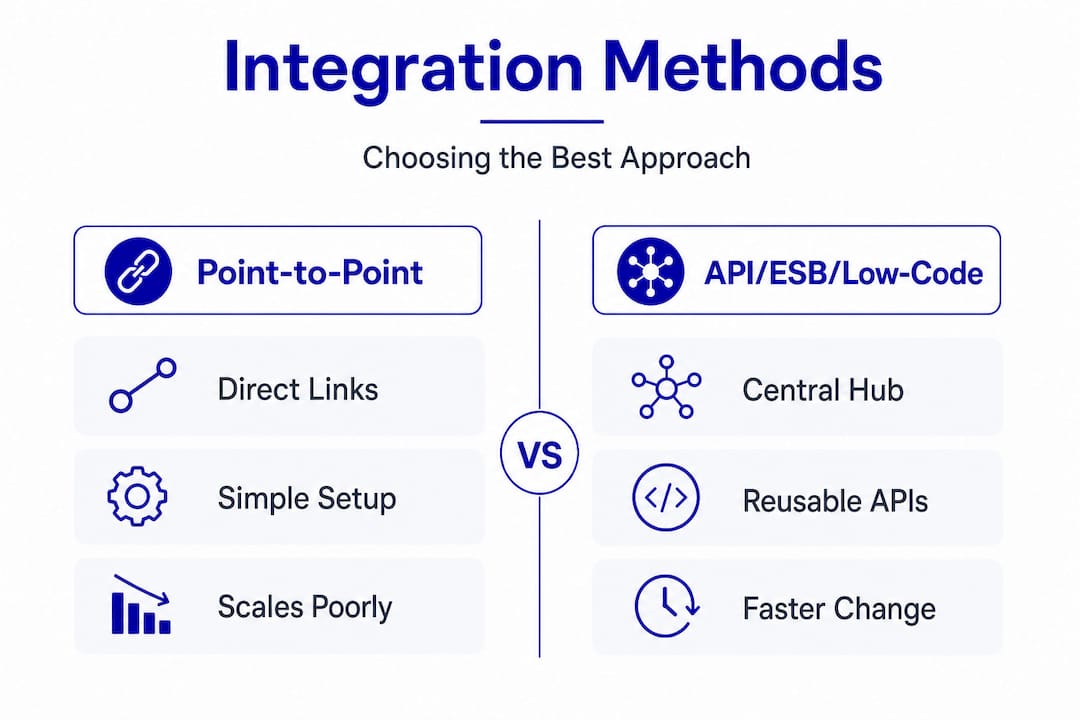
Not every integration method suits every situation. Choosing the wrong approach at the start of a program can multiply cost and complexity for years. Here is how the leading methods compare at enterprise scale.
| Integration method | Best for | Key advantage | Key risk |
|---|---|---|---|
| Point-to-point | Small teams, limited systems | Fast initial setup | Spaghetti architecture at scale |
| Enterprise Service Bus (ESB) | Mid to large enterprises | Centralized message routing | Can become a bottleneck |
| API-led connectivity | Modern, cloud-native stacks | Reusable, flexible connectors | Requires strong governance |
| Low-code integration platforms | MENA enterprises needing speed | Visual design, rapid deployment | Vendor lock-in risk if poorly selected |
Point-to-point integration is the most common starting point for smaller teams. You connect System A directly to System B, and it works. The problem appears when you add System C, D, and E. According to research on integration failures, 38% of enterprise integration failures stem directly from schema mismatches that point-to-point connections make nearly impossible to detect and resolve at scale.

Enterprise Service Bus (ESB) architectures solve the point-to-point sprawl by creating a central hub through which all messages pass. This gives you better monitoring and control. However, ESBs can introduce single points of failure and are notoriously slow to reconfigure when business needs change quickly.
API-led connectivity has become the dominant approach for cloud-first organizations. You expose your data and services through standardized APIs, which other applications can call on demand. This is flexible and scalable, but it requires mature API governance frameworks and skilled teams to manage versioning, security, and documentation.
Low-code integration platforms are gaining rapid traction across the MENA region because they allow business and IT teams to collaborate on building integration workflows without waiting months for custom development. Simplifying multi-system integrations through visual workflow builders reduces delivery time significantly and allows non-technical stakeholders to stay meaningfully involved.
The choice of method is fundamentally a strategic decision, not a technical one. It affects your agility for the next five years. For a practical executive framework on evaluating these choices, this service integration guide is worth exploring before committing to a specific approach.
Pro Tip: Do not let your IT team select an integration method in isolation. Bring your operations and finance leaders into the conversation early. The integration method needs to support how your business actually runs, not just how your technology stack is structured today.
Common system integration challenges and roadblocks
Knowing the most common approaches, executives need to be aware of what tends to go wrong and why.
The statistics here are sobering. Large transformation programs fail 70% of the time, and the primary culprits are almost never the technology itself. They are the invisible problems that surface after the project has already started.
| Challenge | Failure rate contribution | Typical symptom |
|---|---|---|
| Schema mismatches | 38% | Data appears correct but produces wrong outputs |
| Connection timeouts | 24% | Intermittent failures that are hard to reproduce |
| Legacy system incompatibility | High | Blocked data access, expensive custom coding |
| Poor change management | High | Teams revert to manual workarounds |
Schema mismatches deserve special attention. A schema mismatch occurs when two systems use different data formats or field definitions for what appears to be the same information. For example, your ERP might store customer names as a single field while your CRM uses separate first name and last name fields. During integration, this creates silent failures where data transforms incorrectly without generating an obvious error. Leadership sees reports that appear complete but contain inaccurate information.
Connection timeouts are the second most common failure trigger. In enterprise environments with high transaction volumes, network congestion or slow system responses cause integrations to time out. Without proper retry logic and error handling built into the integration layer, these timeouts result in lost transactions or duplicated records.
Here is a practical roadmap to reduce these risks before they become crises:
- Conduct a full data audit before any integration begins. Map every field in every source system and document where formats differ.
- Establish data ownership. Assign a business owner for each data domain, not just an IT owner. When schema conflicts arise, someone with business authority must decide which system is the source of truth.
- Build a test environment that mirrors production. Testing in a sandboxed copy of your real data reveals mismatches that generic test data misses entirely.
- Define error handling protocols. Decide in advance what happens when a transaction fails. Does it retry automatically? Does it alert a human? Does it roll back?
- Implement phased rollouts. Integrate one business process at a time, confirm stability, and then expand. Full big-bang integrations amplify risk dramatically.
- Monitor continuously post-launch. Integration is not a one-time project. Systems update, APIs change, and data volumes grow. Build operational monitoring into your ongoing IT operations.
These enterprise integration steps are particularly relevant for organizations in Saudi Arabia and the UAE, where regulatory data requirements and Arabic language support add additional complexity to the technical picture.
Pro Tip: The most effective way to avoid integration failure is to align your business and IT leadership before a single line of code is written. A one-page integration charter signed by both the CIO and the relevant business unit head creates shared accountability that prevents the finger-pointing that derails most projects.
Unlocking business value: Integration’s impact on efficiency and growth
While challenges are real, the payoff can be transformative. Here is what effective system integration enables for forward-thinking organizations.
When integration works correctly, the impact is visible across the entire organization. Processes that previously took days because of manual handoffs between departments now complete in minutes. Finance closes the books faster because ERP and banking data reconcile automatically. HR onboarding triggers access provisioning in IT systems without a single email being sent. Customer service representatives see complete order and billing histories the moment a client calls.
The business metrics that improve most consistently after successful integration include:
- Decision cycle time: Leadership gets accurate, real-time dashboards instead of waiting for weekly consolidated reports
- Operational error rates: Eliminating manual data re-entry removes a primary source of human error
- Process throughput: Automated workflows handle more volume without adding headcount
- Compliance readiness: Integrated audit trails make regulatory reporting faster and more accurate
- Customer experience: Frontline teams access complete client data instantly, improving every customer interaction
One area where the value is particularly striking is the connection between BI platforms and ERP systems. Integrating BI with ERP turns your financial and operational data into a live decision-support layer for leadership. Instead of static spreadsheets, you get dynamic dashboards that update as transactions occur.
However, it is worth being direct about a risk that is easy to overlook. Data format mismatches causing silent failures can undermine every operational gain you have worked to achieve. An integration that appears to function correctly but quietly corrupts data over weeks or months can produce worse outcomes than having no integration at all. This is why data quality governance is not a technical afterthought. It is a core part of the business case.
For C-level executives evaluating the ROI of integration, these are the questions worth asking your teams:
- How many hours per week are staff spending on manual data reconciliation today?
- How many decisions are delayed because consolidated data is unavailable in real time?
- What is the cost of a single compliance breach caused by mismatched data between systems?
- How quickly could you respond to a market opportunity if your systems shared real-time operational intelligence?
Research on digital integration for business growth consistently shows that connected organizations outpace disconnected ones on both revenue growth and cost efficiency. The operational gains from integration compound over time as automation expands into more process areas.
The real integration hurdle: It’s not the technology, it’s alignment
After years of delivering integration programs across healthcare, banking, construction, and government sectors in KSA and UAE, one pattern stands out above all others. The organizations that succeed do not necessarily have better technology. They have better alignment.
Most integration failures are diagnosed as technical problems after the fact. A schema mismatch here. A timeout issue there. But if you trace those technical failures back to their origin, you almost always find an organizational breakdown. The ERP team made a configuration decision without consulting the CRM team. The business unit changed a data field definition without notifying IT. The project sponsor lost interest after the launch and the integration degraded silently for six months before anyone noticed.
Tamer Badr, CEO of Singleclic, puts it plainly: “We have seen organizations spend millions on the right platforms and still fail because the business and technology leaders were never truly aligned on what success looked like. Integration is a business transformation program that uses technology, not the other way around.”
In the MENA context, this alignment challenge takes on additional nuance. Many large enterprises operate in matrix structures where regional business units have significant autonomy. A Saudi subsidiary and a UAE subsidiary may both operate Dynamics 365, but with different configurations, different data standards, and different IT governance structures. Integrating those environments requires organizational negotiation, not just technical configuration.
The unconventional advice here is to start your integration program with a governance design exercise before you select any platform or vendor. Who owns each data domain? How are conflicting data standards resolved? Who has authority to approve schema changes? These questions feel procedural, but answering them in advance eliminates the most common failure modes entirely.
C-level sponsorship is not a formality in integration programs. It is a functional requirement. When a conflict arises between business process owners, only executive sponsorship has the authority to resolve it quickly enough to keep a program on schedule. Selecting the right technology partner means choosing an organization that will facilitate these governance conversations alongside the technical delivery, not one that hands you software and disappears.
Accelerate transformation with guided integration strategies
For leaders ready to avoid pitfalls and capture value, tailored guidance and proven frameworks make a measurable difference.
At Singleclic, we have spent over a decade helping enterprises in KSA, UAE, and Egypt navigate integration programs that deliver real, measurable outcomes. Whether you are at the early planning stage or managing an integration that has stalled, our team brings the technical depth and regional expertise to move things forward.
Start with a clear foundation. Our business process automation guide walks you through how to connect integration strategy with automation outcomes for maximum operational impact. If you are running ERP platforms in the region, our ERP integration tips for MENA covers the specific compliance, language, and data standards your program needs to address. And if you are not yet sure whether your organization is ready to begin, use our ERP readiness assessment to benchmark where you stand before committing resources.
Frequently asked questions
What exactly is system integration in a business context?
System integration is the process of connecting different IT systems and applications into a unified, efficient workflow so that data flows in real time across business functions, enabling automation and eliminating manual reconciliation. Unmanaged connections quickly lead to spaghetti architecture that becomes costly to maintain at scale.
What common mistakes cause system integration projects to fail?
Most failures result from unmanaged schema mismatches and timeouts, which account for over 60% of technical failures, combined with poor alignment between IT and business teams who hold conflicting priorities.
How does system integration impact operational efficiency?
When implemented correctly, integration removes manual data handling, accelerates decision cycles, and improves data accuracy across departments. However, silent data failures caused by format mismatches can quietly erode those gains if data governance is not maintained.
What systems are most commonly integrated in large enterprises?
ERP, CRM, HR, and Business Intelligence platforms are the most frequently integrated systems because they hold the core operational and financial data that drives cross-functional workflows and executive reporting.
What’s the best way to start a system integration initiative?
Begin with executive alignment and a governance framework that assigns data ownership before selecting any technology. Then define clear KPIs, build a phased roadmap, and select a partner with proven regional experience to guide both the technical and organizational dimensions of the program.