On-premise AI means running your language models and AI applications on servers you control, inside your own data center or private environment, so prompts, documents and outputs never leave your perimeter. For banks, government entities, healthcare groups and other regulated organizations in the UAE and Saudi Arabia, it is the most direct way to put AI on top of sensitive data while keeping access, audit and residency decisions in your own hands. Our On-Prem LLM offering exists for exactly this case, and the rest of this guide shows what a sound deployment involves, from architecture to UAE rules to rollout stages.
TL;DR
- On-premise AI and self-hosted AI models put the model, the data and the logs inside your infrastructure, which keeps sensitive information under your own governance.
- It fits best when workloads are latency-sensitive, compliance limits what can go to a vendor cloud, and the organization can support the infrastructure, according to an inference engineering handbook.
- The UAE has no single AI statute. Your obligations come from the federal data protection law, free-zone regimes and sector rules, so design for those first.
- A deployment is a stack, not a server: serving, storage, access control, monitoring and an owner for each.
- Start with one high-value use case, prove it, then connect it to ERP, CRM and workflows.
Table of Contents
- What on-premise AI and self-hosted models actually mean
- When on-premise is the right choice
- What a UAE organization has to design for
- The architecture of an on-premise AI platform
- A staged path from pilot to production
- Securely operating self-hosted models
- Use cases for UAE and Saudi organizations
- How Singleclic helps
- Our perspective
- Plan your on-premise AI deployment with Singleclic
- SEO details
- FAQ
- Sources
What on-premise AI and self-hosted models actually mean
An on-premise LLM deployment installs a large language model, the engine behind AI assistants and document tools, on hardware your organization owns or exclusively controls. Self-hosted AI models is the broader phrase: the same idea whether the machines sit in your server room, a private cloud or a sovereign hosting arrangement you control.
Three things change compared with a public AI service:
- Data stays inside. Prompts, retrieved documents and generated answers are processed on your systems.
- You own the controls. Identity, permissions, logging and retention follow your policies, not a provider’s defaults.
- You decide when things change. Model versions and updates move on your schedule, which matters when a regulator or auditor asks what ran, when and on what data.
For a CIO in Riyadh or Dubai, the practical effect is that AI can touch the content that matters most: contracts, patient records, credit files, tender documents, HR cases and supplier terms. Those are the datasets that public tools are usually kept away from.
When on-premise is the right choice
The LLM Inference Handbook summarizes the conditions where on-premises operation makes most sense: workloads that are latency-sensitive with strict service levels, compliance that prevents use of a vendor cloud, and an organization able to support the infrastructure investment. Map that to the Gulf and the pattern is clear.
| Situation | Why on-premise fits |
|---|---|
| Bank or insurer processing credit, KYC or transaction data | Banking and credit data sit under their own legislation, so keeping processing in-house simplifies the compliance story |
| Government entity handling citizen records or internal correspondence | Government data is outside the federal personal data law and follows its own rules, which favors in-house control |
| Hospital or clinic group using AI on patient information | Health data has dedicated regulation and strict access expectations |
| Telecom or utility with real-time operational decisions | Local inference keeps response times predictable |
| Construction or real estate developer analyzing contracts and project documents | Commercial documents stay inside the company |
If your use case is generic drafting with no sensitive input, you have flexibility. If the input is something you would not email outside the company, on-premise is the natural default. Our own article on why on-premise AI is gaining momentum in security-sensitive organizations goes deeper on that decision.
What a UAE organization has to design for
The UAE does not have one comprehensive AI law. Legal 500’s 2026 TMT guide notes there is no standalone AI statute or binding rule specific to LLMs or generative AI, and that the 2024 UAE Charter for the Development and Use of Artificial Intelligence sets twelve principles (safety, bias, privacy, transparency, human oversight and governance) without an enforcement mechanism. In practice, your design must satisfy several layers at once.
Federal personal data law
Federal Decree-Law No. 45 of 2021, the PDPL, has been in force since 2 January 2022. It restricts moving personal data out of the country: Articles 22 and 23 of the official text allow transfers to jurisdictions with adequate protection or an agreement, and otherwise only under defined cases such as binding contractual safeguards, explicit consent, contract performance, judicial necessity or public interest. The law also excludes government data, personal health data and banking and credit data, which are covered by their own legislation.
For AI, the consequence is simple. A model hosted abroad that receives personal data in prompts creates a cross-border transfer you must justify. A model running inside your own environment avoids that question for the data it processes.
Free zones
If your entity operates in DIFC or ADGM, separate data protection regimes apply instead of the federal PDPL. DIFC also has Regulation 10, which Legal 500 describes as the one AI-specific rule binding across sectors in the UAE. It requires designated Deployer and Operator roles, transparency about human-initiated versus autonomous processing, registers of use cases, and for high-risk systems either restriction to human-defined purposes or an appointed Autonomous Systems Officer. If you sit in DIFC, build that register and those roles into your deployment from day one.
Sector rules
Health, banking and government entities answer to their own regulators, each with security and audit expectations. Confirm the current requirement with your regulator and compliance team before finalizing architecture. An on-premise design makes those conversations easier because every component is inside the boundary you are describing.
In Saudi Arabia the same logic applies with Saudi regulators and the Kingdom’s own data protection framework. Have your legal team confirm which rules bind each use case before go-live.
For a broader view of governance, read our AI risk management guide for UAE and Saudi leaders.
The architecture of an on-premise AI platform
The model is the visible part. A working platform is the full stack around it, and each layer needs an owner.
- Compute. GPU servers sized to the model and the number of concurrent users. Inference (answering questions) needs far less than training or fine-tuning, and most enterprise use cases start with inference on an open-weight model.
- Model serving. A serving layer that exposes the model through an API your applications can call, with request queuing and batching so many users share the hardware efficiently.
- Knowledge layer. Secure storage and indexing for the documents the model should answer from, with permissions that mirror your existing access rights, so an employee never sees through AI what they cannot open directly.
- Identity and access control. Single sign-on, role-based access, and separation between teams and use cases.
- Orchestration. Containers and a scheduler so you can scale, restart and update services without downtime.
- Monitoring and audit. Latency, queue depth, error rates, usage logs and quality checks, plus an audit trail of who asked what.
- Integration. Connectors to ERP, CRM, document systems and workflow engines, where the value actually appears.
The LLM Inference Handbook adds that on-premises operation brings high upfront cost, operational complexity and a demand for scarce MLOps talent. That is a reason to plan staffing and procurement early, and to work with an implementation partner that has done it before, rather than a reason to hold back.
A staged path from pilot to production
Organizations that succeed usually grow the platform in stages rather than buying the final shape on day one.
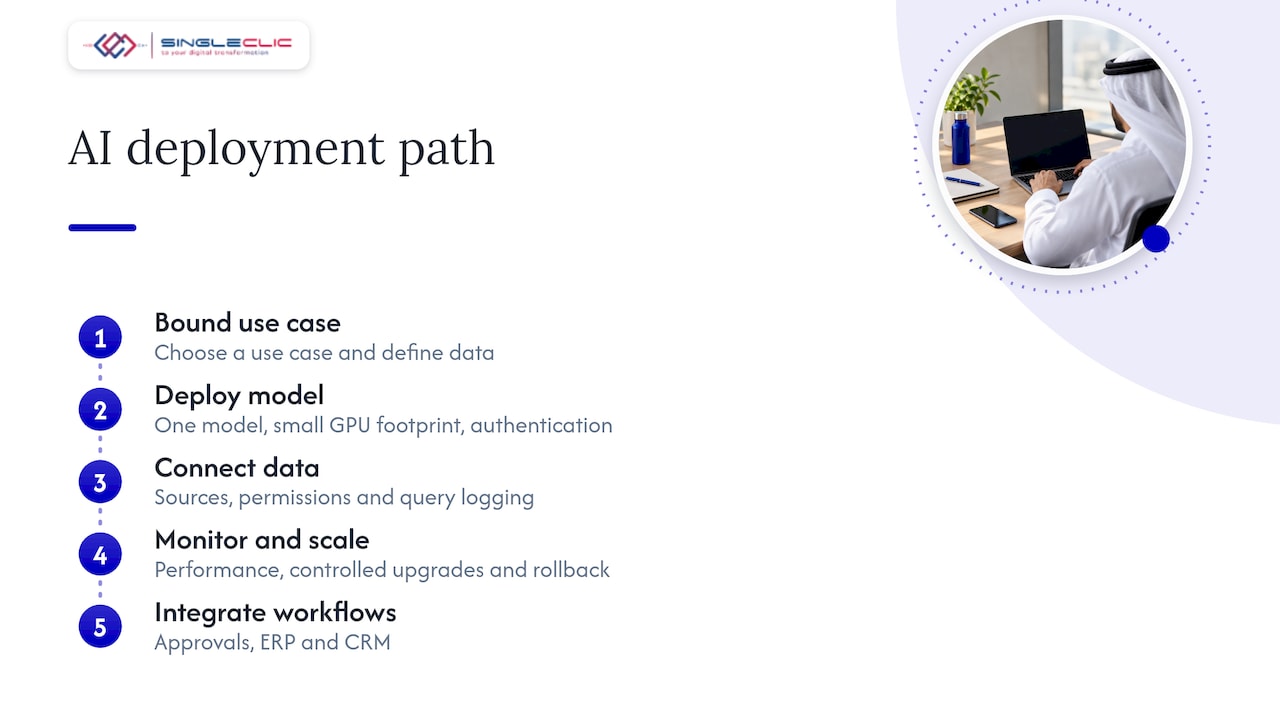
Stage 1: choose one use case and define the data
Pick a process with clear value and bounded data: contract review, policy search for HR, supplier document comparison, claims triage or procurement queries. Classify the data it touches and write down who may access it.
Stage 2: stand up a minimal serving environment
Deploy one model on a small GPU footprint with authentication in front of it. The goal is to measure real response times and quality on your own documents, not benchmark numbers.
Stage 3: add the knowledge layer and permissions
Connect document sources, mirror existing access rights and log every query. This is where most enterprise value, and most risk, is created.
Stage 4: monitor and scale
Add dashboards for latency, queue depth and error rates, set load thresholds, and add capacity when demand justifies it. Introduce controlled model upgrades with a rollback path.
Stage 5: connect to business processes
Wire the model into approvals, ERP and CRM so answers trigger actions: a drafted purchase requisition, a flagged contract clause, a routed HR case. At this point AI stops being a chat window and becomes part of the workflow.
Securely operating self-hosted models
Controlling the infrastructure is the start. Security comes from how you run it.
- Data controls. Classify what may enter the model, mask identifiers where the use case allows, and set retention for prompts and outputs.
- Access. Enforce role-based permissions at the retrieval layer, not only at the chat interface.
- Updates. Treat model and framework updates like any other production change: test, approve, release in stages, keep the previous version available.
- Model risk. Track wrong or fabricated answers, bias and drift with sample reviews, and keep a human approval step for high-impact decisions. The UAE Charter lists human oversight among its principles.
- Records. Keep a register of use cases, owners and model versions. DIFC entities need one under Regulation 10, and every regulated entity benefits from it.
- Network boundary. Limit outbound connections from the AI environment so the on-premise promise holds in practice.
Use cases for UAE and Saudi organizations
- Banking: summarizing credit files and policy documents without exposing customer data outside the bank.
- Government: searching internal regulations and correspondence in Arabic and English inside a government network.
- Healthcare: drafting administrative summaries and answering staff questions from internal protocols.
- Real estate and construction: comparing contracts, variation orders and tender documents.
- HR: answering policy questions from employees and routing cases to the right approver.
- Supply chain: querying supplier contracts and delivery terms, then feeding results into the ERP.
How Singleclic helps
We work with banks, government entities and healthcare organizations across the UAE, Saudi Arabia and Egypt, and our client base of 100+ enterprises includes Emirates Health Services, Dubai Healthcare City, QNB and Al Baraka. Our team of 70+ consultants and engineers has delivered digital projects in the region for over ten years.
On-premise AI is part of that work. Our On-Prem LLM offering is built for organizations that need AI inside their own boundary, and Cortex, our Arabic-enabled, on-premise low-code and BPM platform, connects approvals, ERP, CRM, data and legacy systems so the model’s output lands inside a real workflow. Cortex supports a full Arabic interface, unlimited users and runtime workflow changes without downtime, and can be deployed on-premise for banks and governments.
Because we also implement Microsoft Dynamics 365, Odoo and IBM BAW, the AI layer can be designed together with the systems it has to feed. See our guide to an AI ERP system for UAE and Saudi decision-makers and our overview of BPM and business process automation.
Our perspective
Most leaders ask us first whether the model is good enough. The better first question is where your data is allowed to go. When the answer is “nowhere outside our walls”, on-premise stops being a preference and becomes the architecture.
We design the platform around the workflow, not the model. A private LLM that cannot reach your approvals, your ERP and your Arabic documents is a demonstration. Connected through Cortex to the systems your teams already use, it becomes a process your auditors can follow.
Our advice is to start narrow: one use case, one owner, one measurable outcome. Then widen the platform as trust grows. That is how security-sensitive organizations in the Gulf move from a pilot to something the whole organization relies on.
Tamer Badr
Plan your on-premise AI deployment with Singleclic
If your organization handles data that should stay inside your perimeter, we can scope an on-premise AI deployment with you: the use case, the architecture, the integration with your ERP, CRM and workflows, and the governance around it. Start with our On-Prem LLM page, or explore the full range on our services page.
To understand the wider case, read why on-premise AI is the right fit for data-sensitive sectors and on-premise AI, privacy, governance and enterprise control.
SEO details
- SEO title: On-premise AI deployment: a guide for UAE and Saudi leaders
- Slug: on-premise-ai-deployment
- Primary keyword: on-premise AI deployment
- Secondary keywords: on-premise LLM deployment, self-hosted AI models, enterprise AI, workflow automation
- Pillar cluster: Enterprise AI and Open BPM, supporting Cortex low-code, system integration and data analytics
FAQ
What is the difference between on-premise AI and cloud AI?
On-premise AI runs on infrastructure your organization controls, so data and logs stay inside your boundary. Cloud AI runs on a provider’s infrastructure and is reached over the internet. The choice mostly comes down to data sensitivity, regulation and who you want operating the environment.
Does the UAE require AI to be hosted on-premise?
No. The UAE has no standalone AI statute requiring it. Obligations come from the federal data protection law, free-zone regimes such as DIFC and ADGM, and sector rules for health, banking and government. Hosting inside your own environment is a practical way to meet them, because it avoids cross-border transfers of personal data.
What hardware do we need for an on-premise LLM?
It depends on the model size and the number of simultaneous users. Inference needs GPU servers, fast storage for documents and indexes, and a serving layer with monitoring. Training or heavy fine-tuning needs considerably more. We size the environment to a defined use case rather than guessing at the final scale.
How long does an on-premise AI deployment take?
A focused pilot with one use case can be running much sooner than a full enterprise rollout. Timelines depend on hardware procurement, data classification and integration with your ERP, CRM and workflows. We scope this with you after defining the first use case.
Can on-premise AI work in Arabic?
Yes, language support depends on the model and the application layer. Cortex, our on-premise low-code platform, provides a full Arabic interface, so the workflows and approvals around the model work naturally for Arabic-speaking teams.
Sources
- On-prem LLM deployments, LLM Inference Handbook
- Federal Decree-Law No. (45) of 2021 on personal data protection, UAE Legislation portal
- Country Comparative Guides 2026: UAE TMT, Legal 500