A data warehouse is the right foundation when your analytics are mostly structured, governed and repeatable, such as finance, regulatory and operational reporting. A lakehouse is the better foundation when the same data must also feed machine learning, streaming or unstructured content such as documents and logs. Most large organizations in the UAE and Saudi Arabia end up with both patterns, and the real decision is which workload leads and who will operate the platform.
This guide compares the two architectures on the criteria that matter to a CIO or CTO: data types, performance, governance, cost, skills and fit with your ERP and CRM landscape.
TL;DR
- A data warehouse stores curated, structured data with schema-on-write. It is built for BI and SQL reporting and is the lower-effort route to fast dashboards.
- A data lakehouse keeps structured, semi-structured and unstructured data in open formats on cloud object storage, with warehouse-style transactions and governance on top.
- The two are converging. Warehouses now read open table formats, and lakehouses now offer managed SQL and governance, so the choice is about workloads and team skills more than product labels.
- Choose a warehouse for stable schemas and regulated reporting, a lakehouse when BI and AI share data, and a combined design when both are true.
- Whichever you pick, someone must own the catalog, data quality and maintenance.
Table of Contents
- Article details
- What each architecture is
- Lakehouse vs warehouse at a glance
- Where the real differences show up
- The two are converging
- When to choose which
- Use cases in MENA enterprises
- A practical decision path for CIOs and CTOs
- Our perspective
- How Singleclic helps
- Talk to us about your data architecture
- FAQ
- Sources
Article details
- SEO title: Lakehouse vs warehouse: how to choose for your enterprise
- Slug: lakehouse-vs-warehouse
- Keyword: lakehouse vs warehouse
- Secondary keywords: data lakehouse vs data warehouse, data lake vs data warehouse, enterprise data architecture, Microsoft Fabric lakehouse
- Pillar cluster: AI-enabled business applications and data analytics
What each architecture is
A data warehouse is a centralized repository designed for structured data and SQL analytics. It works on a schema-on-write principle: data is extracted, transformed into a defined structure and loaded into predefined relational tables before anyone queries it. That discipline is why warehouses are trusted for numbers that must reconcile.
A data lakehouse combines a data lake with a warehouse. According to a vendor explainer on lakehouse versus warehouse, it stores structured, semi-structured and unstructured data in one repository and supports BI, machine learning, streaming and data engineering. It adds reliability, ACID transactions, schema enforcement and governance directly on low-cost cloud object storage in open formats.
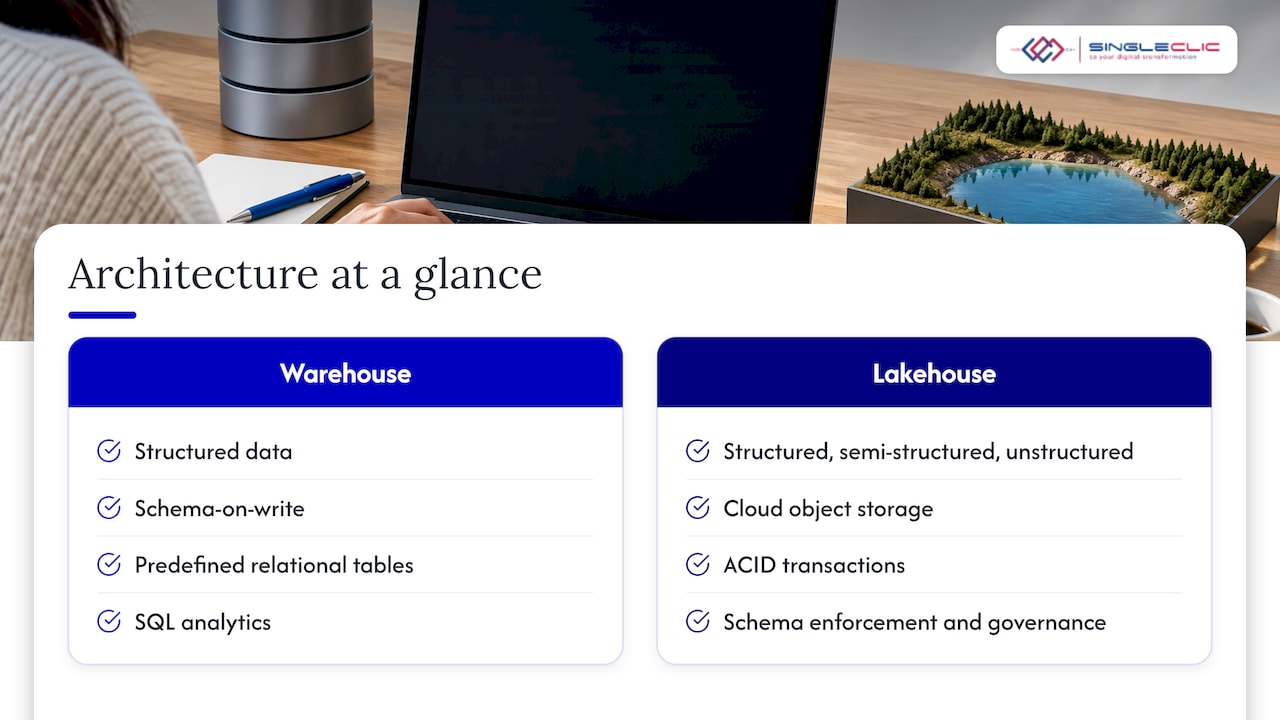
A plain data lake sits underneath both ideas. It holds data in its native, raw format, scales cost effectively to terabytes and petabytes, and applies structure only when the data is read. The lakehouse is what you get when you put transactional tables and governance on that lake.
Lakehouse vs warehouse at a glance
| Criterion | Data warehouse | Data lakehouse |
|---|---|---|
| Data types | Structured, some semi-structured | Structured, semi-structured and unstructured |
| Schema approach | Schema-on-write | Schema enforcement on open tables, with raw data kept alongside |
| Storage format | Often proprietary, increasingly open | Open table formats such as Delta Lake or Apache Iceberg |
| Main users | BI developers and analysts | Data engineers, data scientists and analysts |
| Best workloads | Dashboards, regulatory reporting, repeatable SQL | BI plus ML, streaming, large raw datasets |
| Tuning effort | Lower for fast dashboards | Higher: file layout, partitioning, compaction |
| Multi-engine access | Limited, depends on vendor | Designed for several engines on the same data |
Where the real differences show up
Data types and storage
If your data is ERP transactions, CRM records and finance ledgers, a warehouse handles it cleanly. If you also want to analyze contract PDFs, call-center audio, sensor feeds or clinical documents, you need somewhere to put them that is not a rigid table. A lakehouse accepts these in the same repository, which is why it is the usual base for AI projects.
Openness and engine choice
Open table formats let several engines read one copy of the data. As one explainer describes it, a data scientist can run an ML job with Spark while an analyst runs SQL through a different engine on the same underlying Iceberg table, with no copying. A warehouse-centric design that keeps data in proprietary formats makes it harder for external tools to reach the data without ETL or API layers, which can lead to duplication and latency.
Performance
Warehouses have powered BI for about 30 years, and the Azure Databricks documentation notes that many rely on proprietary formats that limit machine learning support. Lakehouses answer with open access and low query latency for both BI and advanced analytics.
The honest nuance: a well-tuned warehouse needs less engineering effort to serve fast dashboards. A lakehouse is more sensitive to file sizes, partitioning, clustering, statistics and compaction. For very high concurrency, with thousands of short queries at once, lakehouse SQL engines are competitive but may need more configuration. Plan for that tuning in your project scope and it stops being a risk.
Governance and security
In a warehouse, governance is built into the product. In a lakehouse, governance is delivered through a catalog and access layer on top of open storage. Both can meet strict requirements, but the lakehouse depends on discipline. Academic work on the topic warns that flexible lakes raise the dependency on metadata management and catalog curation, and without it the risk of a data swamp is real.
For banks, government bodies and healthcare providers in the Gulf, where data residency and sector rules often shape architecture, ask early where the data physically sits and who controls the keys. That requirement can decide the platform before performance does.
Cost
Neither is automatically cheaper. A peer-reviewed comparison states that lakes involve significant spend on storage, cloud services, network bandwidth and compute, while warehouses typically involve servers, storage systems and periodic software licensing fees.
Operating cost matters as much as unit cost. One analysis points out that a managed warehouse can cost more per query yet be cheaper overall if it removes several services and their maintenance. The same source notes that open storage still leaves someone owning the catalog, compaction, file layout and permissions. Budget for the team, not only the cloud bill.
The two are converging
The line between them is thinning from both sides. In Microsoft Fabric, for example, the Warehouse is described as an enterprise-scale relational warehouse on a data lake foundation. It is developed with T-SQL, stores data in OneLake in open Delta format and supports multi-table ACID transactions. The Lakehouse sits next to it for data engineering and mixed-format data.
Other analysts see the same movement: warehouse vendors adding Iceberg and external access while lakehouse vendors build managed governance and SQL layers. In practice, asking “lakehouse or warehouse?” is becoming “which engine leads for which workload, on which shared storage?”
For a closer look at the Microsoft side of that decision, see our comparison of Microsoft Fabric and Power BI.
When to choose which
Choose a warehouse when
- Structured data, regulatory reporting, repeatable analytics and stable schemas dominate. Research describes the warehouse as a strong fit in exactly those cases, with data quality, lineage and reliable SQL performance as its strengths.
- Your main need is fast, concurrent SQL on business data, with minimal engineering overhead.
- Your team is strong in SQL and BI and light on data engineering.
The trade-off to plan for is lower agility when you onboard new or semi-structured sources.
Choose a lakehouse when
- You run both ML and BI workloads and want one platform that removes duplication between a lake and a warehouse.
- You need flexible storage for multiple data types and still need high query performance, and your team has the technical expertise to implement it.
- You want open formats so you are not locked to one engine.
Use both when
Many enterprises land here. Raw and AI-bound data lives in the lakehouse. Curated, governed marts for finance and executive reporting are served from a warehouse layer, often on the same underlying storage. Microsoft’s own architecture guidance supports this pattern: a lake can coexist with a warehouse in a lakehouse approach that pairs raw storage with structured query performance.
Use cases in MENA enterprises
- Banking and finance: regulatory and management reporting from a governed warehouse layer, with a lakehouse for fraud and risk models that need transaction history and unstructured signals. On-premise or sovereign deployment is often a requirement.
- Healthcare: structured patient and billing data for operational dashboards, plus a lakehouse for imaging metadata, clinical notes and predictive models.
- Construction and real estate: project cost, procurement and sales data from ERP and CRM in a warehouse for control reporting. Site documents, schedules and IoT data suit a lakehouse.
- Government: consolidated cross-agency reporting with strict access control, where data residency drives the deployment model.
- Telecom: high-volume usage and network data for streaming analytics in the lakehouse, with curated revenue and churn reporting in the warehouse.
A practical decision path for CIOs and CTOs
- List your top ten analytics questions. Mark each as structured reporting, advanced analytics or AI. If most are the first kind, start warehouse-first.
- Map your sources. ERP, CRM and finance systems are structured. Count how many documents, logs and device feeds you want to use.
- Audit your team. SQL and BI skills point to a warehouse. Spark, Python and data engineering skills make a lakehouse practical to run.
- Check residency and sector rules. Decide where data may live before you pick a platform.
- Decide your ingestion style. The ETL or ELT choice shapes the design. Our guide to choosing ETL or ELT for enterprise analytics walks through the questions.
- Pilot one workload end to end, including catalog, access control and maintenance, then expand.
For a CIO-level view of matching workloads and skills, see our guide to lake, warehouse and lakehouse choices. Unfamiliar terms are explained in our data analytics architecture glossary.
Our perspective
Most architecture debates we see in Saudi Arabia and the UAE start with the technology and should start with the business process. A warehouse or a lakehouse is only useful if the data that lands in it is trustworthy and the people who need it can act on it.
We have spent more than ten years delivering ERP, CRM and automation projects for banks, healthcare groups, government entities and developers across the region. The pattern is consistent: the best analytics platforms are the ones connected to the systems where work happens, such as Dynamics 365, Odoo and approval workflows, rather than standing apart from them.
That is why we design data architecture together with integration and process automation. Our Cortex platform is built to connect approvals, ERP, CRM, data and legacy systems, with an Arabic interface and on-premise deployment for organizations that cannot move data off their own infrastructure. Whether your analytics layer is a warehouse, a lakehouse or both, we aim to make it the layer your workflows feed and your decisions draw from.
Tamer Badr
How Singleclic helps
We work on the systems that produce and consume your data, and we can help you decide how analytics should connect to them.
- Architecture advice: assessing workloads, team skills and residency needs to recommend a warehouse, lakehouse or combined design.
- ERP and CRM integration: connecting Microsoft Dynamics 365 and Odoo to your analytics layer, through our Dynamics 365 services.
- Data analytics and AI: building analytics and AI-powered business applications on top of the data foundation you choose.
- Process automation: closing the loop so insights trigger approvals and actions, using Cortex and IBM BAW.
Singleclic is a Microsoft Dynamics 365 integrator, an Odoo Silver Partner and an IBM BAW specialist, serving organizations across KSA, UAE and Egypt.
Talk to us about your data architecture
If you are weighing a lakehouse, a warehouse or both, we can help you scope it against your real workloads and systems. Explore our AI solutions and data analytics services, or look at Cortex, our low-code platform for connecting data to workflows.
Tell us your top analytics use cases and the systems that hold your data, and we will come back with a recommended architecture and a phased plan.
FAQ
What is the main difference between a data lakehouse and a data warehouse?
A warehouse stores structured data in curated tables with schema-on-write, mainly for BI and SQL reporting. A lakehouse stores structured, semi-structured and unstructured data in open formats on object storage and adds transactions and governance on top. That lets one platform serve BI, machine learning and streaming.
Is a lakehouse replacing the data warehouse?
Not in most enterprises. The two are converging, with warehouses adopting open table formats and lakehouses adding managed SQL and governance. The warehouse remains a strong fit for structured, regulated and repeatable reporting, so many organizations run both patterns.
Which is cheaper, a lakehouse or a warehouse?
It depends on workloads and operating effort. Lakehouses use low-cost object storage but need catalog, compaction and maintenance work. A managed warehouse may cost more per query yet be cheaper overall if it replaces several services. Compare the total cost of the platform and the team that runs it.
Which should we choose for BI and dashboards?
If dashboards on structured data are the main goal, a warehouse is the simpler route, since a well-tuned one needs less engineering effort for fast queries. If the same data must also feed ML models, a lakehouse or a combined design avoids copying data between systems.
Can we deploy either one on-premise in the UAE or Saudi Arabia?
Deployment options depend on the platform you select and on your sector’s data residency rules. Banks and government bodies often need on-premise or in-country hosting. We can help you assess residency requirements and design an architecture, including on-premise deployments, that fits them.
Sources
- Warehouse and Lakehouse: A Decision Guide (Microsoft Learn)
- What is the difference between a lakehouse and a data warehouse?
- What Is a Data Lake? (Azure Architecture Center)
- Data lakehouse vs. data warehouse (Fivetran)
- What is a data lakehouse? (Azure Databricks, Microsoft Learn)
- The data lakehouse is a better data warehouse: 2026 benchmarks
- Data lakes versus data warehouses: choosing the right architecture (Springer)
- Navigating architectural choices for a lakehouse (AWS Big Data Blog)
- Data Warehouses & Lakehouses in 2026 (Altertable)
- From Data Warehouses to the Lakehouse (Journal of Advanced Studies in Technology)
- Data Lake vs. Cloud Data Warehouse: A Practical Guide
- Data Lake vs. Data Warehouse vs. Data Lakehouse (Amplitude)