What are the best ERP systems for ministries right now?
For most ministries evaluating software in 2026, the answer depends on one question: do you need true fund accounting built in, or will a workaround do? The platforms that consistently rise to the top of any serious ERP comparison for ministries are Unit4 ERP, Blackbaud Financial Edge NXT, MinistryPlatform, Realm (ACS Technologies), and Odoo. Each addresses a distinct ministry profile, from small congregations tracking weekly giving to large multi-campus organizations managing grants, payroll, and procurement.
Before diving into the full comparison, here are the must-have features any ministry ERP should cover:
- Native fund accounting with restricted and unrestricted fund separation
- Grant tracking and compliance reporting (OMB Uniform Guidance / 2 CFR 200 for US-funded organizations)
- Donor management and contribution history
- FASB-compliant financial statements and Form 990 support
- Multi-entity or multi-campus consolidation
- Volunteer and HR management
- Integration with giving platforms and church management tools
Our evaluation methodology: The comparison below draws on published vendor pricing programs, third-party ERP research, and real selection patterns across religious organizations of varying sizes. Products are assessed on fund accounting depth, integration capability, ease of use, scalability, and total cost of ownership. No vendor placement reflects sponsorship.
The table covers the primary platforms ministry leaders most frequently evaluate. Detailed profiles follow.
| Platform | Best For | Fund Accounting | Donor Management | Pricing (starting) | Scalability | Ease of Use |
|---|---|---|---|---|---|---|
| Unit4 ERP | Mid-to-large ministries with complex HR and finance | Strong (native) | Moderate | $95/user/mo | High | Moderate |
| Blackbaud Financial Edge NXT | Grant/donation-funded nonprofits and ministries | Purpose-built | Strong (via Raiser’s Edge NXT) | — | High | Moderate |
| MinistryPlatform | Large ministries needing integrated finance and ops | Strong | Strong | Custom | High | Moderate |
| Realm (ACS Technologies) | Medium-to-large churches wanting finance + member data | Native | Strong | Custom | Medium-High | Moderate |
| Odoo | Small-to-mid ministries wanting modular, open-source ERP | Via modules | Via CRM module | Free (community) / custom | High | Moderate |
| ShelbyNext Financials | Established or multi-campus churches | Native | Strong | Custom | Medium-High | Moderate |
| ParishSOFT | Catholic parishes and multi-entity faith organizations | Supported | Strong | Custom | Medium | Moderate |
| Aplos | Small-to-mid churches needing simple native fund accounting | Native | Strong | ~$59/mo | Low-Medium | High |
| PowerChurch Plus | Small ministries on tight budgets | Native | Included | ~$1,000–$2,000 one-time | Low | High |
| ChurchTrac | Very small ministries on minimal budgets | Add-on only | Included | Low base + add-on | Low | High |
| QuickBooks Online | Churches wanting familiarity and low cost | Workarounds only | Basic | — | Low-Medium | High |
| Oracle Fusion Cloud ERP | Large ministries needing audit-ready multi-entity finance | Strong (enterprise) | Via integrations | — | Very High | Low |
| SAP S/4HANA | Large ministries needing rigorous financial controls | Strong (enterprise) | Via integrations | Custom (enterprise) | Very High | Low |
| FaithTeams | Small-to-mid churches wanting all-in-one solution | Integrated | Strong | Custom | Medium | High |
| ChMeetings | Ministries focused on volunteer coordination | Basic | Moderate | Custom | Low-Medium | High |
| ChurchDesk | Churches prioritizing communication and events | Basic | Moderate | Custom | Low-Medium | High |
| Planning Center | Churches optimizing service scheduling | Basic | Moderate | Custom | Medium | High |
| Church Community Builder | Mid-sized churches with CRM and volunteer needs | Basic | Strong | Custom | Medium | Moderate |
| FellowshipOne | Mid-to-large churches managing membership lifecycle | Basic | Strong | Custom | Medium-High | Moderate |
| CharityPerfect | Ministries needing robust donor CRM and fundraising | Moderate | Strong | Custom | Medium | Moderate |
| Breeze ChMS | Small churches wanting simple member management | Basic | Moderate | Custom | Low | High |
| Tithe.ly | Churches focused on online giving | Basic | Moderate | Custom | Low-Medium | High |
| Subsplash | Churches wanting mobile app and giving tools | Basic | Moderate | Custom | Low-Medium | High |
| Churchteams | Small-to-mid churches managing groups and giving | Basic | Moderate | Custom | Low-Medium | High |
| Text In Church | Ministries focused on communication and follow-up | None | Basic | Custom | Low | High |
| One Church Software | Small churches wanting simple all-in-one management | Basic | Moderate | Custom | Low | High |
| Gracely | — | — | — | — | — | — |
| Blackbaud | Nonprofits in the full Blackbaud ecosystem | Purpose-built | Strong | Custom | High | Moderate |
In-depth comparison of leading ministry ERP and church management platforms
The platforms in this category split into two distinct tiers: true enterprise ERP systems built for complex financial governance, and church management systems (ChMS) that layer on accounting features. Understanding which tier fits your ministry is the most important decision you will make before signing any contract.
Pro Tip: Before evaluating any platform, map your ministry’s operational model. A case-driven organization (one that manages individual constituent journeys) has different software needs than a task-driven one (project and program delivery) or an ERP-governed one (finance, procurement, and compliance at the center). Choosing the wrong operational model leads to costly software mismatches.
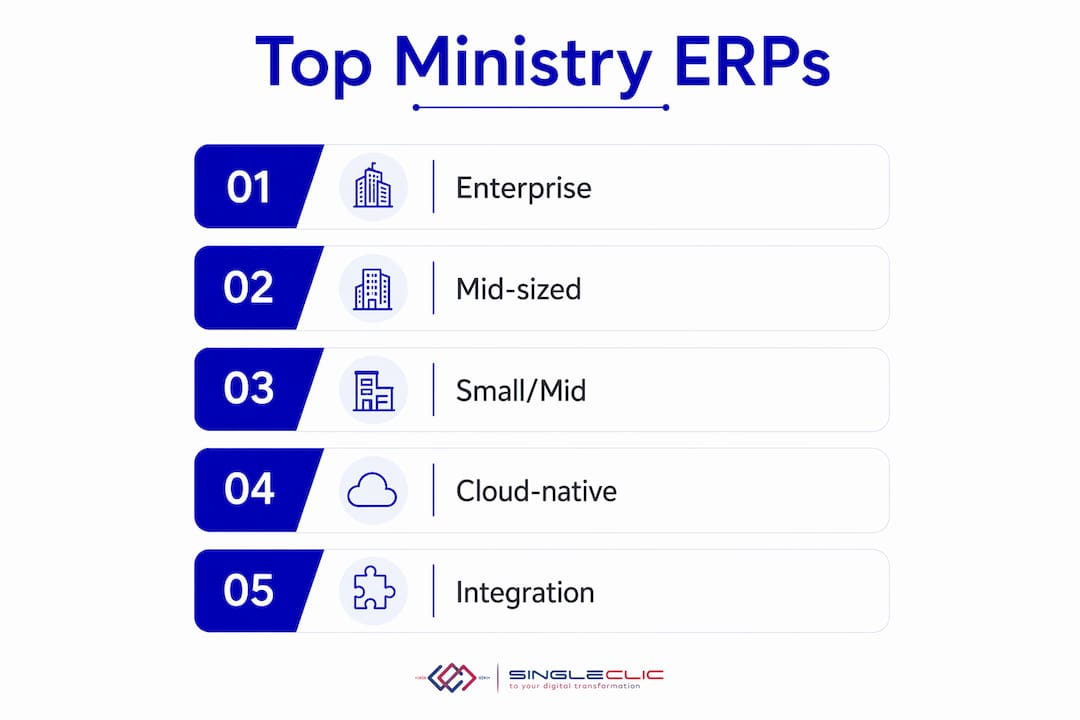
Enterprise ERP platforms for large ministries
Unit4 ERP treats nonprofits and religious organizations as a primary market, which shows in its module depth. Fund accounting with restricted, temporarily restricted, and unrestricted fund classes is native. HR and payroll are strong, and project management handles multi-funder program portfolios well. Pricing starts at $95/user/mo, reflecting a moderate per-user monthly fee with a total cost of ownership and implementation timeline typical for mid-market ERP projects. For religious organizations specifically, Unit4 outperforms Oracle NetSuite across HR, project management, and procurement modules, making it the stronger choice when those functions are central to ministry operations.

Oracle Fusion Cloud ERP suits large ministries where procurement-to-pay governance and multi-entity accounting are the core requirement. It handles configurable procurement workflows, budgetary control, and grant and contract spend reporting across departments. The trade-off is implementation complexity: ministry-specific workflows are not packaged as a single module, so expect significant configuration effort and change management. SAP S/4HANA sits in the same tier, adding real-time in-memory processing and particularly strong audit trails for asset management and inventory. Both platforms carry enterprise price tags and require experienced implementation partners.
Blackbaud Financial Edge NXT occupies a unique position. It is purpose-built for nonprofit fund accounting and integrates natively with Raiser’s Edge NXT for fundraising and donor management. For ministries whose revenue comes primarily from donations and grants, that tight ecosystem integration is a genuine advantage. The platform is less suited to organizations with significant earned revenue or commercial operations, where Sage Intacct’s broader ERP capabilities tend to win. Blackbaud Financial Edge NXT has an annual starting price suitable for organizations focusing on donation and grant funding.
Ministry-focused platforms for mid-sized organizations
MinistryPlatform is an enterprise-grade church management and ERP platform designed specifically for large ministries. It combines workflow automation with financial management, making it a strong fit when you need both operational coordination and fund accounting in one system. Realm (ACS Technologies) takes a similar approach, pairing native fund accounting with member management and giving history. Churches already in the ACS ecosystem will find the transition natural. The main limitation is that integrations with outside systems often rely on file imports rather than real-time sync.
ShelbyNext Financials was built for church finance workflows from the ground up. It supports multi-campus setups, advanced reporting, and true fund accounting. It assumes an experienced finance person is running it day to day, so smaller congregations without that capacity can find it demanding. ParishSOFT handles diocesan and multi-entity reporting cleanly, with strong donor management and fund accounting support. It scales well for larger Catholic and faith-based organizations managing multiple parishes.
FellowshipOne focuses on membership lifecycle management, including integrated giving, group management, and attendance tracking. Church Community Builder takes a CRM-driven approach to community engagement, making it a natural fit for mid-sized churches that prioritize member relationship data alongside volunteer coordination. Planning Center specializes in service scheduling and volunteer management, with a clean interface that ministry teams adopt quickly.
Accessible platforms for smaller ministries
Aplos is the clearest recommendation for small-to-mid churches that need native fund accounting without enterprise complexity. It handles restricted and unrestricted fund separation, donor tracking, and giving statements in one place, with an interface accessible enough for volunteer treasurers. Pricing starts at approximately $59/month. QuickBooks Online remains the most widely used accounting tool in smaller churches, but it requires class-based workarounds to approximate fund accounting and cannot produce a true balance sheet by fund without manual steps. For ministries with few restricted gifts, that trade-off is often acceptable.

PowerChurch Plus offers fund accounting and donor tracking in a stable desktop package with a one-time cost in the $1,000–$2,000 range, making it attractive for small congregations that prefer to avoid monthly subscriptions. ChurchTrac keeps costs low and bundles membership, giving, and basic finances, though fund accounting only comes as a paid add-on. FaithTeams blends member engagement with integrated accounting in an all-in-one package suited to small-to-mid churches.
ChMeetings, ChurchDesk, Breeze ChMS, Tithe.ly, Subsplash, Churchteams, Text In Church, and One Church Software all serve specific operational niches: communication, online giving, mobile engagement, or simple member management. None of them offer deep fund accounting, so ministries with complex financial reporting needs should treat them as complementary tools rather than ERP replacements. CharityPerfect stands out in this group for donor CRM and fundraising capabilities, including grant tracking, making it a useful tool for ministries with active development programs.
How to select the right ERP system for your ministry
Picking the wrong platform is expensive in two ways: the direct cost of the software and the indirect cost of rebuilding processes around a system that does not fit. The selection process below reduces both risks.
Step 1: Assess your operational model and current technology
Start by documenting your ministry’s core workflows: financial reporting, donor management, volunteer coordination, payroll, and grant compliance as detailed in the CRM Developer Guide. Identify where data currently lives and where the gaps are. Ministries that combine a dedicated church management system with a separate fund accounting ERP often achieve better operational efficiency than those trying to force one platform to do everything. Assessing ERP readiness before you evaluate vendors prevents the most common selection mistakes.
Step 2: Prioritize nonprofit-specific financial features
The features that separate ministry-grade ERP from generic business software are specific. Look for:
- Restricted and unrestricted fund tracking with clean separation
- Grant management with budget-to-actual reporting and OMB Uniform Guidance compliance
- FASB-compliant financial statements (Statement of Financial Position, Statement of Functional Expenses)
- Form 990 preparation support
- Donor intent compliance and contribution history
- Multi-entity consolidation for organizations with chapters or affiliates
Nonprofit ERPs emphasize fund accounting, grant tracking, and program-based budgeting as the core differentiators from standard business platforms. If a vendor cannot demonstrate these features natively, ask specifically how they handle restricted fund releases and Form 990 schedules.
Step 3: Evaluate integration with your existing systems
Your ERP needs to connect with your giving platform, donor CRM, volunteer management tools, and payroll provider. Ministries frequently integrate with platforms like Blackbaud Raiser’s Edge NXT, Salesforce NPSP, VolunteerHub, and Fluxx for grant management. Ask vendors for a list of pre-built connectors and confirm whether integrations use real-time APIs or periodic file imports. The difference matters when you need accurate giving data for Sunday’s board report.
Step 4: Analyze total cost of ownership
License cost is only one part of the budget. Add implementation fees (typically 1–2x the annual license cost), ongoing support, training, and any infrastructure costs. Cloud ERP reduces upfront capital expenditure and delivers automatic updates, which is why it is the default choice for most ministries today. On-premise deployment may still make sense for organizations with strict data residency requirements or limited internet connectivity.
Step 5: Plan for user adoption and support
Successful ERP adoption requires executive buy-in and process standardization before deployment. Ministries that skip this step often find that the software works correctly but staff revert to spreadsheets. Identify a project champion at the leadership level, involve key staff in the selection process, and build a training plan before go-live.
Pro Tip: Run a phased rollout. Start with finance and core operations, then add specialized modules like volunteer management or donor CRM. A phased approach reduces risk and gives your team time to build confidence with the system before taking on additional complexity.
Essential considerations when choosing a ministry ERP:
- Does the platform treat nonprofits or religious organizations as a primary market, or as a secondary segment?
- Can it produce a balance sheet by fund without manual workarounds?
- How does it handle restriction releases and endowment accounting?
- What is the vendor’s implementation methodology and what does post-go-live support look like?
- Does pricing scale by user count, transaction volume, or module?
- Is there a nonprofit discount program, and what does it actually cover?
What makes ERP for ministries different from standard business software?
A ministry ERP is not simply accounting software with a donation module bolted on. It is a system built around fund stewardship, program effectiveness, and mission accountability rather than profit generation. The distinction matters because the financial logic is fundamentally different.
In a standard business ERP, the general ledger tracks revenue and expenses against cost centers. In a ministry ERP, the ledger must track funds, each of which may carry donor-imposed restrictions on how the money can be spent. A gift designated for the building fund cannot legally be used for operating expenses. The software must enforce that separation automatically and report on it clearly to donors, boards, and auditors.
The difference between an ERP and a church management system (ChMS) is also worth clarifying. A ChMS like Planning Center, Breeze ChMS, or ChurchDesk focuses on member engagement, service scheduling, communication, and volunteer coordination. An ERP focuses on financial governance, procurement, HR, and compliance. Many ministries run both: a ChMS for community operations and an ERP or dedicated fund accounting platform for financial management. That hybrid approach often delivers better results than trying to find one system that does everything adequately.
Key ERP functionalities specific to ministries include:
- Fund accounting: Tracking restricted, temporarily restricted, and unrestricted funds separately
- Grant management: Budget-to-actual tracking, compliance reporting, and deadline reminders
- Donor management: Contribution history, giving statements, and donor intent compliance
- Program-based budgeting: Allocating costs across programs, departments, and locations
- Multi-entity consolidation: Unified reporting across campuses, chapters, or affiliates
- Form 990 and FASB reporting: Automated generation of required nonprofit financial statements
- HR and payroll: Staff and clergy compensation, benefits, and compliance
- Volunteer management: Scheduling, tracking, and communication
Budgeting and implementation planning for ministry ERP deployments
ERP projects for ministries are not quick wins. Full-scale implementations typically span 5–10 months, with a significant portion of that time allocated to data cleaning and standardizing internal processes before any configuration begins. Ministries that underestimate this phase are the ones that go over budget and over schedule.
What to budget for
For mid-market platforms like Unit4 ERP or Blackbaud Financial Edge NXT, total cost of ownership typically falls in the $100K–$500K range, covering software licensing, implementation services, data migration, training, and first-year support. Smaller platforms like Aplos or PowerChurch Plus carry far lower costs, but they also serve different organizational profiles. Implementation services generally add 1–2x the annual license cost, and annual maintenance for on-premise systems typically runs 18–22% of the license fee.
Cloud ERP reduces upfront capital expenditure and shifts costs to a predictable monthly or annual subscription. That model suits most ministries, particularly those without dedicated IT infrastructure. On-premise deployment remains relevant for organizations with strict data residency requirements or unreliable internet connectivity.
Implementation phases
A realistic ministry ERP rollout follows these phases:
- Readiness assessment: Map current processes, identify data sources, and confirm executive sponsorship. This phase often surfaces process gaps that need to be resolved before software configuration begins.
- Data cleaning: Standardize chart of accounts, clean donor records, and reconcile historical fund balances. Neglecting this phase is the single most common cause of project delays.
- Configuration and testing: Build fund structures, configure approval workflows, and test financial reports against known outputs.
- Training: Train finance staff, administrators, and any volunteers who will use the system. Plan for multiple training sessions, not a single go-live workshop.
- Go-live and stabilization: Run parallel with legacy systems for at least one reporting period before cutting over fully.
Budgeting and preparatory actions to take before selecting a vendor:
- Document your current chart of accounts and fund structure
- Identify all systems the ERP will need to integrate with
- Confirm your Form 990 reporting requirements and any grant compliance obligations
- Get executive sign-off on the project scope and budget before vendor conversations begin
- Request references from similar-sized religious organizations, not just generic nonprofit references
Pro Tip: Ask every vendor for a detailed implementation project plan, not just a timeline estimate. The plan should show who does what at each phase. Vendors who cannot produce one are signaling that their implementation methodology is underdeveloped, and that risk lands on your ministry.
Expert insights on leading ERP solutions and strategic choices for ministries
The most consequential strategic question in ministry ERP selection is not which platform has the most features. It is whether your organization has standardized its processes enough to benefit from an ERP at all.
“The primary challenge for ministries selecting ERP is moving from siloed operations to unified finance, member data, and mission-impact systems. Organizations that skip process standardization before deployment end up with expensive software running on top of the same operational chaos they had before.”
— ERP Research, 9 Best ERP for Nonprofit Organizations
That observation holds across organization sizes. A small congregation that has never standardized its fund accounting will struggle with Aplos just as much as a large ministry will struggle with Unit4 if the underlying processes are not defined first.
Unit4 ERP versus Oracle NetSuite for religious organizations
Unit4 ERP is the stronger choice for religious organizations compared to Oracle NetSuite across the five modules most critical to nonprofits: Finance and Accounting, HR and Payroll, Project Management, CRM, and Procurement. Unit4 treats nonprofits as a primary market, with pricing starting at $95/user/month. Oracle NetSuite serves nonprofits as a secondary market and has weaker scores specifically in HR and Payroll and Project Management. For religious organizations managing complex multi-funder program portfolios, that gap is meaningful.
Oracle NetSuite does have an edge in CRM and is better suited to nonprofits with significant earned revenue or global operations. Its SuiteSuccess for Nonprofits edition includes pre-configured fund accounting and grant management, and it handles multi-entity and multi-currency operations well. For a ministry with international programs and commercial revenue streams, NetSuite may be the more practical choice despite the starting cost of $99/user/month.
The case for cloud-native ERP
Cloud ERP is the preferred deployment model for most US ministries in 2026. It reduces upfront capital costs, delivers automatic compliance updates, and gives staff secure access from any location. The main exception is organizations with strict data residency requirements or unreliable internet infrastructure, where on-premise or hybrid deployment may be necessary.
Low-code platforms add a layer of flexibility that standard ERP deployments often lack. Singleclic’s Cortex platform, for example, enables organizations to customize ERP workflows and connect legacy systems without bespoke software development costs. For ministries in the MENA region managing complex approval chains, multi-language requirements, or on-premise deployment constraints, that kind of adaptability can close the gap between what an ERP does out of the box and what the organization actually needs.
Avoiding the most common pitfalls
The ERP implementation timeline for nonprofits of 5–10 months assumes that data cleaning and process standardization happen before configuration begins. Organizations that treat data migration as a final-phase activity routinely extend their timelines by months. Equally, ministries that select software before standardizing their operational model, whether case-driven, task-driven, or ERP-governed, end up with a costly mismatch between the software’s logic and how the organization actually works.
For practical guidance on avoiding these failure modes, Singleclic’s ERP implementation checklist and common implementation failures resources cover the process standardization and data hygiene steps that determine whether a deployment succeeds or stalls.
How Singleclic supports ministries and nonprofits with ERP and process automation
If you are evaluating the platforms compared above and finding that none of them quite fits your operational complexity, or that the implementation risk feels high, there is a different approach worth considering.
Singleclic is a Microsoft Dynamics 365 integrator and Odoo Silver Partner with over 10 years of ERP delivery experience across the MENA region. Rather than selling you a packaged church management system, Singleclic configures enterprise-grade ERP platforms to fit your ministry’s specific fund structures, approval workflows, and reporting requirements. That means you get the financial governance of Dynamics 365 or the modular flexibility of Odoo for ministry operations without paying for features your organization will never use.
Singleclic’s Cortex low-code platform connects ERP, CRM, legacy systems, and approval workflows in one place, with full Arabic UI support and on-premise deployment for organizations with data residency requirements. For ministries managing multi-entity structures, restricted fund compliance, or complex HR workflows, that combination of enterprise ERP and configurable process automation is a practical alternative to the off-the-shelf platforms reviewed above. Learn more about Microsoft Dynamics 365 for ministries and how it compares to purpose-built church management systems.
Key Takeaways
The best ERP for ministries is the one that matches your fund accounting complexity, operational model, and budget, not the one with the most features.
| Point | Details |
|---|---|
| Fund accounting is the core differentiator | Native fund accounting with restricted/unrestricted separation separates true ministry ERPs from generic business software. |
| Unit4 leads for mid-to-large nonprofits | Unit4 ERP treats religious organizations as a primary market, with pricing starting at $95/user/month and stronger nonprofit module scores than Oracle NetSuite. |
| Implementation takes 5–10 months | ERP projects for ministries typically span 5–10 months; data cleaning and process standardization before go-live determine whether that timeline holds. |
| Hybrid ChMS plus ERP often works best | Many ministries achieve better results by combining a dedicated church management system with a separate fund accounting ERP rather than forcing one platform to do both. |
| Singleclic offers enterprise ERP configuration | As a Dynamics 365 integrator and Odoo Silver Partner, Singleclic configures enterprise ERP platforms to fit ministry-specific fund structures and approval workflows. |