TL;DR:
- To choose a CRM, vendors must demonstrate six of eight essential capabilities in a real sandbox test.
- Successful selection prioritizes adoption, practical testing, and three-year costs over flashy demos and feature lists.
Use this CRM selection checklist to short-list, test, and score vendors so you pick a system that delivers adoption and time-to-value, not just a polished demo. Copy the eight must-haves below and disqualify any vendor missing more than two.
Must-have disqualifiers:
- Contact and account management with custom fields, accessible in under three clicks
- Sales pipeline with configurable deal stages that match your actual process
- Workflow automation triggered by record changes, time delays, or external events
- Email tracking with automatic logging to the contact record, no manual entry
- Role-based access controls with field-level permissions
- Native integration with your email client, calendar, and at least one core business system
- Full data export (contacts, activities, notes, attachments) without a support ticket
- A mobile app that lets a rep update a deal stage and log a call from the field
Any vendor that cannot demonstrate at least six of these eight capabilities in a sandbox (not a scripted tour) is off the list.
Three immediate actions to start today:
- Run a pipeline stage test: take some live, anonymized deals and move them end-to-end through each shortlisted CRM. Log activities as your reps actually would. Time every step.
- Request 18-month references from each vendor, specifically from customers in your industry and at your team size. Ask about post-launch support, not just the sales experience.
- Commit to a two-week pilot with a representative team before signing any multi-year contract.
Table of Contents
- What does your CRM selection checklist need to cover functionally?
- Which advanced features are actually worth evaluating?
- Is your organization actually ready to absorb a new CRM?
- What integration and data migration checks should you run?
- How do you score vendors objectively and ask the right questions?
- What does a realistic implementation timeline and TCO look like?
- How do you run a demo and POC that actually reveal fit?
- How to use the one-page checklist and requirements template
- What does the research say you should actually prioritize?
- Key takeaways
- What Singleclic’s implementations have taught us about CRM selection
- Singleclic helps you run the evaluation, design the pilot, and deliver the implementation
- Useful sources, templates, and downloads
What does your CRM selection checklist need to cover functionally?
CRM evaluation starts with functional requirements, and the most useful way to write them is as acceptance criteria, not feature labels. “Pipeline management” tells you nothing. “A sales rep can move a deal stage and log a call activity in under 30 seconds from the mobile app” tells you exactly what to test.
The five core CRM components every checklist must address are contact management, sales force automation, marketing automation, customer service, and analytics. Here is how to translate each into testable requirements.
Sales: pipeline and deal model
| Capability | Acceptance criterion | Priority |
|---|---|---|
| Pipeline configuration | Admin can add, rename, and reorder deal stages without developer help | Must-have |
| Activity logging | Rep logs a call note in under 30 seconds from mobile | Must-have |
| Deal-type support | System supports at least two distinct pipeline types (e.g., new business vs. renewal) | Must-have |
| Forecasting | Manager sees weighted and commit-based forecast views without a custom report | Must-have |
| Duplicate detection | System flags duplicate contacts on import and on manual entry | Must-have |
Service: cases, SLAs, and knowledge base
Your service team needs case routing, SLA timers, and a shared inbox that does not require a separate tool. Verify that cases can be created from email automatically, that SLA breach alerts fire before the deadline (not after), and that agents can link a knowledge article to a case reply in one action.
Marketing: campaigns and lead scoring
Confirm that the marketing module can segment contacts by field value, trigger a nurture sequence from a deal stage change, and pass a lead score back to the sales pipeline view. If the vendor requires a separate marketing license to access these features, factor that into your total cost of ownership calculation from day one.
Shared platform capabilities
G2 review data consistently surfaces these as the capabilities users rely on most in daily work: lead tracking and lifecycle management, sales pipeline management, workflow automation, reporting and analytics, email tracking, third-party integrations, custom fields, and sales forecasting. Treat all eight as baseline requirements, not differentiators.
Pro Tip: Convert every vague requirement into a measurable acceptance criterion before your first vendor call. “Good reporting” becomes “Manager can build a pipeline-by-stage report filtered by rep and date range in under five minutes, without exporting to a spreadsheet.” That single reframe eliminates half the vendors before you schedule a demo.
Which advanced features are actually worth evaluating?
Advanced capabilities matter only when they map to a specific business need you have today or within 12 months. Buying them speculatively inflates your TCO and slows adoption.
- AI lead scoring: Worth evaluating if you have more than 500 leads per month and a defined ideal customer profile. Treat it as a nice-to-have if your team is still manually qualifying every lead.
- Configure, Price, Quote (CPQ): Necessary for businesses with complex product catalogs, tiered pricing, or approval workflows on quotes. Overkill for teams with fewer than three pricing tiers.
- Custom objects: Relevant when your data model does not fit standard contact/account/deal structures, common in healthcare, real estate, and project-based services. Ask whether custom objects require developer access or admin configuration.
- Advanced analytics and revenue intelligence: Useful for enterprise forecasting, territory planning, and pipeline health scoring. For scaling teams, a well-configured standard dashboard usually covers 90% of the need.
- Multi-region compliance and data residency: Required if you operate across jurisdictions with different data sovereignty rules, including GDPR in Europe and CCPA in California. Confirm the vendor can provide written documentation, not just a sales assurance.
- Revenue intelligence: Designed for enterprise teams that need call recording analysis, deal risk scoring, and rep coaching at scale. Evaluate it only after your core pipeline process is stable.
Watch for two vendor traps. First, AI features paywalled behind an enterprise tier that costs two to three times your current plan. Ask specifically which AI capabilities are included in the tier you are evaluating, and get that in writing. Second, per-feature pricing that looks reasonable at 20 users but escalates sharply at 100. Model your three-year cost at your projected headcount, not your current one.
Is your organization actually ready to absorb a new CRM?
A CRM selection that fails on adoption is not a vendor problem. It is an organizational readiness problem. Before you score a single vendor, run this readiness check.

Stakeholder roles
Every successful CRM deployment needs five roles filled before go-live: an executive sponsor with budget authority, a product owner who owns the requirements and acceptance criteria, a CRM administrator with dedicated capacity (not a part-time assignment), power users from sales and service who will test and train peers, and an IT or RevOps lead who owns integrations and data governance.
Process maturity assessment
| Dimension | Ready | Needs work | Not ready |
|---|---|---|---|
| Deal types documented | All deal types defined and agreed | Some deal types documented | No standard deal types |
| Pipeline stages | Stages defined with entry/exit criteria | Stages exist but criteria are informal | No standard pipeline |
| Activity logging rules | Rules written and enforced | Rules exist but inconsistently followed | No logging standards |
| Data ownership | Named owner per data domain | Partial ownership assigned | No data ownership |
| Admin capacity | Dedicated admin resource confirmed | Admin role assigned part-time | No admin identified |
| Training budget | Budget approved | Budget under discussion | No budget allocated |
| Executive sponsorship | Named sponsor with authority | Sponsor identified, authority unclear | No sponsor |
Governance checklist
Confirm decision rights before you start: who approves field additions, who owns pipeline stage changes, and who can grant user access. Document change control so that customizations go through a review before they reach production. Assign data ownership by domain (contacts, accounts, deals, activities) so that cleanup and deduplication have a named accountable party.
For organizations in KSA and UAE, CRM adoption practices often require additional attention to Arabic language support, local data residency preferences, and approval workflow alignment with regional organizational structures.
What integration and data migration checks should you run?
Integration gaps are the most common source of hidden implementation cost. Run these checks before you sign.
Native integration inventory:
- Email client (Microsoft 365 or Google Workspace): confirm two-way sync, not just outbound logging
- Calendar: bidirectional event sync with activity creation in CRM
- Marketing automation: lead score passback and list sync, not just a Zapier workaround
- ERP or finance system: account and order data sync, with field-level mapping confirmed
- Support platform: case creation from CRM contact record, status sync back to CRM
- Data warehouse or BI tool: confirm export format, frequency, and whether historical data is included
Sandbox migration test (run this before contract signing):
- Import a representative sample of 500 contacts, 200 accounts, and 100 deals with full activity history
- Validate field mapping: check that every source field lands in the correct destination field
- Check for duplicate records created during import
- Confirm activity history (calls, emails, notes) is attached to the correct contact and deal records
- Verify that custom field values survive the import without truncation or data type errors
| Migration phase | Typical duration | Owner |
|---|---|---|
| Data audit and field mapping | 1–2 weeks | IT / CRM admin |
| Sandbox import and validation | 1 week | CRM admin + sales ops |
| Duplicate resolution | 3 days | Data owner |
| Production cutover | 1–2 days | IT lead |
| Post-migration validation | 3 days | Power users |
Security and compliance bullets:
- SSO (SAML 2.0 or OAuth 2.0) confirmed and included in your pricing tier
- SOC 2 Type II report available on request, not just referenced on a marketing page
- GDPR and CCPA data processing agreements available and signed before go-live
- Encryption at rest and in transit confirmed in writing
- Role-based and field-level permissions tested in sandbox, not assumed from documentation
- Full data export (all objects, all fields, all activity history) available without a support escalation
Key selection factors include data portability and export options as non-negotiable criteria, not afterthoughts. If a vendor cannot show you a clean export of your own data during the trial, treat that as a disqualifying red flag.
How do you score vendors objectively and ask the right questions?
A CRM comparison checklist without a scoring model is just a list. Use a weighted rubric to convert subjective impressions into a ranked shortlist.

| Criterion | Suggested weight | What “good” looks like |
|---|---|---|
| Functional fit (must-haves met) | 25% | All must-haves demonstrated in sandbox |
| Ease of use / rep adoption | 20% | Rep completes core tasks in under 2 minutes without training |
| Integration depth | approximately 15% | Native connectors for all required systems, no middleware required |
| TCO over 3 years | approximately 15% | Pricing modeled at projected headcount; no surprise add-ons |
| Vendor support and SLA | approximately 10% | Named support tier, documented response times, 18-month references available |
| Customization / extensibility | approximately 10% | Admin can configure without developer; API is open at your pricing tier |
| Security and compliance | approximately 5% | SOC 2, SSO, and data export confirmed in writing |
Score each vendor per criterion, multiply by weight, and sum the totals. Adjust weights by buyer profile: SMB teams should weight ease of use and TCO higher; enterprise buyers should weight security, extensibility, and vendor support more heavily. A weighted scoring rubric applied consistently across vendors removes the risk of leadership preference overriding user feedback.
Vendor question checklist (ask these on the second call):
- Is the API open at our pricing tier, or does it require an upgrade?
- Which integrations are native, and which require a third-party middleware subscription?
- What is the exact pricing structure at 50, 100, and 200 users, including all add-ons?
- Can we export all data, including activity history and attachments, without a support ticket?
- What is your average response time for P1 issues, and is that guaranteed in the contract?
- Can you provide three references from customers in our industry who went live in the last 18 months?
Red flags that should disqualify a vendor quickly:
- API access locked to an enterprise tier you are not buying
- No export of activity history, only contact and account data
- AI features visible in the demo but not available in your trial environment
- References offered only from customers who went live more than two years ago
- Pricing that changes materially between the sales call and the written proposal
What does a realistic implementation timeline and TCO look like?
Expect implementation to run longer than the vendor’s sales deck suggests. The phases below reflect what actually happens, not what looks good in a proposal.
| Phase | Small team (under 25 users) | Mid-size (25–100 users) | Enterprise (100+ users) |
|---|---|---|---|
| Discovery and requirements | 1–2 weeks | 2–3 weeks | 4–6 weeks |
| Configuration and customization | 2–3 weeks | 4–6 weeks | 8 weeks |
| Data migration | 1–2 weeks | 2–4 weeks | 4 weeks |
| Training | 1 week | 2–3 weeks | 4–6 weeks |
| Pilot and UAT | 1–2 weeks | 2–3 weeks | 3–4 weeks |
| Cutover and hypercare | 1 week | 1–2 weeks | 2–3 weeks |
| Total | 7 weeks | 13 weeks | 25 weeks |
For a detailed breakdown of go-live milestones, the CRM implementation timeline guide covers phase-by-phase planning with Dynamics 365 and Odoo.
Cost checkpoints to confirm before signing:
- Upfront licensing: per-user per-month rate at your exact tier, confirmed in writing
- Migration cost: who owns data cleanup, and is it included or billed separately?
- Paid integrations: which connectors require an additional subscription?
- Onboarding fees: is implementation support included, or is it a separate statement of work?
- Admin headcount: does the vendor’s model assume a dedicated admin, and do you have one?
- Ongoing support: what tier of support is included, and what does an upgrade cost?
Three-year TCO hidden cost checklist:
- Per-feature add-ons (AI, CPQ, advanced analytics) not included in base pricing
- API call limits that trigger overage charges at scale
- Storage or record limits that require a paid upgrade as your database grows
- Annual price escalation clauses buried in the contract (common in multi-year agreements)
- Customization debt: configurations that require paid professional services to modify later
Pricing tiers in 2026 typically fall into Free, Starter ($9–$25/user/month), Professional ($40–$90/user/month), and Enterprise ($100–$300+/user/month). The gap between Starter and Professional is where most scaling teams get surprised. Model your three-year cost at your projected headcount before you fall in love with a platform. A detailed CRM implementation cost guide can help you build a complete budget before vendor negotiations begin.
How do you run a demo and POC that actually reveal fit?
Most vendor demos are theater. The rep controls the data, the workflow, and the sequence. You learn what the product can do in ideal conditions, not what your reps will experience on day one.
The fix is a 30-minute pipeline stage test using real, anonymized deal data. Take three active deals, strip out any identifying client information, and ask your team to run them through the CRM as they would in daily work. Log a call, move a deal stage, create a follow-up task, and pull a pipeline report. Time every step.
POC scoring sheet:
| Test area | What to measure | Score (1–4) |
|---|---|---|
| Data model fit | Do your deal types and fields map cleanly without workarounds? | |
| Automation behavior | Do triggered workflows fire correctly and at the right time? | |
| Time to complete core tasks | Can a rep log an activity in under 30 seconds? | |
| Mobile UX | Can a rep update a deal and log a call from a phone without friction? | |
| Integration fidelity | Does data sync correctly between CRM and your email/calendar? | |
| Admin configurability | Can an admin add a field or change a stage without developer help? |
Running a vendor-free rep test:
Give five to eight representative users sandbox access with no vendor present. Ask them to complete a defined task list: add a contact, create a deal, log an activity, move a deal stage, and pull a report. Collect their time-on-task and friction notes. This is the most honest signal you will get about adoption risk.
During a two-week pilot, allow vendor access only for technical support questions. Do not allow the vendor to run training sessions that mask usability problems. Your reps should be able to figure out core workflows from the interface alone.
Pro Tip: Require sandbox access and one admin-free walkthrough of the data model as a condition of your evaluation. Any vendor that insists on a guided demo before granting sandbox access is protecting a weakness. The products that hold up under unscripted testing are the ones worth buying.
How to use the one-page checklist and requirements template
A checklist only works if everyone on the evaluation team uses the same version and scores vendors at the same point in the process. Here is how to run the evaluation rhythm.
Scoring instructions:
- Score each criterion on a scale to quantify presence and usability, reflecting how well the feature meets expectations.
- Multiply each score by its assigned weight (from the scoring rubric in section 6).
- Sum the weighted scores for each vendor to produce a ranked shortlist.
- Any vendor scoring below 3 on a must-have criterion is automatically disqualified, regardless of total score.
Template storage and ownership:
- Store the shared template in a location all evaluators can access simultaneously (a shared drive or project management tool).
- Assign sections by role: sales reps complete the usability and mobile UX rows, IT completes the integration and security rows, and the product owner completes the functional fit and customization rows.
- Score vendors within 24 hours of each demo or trial session, while impressions are fresh.
Evaluation cadence:
- Pre-demo prep: confirm sandbox access, load your anonymized deal data, and distribute the task list to testers.
- During demo or trial: run the pipeline stage test, complete the POC scoring sheet, and note any workarounds the vendor suggests.
- Post-demo scoring: each evaluator submits their scores independently before a group debrief.
- Final shortlist: after all vendors are scored, the product owner presents the weighted totals to the decision group. The top two scores go to reference checks and contract review.
A phased CRM checklist covering requirements, setup, and adoption confirms that the evaluation rhythm above maps directly to how successful implementations are structured.
What does the research say you should actually prioritize?
The single most important shift in choosing a CRM system is this: prioritize fit and adoption over feature lists. Teams that evaluate for the demo rather than daily workflows consistently end up with a system their reps avoid. The feature count on a vendor’s website is not a proxy for how well the product fits your process.
For scaling businesses, time-to-value and rep adoption are the primary selection drivers. A lightweight CRM your team uses every day beats a heavy enterprise platform that requires a dedicated admin team and six months of configuration before anyone logs a deal.
Pilot acceptance criteria (use these as go/no-go gates):
- Rep adoption target: at least 80% of pilot users log at least one activity per day during the two-week pilot
- Time-to-first-value: a new rep can complete a full deal cycle (create, progress, close) without help within their first two hours in the system
- Integration pass/fail: all required integrations sync correctly with zero manual data entry required
- Mobile UX pass/fail: reps can complete their three most common tasks from a phone without accessing the desktop version
Adoption KPIs to track during the pilot:
- Daily active users as a percentage of total licensed users
- Average time to complete core tasks (log activity, update deal stage, create contact)
- Pipeline update rate: percentage of open deals updated at least once per week
- Support ticket volume: number of “how do I do X” questions submitted during the pilot period
Pro Tip: If your pilot adoption rate falls below 60% in week one, do not extend the pilot. The data is already telling you something. Either the product has a usability problem, or your team has not been given enough context to evaluate it fairly. Diagnose which one before you invest more time.
Avoiding common post-launch failures requires the same discipline applied during selection. The implementation failure patterns that Singleclic sees most often trace back to skipped readiness steps and underweighted adoption criteria during the vendor evaluation.
Key takeaways
A CRM selection that prioritizes rep adoption, hands-on testing, and total cost of ownership over feature lists and vendor demos produces faster time-to-value and lower three-year cost.
| Point | Details |
|---|---|
| Disqualify fast | Any vendor that cannot demonstrate at least six of your eight must-haves is off the list before the demo. |
| Test with real deals | A 30-minute pipeline stage test with anonymized data reveals fit problems that scripted demos hide. |
| Require 18-month references | Ask for recent references in your industry and at your team size before signing any contract. |
| Model three-year TCO | Price at projected headcount and include add-ons, migration, and admin cost from day one. |
| Singleclic for implementation | Singleclic delivers CRM discovery, pilot design, and Microsoft Dynamics 365 or Odoo implementation with Cortex low-code integration for complex environments. |
What Singleclic’s implementations have taught us about CRM selection
The most consistent pattern across CRM projects is that organizations spend 80% of their evaluation time on features and 20% on adoption readiness. The projects that go well invert that ratio.
Two patterns stand out from Singleclic’s delivery work. In one mid-size services organization, the evaluation team had shortlisted a platform with strong marketing materials and a compelling demo. The pipeline stage test, run with real deal data in a sandbox, revealed that their non-standard deal structure required three workarounds just to log a standard activity. They switched to a different platform in week two of the pilot. The implementation went live on schedule. In a second case, a healthcare organization in the region prioritized data residency and role-based access controls as hard requirements from day one. That decision eliminated two vendors immediately and shortened the evaluation by three weeks.
For organizations in KSA and UAE where integration complexity is a real risk, Singleclic’s Cortex low-code platform connects CRM approvals, ERP data, legacy systems, and workflow automation without requiring custom development for every integration point. That matters most when your CRM needs to talk to a government portal, a local banking system, or an on-premise ERP that predates modern API standards. CRM selection considerations for KSA and UAE differ meaningfully from US-market guidance, particularly around Arabic UI requirements, data sovereignty, and approval workflow design.
The vendors that hold up under unscripted testing, deliver clean 18-month references, and price transparently at scale are a short list. Your job is to find them before you sign, not after.
Singleclic helps you run the evaluation, design the pilot, and deliver the implementation
Singleclic’s CRM practice gives you a faster path from checklist to go-live, without the guesswork that comes from running a vendor evaluation without a reference point. The concrete advantage: you get a structured discovery workshop that converts your requirements into a scored vendor shortlist in two weeks, not two months.
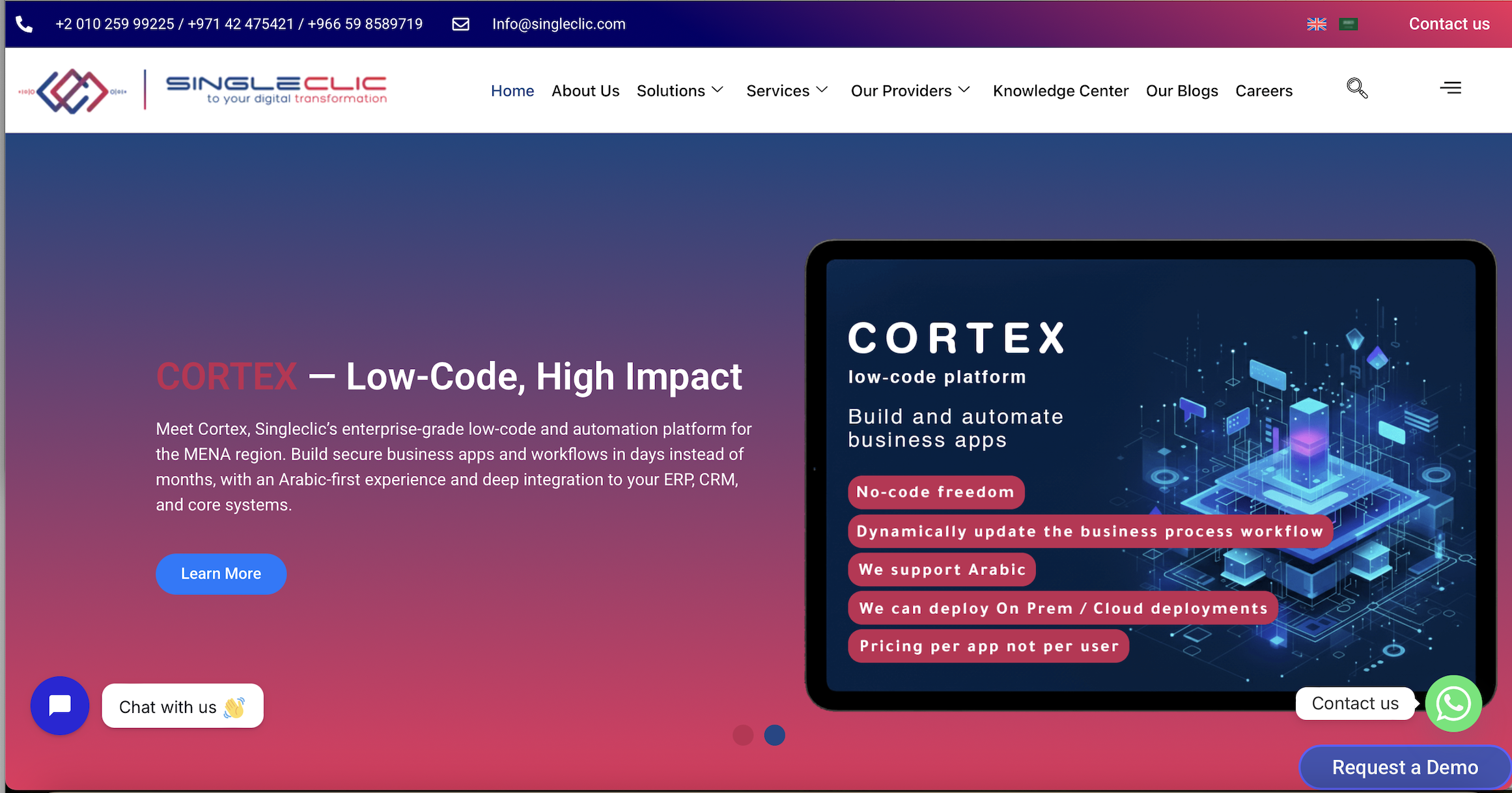
The engagement model is straightforward. A discovery workshop produces your requirements matrix and weighted scoring rubric. A pilot design engagement sets up your sandbox, loads your anonymized data, and runs the two-week rep test with your team. Implementation and change management follow a proven phase plan, with Microsoft Dynamics 365 and Odoo as the primary delivery platforms. Where integration complexity is a risk, Cortex handles the connections between CRM, ERP, approvals, and legacy systems without custom code for every touchpoint.
Outcomes from Singleclic engagements include implementations delivered within the phase timelines outlined in this article, adoption rates that meet or exceed the 80% pilot threshold, and integration deployments that eliminate manual data entry between CRM and core business systems. To start your evaluation with a structured workshop, contact Singleclic directly at singleclic.com.
Useful sources, templates, and downloads
| Resource | What it covers | Where to find it |
|---|---|---|
| Buyer’s checklist and pipeline test guide | buyer checklist with pipeline stage testing and must-have scoring | rework.com buyer checklist |
| CRM evaluation criteria and weighted rubric | Scoring rubric with suggested weights and “what good looks like” per criterion | rework.com evaluation criteria |
| CRM checklist template (phased) | Phased checklist covering requirements, setup, migration, and adoption | pipedrive.com checklist |
| CRM features list backed by G2 data | features users rely on most in daily work, ranked by G2 review frequency | learn.g2.com CRM features |
| CRM evaluation step-by-step guide | evaluation process with usability testing and vendor scoring | vtiger.com evaluation guide |
| Implementation timeline and TCO guide | Phase-by-phase timeline and full budget model for Dynamics 365 and Odoo | Singleclic implementation timeline |
| CRM implementation cost and TCO | Budgeting, TCO, and ROI guidance for CRM projects | Singleclic cost guide |
| Singleclic discovery workshop and pilot | CRM evaluation workshop, pilot design, and implementation services | singleclic.com |