HL7 and FHIR are not rivals in the way the search query suggests. HL7 is the standards organization, Health Level Seven International, and FHIR is one of the standards it publishes, alongside HL7 v2, v3 and CDA. The real decision is between the older HL7 v2 message feeds and FHIR’s API-based approach. Most healthcare organizations in the UAE will run both, and this guide shows where each belongs.
TL;DR
- HL7 is the organization and the family of standards. FHIR is its newest standard, built around web APIs and discrete data “resources.”
- HL7 v2 carries real-time feeds such as admissions, orders and lab results. FHIR suits app, portal and data-access use cases.
- Dubai’s DHA standard recommends HL7 v2 for accessing and submitting data and expects health information systems to also support FHIR.
- For most providers the practical answer is both, joined by an integration layer and a clear data mapping plan.
- Start from your workflows and your regulator’s requirements, not from which standard sounds more modern.
Table of Contents
- Article details
- What HL7 and FHIR actually are
- How HL7 v2 works and where it is used
- How FHIR works
- HL7 v2 vs FHIR: side-by-side comparison
- When to use HL7 v2, FHIR, or both
- What the UAE requires: the Dubai DHA standard
- What a real HL7 or FHIR project involves
- Use cases: where each standard fits
- Our perspective
- How Singleclic helps
- Connect your clinical and business systems with Cortex
- A short decision path
- FAQ
- Sources
Article details
- SEO title: HL7 vs FHIR: how they differ and which to use
- Slug: hl7-vs-fhir
- Primary keyword: HL7 vs FHIR
- Secondary keywords: FHIR vs HL7, HL7 or FHIR, HL7 v2 vs FHIR, healthcare interoperability standards, healthcare system integration UAE
- Pillar cluster: Healthcare IT and system integration, supported by ERP/CRM integration, workflow automation and Cortex low-code
What HL7 and FHIR actually are
Health Level Seven International (HL7) is a standards body. According to the NLM health data standards tutorial, it has more than 1,600 members from more than 50 countries, including over 500 corporate members such as providers, government stakeholders, payers, vendors and consulting firms. It produces several standards, including V2, CDA and FHIR, and each was built on the lessons of the one before.
So when someone asks “HL7 or FHIR?”, they usually mean one of two things:
- HL7 v2, the message format most hospital systems have spoken for decades.
- FHIR (Fast Healthcare Interoperability Resources), the newer standard that models health data as resources you can read and write through an API.
CDA is a third generation worth knowing, because it carries clinical documents. HL7 v3 sits mostly in the history column for new projects.
How HL7 v2 works and where it is used
HL7 v2 is a messaging standard. One system sends a structured message, such as “patient admitted,” and another system receives it and acts. The HL7 v2 product brief describes v2.x as the workhorse of clinical data exchange, first released in October 1987. HL7 reports that 95% of U.S. healthcare organizations use it and that more than 35 countries have implementations.
The NLM tutorial on HL7 v2 lists the common message types:
- Patient movement: admission, discharge and transfer
- Orders, for example to laboratories or pharmacies
- Test results and clinical reports
- Billing and scheduling
- Public health reporting, including disease surveillance and immunization tracking
The same page explains why v2 endures: it is easy to use, understand and implement, and it works well inside one organization where everyone can agree on which data elements are exchanged.
That last point is also where v2 needs care. Because teams agree on fields locally, two hospitals can both say “HL7 v2” and still need a specification and mapping exercise before their systems understand each other.
How FHIR works
FHIR takes a different route. Instead of pushing a message when an event happens, it exposes data as resources, such as Patient, Encounter, Observation or Medication, that applications can request and update.
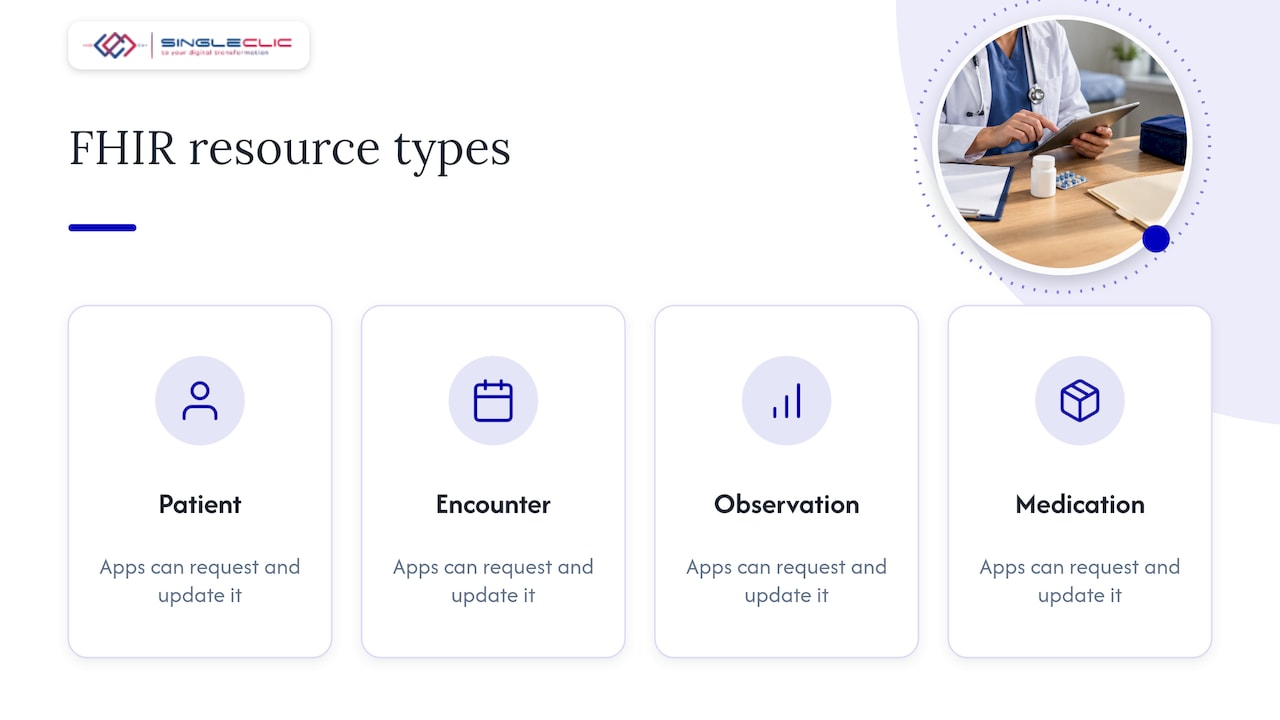
The FHIR RESTful API specification defines a set of interactions on those resources: read, search, create, update, delete and history, plus whole-system interactions such as batch and transaction. Servers publish a capability statement that tells client applications which resources and interactions they support. The same page notes FHIR resources use XML and JSON content types, which is why web and mobile developers find it familiar.
Is HL7 a type of API?
Not in the sense most people mean. HL7 v2 is a message standard, usually moved over point-to-point connections through an interface engine. FHIR is the HL7 standard that defines a web API. So “is HL7 an API?” has a split answer: HL7 the organization is not, HL7 v2 is not, and FHIR is.
HL7 v2 vs FHIR: side-by-side comparison
| Criterion | HL7 v2 | FHIR |
|---|---|---|
| First released | October 1987 | Later generation of HL7 standards, designed around web APIs |
| Exchange model | Event-driven messages between systems | Resources accessed through a RESTful API |
| Typical use | Admissions, orders, results, billing, scheduling inside and between organizations | Apps, portals, patient access, data sharing, new integrations |
| Formats | Delimited message syntax | JSON and XML |
| Learning curve for developers | Needs HL7 expertise and local mapping | Familiar to web developers |
| Where it dominates | Established hospital, lab and pharmacy feeds | New builds and external API access |
| Coexistence | Will continue for a long time | Designed to cover what v2, v3 and CDA do |
HL7’s own FHIR comparison page says FHIR can satisfy the needs covered by v2, v3 and CDA, and often adds ease of interoperability. It also says it is unclear how fast, or even whether, the market will migrate, and that most of these standards will likely exist in parallel for quite some time. HL7 has committed to maintaining existing standards for as long as its membership requires.
That is the most useful sentence in the whole debate: you are not choosing a winner, you are choosing where each standard earns its place.
When to use HL7 v2, FHIR, or both
A practical rule from one operator-focused guide: v2 carries today’s feeds, FHIR carries tomorrow’s APIs, CDA carries documents, and v3 is mostly history. For most organizations the honest answer to “which one do I need?” is both.
Use HL7 v2 when:
- Your laboratory, radiology, pharmacy or hospital partners already send and receive it.
- You need real-time event feeds, such as admit, discharge and transfer notifications.
- A working interface already exists and replacing it adds risk without adding capability.
Use FHIR when:
- You are building a patient app, portal or analytics layer that needs on-demand access to data.
- You want a modern API your developers can consume without learning legacy message syntax.
- A regulator or exchange platform asks for FHIR-based interfaces.
Use both when:
- Your core clinical systems speak v2 and your new digital front door speaks FHIR. This is the most common situation.
What the UAE requires: the Dubai DHA standard
For a UAE reader, the standard that matters most is the Dubai Health Authority’s Standards for Interoperability and Data Exchange (document code DHA/HISHD/ST-02, Issue 2). Issued on April 2, 2025 and effective from July 2, 2025, it names HL7 v2.x, HL7 v3, HL7 CDA R2 and HL7 FHIR R4 as the standards in scope.
Three points from it shape your plans:
- HL7 v2 is the recommended standard for accessing and submitting data (clause 5.2).
- Health information systems should also support FHIR and IHE messaging standards (clause 5.3).
- All facilities integrating with or accessing the HIS must adhere to DHA regulations and UAE laws (clause 5.1).
The FHIR-based interface in the standard specifies APIs for areas including Patient, Encounter, Allergies, Condition, Procedure, Medications, Immunizations, Observations, Results and Clinical Documents. The standard applies to DHA-licensed public and private healthcare facilities in the Emirate of Dubai, in support of the NABIDH health information exchange.
A compliance guide for Dubai clinics adds that the standard sits alongside IHE profiles such as PIX, PDQ, XDS.b and XDS-SD, plus the FHIR-based PDQm and PIXm, and that clinical coding is governed by a separate standard naming ICD-10-CM, SNOMED CT and LOINC.
If your facility is outside Dubai, check which emirate-level or national requirements apply to you before you finalize an architecture. The Dubai standard is a clear reference point, but it is not a universal UAE rule.
What a real HL7 or FHIR project involves
When a vendor says “that will require an HL7 interface,” the work typically includes:
- Two endpoints, for example your EHR and a partner system.
- An interface engine, middleware that receives, translates, filters and routes messages.
- A specification and mapping exercise: agreeing which fields carry which data, mapping codes and testing edge cases.
- Ongoing monitoring, because feeds can fail quietly and you need alerts when messages stop flowing or start erroring.
Budget for all four. Teams that plan only for the build usually discover the monitoring gap in production.
Questions to answer before you start
- Does your facility fall within the scope of the DHA standard, or another regulator’s requirements?
- Which of your systems already speak v2, and which expose or consume FHIR?
- Which data must be exchanged in real time, and which can be fetched on demand?
- Who owns code mapping, and are you aligned to the coding standards your regulator names?
- Who is alerted when a feed stops, and how fast do they respond?
Use cases: where each standard fits
Hospital to laboratory ordering and results. This is a classic v2 flow. Orders go out, results come back, and the feed already works across many vendors.
Patient app showing appointments and results. An API-first need. FHIR resources such as Patient, Observation and Encounter map directly to what the app shows.
Submitting data to a health information exchange. Here the regulator’s specification governs. In Dubai that means following the DHA standard’s v2 recommendation and its FHIR support expectation.
Connecting the EHR to ERP, CRM and workflow tools. Billing, procurement, patient engagement and approvals often sit outside the EHR. A FHIR or v2 integration layer feeds them without replacing the clinical system.
Analytics and AI. Discrete FHIR resources are easier to query than free-form messages, which helps when you build dashboards or train models on clinical data.
Our perspective
We see the same mistake in healthcare IT programs across the Gulf: treating HL7 and FHIR as a choice between old and new. In practice, hospital and clinic estates are mixed. Lab systems, radiology, pharmacy and the core EHR speak one dialect, while the patient app, the ERP and the analytics layer speak another.
Our advice is to design for the whole estate. Keep the v2 feeds that work, expose FHIR where new applications and regulators need it, and put a governed integration and workflow layer between them so that no single system becomes a bottleneck.
That is where Cortex, our Arabic-enabled, on-premise low-code platform, fits. It connects approvals, ERP, CRM, data, legacy systems and workflows, and its on-premise deployment suits organizations that must keep data inside their own environment. Interoperability is not a one-off interface. It is a living process that needs monitoring, change control and clear ownership.
Tamer Badr
How Singleclic helps
We work with healthcare and government organizations across the UAE, Saudi Arabia and Egypt, including Emirates Health Services, Dubai Healthcare City and Saba medical clinics in Jeddah. Our teams connect clinical and business systems so that data moves where it is needed.
In an HL7 and FHIR context, that typically means:
- Integration planning: mapping your current systems, feeds and regulator requirements before any build starts.
- System integration: connecting your clinical platform with Dynamics 365 or Odoo for finance, supply chain, HR and patient engagement. See our Dynamics 365 integration services and our guide to Dynamics 365 for healthcare, which covers gains without replacing the EHR.
- Workflow automation: turning approvals, referrals and exceptions into governed, monitored processes through business process automation.
- Legacy connectivity: linking older systems to new platforms, as discussed in tools that simplify legacy-to-cloud integration.
- Analytics and AI: building on the data once it flows, as covered in AI and analytics in healthcare transformation.
For a broader view of our sector work, see our healthcare solutions and IT solutions for the healthcare sector.
Connect your clinical and business systems with Cortex
If your team is weighing HL7 feeds, FHIR APIs and the workflows around them, our Cortex low-code platform gives you one place to design, automate and change those processes. It supports a full Arabic interface, unlimited users, deep enterprise system integrations, runtime workflow changes without downtime and on-premise deployment for banks and governments.
To discuss your integration roadmap, contact the team through singleclic.com and tell us which systems you need to connect.
A short decision path
- Confirm your regulatory scope. In Dubai, start with the DHA standard and its clauses on HL7 v2 and FHIR.
- Inventory your interfaces. List every feed, its standard, its owner and its failure alerts.
- Keep what works. Leave stable v2 feeds in place unless a clear need justifies change.
- Add FHIR where APIs create value. Patient access, apps, analytics and exchange platforms are the usual starting points.
- Plan the integration layer. Choose where translation, routing and monitoring will live.
- Automate the surrounding workflows. Approvals, exceptions and handoffs need owners and service levels as much as the data does.
FAQ
What is the difference between HL7 and FHIR?
HL7 is the standards organization and the family of standards it publishes, including v2, v3, CDA and FHIR. FHIR is the newest of them and exposes health data as resources through a web API. HL7 v2, by contrast, exchanges event-driven messages between systems.
Is FHIR replacing HL7 v2?
Not quickly. HL7’s own comparison says FHIR can meet the needs of earlier standards, yet it expects them to exist in parallel for quite some time. In Dubai, the DHA standard recommends v2 for data access and submission and expects FHIR support as well.
Is HL7 a type of API?
No. HL7 v2 is a message standard, usually moved through an interface engine. FHIR is the HL7 standard that defines a RESTful API, with interactions such as read, search, create and update on resources.
Which standard should a Dubai healthcare facility follow?
Facilities within the DHA standard’s scope should follow it: HL7 v2 is the recommended standard for accessing and submitting data, and systems should also support FHIR and IHE messaging standards. Confirm your scope and any additional rules with DHA.
Can we use FHIR without replacing our EHR?
Yes, in many cases. An integration layer can expose FHIR interfaces on top of existing systems while v2 feeds continue to run underneath. We cover this approach for Dynamics 365 in our guide on adding value without replacing the EHR.
Sources
- Health Data Standards and Terminologies: A Tutorial, HL7 overview (NLM)
- Health Data Standards and Terminologies: A Tutorial, HL7 v2 (NLM)
- HL7 Standards Product Brief: HL7 Messaging Standard v2
- FHIR RESTful API specification (HL7)
- FHIR comparison with other HL7 standards (HL7)
- Standards for Interoperability and Data Exchange, DHA/HISHD/ST-02
- NABIDH compliance for Dubai clinics
- HL7 Explained: Standards, Messages and FHIR