Start with a monolith or modular monolith. Adopt microservices only when you have a concrete driver: divergent scaling needs across services, a regulatory requirement for hard isolation, or an engineering organization already past roughly 150 people with a dedicated platform team. Below, you’ll find a technical comparison, an eight-point checklist, and Singleclic’s take on running this decision inside enterprise environments in the Gulf.
TL;DR:
- Microservices only justify themselves when teams exceed 150 engineers, face 10x or greater load divergence, or require strict data residency and regulatory isolation.
- Transitioning from a monolith to microservices involves long migration timelines, complex testing, and significant operational overhead, especially after surpassing a handful of services.
- For smaller teams under 30, or up to 150 with clear domain boundaries, a modular monolith offers faster delivery and simpler maintenance, with less infrastructure complexity.
- Data consistency challenges in microservices demand eventual consistency or complex distributed transactions, which can increase system complexity and risk of data drift.
- Many enterprises in regulated industries prefer modularizing around existing platforms like Microsoft’s Dynamics 365 or Odoo instead of full microservices, reducing operational costs and migration risks.
Table of Contents
- Microservices vs monolith: what each term actually means
- The tradeoffs that actually move the needle for your business
- When to actually choose monolith, modular monolith, or microservices
- The modular monolith and how to migrate without breaking everything
- What microservices actually cost to operate
- An eight-question checklist to decide right now
- How Singleclic advises enterprises on this decision
- Testing gets harder before it gets better
- Data consistency doesn’t get easier, it gets distributed
- Security boundaries shift depending on which way you split
- A pragmatic take heading into 2026
- How Singleclic helps you modernize without overbuilding
- Sources
- FAQ
Microservices vs monolith: what each term actually means
A monolithic architecture is one deployable unit: a single codebase, one database, one release pipeline. A modular monolith keeps that single deployment but enforces internal boundaries between domains, so modules can’t reach into each other’s data uncontrolled. Microservices architecture splits the system into independently deployable services, each owning its own data store and talking to others over the network, typically via REST or messaging queues, as Atlassian’s architecture comparison frames it.
The practical differences show up in four places:
- Data ownership: monolith shares one schema; microservices give each service its own store, which means no cross-service joins and no shared transactions.
- Communication: in-process function calls in a monolith versus network calls (HTTP, gRPC, or event streams) between services.
- Deployment: one artifact ships at a time in a monolith; each microservice ships independently, on its own schedule.
- Testing: monolith tests run against one process; microservices require contract tests and integration environments that simulate a distributed system.
You’ll find monoliths underneath most early stage SaaS products and internal enterprise tools. Modular monoliths show up in mid-size platforms that have outgrown a tangled codebase but haven’t hit the scale that justifies splitting deployments. Microservices dominate at companies like Netflix and in the Shopify-style pattern, where hundreds of engineering teams need to ship independently without blocking each other, according to GeeksforGeeks’ architecture breakdown.
The tradeoffs that actually move the needle for your business
A monolith gets you to market faster. One codebase means one CI/CD pipeline, one deployment target, and strong data consistency because everything lives in a single transaction boundary. The tradeoff is real: scaling limits kick in when different parts of the app have wildly different resource needs, and you can get locked into one language or framework across the whole system.
Microservices advantages run the other direction. Teams gain autonomy to ship on their own schedule, services scale independently based on actual load, and a failure in one service doesn’t necessarily take down the rest. The microservices disadvantages are just as concrete:
- Observability gets harder. You need distributed tracing to follow a single request across a dozen services.
- API versioning becomes a permanent job, not a one-time task.
- Operational cost rises because every service needs its own monitoring, deployment pipeline, and on-call rotation.
AI-assisted code generation and automated testing have quietly extended the practical lifespan of monoliths, easing some of the cognitive load that used to push teams toward splitting too early, per Pluralsight’s analysis of the tradeoff. But automation doesn’t repeal network physics.
The distributed-system tax is real and it’s not small. Industry guidance pegs the operational overhead of running microservices, tracing, deployment coordination, service mesh maintenance, at a meaningful share of total engineering capacity once service count grows past what a platform team can automate, according to The HLD Handbook’s breakdown of the distributed-system tax.
When to actually choose monolith, modular monolith, or microservices
Team size is the strongest predictor of which architecture will serve you well, and it lines up with a version of the two-pizza rule: teams small enough to feed with two pizzas can usually own a service end to end without excess coordination overhead.
- Under 30 engineers: default to a monolith or modular monolith. You don’t have the headcount to staff a platform team, and coordination overhead from microservices will outweigh any autonomy benefit.
- 30 to 150 engineers: this is modular-monolith territory for most organizations. You’re big enough to need boundaries, not yet big enough to justify N separate deployment pipelines.
- 150+ engineers with distinct scaling needs: microservices start paying off, especially when one part of the system faces 10x the load of another, or when a workload is CPU-bound and needs to scale independently from the rest.
- Regulatory isolation or data residency requirements: a hard driver regardless of team size. If a payments or health-records module must sit in its own security boundary, that’s a legitimate reason to extract it early.
- DevOps maturity check: if you don’t have automated CI/CD, centralized logging, and at least basic tracing today, build those first. Microservices without that foundation just multiply the pain.
The modular monolith and how to migrate without breaking everything
A modular monolith is a single deployable app with strict internal walls. Each domain module owns its own tables and exposes a defined interface. Tools like Packwerk for Ruby or ArchUnit for Java enforce those boundaries at build time, so a developer physically can’t import another module’s internals without the build failing. ZenDevy’s 2026 decision guide treats this as the safest starting posture for most teams, since it reduces the risk of extracting a service before you actually understand its boundaries.
When extraction is warranted, the strangler fig pattern is the standard approach:
- Identify a well-bounded capability, file processing, search, or payments are common first candidates because they have narrow interfaces and clear data ownership.
- Stand up the new service alongside the monolith and route a slice of traffic to it.
- Use an outbox pattern to publish events reliably as you migrate data, avoiding dual writes that silently drift out of sync.
- Cut over fully once the new service has proven itself under production load, then retire the old code path.
Migration timelines commonly run months to years rather than weeks, and coexistence between old and new systems during that window is normal, not a failure state, as Scalarly’s decision framework notes from patterns at companies like Shopify and Spotify.
Pro Tip: Watch for the distributed monolith anti-pattern: services that deploy independently but still share a database or require synchronized releases. If two “microservices” can’t ship without coordinating a deploy, you’ve paid the network tax without gaining any of the autonomy.
What microservices actually cost to operate
The infrastructure list for microservices is longer than most teams expect going in. You need distributed tracing and log correlation just to debug a single user request, an APM tool to catch latency regressions before customers do, and often a service mesh to manage mTLS and traffic routing between services.
- Distributed tracing and centralized log correlation (non-negotiable past a handful of services).
- CI/CD pipelines multiply, one per service, each needing its own maintenance.
- API gateway, service mesh, and health-check infrastructure become platform-team responsibilities, not app-team ones.
- On-call rotations expand because failure domains multiply even as blast radius shrinks.
Industry guidance puts the distributed-system tax at roughly 30 to 50 percent of engineering capacity once service sprawl outpaces platform automation, a threshold The HLD Handbook ties directly to whether a dedicated platform team exists. Not every application needs this. Plenty of systems never approach the transaction volume where per-service scaling pays for itself, a point global e-commerce scale data puts in perspective: massive scale is the exception, not the baseline. Pilot with one extracted service before building out a full platform team.
An eight-question checklist to decide right now
Score each item yes or no. Four or more “yes” answers point toward microservices being worth the investment; fewer than four means stay modular monolith.
- Do you have more than 150 engineers, or are you approaching that threshold within 12 months?
- Do different parts of your system see load that diverges by 10x or more?
- Does a regulator require hard data isolation for one module (payments, health records, financial reporting)?
- Do you already have automated CI/CD, centralized logging, and basic tracing in production?
- Are your domain boundaries clear enough that a module could own its own database today?
- Can the business absorb higher infrastructure and staffing cost for the next 12 to 18 months?
- Is any part of the system latency-sensitive in a way that shared deployment currently blocks?
- Does leadership have the appetite for a multi-quarter migration, not a quick win?
If you pilot an extraction, track deployment frequency, mean time to recovery, and whether the new service’s on-call load actually dropped compared to the monolith. If those numbers don’t improve within two release cycles, the split wasn’t the right call yet.
How Singleclic advises enterprises on this decision
Singleclic works across banking, healthcare, real estate, and government projects in Saudi Arabia and the UAE, environments where regulatory isolation and legacy integration usually matter more than theoretical scale. That context shapes how we approach this decision with clients: an architecture assessment first, then a scoped pilot before any full migration commitment.
For many of these organizations, the more useful move isn’t a full microservices rebuild. It’s modularizing around Cortex, Singleclic’s Arabic-enabled, on-premise low-code and Open BPM platform, which connects approvals, ERP, CRM, data, and legacy systems without requiring a ground-up rewrite. Cortex supports runtime workflow changes without downtime, which gives enterprises a governed way to extract and evolve specific processes on their own timeline. Paired with Microsoft Dynamics 365 or Odoo implementations, this typically means fewer moving parts than a full microservices platform build, and a shorter path to a working pilot.
Testing gets harder before it gets better
A monolith’s test suite runs in one process. You spin up the app, hit an endpoint, and assert on the response, no network calls to mock, no service boundaries to fake. Integration tests are cheap because everything lives in the same memory space and the same transaction.
Microservices break that simplicity apart. You now need contract testing to verify that a service’s API still matches what its consumers expect, since a schema change in one service can silently break another team’s code without either side noticing until production. Tools built around consumer-driven contracts (the Pact family is the common industry choice) catch this before deployment rather than after. You also need a way to run integration tests across multiple services at once, which usually means either a shared staging environment that’s expensive to keep in sync, or service virtualization that fakes downstream dependencies convincingly enough to trust the results.
End-to-end tests in a microservices environment are slower, flakier, and more expensive to maintain than the equivalent monolith test, because a single failing test might mean any one of ten services misbehaved, not one. Most mature microservices teams solve this by leaning harder on unit tests and contract tests within each service, and treating full end-to-end suites as a smaller, slower safety net rather than the primary testing layer. That shift in testing philosophy is often more disruptive to a team’s habits than the architectural change itself, and it’s worth planning for explicitly rather than discovering mid-migration.
Data consistency doesn’t get easier, it gets distributed
A monolith’s biggest quiet advantage is the database transaction. Update three tables in one request, and either all three commit or none do. That guarantee disappears the moment data ownership splits across services.
Microservices force a choice between two imperfect options. You either accept eventual consistency, where a change in one service propagates to others asynchronously and there’s a window where the system is technically out of sync, or you build distributed transactions using patterns like Sagas, which coordinate a sequence of local transactions with compensating actions if a step fails partway through. Neither is free. Eventual consistency means your application logic has to tolerate stale reads. Sagas mean you’re writing rollback logic by hand for scenarios a database transaction used to handle for you automatically.
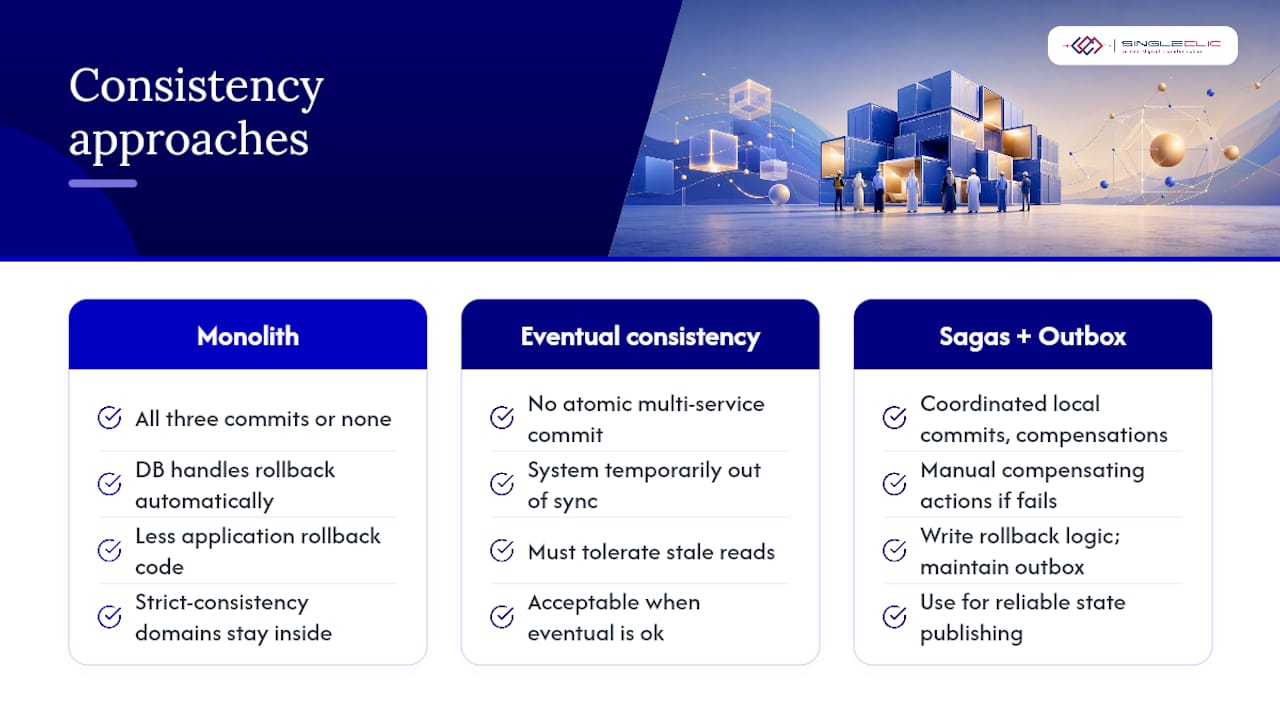
This is where the outbox pattern mentioned earlier in migration planning becomes a permanent architectural fixture, not a one-time migration tool: it’s how services publish state changes reliably without dual writes silently drifting apart. Teams that skip this step often discover data drift months later, usually during an audit or a customer complaint about a balance that doesn’t match across two systems. If your domain has strict consistency requirements, financial ledgers, inventory counts, anything where “probably in sync” isn’t good enough, that’s a strong signal those specific modules should stay together in a shared transaction boundary even if the rest of the system splits out.
Security boundaries shift depending on which way you split
A monolith’s attack surface is comparatively simple: one perimeter, one authentication layer, one set of firewall rules to get right. Get that boundary correct and most of your security work is done. The risk is concentration. A vulnerability anywhere in the codebase potentially exposes the entire application, since everything runs in the same process with the same permissions.
Microservices trade that concentrated risk for a wider, more complex surface. Each service-to-service call is a network hop that needs its own authentication, typically mutual TLS (mTLS) so services verify each other’s identity rather than trusting the internal network by default. That’s more infrastructure to configure correctly, but it also means a compromised service doesn’t automatically hand an attacker the keys to everything else. Fault isolation and security isolation overlap here: a breach in a payments service, properly bounded, doesn’t necessarily reach your customer-notification service.
This is also where regulatory drivers and security architecture intersect directly. Data residency rules, common in banking and healthcare, often require certain data to live in specific infrastructure with specific access controls. Microservices make that kind of hard isolation easier to enforce cleanly, because you can lock down one service’s data store without touching the rest of the system. A monolith can achieve similar isolation with strict internal access controls and encryption at the field level, but it takes more discipline to enforce consistently, since there’s no network boundary forcing the separation. For regulated industries, this tradeoff alone sometimes tips the decision toward extracting one specific module, even when nothing else about the system calls for microservices.

A pragmatic take heading into 2026
My stance: default to the modular monolith and extract only when you can point to a measurable reason, not a hunch. AI-assisted tooling has made monoliths more livable for longer, but it hasn’t changed network latency, data consistency physics, or what a platform team actually costs to run. Run the eight-question checklist honestly, then pilot one extraction before you commit to a full rebuild.
— Tamer Badr
How Singleclic helps you modernize without overbuilding
If you’re weighing this decision for an enterprise system already tangled with legacy integrations, the honest starting point usually isn’t a from-scratch microservices platform. It’s an assessment of where your current architecture actually breaks down, followed by a scoped pilot that proves the case before you commit budget to a multi-quarter migration.
Singleclic runs these engagements around Microsoft Dynamics 365 and Odoo ERP/CRM implementations, business process automation with IBM BAW, and Cortex, an on-premise, Arabic-enabled low-code platform built for banks, government bodies, and enterprises. Cortex connects approvals, legacy systems, and workflows without forcing a full microservices rebuild, which for most clients means faster time to a working pilot and fewer new operational costs. If your team is evaluating whether to modularize an ERP or CRM system, or where system integration is creating the most friction, start with an architecture assessment built around Microsoft Dynamics 365 to see where a pilot makes sense before any larger commitment.
Sources
- Monolith vs Microservices: Team Topology, Conway’s Law, and the Distributed System Tax – The HLD Handbook
- Monolith vs microservices software architecture (Pluralsight)
- Microservices vs. monolithic architecture
- Monolithic Vs Microservices Architecture
- Modular Monolith vs Microservices: 2026 Architecture Decision Guide — ZenDevy
FAQ
Is Amazon monolithic or microservices?
Amazon famously migrated from a large monolith to microservices, and it’s often cited alongside Netflix as the reference case for large-scale microservices adoption at massive organizational size.
What is an example of a monolith?
A classic example is a single Ruby on Rails or Django application handling web requests, business logic, and database access in one deployable codebase, common in early-stage SaaS products and internal enterprise tools.
What is replacing microservices?
Nothing is replacing microservices outright, but the modular monolith has emerged as the preferred middle path for many teams, preserving single-deployment simplicity while enforcing internal domain boundaries that make future extraction safer.
Is MVC monolithic or microservices?
Model-View-Controller (MVC) is an application design pattern, not a deployment architecture, so it can exist inside either a monolith or an individual microservice; most monoliths happen to use MVC internally.
How do I know if I should migrate to microservices?
Run a concrete checklist covering team size, scaling divergence, regulatory isolation, and DevOps maturity; if you score fewer than half the drivers as genuine “yes” answers, a modular monolith remains the safer, lower-cost choice.