ERP implementation cost in Saudi Arabia ranges from SAR 15,000 for a basic small-business setup to well over SAR 1,000,000 for a large enterprise deployment. Where your project lands depends on five core variables: the platform you choose, how many modules you activate, the depth of customization required, your compliance obligations under ZATCA, and whether you deploy on the cloud or on-premise.
Here is what the full cost picture looks like at a glance:
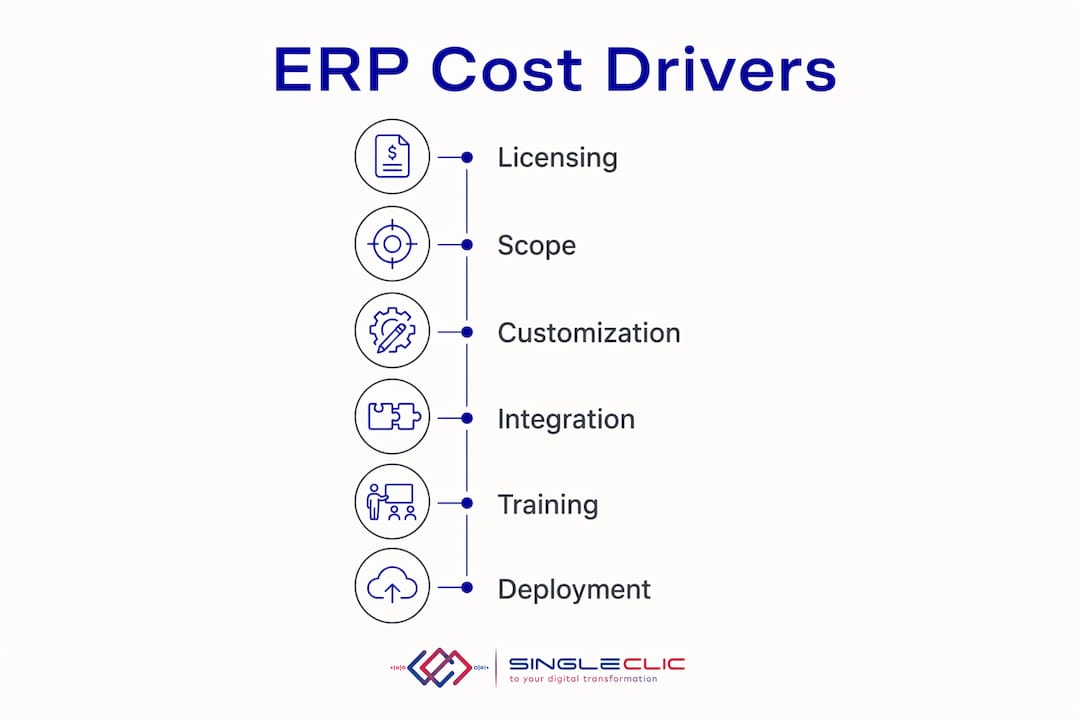
- Licensing and subscriptions: Per-user monthly fees or perpetual license costs, varying by user type and module count
- Implementation and configuration: Consulting days, project phases, and go-live support, often the largest single line item
- Customization and development: Custom workflows, Arabic UI, industry-specific reports, and third-party integrations
- Training and change management: End-user training, train-the-trainer programs, and internal adoption support
- Ongoing maintenance and support: Annual support contracts, version upgrades, and hosting fees
- Compliance costs: ZATCA e-invoicing readiness, VAT reporting modules, and Arabic localization
Each of these categories carries its own pricing logic, and they interact in ways that catch many budget owners off guard. The sections below break down each driver in detail, with realistic cost ranges by company size and practical advice for keeping your project on budget.
What drives ERP implementation costs in Saudi Arabia?
No two ERP quotes look alike, even for companies in the same industry and city. The variables below explain why, and knowing them lets you pressure-test any vendor proposal before you sign.
Licensing model and user count

Licensing fees vary by user type (admin versus standard), whether licenses are named or concurrent, and whether you choose a subscription or a perpetual model. Subscription pricing shifts cost from a large upfront payment to a predictable monthly or annual fee, which suits companies managing tight capital budgets. Perpetual licenses cost more at the start but reduce long-term recurring expenses for stable, large teams.
Scope and module selection
A finance-plus-inventory deployment costs a fraction of a full manufacturing, supply chain, and analytics suite. Every module you add brings its own configuration effort, data migration work, and testing cycles. Defining scope tightly before you go to market is the single most effective way to control your ERP implementation budget in Saudi Arabia.
Customization depth
Out-of-the-box configurations are fast and affordable. Custom workflows, Arabic-language forms, industry-specific reports, and bespoke integrations add consulting hours quickly. Implementation services can represent a substantial portion of total project cost on heavily customized deployments.
Integration requirements
Connecting your ERP to Saudi banking systems, the ZATCA Fatoorah e-invoicing portal, payroll providers, e-commerce platforms, and legacy applications each adds a discrete cost. These integrations are not optional for most Saudi businesses. ZATCA compliance alone requires tested, certified connectivity that takes real engineering time. You can find practical guidance on managing these connections in Singleclic’s ERP integration tips for MENA.
Training and change management
Quality end-user training and change management reduce implementation risk and improve adoption, but they add to upfront costs and should be budgeted as a separate line item, not absorbed into implementation days. Projects that skip this step tend to see lower adoption rates and higher post-go-live support costs.
Deployment model
Cloud ERP shifts capital expenditure to operational subscription costs. On-premise solutions require upfront hardware, networking, backup infrastructure, and disaster recovery planning. Hybrid models split the difference but add integration complexity. Government and banking clients in Saudi Arabia often prefer on-premise or private-cloud deployments for data sovereignty reasons, which affects both cost structure and vendor selection.
Realistic cost ranges by company size in Saudi Arabia
The table below reflects typical first-year total costs, combining licensing, implementation, customization, training, and initial support. These are planning benchmarks, not vendor quotes.
| Company size | Typical first-year cost (SAR) | Typical first-year cost (USD approx.) | Scope profile |
|---|---|---|---|
| Small business | SAR 15,000–SAR 50,000 | — | Accounting, invoicing, inventory, ZATCA readiness |
| Medium business | SAR 50,000–SAR 150,000+ | — | Multi-department, moderate customization, integrations |
| Large enterprise | SAR 1,000,000 | — | Full suite, manufacturing, supply chain, BI, multi-year contracts |
Small businesses in Saudi Arabia can get a working ERP covering accounting, ZATCA e-invoicing, inventory, and entry-level reporting for SAR 15,000 to SAR 50,000. These projects typically use cloud-hosted platforms with minimal customization and a small named-user count.
Medium-sized companies face a wider range because scope varies so much. A realistic three-year total cost of ownership for a mid-market Saudi company with multiple integrations and moderate customization falls between SAR 50,000 and SAR 150,000+, with customization and training commonly representing 30–60% of that total.
Large enterprises running manufacturing, supply chain optimization, business intelligence, and complex integrations can see costs exceed SAR 1,000,000, driven by licensing volume, infrastructure investment, and multi-year maintenance contracts. These projects almost always involve dedicated project management offices and phased rollouts across business units.
A few additional cost factors apply across all sizes:
- Annual support contracts typically run a notable percentage of the license value per year.
- Odoo license costs vary per user per month depending on modules and scale.
- On-premise deployments add server, networking, and backup costs that cloud deployments do not carry
- Multi-year contracts often include version upgrade fees that are easy to overlook in year-one budgets
For a deeper breakdown of how modules and integrations affect total cost of ownership, Singleclic’s practical TCO and budgeting guide covers the full picture across Dynamics 365 and Odoo deployments.
How to plan your ERP budget and avoid hidden costs
The biggest budget surprises in ERP projects are not random. They follow predictable patterns, and you can plan for most of them before a single vendor proposal arrives.
Build in a contingency from day one. ERP projects require a contingency budget to cover scope creep and data cleanup. Data migration alone, cleaning, mapping, and validating years of legacy records, regularly adds weeks of effort that was not in the original estimate. Budget for it explicitly rather than hoping it fits inside the implementation fee.
Common hidden cost categories to track:
- Data migration and cleansing labor (internal and vendor)
- Productivity loss during cutover and the first weeks post-go-live
- Internal project team time (finance leads, IT staff, department heads pulled into UAT)
- Compliance-specific development, particularly ZATCA certification and VAT reporting
- Post-go-live hypercare support, often billed separately from the implementation contract
- Future upgrade costs if you are on a perpetual license model
Structure payments around milestones. Tying vendor payments to delivered milestones (design sign-off, UAT completion, go-live) gives you leverage if the project drifts. Avoid paying large percentages upfront before any configuration work is complete.
Think in total cost of ownership, not year-one cost. A platform with a low implementation fee but high annual support costs may be more expensive over five years than a higher-upfront alternative. Evaluate every proposal on a three-to-five-year horizon, including subscription renewals, support contracts, and upgrade fees. Singleclic’s ERP implementation checklist for the Middle East covers the compliance and integration checkpoints that most Saudi projects underestimate.
Pro Tip: When collecting vendor proposals, require every bidder to quote the same scope: identical modules, the same integration list, matching training hours, and a defined go-live date. Without a standardized scope, you are comparing different projects, not different prices. Once proposals are normalized, calculate total cost of ownership over three to five years before making any selection decision.
For broader cost-control strategies beyond ERP, the 2026 SMB cost-saving guide offers practical frameworks for aligning IT project milestones with budget cycles.
ERP platforms and regional expertise worth knowing in Saudi Arabia
The Saudi ERP market has matured considerably, and the choice between global platforms and regional partners now carries real cost and compliance implications.
Odoo is the most widely deployed mid-market ERP in Saudi Arabia, partly because its modular structure lets companies start small and expand. Base licensing is relatively affordable, but implementation and customization costs can approach those of commercial platforms when you need enterprise-level support or complex modules. As an Odoo Silver Partner, Singleclic implements Odoo specifically for real estate and construction clients across the Kingdom, where Arabic UI and ZATCA readiness are non-negotiable from day one. You can explore Singleclic’s ERP solutions for Saudi businesses to see how these deployments are structured.
Microsoft Dynamics 365 is the platform of choice for larger Saudi enterprises and government-adjacent organizations. It carries higher licensing costs than Odoo, but its depth in finance, supply chain, and analytics is hard to match at scale. Dynamics 365 Finance and Operations integrates natively with Microsoft Copilot agents, which is increasingly relevant for Saudi organizations investing in AI-assisted operations. Singleclic’s Dynamics 365 guide explains the platform’s full capability set and how it maps to enterprise needs in the region.
Regional and local ERP partners offer a specific advantage that global vendors often cannot match: faster compliance turnaround. Local partners typically provide better support for VAT reporting, ZATCA e-invoicing, and Arabic language features, with lower implementation day rates and quicker response times. The tradeoff is sometimes a narrower feature set for global operations or advanced manufacturing scenarios.
Singleclic operates across KSA, UAE, and Egypt with 70+ consultants and engineers and more than 100 enterprise clients, including Miahona in Saudi Arabia and Saba Medical Clinics in Jeddah. That regional depth means compliance requirements like ZATCA certification and Arabic localization are handled as standard deliverables, not afterthoughts billed as change requests.
Cortex, Singleclic’s Arabic-enabled, on-premise low-code platform, complements ERP deployments by connecting approvals, workflows, CRM data, and legacy systems without custom development. For Saudi banks and government entities that require on-premise data residency, Cortex provides process automation and real-time workflow changes without system downtime. This reduces the customization burden on the core ERP, which directly lowers implementation cost and ongoing maintenance complexity.
Key factors to weigh when choosing between local and international providers:
- ZATCA e-invoicing certification status and update frequency
- Arabic UI and right-to-left interface support
- Local support SLA response times versus offshore support models
- Implementation day rates and whether they are fixed-price or time-and-materials
- Data residency requirements for regulated industries
Key Takeaways
ERP implementation cost in Saudi Arabia is shaped by licensing model, customization depth, compliance requirements, and deployment choice, making a normalized three-to-five-year total cost of ownership comparison the only reliable basis for vendor selection.
| Point | Details |
|---|---|
| Cost range by size | Small businesses typically incur lower first-year costs, while large enterprises face significantly higher expenses in the first year. |
| Customization weight | Implementation and customization services often represent 30–60% of total project cost on complex deployments. |
| Contingency budget | Always reserve 10–25% of project cost for scope creep and data migration overruns. |
| Compliance adds cost | ZATCA e-invoicing, VAT reporting, and Arabic localization are required deliverables in Saudi Arabia, not optional add-ons. |
| Evaluate on TCO | Compare proposals on a three-to-five-year total cost of ownership basis, not year-one license fees alone. |
How Singleclic helps you budget and implement ERP in Saudi Arabia
Singleclic works with Saudi organizations across construction, real estate, healthcare, banking, and government to scope, price, and deliver ERP projects that stay on budget. As both an Odoo Silver Partner and a Microsoft Dynamics 365 integrator, Singleclic can match the right platform to your size, industry, and compliance profile rather than defaulting to a single solution.
Every engagement starts with a normalized scope definition, so you get proposals you can actually compare. ZATCA compliance, Arabic localization, and regional banking integrations are built into the delivery model, not billed as extras. And for organizations that need process automation beyond the core ERP, Cortex provides on-premise low-code workflow management with full Arabic UI and unlimited users.
If you are ready to move from budget estimates to a real project plan, explore Singleclic’s Dynamics 365 solutions or contact the team directly to discuss your requirements.
Recommended
- Top 5 ERP Solutions for Saudi Businesses 2026
- Best ERP for Manufacturing Companies in Saudi Arabia: Dynamics 365 vs SAP vs Oracle | Singleclic
- How to Choose the Right Microsoft Dynamics 365 Implementation Partner in Saudi Arabia | Singleclic
- ERP Implementation Cost: A Practical Guide to TCO, ROI, and Budgeting with Dynamics 365 and Odoo | Singleclic