TL;DR:
- A continuous improvement process is a systematic approach to making ongoing, incremental enhancements that lead to operational excellence. It relies on structured methodologies like PDCA, Lean, Six Sigma, and Kaizen, supported by modern digital tools including low-code platforms to accelerate and sustain improvements. Successful implementation depends on frontline involvement, measurable KPIs, effective change management, and technology that adapts quickly to organizational needs.
A continuous improvement process (CIP) is a systematic, ongoing effort to make incremental enhancements to workflows, products, and services so that organizations achieve sustained operational excellence. For business leaders in Saudi Arabia and UAE, where Vision 2030 and national competitiveness agendas are reshaping expectations, CIP is not optional. It is the operating model that separates organizations that grow from those that stagnate. Core methodologies including PDCA, Lean, Six Sigma, and Kaizen each offer distinct advantages depending on your industry and goals. Modern enablers like low-code platforms and process automation tools make these methodologies faster to deploy and easier to sustain across large enterprises.
What is the continuous improvement process and why does it matter?
The continuous improvement process is defined by one foundational principle: small regular adjustments compound into transformative cumulative results over time. Most organizations treat improvement as a one-time project with a defined end date. That mindset is the single biggest reason improvement initiatives fail to stick.

CIP reframes improvement as a permanent operating discipline. Every process, from procurement approvals in a Riyadh bank to patient intake workflows at a Dubai healthcare facility, contains friction that costs time and money. CIP gives your teams a structured method to find that friction, eliminate it, and prevent it from returning.
The business case is direct. Organizations that embed CIP into daily operations report measurable gains in efficiency, quality, and customer satisfaction. More importantly, they build institutional knowledge that compounds. Each improvement cycle makes the next one faster and more precise.
Which methodologies power a lean improvement process?
Four frameworks dominate the field. Each solves a different problem, and choosing the right one depends on your industry and the nature of the inefficiency you are targeting.
| Methodology | Best for | Typical application in KSA/UAE |
|---|---|---|
| PDCA (Plan-Do-Check-Act) | Universal process cycles | Government service delivery, operations |
| Lean | Waste elimination | Construction, logistics, real estate |
| Six Sigma | Defect reduction in regulated sectors | Banking, healthcare, telecom |
| Kaizen | Employee-driven incremental change | Manufacturing, shared services |
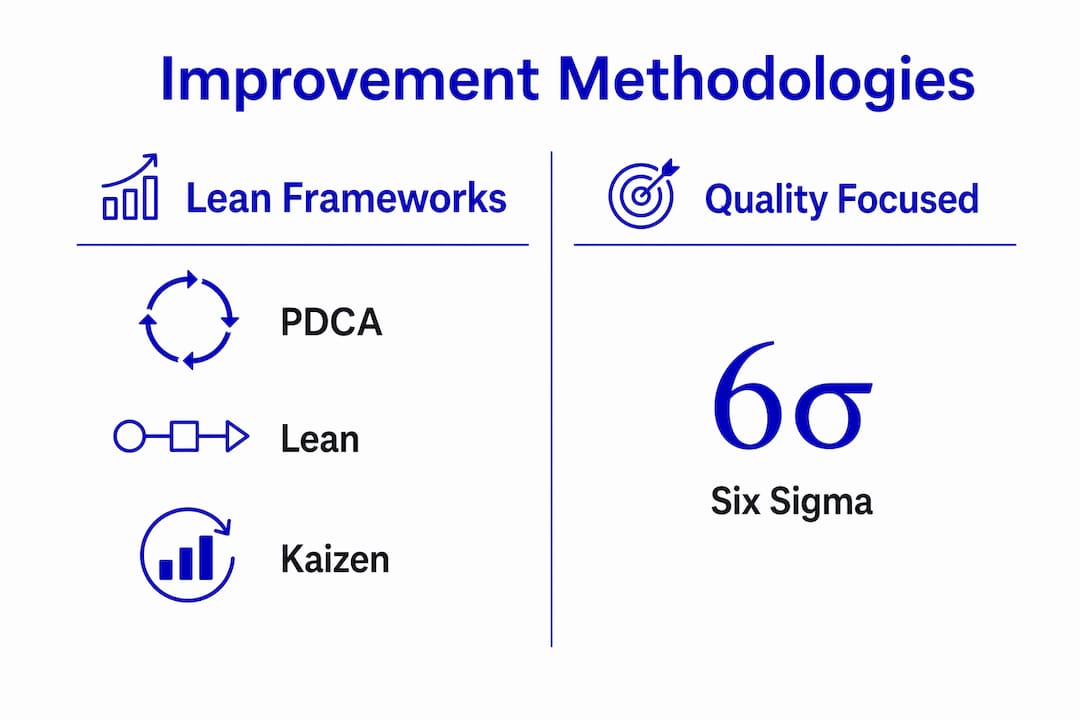
PDCA is the most universally applicable framework. You plan a change, execute it at small scale, measure the outcome, and act on what you learned. It works in any department and requires no specialized training to begin.
Lean principles focus on eliminating eight categories of waste: overproduction, waiting, transport, over-processing, inventory, motion, defects, and unused talent. For construction and real estate firms across the UAE, Lean has delivered measurable reductions in project cycle times.
Six Sigma is purpose-built for defect minimization. Lean is optimal for waste reduction, Six Sigma for defect reduction in regulated sectors like banking and healthcare, which are among the largest employers in KSA and UAE. The hybrid approach, Lean Six Sigma, is the most pragmatic choice for enterprises that need both.
Kaizen methodology is distinct because it is employee-driven. Toyota’s CIP program, dating back to the 1950s, solicits over one million frontline suggestions annually. That volume of input is what produces the lowest defect rates in the industry. The lesson for regional enterprises is clear: your frontline staff see problems that leadership dashboards never capture.
Pro Tip: If you are unsure which methodology to start with, begin with PDCA. It is framework-agnostic and creates the habit of structured reflection before you commit to a more specialized approach like Six Sigma or Kaizen.
How to implement continuous improvement in your organization
Implementation is where most organizations lose momentum. The steps below reflect best practices for process improvement validated across enterprise deployments in the Middle East.
-
Map and analyze existing processes. Document every step in the process you want to improve. Use both data from your ERP or CRM system and direct input from the people doing the work. Frontline staff consistently identify bottlenecks that do not appear in system logs.
-
Prioritize using an impact-effort matrix. Not every improvement opportunity deserves equal attention. Plot potential changes on a two-axis grid: impact on the vertical axis, effort on the horizontal. Focus first on high-impact, low-effort changes to build early wins and organizational confidence.
-
Run a pilot in one department. Piloting changes in a single department before company-wide adoption reduces risk and allows you to refine your standard operating procedures before scaling. A workspace rearrangement that reduced task prep time by 30 seconds per unit sounds trivial until you multiply it across hundreds of daily operations.
-
Measure results with defined KPIs. Every pilot needs a measurement framework established before it begins. Define your baseline, set target metrics, and track weekly. Without pre-defined KPIs, you cannot distinguish genuine improvement from normal variation.
-
Standardize successful changes and update SOPs. Once a change proves effective, document it formally and update your standard operating procedures. This step is where most organizations fail. They achieve a result and move on without locking in the gain.
-
Repeat the cycle. CIP is not a project with a finish line. Each completed cycle feeds the next. Over 12 to 24 months, incremental improvements led by frontline staff deliver greater sustained value than isolated large projects, at very low risk and cost.
Pro Tip: Assign a named process owner to every improvement initiative. Anonymous ownership produces no accountability. When one person is responsible for results, the cycle completes.
Overcoming cultural and organizational challenges in Saudi Arabia and UAE
Change management is the primary factor in CIP failure. Ignoring frontline feedback causes a 70% failure rate in process improvement initiatives. That statistic reflects a structural problem: most organizations design changes at the top and announce them downward, which generates resistance rather than adoption.
In KSA and UAE corporate environments, several specific dynamics shape how change lands:
- Hierarchy is real and must be respected. Senior leadership endorsement is not optional. When executives visibly participate in improvement cycles, teams follow. When they delegate entirely, teams wait.
- Frontline employees hold the most accurate process knowledge. Structured feedback sessions, not just anonymous surveys, surface the friction that data alone misses.
- Short-term project mindset is the default trap. Organizations in the region frequently launch improvement initiatives tied to a specific deadline or audit cycle. When the deadline passes, the initiative dissolves. Sustainable CIP requires embedding the practice into performance reviews and team rituals.
- Psychological safety determines participation quality. If employees fear that identifying a problem will reflect poorly on them, they will not identify problems. Leaders who reward problem-spotting get better data and faster cycles.
- Transparent communication reduces resistance. When the purpose and expected impact of a change are explained clearly, adoption accelerates. Ambiguity breeds skepticism.
Effective change management that includes frontline involvement and transparency measurably improves adoption rates for both digital and process changes. In the MENA context specifically, pilot programs build internal champions who reduce organizational resistance and help scale initiatives that might otherwise stall at the department level.
How technology and low-code platforms accelerate continuous improvement
Technology does not replace the discipline of CIP. It amplifies it. The right digital infrastructure makes improvement cycles faster, more measurable, and easier to sustain without depending on manual coordination.
The most impactful technology investments for CIP in KSA and UAE enterprises include:
- Process monitoring dashboards that surface bottlenecks in real time, replacing the quarterly review with a continuous feedback signal.
- Workflow automation tools that eliminate manual handoffs, reducing the error rate and freeing staff to focus on higher-value tasks.
- Low-code platforms that allow process owners to modify workflows without waiting for IT development cycles. This is where speed of improvement compounds dramatically.
- Gamified feedback mechanisms that encourage frontline staff to log friction points and suggestions, turning qualitative input into structured data.
Data-driven improvements must be paired with human feedback loops such as gamified dashboards and cross-department workshops. Automated tools provide metrics, but feedback reveals the process friction that metrics alone cannot explain.
Singleclic’s low-code platform, Cortex, is built specifically for this use case in MENA enterprises. Cortex supports full Arabic UI/UX, on-premise deployment for banks and government entities, and runtime workflow changes without system downtime. That last capability is critical for CIP: you can modify a process mid-cycle based on pilot feedback without scheduling a maintenance window or engaging a development team. For organizations in KSA and UAE operating in regulated sectors, low-code platforms represent the most practical path to agile, scalable process improvement.
Pro Tip: Before selecting a technology platform for CIP, run a 30-day pilot with one team and one process. The adoption behavior you observe in that pilot predicts your organization-wide rollout far more accurately than any vendor demo.
Key takeaways
A continuous improvement process succeeds when it combines structured methodology, frontline involvement, measurable KPIs, and technology that adapts as fast as your processes do.
| Point | Details |
|---|---|
| Choose the right methodology | Match PDCA, Lean, Six Sigma, or Kaizen to your industry and problem type before starting. |
| Pilot before scaling | Test changes in one department first to reduce risk and build internal champions. |
| Frontline input is non-negotiable | Ignoring frontline feedback is the leading cause of CIP failure across organizations. |
| Technology amplifies discipline | Low-code platforms like Cortex enable real-time workflow changes without IT dependency. |
| Culture sustains results | Embedding CIP into daily operations and performance reviews prevents initiative decay. |
What I have learned from CIP implementations across the region
Working with enterprises in Saudi Arabia, the UAE, and Egypt over the past decade, I have seen one pattern repeat more than any other: organizations invest heavily in the methodology and almost nothing in the culture. They train teams on Six Sigma, deploy dashboards, and then wonder why adoption plateaus after six months.
The organizations that sustain improvement are the ones where a mid-level manager in Riyadh feels safe saying “this process is broken” without it becoming a political event. That psychological safety is not soft. It is the infrastructure that makes every other investment work.
I have also seen the opposite mistake: leaders who focus entirely on culture and skip the measurement discipline. Enthusiasm without KPIs produces anecdotes, not results. The most effective implementations I have been part of combine both: a structured cycle like PDCA or Lean Six Sigma, paired with weekly team rituals where frontline staff share what is working and what is not.
For regulated industries like banking and healthcare, which represent a significant share of enterprise clients across KSA and UAE, Six Sigma’s defect-reduction rigor is worth the investment in training. For construction and real estate, Lean’s waste-elimination focus delivers faster visible results. The hybrid approach works when you have the organizational maturity to run both simultaneously.
My honest recommendation: start smaller than you think you need to. One department, one process, one cycle. The confidence that comes from a visible early win is worth more than a perfect methodology applied to a resistant organization.
— Tamer
How Singleclic supports your improvement initiatives in KSA and UAE
Singleclic works with enterprise clients across Saudi Arabia, UAE, and Egypt to design and deploy process improvement programs that produce measurable results. From ERP and CRM implementation using Odoo and Microsoft Dynamics 365 to business process automation with IBM BAW and UiPath, Singleclic brings the full technology stack needed to support every stage of your improvement cycle.
The Cortex low-code platform gives your teams the ability to build, automate, and evolve workflows without writing code, with full Arabic support and on-premise deployment for regulated sectors. For leaders ready to move from digitalization to genuine optimization, the business process automation guide is the right starting point. You can also explore the ERP implementation checklist designed specifically for Middle East organizations. Singleclic’s 70-plus consultants and engineers are ready to support your next improvement cycle.
FAQ
What is a continuous improvement process?
A continuous improvement process is a systematic, ongoing practice of making incremental enhancements to workflows, products, and services. It uses structured methodologies like PDCA, Lean, Six Sigma, and Kaizen to deliver compounding operational gains over time.
Which continuous improvement methodology is best for banking and healthcare in KSA and UAE?
Six Sigma is the most effective methodology for regulated sectors like banking and healthcare because it focuses specifically on defect reduction and process consistency. Many enterprises in the region use the hybrid Lean Six Sigma approach to combine waste elimination with defect control.
How do you start implementing continuous improvement in your organization?
Start by mapping one existing process, gathering both data and frontline feedback, and running a small pilot in a single department. Measure results against pre-defined KPIs before standardizing the change or scaling it across the organization.
Why do most continuous improvement initiatives fail?
The primary cause of failure is poor change management, specifically ignoring frontline employee feedback and treating improvement as a one-time project rather than a permanent cultural practice. Research shows this contributes to a 70% failure rate in process improvement programs.
How does a low-code platform support continuous improvement?
Low-code platforms like Cortex allow process owners to modify and automate workflows in real time without IT development cycles. This capability directly accelerates improvement cycles by removing the technical bottleneck between identifying a problem and deploying a fix.