TL;DR:
- System integration unifies business systems, enabling real-time data flow and operational efficiency.
- It drives measurable ROI, reduces errors, and accelerates digital transformation in MENA enterprises.
System integration is defined as the process of connecting multiple business systems, applications, and data sources so they operate as a unified whole, rather than as isolated silos. Why integration is important becomes clear the moment you try to run a modern enterprise without it: finance reports one number, CRM reports another, and your operations team is working off a spreadsheet that is three days old. For business leaders in Saudi Arabia, UAE, and across the MENA region, where digital transformation is accelerating at pace, the importance of system integration is not a technical debate. It is a strategic one. The Integration Platform-as-a-Service market is projected to grow from USD 9.24 billion in 2026 to USD 20.93 billion by 2031, a CAGR of 17.75%. That growth reflects a global recognition that connected systems are the foundation of competitive business.
What are the operational benefits of integration for MENA businesses?
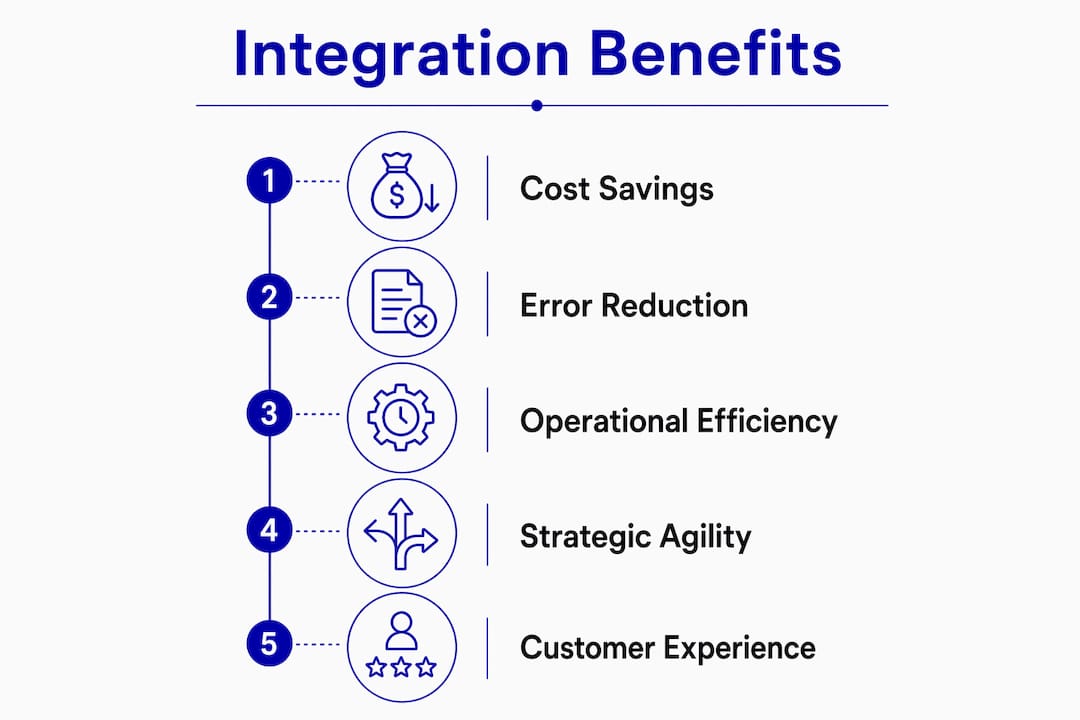
The most direct answer: integration cuts costs, reduces errors, and frees your teams to focus on work that matters. When your ERP, CRM, procurement, and finance systems share data automatically, you eliminate the manual reconciliation that drains hours from every department every week.

The numbers from enterprise deployments are striking. Organizations using the JFrog Platform realized a 282% ROI and $5.4M in total benefits over three years, with payback in under six months. That result was driven by tool consolidation savings of 71%, faster developer onboarding, and improved audit readiness. The lesson for MENA enterprises is that integration does not just connect systems. It removes the overhead of managing too many of them.
For organizations in Saudi Arabia and UAE, where Vision 2030 and UAE Centennial 2071 are pushing rapid digital adoption, the operational case for integration is even sharper. Consider what connected systems deliver in practice:
- Reduced manual data entry across finance, HR, and operations, cutting input errors at the source
- Faster reporting cycles because data flows automatically from source systems into dashboards and BI tools
- Audit readiness maintained continuously rather than scrambled for at quarter-end
- Lower IT overhead from consolidating redundant tools into a single integrated platform
- Faster onboarding for new employees who work within one connected environment rather than learning five separate systems
For companies working with ERP integration in MENA, these gains are not theoretical. They show up in monthly close times, procurement cycle times, and customer response rates.
Pro Tip: Start your integration program with the systems that touch the most departments first, typically ERP and CRM. Connecting these two creates an immediate data foundation that every other integration can build on.
How does integration support strategic agility and scalability?
Strategic agility is the ability to adapt your business model, processes, and technology faster than your competitors. Integration is the mechanism that makes that speed possible. Without it, every change to your technology stack becomes a months-long project.
The evidence from a16z is direct: integration reduces project durations by an order of magnitude. Financial reporting stack consolidations that previously took 18 months have been cut to weeks when proper integration architecture is in place. That is not an incremental improvement. It is a structural advantage for any organization facing a merger, a market expansion, or a platform migration.
For MENA business leaders, this matters in three specific scenarios:
- Mergers and acquisitions: Integrating two companies’ financial and operational systems is the single biggest bottleneck in post-merger value realization. Proper integration architecture cuts that timeline dramatically.
- Market expansion: Entering a new country or sector requires connecting local compliance systems, local banking, and local CRM data to your central platform. Integration makes that possible without rebuilding from scratch.
- AI and automation readiness: Disconnected systems limit AI benefits even when the tools are purchased. AI models require clean, connected data to generate reliable predictions. Integration is the prerequisite, not the afterthought.
Low-code platforms like Singleclic’s Cortex accelerate this further. Cortex is built specifically for MENA enterprises, with full Arabic UI/UX, on-premise deployment for banks and government entities, and the ability to modify workflows at runtime without downtime. For organizations in Saudi Arabia and UAE that need to adapt processes quickly without waiting on development cycles, this is a material advantage. You can read more about low-code platforms for MENA to understand how they fit into an integration strategy.
Integration also acts as connective tissue across the enterprise lifecycle. As a16z notes, integration work is continuous and reduces friction in enterprise evolution, enabling quicker adaptations to market shifts. That framing is important: integration is not a one-time project. It is an ongoing capability that compounds in value over time.
What challenges arise in integration projects and how do you overcome them?
Integration projects fail more often than they should, and the failures are rarely dramatic. They are quiet. A field changes its data type in an upstream system. A downstream system starts receiving null values. Reports drift silently for weeks before anyone notices.
Based on analysis of 50+ enterprise integrations, the most common failure modes are schema drift, silent failures, and timing issues. Undocumented structural changes occurred in 23 of 47 internal APIs over a six-month period, with an average cost per drift incident estimated at $35,000. That figure does not include the downstream business impact of decisions made on corrupted data.
The architectural solutions are well-established. Here is how experienced integration engineers address the most common failure points:
- Implement a canonical schema. With six applications and no canonical schema, you need 30 translators to map data between systems. With one canonical schema, you need only 12. That reduction in complexity directly reduces the surface area for failures.
- Build payload validation at every integration boundary. Every message entering or leaving an integration layer should be validated against a schema before processing. This catches drift before it propagates.
- Use dead-letter queues for failed messages. Rather than losing failed transactions, route them to a holding queue for inspection and reprocessing. This is standard practice in IBM BAW and N8N environments.
- Design for idempotency. Every integration endpoint should handle duplicate messages safely. Network retries are inevitable. Your system should process the same message twice without creating duplicate records.
- Monitor integration health continuously. Observability is not optional. Set alerts on message volume, error rates, and processing latency so silent failures surface within minutes, not weeks.
Pro Tip: Before any integration goes live, run a chaos test: deliberately send malformed payloads, duplicate messages, and out-of-order events. If your integration handles these gracefully, it will handle production reality.
Low-code platforms simplify this considerably. Singleclic’s Cortex includes built-in workflow monitoring, runtime modification, and deep enterprise system integrations that handle many of these safeguards by default, reducing the engineering burden on your internal teams.
How does integration improve decision-making and customer experience?
Data integration creates a single source of truth that eliminates the departmental silos where conflicting numbers live. When your CRM, ERP, e-commerce platform, and marketing automation tools all feed into one unified data layer, every team works from the same reality. That alignment is the foundation of both better decisions and better customer experiences.
The practical impact on business intelligence is significant. Unified data enables predictive analytics, AI model training, and real-time reporting that simply cannot be built on fragmented systems. For a healthcare organization in UAE or a bank in Saudi Arabia, this means the difference between reacting to problems after they occur and anticipating them before they do.
| Integration area | Business outcome |
|---|---|
| CRM and ERP connected | Sales teams see inventory and credit limits in real time, reducing order errors |
| Marketing and CRM unified | Customer journey data feeds campaign targeting, improving conversion rates |
| Finance and operations linked | Cash flow forecasting uses live operational data, not last month’s export |
| Support and product data merged | Customer service agents see full account history, reducing resolution time |
For customer experience specifically, integration enables what practitioners call a “customer 360 view.” Every touchpoint, purchase, support ticket, and communication is visible in one place. In Saudi Arabia and UAE markets, where customer expectations for digital service quality are high and competition is intense, this visibility is a direct competitive advantage. Unified data enables trusted decision-making for leadership across the entire organization, not just the IT department.
The role of integration in business also extends to AI readiness. In the MENA context, integrated data enables AI-driven analytics and intelligent customer experiences. Without clean, connected data, AI tools produce unreliable outputs. With it, they become genuinely useful for forecasting, personalization, and process optimization.
Key takeaways
System integration is the single most important infrastructure decision a MENA business leader can make before investing in AI, automation, or digital transformation.
| Point | Details |
|---|---|
| Integration drives measurable ROI | Enterprises report up to 282% ROI and 71% tool consolidation savings from unified platforms. |
| Strategic agility depends on integration | Projects that took 18 months shrink to weeks when integration architecture is properly in place. |
| Silent failures are the biggest risk | Schema drift affected 23 of 47 internal APIs in six months; canonical schemas and monitoring prevent this. |
| Unified data powers better decisions | A single source of truth across CRM, ERP, and finance enables real-time analytics and AI readiness. |
| Low-code platforms accelerate integration | Tools like Cortex reduce integration complexity and allow runtime changes without downtime. |
Why I think most MENA leaders underestimate integration until it’s too late
After working with enterprises across Saudi Arabia, UAE, and Egypt for over a decade, I have seen the same pattern repeat. A company invests in a new ERP. Then a new CRM. Then an analytics platform. Then an AI tool. Each purchase is justified individually. But nobody asks the harder question: how do these systems talk to each other?
The result is a technology portfolio that looks impressive on paper and performs poorly in practice. Reports take days to compile. Finance and operations disagree on the numbers. The AI tool produces recommendations that nobody trusts because the underlying data is inconsistent.
What I have found is that integration is not a technical problem. It is a leadership problem. When the CTO owns integration and the CFO owns the business case and the COO owns the process, integration projects get funded, resourced, and completed. When integration is treated as an IT task with no executive sponsor, it stalls.
The businesses I have seen succeed in digital transformation, including several of our clients at Singleclic, share one trait: they treated integration as a strategic capability, not a project. They built integration architecture before buying more tools. They used business agility frameworks to assess readiness before committing to new platforms. And they invested in low-code platforms that let their teams adapt integrations without waiting on development queues.
My honest advice: before your next technology purchase, ask your team to map how that system will exchange data with everything you already own. If the answer is unclear, the integration work is your first priority, not the new tool.
— Tamer
How Singleclic helps MENA enterprises build integration that lasts
Singleclic works with enterprises across Saudi Arabia, UAE, and Egypt to design and implement integration architectures that deliver real operational results. Whether you are connecting Odoo and Microsoft Dynamics 365, automating workflows with IBM BAW, or deploying N8N for system integration, Singleclic brings the regional expertise and technical depth to make it work.
Start with a clear foundation. Singleclic’s ERP implementation checklist for the Middle East gives you a structured approach to integration readiness before go-live. For organizations already running ERP systems, the ERP integration tips for MENA operations guide covers practical steps to connect your existing stack. And for teams looking to reduce integration complexity without heavy development, Cortex, Singleclic’s Arabic-enabled low-code platform, is built for exactly that purpose.
FAQ
Why is integration important for business operations?
Integration connects separate systems so data flows automatically between them, eliminating manual reconciliation, reducing errors, and giving every team a consistent view of business performance. Without it, organizations operate on fragmented data that slows decisions and increases costs.
What is the ROI of system integration?
Enterprise deployments show that unified platform integration can deliver 282% ROI over three years, with payback in under six months, driven by tool consolidation, productivity gains, and reduced operational overhead.
What are the most common integration failures?
Schema drift, silent failures, and timing issues are the leading causes of integration breakdowns. Undocumented API changes affected 23 of 47 internal APIs over six months in one study, with each incident costing an estimated $35,000 on average.
How does integration support AI adoption in MENA?
AI tools require clean, connected data to produce reliable outputs. In the MENA context, integration is a prerequisite for AI-driven analytics and intelligent automation. Disconnected systems limit AI performance regardless of the quality of the tools purchased.
What is a practical first step for integration in a MENA enterprise?
Connect your ERP and CRM first, as these two systems touch the most departments and generate the most cross-functional data. From there, use a practical integration guide to build out your integration architecture in phases, prioritizing the data flows that directly affect revenue and customer experience.