TL;DR:
- Most organizations in MENA treat business continuity plans as compliance exercises rather than strategic resilience tools. Regular testing, leadership engagement, and adaptation to local frameworks like NCEMA and SAMA are essential for effective disaster preparedness. Building a resilient organization requires ongoing assessment, leadership accountability, and integration of automation and cybersecurity.
85% of organizations faced disruption in 2023, and when systems go down, the cost runs between $5,600 and $9,000 per minute. For C-level leaders in KSA, UAE, and Egypt, those numbers are not hypothetical. They represent board-level consequences, regulatory exposure, and reputational risk that lands squarely on your desk. This guide walks you through exactly what it takes to build a business continuity plan that performs when pressure is highest, from selecting the right frameworks to testing protocols that actually reduce recovery time and protect your organization long-term.
Table of Contents
- Understanding business continuity: Beyond compliance
- Key frameworks: ISO 22301, NCEMA & SAMA
- Step-by-step: Building your business continuity plan
- Testing, updating, and owning the plan
- Why most business continuity plans in MENA miss the mark
- Take your continuity plan to the next level
- Frequently asked questions
Key Takeaways
| Point | Details |
|---|---|
| Leadership is critical | C-level buy-in is required for an effective continuity culture in MENA organizations. |
| Align global and local standards | Best-in-class resilience fuses ISO 22301 with local regulation frameworks like NCEMA and SAMA. |
| Plan, test, repeat | Continuity plans must be regularly tested and updated for real-world effectiveness. |
| Measure, don’t assume | Most organizations overestimate readiness—use metrics and outside audits to verify. |
| Digitalization raises the bar | As tech risk grows, continuity must integrate cybersecurity and digital resilience into every layer. |
Understanding business continuity: Beyond compliance
With the scale of risk established, let’s clarify exactly what business continuity planning involves and why top organizations take it further than minimum compliance.
Business continuity planning (BCP) is the structured process of identifying threats to your organization, assessing how those threats affect critical functions, and designing recovery procedures that keep operations running. Most executives understand that much. Where things go wrong is treating BCP as a one-time compliance exercise rather than a living management discipline embedded into organizational culture.
“Business continuity is not a project with a finish line. It is a leadership posture. Organizations that treat it as a checkbox will discover that gap when it matters most.” — Tamer Badr, Singleclic
ISO 22301 is the international standard for Business Continuity Management Systems (BCMS). It provides structured requirements across six areas: leadership, planning (Business Impact Analysis and risk assessment), support, operation, performance evaluation, and improvement. This is your global benchmark.
Regionally, certification against ISO 22301 is becoming a mark of institutional credibility. QNB Egypt achieved ISO 22301 certification for its BCMS, signaling to clients and regulators that resilience is a managed capability, not a promise. For executives navigating digital compliance in KSA, UAE & Egypt, this kind of certification matters both for trust and for regulatory standing.
Common misconceptions still undermine execution. Many leadership teams believe a BCP document sitting in a shared folder means they are covered. Others assume their IT disaster recovery plan is sufficient. Neither is true. BCP covers the full spectrum of business functions, not just technology recovery. It is also an essential component of broader digital strategy elements that C-level leaders must embed across the enterprise.

| BCP Myth | Reality |
|---|---|
| “Our IT backup is our BCP” | BCP covers people, processes, suppliers, and facilities, not just data |
| “We only need this for large enterprises” | SMEs face proportionally higher failure risk without a plan |
| “Certification means we are ready” | Certification without regular testing creates a false sense of security |
| “BCP is an IT department responsibility” | BCP requires ownership from the C-suite and every business unit |
Key frameworks: ISO 22301, NCEMA & SAMA
Understanding the need for more than compliance, executives must select and tailor the right frameworks. Here’s how the global and local models fit together.
ISO 22301 aligns with the Plan-Do-Check-Act (PDCA) cycle and provides guidance across leadership accountability, context analysis, planning, operations, performance evaluation, and continual improvement. It is designed to be sector-neutral and geography-neutral, which is both its strength and its limitation for MENA-based organizations.
In the UAE, the National Crisis Emergency Management Authority (NCEMA) has published its own business continuity framework, which mandates alignment for federal entities and critical infrastructure operators. NCEMA goes beyond ISO 22301 by specifying escalation protocols, government reporting requirements, and sector-specific thresholds that directly affect telecommunications, energy, and healthcare providers.
In KSA, the Saudi Arabian Monetary Authority (SAMA) has issued a Cyber Security Framework and a Business Continuity Management Policy specifically designed for financial institutions. SAMA’s requirements include defined Recovery Time Objectives (RTOs), mandatory board-level accountability, and incident reporting timelines that differ from what ISO 22301 alone would prescribe. For executives managing compliance with local regulations, aligning both frameworks is non-negotiable.
Here is how the three frameworks compare across key dimensions:
| Dimension | ISO 22301 | NCEMA (UAE) | SAMA (KSA) |
|---|---|---|---|
| Scope | All sectors, global | UAE federal and critical entities | KSA financial sector |
| BIA required | Yes | Yes | Yes |
| RTO/RPO defined | Recommended | Mandatory for critical functions | Mandatory with board sign-off |
| Testing frequency | Organization-defined | Annually at minimum | Annually; scenario-based |
| Incident reporting | Internal | Government notification required | SAMA notification required |
| Leadership accountability | Senior management | C-level and board | Board and audit committee |
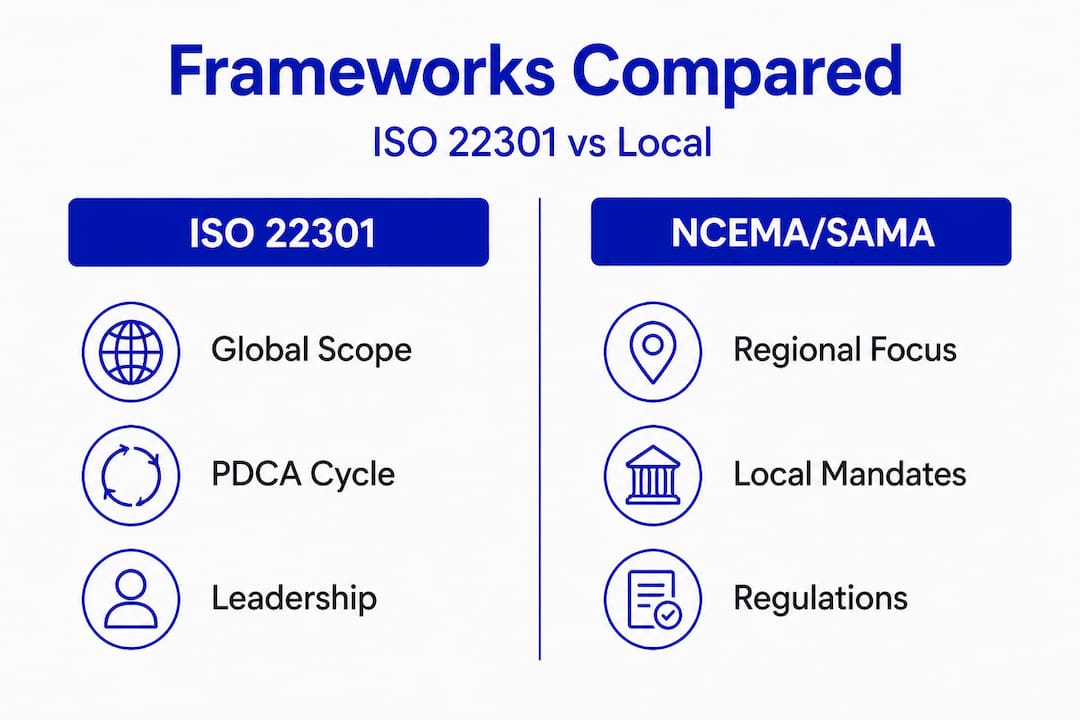
Pro Tip: Do not choose between ISO 22301 and local frameworks. Build your BCMS on ISO 22301 as the structural backbone, then layer NCEMA or SAMA requirements on top. This hybrid approach satisfies both your auditors and your regulators without duplicating effort.
The cyber dimension adds another layer of urgency. Regional organizations managing cloud security for KSA & UAE need to ensure their BCP explicitly addresses cloud service provider failure scenarios, data residency requirements during recovery, and multi-region failover configurations. Cyber threats do not respect borders, but your recovery plan must respect local data laws.
Key actions for framework alignment:
- Map your existing policies against ISO 22301 clauses first to find the gaps
- Identify which local framework applies to your sector and jurisdiction
- Appoint a designated BCP owner at the senior management level
- Build a regulatory calendar that tracks NCEMA and SAMA update cycles
- Integrate your BCP review cycle with your annual board risk reporting process
Step-by-step: Building your business continuity plan
Having chosen your frameworks, it’s time to break down exactly how to craft and sustain a business continuity plan that works in practice.
Building a BCP is not a linear task completed once. It is a cycle of analysis, design, testing, and refinement. Here is the structured approach that high-performing organizations follow:
-
Conduct a Business Impact Analysis (BIA). Start by identifying every critical business function, the resources each requires, and the maximum tolerable downtime. Your BIA will surface which processes carry the greatest financial and operational risk. This is the foundation everything else is built on.
-
Perform a risk assessment. Map the specific threats your organization faces: cyber incidents, geopolitical disruptions, supply chain failures, infrastructure outages, and natural disasters. Cyber incidents alone affect 51% of organizations that experience disruption. Your risk register should be region-specific, not a copy-paste from a global template.
-
Define your RTOs and Recovery Point Objectives (RPOs). RTO is the maximum time a function can be offline before the business suffers unacceptable damage. RPO is the maximum data loss measured in time that is tolerable. Both need board-level agreement, not just IT sign-off.
-
Design recovery strategies and document protocols. For each critical function identified in your BIA, document step-by-step recovery procedures. Assign owners. Specify resources. Include contact trees, vendor escalation paths, and workaround procedures for manual operation if systems are unavailable.
-
Secure and protect critical data environments. Your recovery procedures are only as reliable as the data and infrastructure behind them. Executives should review securing cloud environments practices and ensure that cybersecurity in ERP systems is addressed explicitly in recovery protocols.
-
Test the plan. This is where most organizations fall short. Tested plans recover 2.5 times faster than untested ones. Yet DR test failure rates hover around 35% on the first attempt. Testing reveals gaps that documentation never will.
-
Review and update continuously. A plan older than two years is likely outdated. Build formal review triggers into your operational calendar.
Statistic callout: Organizations without a BCP fail within two years of a major disruption at a rate of 43%. Regular testing reduces disruption frequency by 74%.
The link between BCP and broader organizational resilience cannot be overstated. Leaders building digital resilience for organizations need to treat BCP as one component of a larger capability, alongside cybersecurity, process automation, and data governance.
Pro Tip: Run a “tabletop exercise” before your first full-scale test. Gather your crisis management team and walk through a simulated incident scenario in a conference room. It surfaces decision-making gaps and role confusion at a fraction of the cost and disruption of a live drill.
Common failure points to avoid:
- Writing recovery procedures that only the IT team understands
- Assigning single points of failure in the recovery chain (one person owns a critical step and is unreachable)
- Failing to include third-party vendors in your BIA and recovery planning
- Setting RTOs that are technically achievable but operationally unrealistic
- Treating the BIA as a one-time exercise rather than an annual update
Testing, updating, and owning the plan
Even the best-designed plans fail without operational ownership and ongoing investment. Here’s how high-performing organizations make resilience routine.
Testing is not optional. It is the mechanism that converts a plan from a document into a capability. Yet 75% of organizations overestimate their readiness, and 48% of plans are more than two years old, meaning the gap between confidence and actual recovery performance is enormous in practice.
“We often see organizations that are proud of their BCP documentation but have never run a real drill. The plan looks good on paper until the first real incident exposes every assumption that was never tested.” — Tamer Badr, Singleclic
Effective testing uses multiple methods, each revealing different types of gaps:
- Tabletop exercises: Scenario-based discussions with leadership teams. Low cost, high insight into decision-making gaps.
- Structured walkthroughs: Each team member reviews their role in the plan, step by step, and identifies inconsistencies or missing resources.
- Simulation tests: Realistic scenarios with partial activation of recovery procedures. Moderate cost, high operational value.
- Full interruption tests: Complete activation of the BCP, including failover to backup systems. Highest cost and disruption, but the most accurate readiness measure.
| Test Type | Frequency Recommended | Cost Level | Insight Depth |
|---|---|---|---|
| Tabletop exercise | Quarterly | Low | Medium |
| Structured walkthrough | Semi-annually | Low | Medium |
| Simulation test | Annually | Medium | High |
| Full interruption test | Every 2-3 years | High | Very High |
Plan updates must be triggered by more than just the calendar. Regulatory changes, major operational shifts, new technology deployments, acquisitions, and post-incident reviews should all initiate a plan review cycle. Staying digitally compliant in KSA, UAE, and Egypt means keeping your BCP aligned with evolving NCEMA and SAMA requirements as they are updated.
Leadership accountability is the final and most critical element. When the CEO treats BCP as a quarterly agenda item, the entire organization follows. When it is delegated entirely to a risk manager and never surfaces at the board level, it atrophies. Data governance for leaders frameworks increasingly recognize BCP as a board-level governance matter, not purely an operational one.
Key metrics every executive should track:
- Time to recover critical functions vs. documented RTO
- Percentage of staff who have participated in a test exercise in the past 12 months
- Number of plan sections reviewed and updated in the past year
- First-attempt test failure rate and root causes
- Vendor and third-party participation in recovery exercises
Why most business continuity plans in MENA miss the mark
Now that you know the technical how-to, here is a frank take on why these principles so often fail in the real world and what to do differently.
The uncomfortable truth is that most business continuity plans in MENA are written to satisfy an auditor, not to survive a crisis. Organizations invest time and money in documentation, achieve certification, and then file the plan away until the next audit cycle. The certification becomes the goal rather than the outcome: actual operational resilience.
75% of organizations overestimate their readiness, and the hybrid approach blending ISO 22301 with local frameworks like NCEMA and SAMA is still the exception rather than the rule. This gap is particularly pronounced in organizations that adopted global BCP templates without adapting them to the regulatory nuances of operating in KSA, UAE, or Egypt.
The second failure pattern is cultural. BCP requires people to practice failure scenarios, acknowledge gaps in readiness, and admit that current processes may not survive disruption. For organizations where admitting risk can feel politically sensitive, this honest self-assessment never happens. The result is a plan built on optimistic assumptions rather than operational facts.
The executives who get this right share three behaviors. First, they personally participate in tabletop exercises rather than delegating the testing process entirely. Second, they ask hard questions about recovery assumptions during board reviews, not just about compliance status. Third, they connect BCP to broader digital trends in KSA & UAE, recognizing that digital transformation without resilience planning is building faster on an unstable foundation.
The shift required is not technical. The frameworks are clear. The tools are available. What separates resilient organizations from vulnerable ones is leadership commitment to honest testing, local adaptation, and treating BCP as a strategic capability rather than a compliance obligation.
Take your continuity plan to the next level
If your organization is ready to move from theory to action, here is where to find the expert support and proven resources you need.
At Singleclic, we work with enterprise leaders across KSA, UAE, and Egypt who understand that business continuity and digital transformation are two sides of the same strategy. Resilience is not built in isolation. It requires automated processes, governed data environments, and systems that recover fast.
Whether you are beginning your BCP journey or strengthening an existing framework, our team of 70+ consultants and engineers brings 10+ years of regional delivery experience to the work. Explore our business process automation guide to see how automated workflows reduce human dependency during recovery scenarios. Our digital compliance guide gives you a concrete roadmap for aligning with NCEMA, SAMA, and international standards simultaneously. When disruption strikes, organizations that have automated their critical processes recover faster, with fewer errors and less dependence on individuals who may be unavailable.
Frequently asked questions
What is the difference between business continuity planning and disaster recovery?
Business continuity planning covers overall strategies to keep key business functions operational during any disruption, while disaster recovery focuses specifically on restoring IT systems and data after a technical incident.
How often should a business continuity plan be tested?
Industry benchmarks recommend testing at least annually, with tested plans recovering 2.5 times faster than untested ones. High-performing organizations supplement annual full tests with quarterly tabletop exercises.
Can ISO 22301 be integrated with local regulations in UAE, KSA, or Egypt?
Yes. Best practice is to use ISO 22301 as the structural foundation and layer local standards on top, with NCEMA and SAMA requirements addressed as addendums that satisfy jurisdiction-specific obligations.
What are the main reasons business continuity plans fail in MENA?
Plans most commonly fail because they are outdated (48% are over two years old), untested, or not adapted to the regulatory realities and operational contexts of KSA, UAE, and Egypt.
What role should executives play in BCP?
Executives must personally champion business continuity, participate in testing exercises, oversee regular plan updates, and build a culture where resilience is treated as a strategic priority at every level of the organization.