TL;DR:
- Digital security encompasses organizational policies, people, and processes, beyond just cybersecurity tools.
- Frameworks like NIST CSF and ISO 27001 guide risk management and compliance, serving different organizational needs.
- Leaders must treat security as a strategic business enabler, embedding it into decision-making and digital transformation.
Most executives assume digital security is an IT department problem. Buy the right tools, hire a capable CISO, and you’re protected. That assumption is exactly what threat actors count on. Digital security is the practice of protecting systems, networks, data, and digital assets through structured risk management, frameworks, and controls that ensure confidentiality, integrity, and availability. For C-level leaders across KSA, UAE, and Egypt, it’s not a technology purchase. It’s a business strategy that determines whether your organization survives a crisis, retains customer trust, and sustains competitive advantage.
Table of Contents
- Understanding digital security: More than cybersecurity
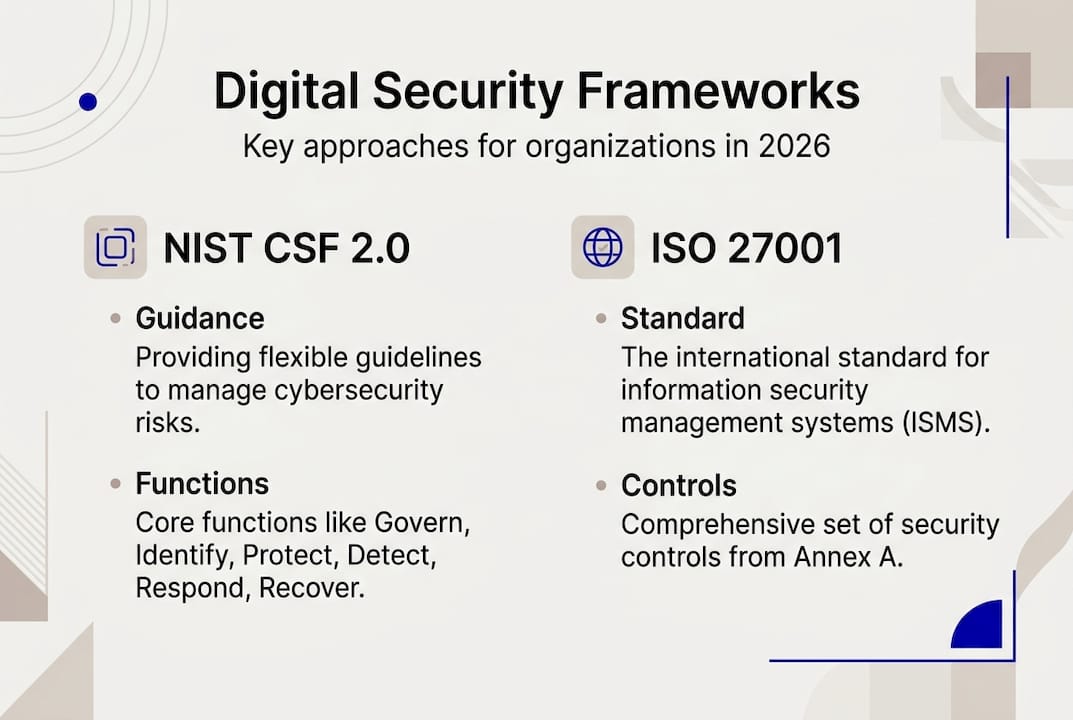
- Key frameworks: NIST CSF 2.0 and ISO 27001 explained
- Digital risk management: From theory to ongoing practice
- Emerging challenges: AI, adversarial threats, and regional nuances
- From compliance to business enablement: Shifting the security mindset
- Our take: What many leaders still overlook about digital security
- Accelerate your secure digital transformation with SingleClic
- Frequently asked questions
Key Takeaways
| Point | Details |
|---|---|
| Digital security is multi-layered | It covers not just technology, but people, processes, and risk management at every business level. |
| Frameworks guide security strategy | NIST CSF and ISO 27001 help organizations structure security policies, processes, and improvement cycles. |
| AI and regional risks demand attention | Adversarial AI, skills gaps, and local surveillance pose rising challenges for business leaders in KSA, UAE, and Egypt. |
| Leadership drives security success | C-level sponsorship and a proactive culture are crucial for ongoing digital security effectiveness. |
Understanding digital security: More than cybersecurity
Having set the context for why digital security matters, let’s break down its core meaning and scope for modern enterprises.
Cybersecurity focuses on defending networks, endpoints, and systems from technical attacks. Digital security is broader. It covers the organizational policies, people behaviors, process controls, and risk governance that surround those technical defenses. Think of cybersecurity as the lock on the door. Digital security is the entire security system, including who has keys, how keys are issued, and what happens when one goes missing.
At the heart of digital security sits the CIA triad:
- Confidentiality: Only authorized parties access sensitive data.
- Integrity: Data remains accurate and unaltered throughout its lifecycle.
- Availability: Systems and data are accessible when the business needs them.
For enterprises running ERP systems, CRM platforms, or automation workflows, a failure in any one of these three pillars creates cascading consequences. A data breach during transformation doesn’t just expose records. It halts operations, triggers regulatory penalties, and erodes the market trust you’ve spent years building.
Consider what a single ransomware incident can cost. Beyond the ransom itself, organizations face downtime costs, legal fees, reputational damage, and customer churn. For a regional bank or healthcare provider, even 24 hours of system unavailability can translate into millions in lost transactions and compliance violations.
“Security is not a product you buy. It’s a discipline you build into every layer of your organization.” — Tamer Badr, Singleclic
Building digital resilience for organizations means treating security as foundational infrastructure, not an afterthought. When your digital security posture is strong, it enables faster digital transformation because teams can move with confidence rather than caution.
Key frameworks: NIST CSF 2.0 and ISO 27001 explained
With a foundational understanding of digital security, it’s essential to explore how industry frameworks structure and guide effective practices.
Two frameworks dominate boardroom conversations: NIST CSF 2.0 and ISO 27001. Both are credible. Both are widely adopted. But they serve different purposes, and choosing between them requires clarity on your organization’s goals.
NIST CSF 2.0 organizes security activity into six core functions:
- Govern: Establish risk strategy, policies, and accountability.
- Identify: Understand assets, risks, and vulnerabilities.
- Protect: Implement safeguards for critical services.
- Detect: Identify cybersecurity events in real time.
- Respond: Take action after a detected incident.
- Recover: Restore capabilities and reduce future impact.
ISO 27001 takes a different approach. It establishes an Information Security Management System (ISMS) and offers 93 Annex A controls across organizational, people, physical, and technological domains. Critically, ISO 27001 is certifiable, meaning your organization can earn a recognized credential that satisfies regulators, clients, and partners.

| Dimension | NIST CSF 2.0 | ISO 27001 |
|---|---|---|
| Type | Voluntary guidance | Certifiable standard |
| Structure | 6 functions, categories | ISMS + 93 Annex A controls |
| Risk approach | Dynamic and continuous | Structured and auditable |
| Best for | Operational agility | Regulatory compliance |
| Regional adoption | UAE, KSA government use | Banking, healthcare, enterprise |
For executives reviewing your digital compliance posture, the practical answer is often both. Use NIST CSF to drive your internal risk culture and operational agility. Pursue ISO 27001 certification when you need to demonstrate security maturity to regulators, clients, or international partners.
Pro Tip: If your organization operates across KSA, UAE, and Egypt simultaneously, ISO 27001 certification creates a single, recognized proof point that satisfies multiple regulatory environments without redundant audits.
Digital risk management: From theory to ongoing practice
Now that frameworks are clear, let’s translate them into the ongoing, practical management of digital risk within executive decision-making.
Frameworks tell you what to do. Risk management tells you how to prioritize. The continuous risk management cycle follows a clear sequence:
- Identify: Catalog your digital assets, data flows, and potential threat sources.
- Assess: Evaluate the likelihood and business impact of each identified risk.
- Treat: Choose a response strategy for each risk.
- Monitor: Track changes in risk posture continuously, not annually.
The treatment step is where executives make strategic decisions. The four responses are:
- Accept: Acknowledge the risk and absorb potential consequences.
- Avoid: Eliminate the activity that creates the risk.
- Mitigate: Reduce likelihood or impact through controls.
- Transfer: Shift financial exposure through insurance or contracts.
| Risk category | Example threat | Recommended response |
|---|---|---|
| Data exposure | Customer PII leak via third-party API | Mitigate via access controls |
| System downtime | Ransomware on core ERP | Mitigate + Transfer (cyber insurance) |
| Insider threat | Privileged user data exfiltration | Mitigate via monitoring |
| Compliance gap | PDPL non-compliance in KSA | Avoid or Mitigate |
For organizations in the Gulf and Egypt, digital identity risk assessment is increasingly critical as cloud adoption accelerates and workforce mobility increases. The NIST Risk Management Framework (RMF) adds a structured authorization step, requiring formal sign-off before systems go live, which is particularly valuable for government-adjacent organizations.
A well-designed process risk management workflow integrates these steps directly into your business operations, rather than treating them as a separate security exercise. When risk management is embedded into your innovation and workflow optimization cycles, it stops feeling like overhead and starts functioning as a business accelerator.
Pro Tip: Assign a named executive owner to each top-tier risk category. Accountability without a name attached rarely produces action.
Emerging challenges: AI, adversarial threats, and regional nuances
While fundamental frameworks and processes are vital, executives must stay alert to emerging and regional threats that can upend even robust strategies.
The threat landscape in 2026 looks fundamentally different from five years ago. Artificial intelligence has become both a defensive tool and an offensive weapon. Understanding this duality is non-negotiable for regional leaders.
The numbers are stark. Over 91% of KSA organizations faced AI-related security incidents recently, while 60% of UAE organizations report having no visibility into their generative AI usage. These aren’t future risks. They’re active gaps in your security posture right now.
Key AI-driven and adversarial threats to watch:
- Deepfakes and synthetic identity fraud: Attackers use AI-generated audio and video to impersonate executives, authorize fraudulent transactions, or manipulate employees.
- Agentic AI risks: As organizations deploy autonomous AI agents for workflows, each agent becomes a potential attack surface with its own access privileges.
- Adversarial machine learning: Threat actors manipulate AI models by feeding them corrupted data, causing systems to make wrong decisions silently.
- State-sponsored AiTM attacks: Adversary-in-the-middle attacks targeting censorship circumvention tools are particularly relevant in the Middle East context.
“The most dangerous threats in 2026 are the ones your AI systems can’t yet recognize, because attackers trained them not to.” — Tamer Badr, Singleclic
Regional organizations also face dual-use surveillance risks, where monitoring technologies deployed for compliance or safety purposes can be exploited or repurposed. For leaders managing AI-driven data threats, the answer isn’t to slow AI adoption. It’s to build governance structures that match the speed of deployment.
Understanding the difference between traditional versus AI-powered protection is a practical starting point. And embedding security into your AI transformation strategy from day one prevents costly retrofitting later.
From compliance to business enablement: Shifting the security mindset
Understanding threats and frameworks is important; realizing digital security’s strategic value is the game-changer for executive leaders.
Many organizations still treat digital security as a compliance checkbox. Pass the audit, file the report, move on. This approach creates a dangerous illusion of safety while leaving real vulnerabilities unaddressed.
The distinction matters:
- Compliance security asks: “Are we meeting the minimum requirements?”
- Active risk management asks: “Are we actually protected against what’s likely to harm us?”
Gartner’s position is clear: security enables business rather than restricting it. Organizations that embed security into their digital transformation strategy move faster, not slower, because they build trust with customers, partners, and regulators simultaneously.
Here’s what security-as-enabler looks like in practice:
- A healthcare provider in UAE secures patient data to ISO 27001 standards, which accelerates its ability to onboard international partners and expand services.
- A KSA bank implements continuous monitoring aligned to NIST CSF, enabling faster product launches because risk sign-off is embedded in the process rather than bolted on at the end.
- An Egyptian logistics firm treats cloud security best practices as a prerequisite for cloud migration, reducing incident response costs by proactively addressing vulnerabilities.
“Security is your license to innovate. Without it, every new capability you build carries hidden liability.” — Tamer Badr, Singleclic
The organizations winning in the Middle East market aren’t the ones spending the most on security tools. They’re the ones where security thinking is embedded in every business decision, from product design to vendor selection to workforce onboarding.
Our take: What many leaders still overlook about digital security
These mindset shifts set the stage for transformative digital resilience, but let’s share a candid viewpoint on what really moves the needle.
After working with over 60 enterprise clients across KSA, UAE, and Egypt, we’ve observed a consistent pattern. When organizations experience serious security failures, the root cause is rarely a missing tool. It’s a gap in leadership attention and organizational culture.
Technology can only do so much. If your teams don’t understand why security protocols exist, they’ll find workarounds. If your board only reviews security metrics after an incident, you’re always reacting rather than leading.
The organizations that build genuine digital resilience share one trait: C-level executives treat security outcomes as core business metrics, not IT reports. Revenue, customer satisfaction, and security posture sit on the same dashboard.
In the Middle East context specifically, balancing regulatory compliance with agile resilience creates real market dividends. Organizations that demonstrate mature security practices win larger contracts, attract international investment, and retain talent more effectively.
Pro Tip: Add a digital security KPI to your next board agenda. Measure it the same way you measure revenue. That single act signals to your entire organization that security is a leadership priority, not a department task.
Accelerate your secure digital transformation with SingleClic
With actionable takeaways in mind, this is how SingleClic supports your organization’s secure transformation journey.
At SingleClic, we partner with C-level teams across KSA, UAE, and Egypt to align digital security with business strategy, not just IT compliance. Our consultants work from the Digital Transformation Office level down, embedding security governance into ERP implementations, process automation, and AI deployments from day one.
Whether you’re evaluating your current risk posture, preparing for ISO 27001 certification, or integrating AI tools responsibly, our business process automation guide and enterprise consulting services give you a structured path forward. Connect with our team for a tailored security transformation assessment and discover how protecting your data can become your strongest competitive advantage.
Frequently asked questions
What is the main difference between digital security and cybersecurity?
Digital security includes cybersecurity but also covers broader organizational, process, and risk management perspectives beyond technology tools and technical defenses.
Which framework should our organization use: NIST or ISO 27001?
NIST CSF offers flexible, voluntary guidance while ISO 27001 is certifiable. The right choice depends on your risk tolerance, compliance goals, and whether you need a recognized certification for regulators or clients.
How are AI threats changing digital security in KSA, UAE, and Egypt?
AI-driven deepfakes and adversarial attacks are rising sharply, with over 90% of KSA organizations already impacted by AI-related security incidents in recent reporting periods.
Does digital security only matter for compliance?
No. Digital security enables innovation, business agility, and trust well beyond compliance. Security enables business growth when embedded into strategy rather than treated as a regulatory checkbox.
How often should digital risk management processes be reviewed?
Digital risk management should follow a continuous identify-assess-treat-monitor cycle, with formal reviews triggered by business changes, new deployments, or emerging threat intelligence.
Recommended
- Data Security in Digital Transformation – Protecting Enterprise Operations
- Digital scalability strategies for C-level leaders in 2026
- Digital Transformation Roadmap for C-Level Success
- Singleclic: Download the 7-step digital transformation checklist for leaders to drive growth, align stakeholders, and optimize operations—start today.